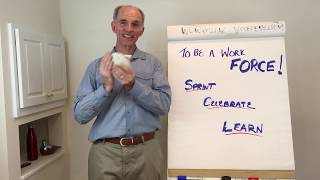
Patrick Mosher uses physics to explain why organizations confuse momentum with acceleration. He offers a three-step practice—Sprint, Celebrate, Learn—to build lasting speed without burnout, with diagnostic questions to assess whether your project is stuck, moving slowly, or accelerating.
Chapters
Welcome to the Change Science Academy channel, where we explore and discover alternative ways of thinking to drive measurable value in executing our personal and organization strategies. Hello, I'm Patrick Mosher, and in this channel, we like to share ways to get from point A to point B. I'll take 30 years of experience in consulting and give you tips and tricks, practices, habits that you can deploy to get from point A to point B in as straight a line as possible. But we all know through our own personal experiences that it doesn't necessarily always go from point A to point B so straight. Sometimes you take some curves and twists along the way. So what we're going to do in this channel— I was taking my daily walk and I started thinking, which is a little dangerous, and I started thinking of the term workforce. Now, workforce has been around a long time, that term, and we use it in social sciences to refer to, you know, our workforce or workforce statistics or something like that. But as I was walking that one day, I started thinking, wow, workforce is actually two scientific terms. I found that really interesting. So I came back home and I looked up the definitions. And the definition of work is displacement in the direction of a force. So basically, there's a displacement in the direction of a force. So when you talk about work, you're putting work, you know, work on an object means that that object gets displaced, it moves. So work is about movement. And then force is actually a push on an object, you know, resulting from another object hitting it. So basically, a work force is, you know, displacing something to go from point A to point B. So workforce is almost the definition of A to B. Now, if I think about that, and let's look at the word force. And I wanted to, you know, I started thinking about that too. The word force is actually Newton's second law of motion talks about force equals mass times acceleration. And what that means is, you know, mass being on this channel talking about the size of an effort, how big an effort is. And so a bigger effort is harder to move, little efforts are easier to move. But then if you look at force, it's actually acceleration and acceleration in a certain direction. But when we think about force as acceleration, wow, now that gives me a whole different idea about what workforce is. Workforce isn't just about momentum. You know, in the 1930s when this term came up, we didn't sit there, they didn't sit there and dream up and go, let's create work momentum. And we didn't all of a sudden be called work momentums. We were called workforce. Workforce then means that we expect when we apply people to a particular object, we expect acceleration, not just momentum. That was a fascinating way for me to look at this. It's like, "Wow, so am I really a workforce for the work that I'm doing? Is the work actually accelerating or is it just in some sort of state of inertia or momentum?" I wanted to look into this a little bit further, so we're going to take a few graphs, which I'm fond of doing on this channel, and talk about momentum and acceleration. So if you talk about, oh, we need a little bit, you know, we need momentum on this project. Well, you know, if you talk about momentum, it's actually constant velocity. So you can have low momentum and be at a very low productivity level, so you're moving very slowly. But if you talk about high momentum, that mass is moving at a higher rate. So you actually want to have a high momentum. So if you're looking at this and you go, wow, okay, if we're working at a slow momentum, the only way to get from point A to point B is if you're at a low momentum, is you're going to have to apply a little force, some acceleration to increase that velocity to get to another level. And we might call those sprints. So now if I look at this and I say, well, now if we're working at a low momentum and we want to do a sprint, I'm sure many times we've been on projects or with people and they go, let's sprint. And you know, it's a marathon. They're sprinting in mile 1 and sprinting in mile 4 and sprinting in mile 6 and they get exhausted. What happens with that is if you're at this momentum place and you sprint and you drop and you sprint and you drop and you sprint and you drop, all of a sudden you're going to be at a lower momentum because the energy's all it's all gone. So you don't have anything left to give, so your momentum actually stays pretty low. What you really want to do is if you're going to sprint to get to another level of momentum, you actually want to drop down to that level of momentum that's higher. I've got 2 tactics that I want to share with you today about how to do that. Those tactics are called sprint, celebrate, and learn. To be a workforce, you really need to be able to sprint and then to celebrate and then learn. What that allows you to do is it allows you to sprint and then if you learn from that experience, you're not going to drop down to that level of momentum where you were before. Let me share with you a little story. People that have worked with me a lot over the last 10 years know that they always get this question from me. I was on a project in Connecticut on helping sellers sell better. And it was a big project, we were working with the chief commercial officer of this multi-billion dollar company, and we had this big steering committee meeting. We had 5 topics that we wanted to bring up, each of those had decisions that we wanted the steering committee to make. And it was a sprint. We had to get all these, the materials pulled together, and each team was working on their stuff. Some of the stuff was hitting, some of it wasn't. Finally, we get to the meeting and we have the meeting. Again, some of the topics just hit. They were like, "Yep, perfect. Let's make this decision. Let's go this way." Some of them were a little harder. We had to navigate this thing and then we left with some to-dos. We walked out of the meeting and my project manager basically sat the team down and said, "All right, team. Here's the follow-ups. Let's get started on—" I was like, "Wait, wait, wait. Stop. Stop. After the sprint, "Hey guys, you just did a great job." That celebration, recognizing good hard work, goes so far in helping maintain that level of momentum. So, "Great job guys, you worked really hard to make this happen and we had a good meeting today." And secondly, the second question I ask, or the second thing I put to my team is, "What'd you learn?" And you know, when a team's worked with me for a while, or people have worked with me for a while, They just roll their eyes and go, "Ugh, Patrick's asking me what did I learn again question." But when I ask, "What did you learn?" People sit back and they start saying, "Well, not so much about the content or the decisions made, but what did you learn about facilitation? What did you learn about how these executives make decisions? What did you learn about how they interact with each other?" Those are the gems in having a meeting like that, that you might miss if you don't ask the question, "What did you learn?" Well, when I work with a team over a number of months, which I did on most of my projects, they knew that I would ask the question, "What did you learn?" What happened is learning became a habit. That's the key to success in creating that momentum at a higher level, is people are constantly learning. When they know that I'm going to ask the question, "What did you learn?" they're actually in the meeting. Doing the meeting, but also watching themselves in the meeting and watching themselves, you know, figuring out, "Oh, I'm going to have to answer this question to Patrick, so here's these 3 things that I learned from this meeting. Here's what I learned about these executives and their style. This is what I learned about how I could have done the content a little differently to get a better result." Anything that said, "What did I learn?" Now, that becomes a habit. People learn from those experiences, and then you can actually achieve that higher level of momentum that you were looking for after you do those sprints. Let me say it again: sprint, celebrate, learn. Whenever you do a sprint, always celebrate that sprint and then learn from it so that you don't drop down to the levels of momentum where you were before. I want to put this into a major— into a practice for you. I want you to think of a big project that you're doing right now. Write it down. What's that big project you're doing? I want you to rate it one of three ways. Are you a work inertia for that project? Like it's not going anywhere, it's this big boulder, it's just sitting right there and you know you got to do it and you haven't touched it and it's just sitting there staring back at you. What I want you to do is say, "Hmm, if that's a work inertia, the best thing you can do with work inertia is to break it down into parts and move the first rock. You take that rock from the pile of that big, big project that you've got and put that rock from point A to point B so that you're moving that first rock. That's how you overcome inertia, is just get that first rock moving. Now, if your project isn't inertia, you've got some momentum going on it, but it's lower than you want it to be. You've got this momentum, it's moving, but you know you're not going to make a deadline, you know it's not moving as fast as you want it to, so what do you need to do? You need to increase the velocity, you need to apply a little force. You need to accelerate a little bit. I'd like you to think about, how do I double down on that project, the effort on that project? Today I'm going to work on it for an hour, tomorrow 2, the next day 4 hours, and really create that acceleration, that sprint. But as you do that sprint, remember, sprint, celebrate, and learn. So when you get through that sprint and you got it moving at a pace that you like better, make sure you sit down and celebrate it and make sure you learn from that. And then finally, if you've got a project and it's accelerating, it's doing everything you want it to do, you're in the middle of this great sprint, be mindful and be careful. I want you to ask right now, Just take a moment, close your eyes, take a deep breath, and say, "Wow, I'm doing a good job here. My team is doing a great job here." And I want you to sit back and think, "What did I learn?" Write that down. "What did I learn so far in this sprint?" So that you can capture those learnings and so you don't drop down and get exhausted after your sprints. That's a practice I want you to put in place, but here's the challenge I want to make for you on this channel. Number 1, I want you to take that sprint, celebrate, and learn. I know you're going to sprint on something this week, so take sprint, celebrate, and learn and put it into practice for yourself on one of your own projects or with your team on their project and say, "Hey, we did the sprint," and I want you to go, "Team, great job. What did you learn?" If you would, I'd love for you to come back to this channel, write down in the comments section below some of the things that your team learned or that you learned from that Sprint, Celebrate, and Learn exercise that you did. Let's celebrate and collaborate in our comments section below of the Sprints, Celebrates, and Learns that you do over the next week. Well, that's all for this week. What I'd like you to do is, if you like this episode, like it, subscribe to the channel, find 3, 4, 5, 10 other people to come and join our next episode of the Change Science Academy. I'm going to leave you with this as I always do. Learn continuously, which was a big deal in today's session about learning continuously is how you help your sprints maintain the momentum. Learn continuously and live your life 100% empowered. Until next time.
More from Patrick

Unlock Your Unique Energy: The Ripple Effect Explained! #telepathy #telepathicconnection #purpose

How Telepathy Works: Tapping Into Energy Bigger Than Yourself with Patrick Mosher (Wisdom4Humanity)

Telepathy: Unlocking Mind to Mind Communication Explained #telepathy #telepathiccommunication #love

Unlock Your True Self: Connect to Infinity #telepathy #telepathicconnection #purpose #love #mission

True Self, Soul, and the Sense of Infinity - Patrick Mosher - Wisdom4Humanity #soul #trueself #love

Unlock Telepathic Powers: Your Guide to Intentions #telepathy #telepathiccommunication #purpose

Unlock Telepathy: Release Distractions, Embrace Love #telepathy #telepathychallenge #wisdom4humanity

Serendipity & Goldfinches: A Spiritual Moment Shared #telepathicconnection #spiritualjourney #love

Unlock Your Telepathic Power: Tap Into Larger Energy #patrickmosher #wisdom4humanity #presence #love

Build Telepathic Capability in 6 Simple Steps - Patrick Mosher, Wisdom4Humanity #leadership #love

3 Words Defining Today's World & Personal Rhythm #worldpulse #today #humanity #purpose #vision #love