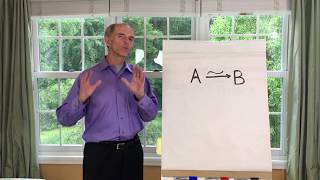
Patrick Mosher breaks down how to spot and handle resistance in meetings and projects. Active resistance shows up as arguments; passive resistance hides in missed deadlines and hallway gossip. His approach: treat it as normal, search for a solution that combines both sides, and stay curious about what's actually blocking people.
Chapters
Hello and welcome to the A2B Academy channel, where we explore and discover alternative ways of thinking to drive measurable value in your personal and organization strategies. In this, in this channel, we look at getting from point A, where you are right now, to point B, and we try to take as straight a line as possible. And that's sometimes all of our expectations about getting from A to B, but we all know that along the way we see some twists and turns along the way, and that make it a little bit more difficult. And what we look at to do on this channel is to provide strategies, analyze ways, and get from A to B in a straight line, kind of ironing out that straight line. Now, have you ever had a situation where you had a great meeting with a bunch of people and you say, "Hey, this is gonna work out great." People take their to-dos, they sign up for stuff. There's a lot of energy going on about like, "Yeah, we're gonna get this done." And then you go, "Great!" You feel really good, high fives at the end of the meeting, you walk away. 2 weeks later, you come back, nothing's done. And you go, "Gee, what happened?" Now, there's a whole bunch of things that could have happened with that. But today, we're going to talk about one particular thing that may be happening, and it's a term called resistance. Now, I'm not going to talk about our own internal resistance. That's for a different time and channel. But what we're going to talk about is external resistance, not your own internal resistance, but resistance from other people to getting things done. The definition of resistance is refusing to accept or comply with something. We've seen people do that. A second definition is an attempt to prevent something by action or by argument. Of course, we've seen that happen as well. What I really like is that resistance is, of course, a scientific term. And the scientific definition, it's in the electrical area. Resistance is the degree to which a substance or device opposes the passage of an electrical current. And this is the part that I love about the definition, which causes an energy dissipation. So don't you feel it? When you feel that resistance popping up, either it's right in your face, or you see it another way, and can't you just feel that energy dissipating? Either, you know, "Oh, here we go again," or you have to go chase all these different little pieces and parts, and it's just dissipating the energy to get from point A to point B. In today's episode, we're going to look at resistance as a way to conserve more of that energy and focus that energy to get from point A to point B in creating better strategies for engaging that resistance. Now, what's interesting, you know, resistance actually has a scientific measurement for it. It's called an ohm, O-H-M. If you want to get really curious about the science of this, go look up Ohm's Law of Resistance and, you know, look that up and we can talk about that some other time. But right now, we're going to talk about resistance in terms of two types: passive resistance and active resistance. Now, I loved engaging in active resistance. When I was consulting for 30 years with big consulting and large Fortune 500 companies, Active resistance was in your face. It's people arguing. It's handling objections. And I loved engaging that. Why? Because when somebody actually openly argues with you on something, there's hope. They hope that they're going to change your mind. They hope that something's going to go differently. And they're putting their position, their way of thinking on the table. And now you got something to deal with. So active resistance was always so much better for me to deal with. Than passive resistance. That's so much harder. Passive resistance is, you get the nods, "Mm-hmm, yeah, sounds good," and then nothing happens, or there's the hallway conversations or something. That was always more difficult to deal with. Some of the resistance indicators that you might see that say, "Oh, I've got resistance happening here," would be like an open argument. That'd be awesome to engage that, as long as there's a good container for it. Where that conflict can happen. I'm totally on board with that. But there's also other types of resistance like hallway conversations, gossip, you talk about what's talked about around the water coolers, like, "Oh yeah, that's never gonna happen." And all those kinds of conversations is a form of passive resistance. And then also, some project management things that you might see in terms of that is slipped deadlines. A slipped deadline may just be a slipped deadline, But a slipped deadline might also be people resisting what's happening. And another kind of thing in the same way of thinking is a slow learning curve. Because that might be people going like, "I don't really see why we need to do it this new way." And that would be a form of resistance. So sometimes that slow learning curve may be an indicator that you've got resistance in your hands. Another way that I see resistance, which is really difficult to overcome, is what I call knowledge or expertise hoarding. This is where people go, "Hey, I've got the expertise," or, "I've got the knowledge, and so I'm not willing to give that out." There's a resistance to collaborate because they want people to come through them for everything. There's not a sharing of tips and tricks and expertise and knowledge. Hoarding is also a form of resistance. And then the last and worst case of resistance that I've seen in the corporate world is sabotage. Now, I didn't see that very much, but I did see it at one client. And, you know, when I actually was on a project where we were looking at some customer service data and it just didn't seem to jive with what other things we were seeing, and we found out that one of the representatives was actually changing the customer service data to make the customer service new procedures look bad. And so when that happens, there has to be immediate action. So there's lots of different ways that you might see resistance. So what do you do about it? So one of the things I want to show you is— I'm very excited about this— is A to B, and this is resistance. That's actually the scientific symbol for resistance, and it just works with our model so well. Getting from A to B, this is where you see resistance in getting from A to B. One of the things that I want to present to you is there's 3 key mindsets when you see resistance pop up that I'd really like you to adopt and try to practice and create as a habit because these ways of addressing resistance will help you navigate it a lot better and conserve some of that energy that might dissipate. The first mindset to adopt with resistance when you see it is that Resistance is normal. Hey, resistance pops up all the time, so don't look at it as something abnormal. Wow, why is that person doing that? It's like, wow, that person's engaging the process. That's great. So it's a normal thing for resistance to happen. So wait for it, and when it's ready to— when it pops up, say, okay, this is normal. The second mindset that I'd like to share with you is to come up with Solution Z. Oftentimes resistance and conflict comes up as, you know, you're trying to do A and I want to do B, and those things are just counter to each other. When I was in my PhD work in organization behavior a long time ago, I had a small group decision-making class, and the professor there, you know, he's talking about distributive bargaining and integrative bargaining, and you can look those things up too, but basically He said, "Whenever there's A versus B on the table, there's always Z." And so, you know, what I try to do is always look at what's the Z solution here? What's the creative solution? And oftentimes what you have to do to get to Solution Z is to break a few assumptions, both on who's supporting A and who's supporting B. What are the assumptions you're making about each other or about your own solutions that maybe if you break a couple of the assumptions, You can each both overlap and have something that meets both of your needs and both of your interests. So, always looking for that Solution Z. And one thing that I have as a mindset about that, the number of possible solutions in any situation is as infinite as the stars. So you could find so many solutions here if you just kick in a creative process. So Solution Z is the second way to start thinking about How do you reduce or address that resistance? The third one that I want to put out there that is really key to navigating resistance is true curiosity. I didn't want to just say curiosity, because I think true curiosity is all about expectations. If you're truly curious about something, you don't carry any expectations into that conversation. If you don't have any expectations, you're not sitting there thinking about what that person believes, you're not sitting there thinking about what you're going to say next to counter what they're saying. You go in truly curious about what are they saying? What position are they trying to take? What are they really interested in? Are there things behind what they're actually saying that they're really trying to protect? So that you're truly curious. These 3 mindsets just alone that resistance is normal, that there's a creative solution Z, and then walking with true curiosity. Those 3 mindsets will help you in the very next time that you see resistance. I really encourage you to use these strategies to get from A to B a lot faster. I'm going to bring up one more set of strategies. You see strategy happening, or you see resistance happening, you've got a mindset that you walk in with, And then we're going to talk about these strategies for getting from point A to point B and addressing that resistance. So again, from A to B, here's our resistance strategy. The first thing that you should do is look in and say, "Oh, I've got resistance happening here." And that's the first thing. What is resistance and am I seeing it or is it just, you know, people aren't just picking up this fast enough, they want to get from point A to point B. But they're just not getting there fast enough. But when you see this as a resistance, ah, now I've got the big R, resistance. The second step in strategizing on how to address resistance is to categorize it. Am I seeing an active resistance, which means that there's hope, that they want to engage this process and they're just arguing, and engage that with the great mindset. Or is it passive resistance, which takes a whole different set of strategies of Really trying to bring those concerns to the table. And that people may be resisting actually bringing them to the table. Then the third part of the strategy for resistance is to assess it. And I'd really encourage you to assess it on a scale of 1 to 10. 10 being, if I don't address this resistance, my initiative will stop. Cold, dead, it's over, done, done. And so if you've got that much resistance, man, you've got to really kick in and go, Or is the resistance a 1, meaning it's a little blip, it's a little annoying that this resistance is happening, but on a 1 scale, the criticality of addressing isn't very high. What happens with this is sometimes people chase resistance just because it's there, and it might be a 3 or 4, and they're putting way too much time, a lot of energy dissipation, into a 3 or 4, where there's a hidden 8 or 9 sitting out there looming And they're missing that. So part of this is to really assess on a scale of 1 to 10, where is this resistance? How critical is it for me to address it? And then engage it. Engage it with a great mindset. Engage it with creative solutions. Engage it with curiosity. But engage the resistance. And that sometimes is a really authentic approach to take, to go in and say, I really want to understand, what are you concerned about? What are your issues here? And to really engage those people so there's an exchange happening and they feel like they're heard, they feel like their point of view is on the table, their position, their concerns are being taken into account into the solution. So engage that resistance. And then once you engage it, then you should navigate it. So how are we going to navigate this? Create strategies. How are you going to navigate, get from point A to point B and do this with as few of these resistance blips that you can along the way. And then once you get through that resistance, then most of the times, if the resistance is really big and hard, and that's why this one's purple, well then you should celebrate at the end. Say, "Hey, gosh, we got through this very difficult thing. Thanks, kudos to everybody." And actually, probably, if you engage that resistance in a good way, your solution is better. That's what diversity is all about, is creating better solutions. It takes more time, it takes more difficulty to hold a container for it, but usually that solution Z is much better than A or B could have ever been. This is the strategy to get from point A to point B in resistance. Let me offer up a challenge for you. I'd love to hear your points of view on resistance, but also I'd like to hear about some challenges of resistance that you've seen or you're seeing right now. And put them in the comments section below. That'd be awesome to see that, and then we can engage that as a community to collaborate on that. Then next week too, if you want to come in and put, "Hey, I tried some of those mindsets. They worked really well," I'd love to hear some success stories as well. Please put those in the comments section below as well. That's it that I have for you today. If you really like this episode, please like it, and then Subscribe to the channel, invite 3 or 4, 10 other people to come and look at these videos and subscribe as well. And then, until next time, learn continuously and live your life 100% empowered. Thank you very much.
More from Patrick

Unlock Your Unique Energy: The Ripple Effect Explained! #telepathy #telepathicconnection #purpose

How Telepathy Works: Tapping Into Energy Bigger Than Yourself with Patrick Mosher (Wisdom4Humanity)

Telepathy: Unlocking Mind to Mind Communication Explained #telepathy #telepathiccommunication #love

Unlock Your True Self: Connect to Infinity #telepathy #telepathicconnection #purpose #love #mission

True Self, Soul, and the Sense of Infinity - Patrick Mosher - Wisdom4Humanity #soul #trueself #love

Unlock Telepathic Powers: Your Guide to Intentions #telepathy #telepathiccommunication #purpose

Unlock Telepathy: Release Distractions, Embrace Love #telepathy #telepathychallenge #wisdom4humanity

Serendipity & Goldfinches: A Spiritual Moment Shared #telepathicconnection #spiritualjourney #love

Unlock Your Telepathic Power: Tap Into Larger Energy #patrickmosher #wisdom4humanity #presence #love

Build Telepathic Capability in 6 Simple Steps - Patrick Mosher, Wisdom4Humanity #leadership #love

3 Words Defining Today's World & Personal Rhythm #worldpulse #today #humanity #purpose #vision #love