How to Follow Up on Intentional Interactions - Wisdom 4 Humanity - Patrick Mosher
Patrick Mosher breaks down how to plan and follow up on meaningful conversations. He introduces the Cue Card method for note-taking, a next-best actions list with owners and due dates, and an assessment tool that rates five elements of an interaction. Most people skip the follow-up phase entirely, which is where the real value gets lost.
Chapters
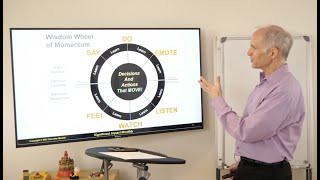
I've got a lightning round of questions around the Wisdom Wheel of Momentum. Lightning round, so we got to get ready. Okay, shake out your hands a little bit. Here we go, because I'm going to ask you to write down some things in the next 30 seconds or so with this lightning round. Here we go. First of all, here's some Wheel of Momentum lightning round questions. First one is: When you look at this interaction that you're going to have, what meme do you want them to remember from the interaction? Write that down. What do you— what meme, what phrase, what words do you want them to remember from the interaction? Write down what is it that you want them to remember. Today I've mentioned this I think 5 times now, and you can probably repeat it with me now. Planned interactions go better than unplanned interactions. There, I've probably said it 6 times now. Planned interactions go better than unplanned interactions. That's a meme that I want you to take away from today's conversation. So I purposely wove that into our curriculum. That's the meme I want you to remember from today's interaction. Just one of them. Just pick one meme, one phrase, one thing, and then make sure you repeat it enough and there's redundancy to it that they remember it. Okay, lightning round. What percent of time should you talk versus listen in that interaction? Should you be listening 20% or talking 20%? Write that down. What percent of time should you be talking versus listening? Oh, this is tough, isn't it? This is tough. Okay, next one in. What will you watch for in this interaction? So if you're on a Zoom call or some sort of video conferencing, you know, what nonverbals are you watching for there? But if you're face-to-face with that person, you know, what are you looking for for those emotional blips? Those things that they go like, "Mmm." Like, "Ooh, that's a thing." They just were like, "Mmm." They scrunched their face up, they looked up and to the right, and they're going like, "That means something." So what are you watching for in this interaction? The nonverbals, the affirmations, the "Mmm, I get it," the enthusiasm. You know, you're watching for this enthusiasm. How does that come out? So what are you watching for in this interaction? Lightning round, next question. How do you want the person to feel at the end of the interaction? So important to get this right. How do you want people to feel? So many times we go like, we're missing, we're getting to the end of our agenda and we got a lot of things to to fit in, so then we speed up. We go like, oh, and we have these other 6 points that we need to do. We can do that, we can do that, we can do that, and you're going like this, and then they're going like, I feel exhausted at the end of the interaction. Is that how you want somebody to feel? No. How do you want them to feel? So many times I've cut the end of an interaction short. I've cut agenda items out because I want people to feel Serene. How's my voice sound that helps you feel the way that I'm going for here? I want you to feel grounded. Yeah, so different, right? How do you want a person to feel at the end of your interaction? What decision do you want them to make? And is that decision reasonable? You know, you're going to have a conversation with a prospect and you go like, I want them to buy my product. It's like, Is that really a reasonable thing? Maybe you just want them to be interested, to be aware of it. Maybe it's going to take 3 or 4 interactions before they actually buy a high-ticket item. So what decision do you want them to make? And how are you crafting the whole situation so that you're leading them up to that? And are you listening a lot to what they actually need or want? And does it fit? Okay, so what decision do you want to get out of this, this interaction? And then what action do you want them to take within 24 hours after? Oh, this is— that's a tough one. I want them to like my post. I want them to subscribe to my blog. Okay, that's great, but do you want— what do you want them to do within the next 24 hours? So important. Okay, and the last question, most important, most important: what do you want to learn from this interaction? That's an objective. What do you want to learn? I want to learn— but it may be a meta-learning thing too. I want to learn what they need to buy my product. Or maybe it's more of, I want to learn how to put my product in front of a client so that they, they like it, so that they love it, so they understand its features. I want to learn more about that. We're in a constant learning process. So what do you want to learn from this interaction? That's my lightning round of questions. I could have come up with 20 other ones, but I thought those were really good for looking at the questions that you should ask about an intentional interaction to get it so that it is tweaked and you've got this intentional interaction that you're gonna have next week. Is this awesome or what? You're gonna have this interaction next week and you're just gonna kill it. It's gonna be so awesome. Okay, whoo, and that is Showing up. And so now let's talk about follow-up. We're going to talk a little bit about follow-up here. And then follow-up in an intentional interaction. So I go to a lot of events. I have mastermind events. I go to personal development events. I go to business development events. I've done training events for a long time. And so you pay money for these things. And so I joined a mastermind and it was a pricey mastermind. And I was going to an event in Cabo, Mexico for this event, 3 days at this event. So many people go to these 3-day events, these training programs. They're paying for the hotel, the air, the ground. Food, the registration, and then their own time. You got all these costs baked in, and they're just showing up going like, "Bring it on, shower wisdom on me, I hope I get something out of today." I'm like, "Oh my gosh." So part of this is, how do you set this up where you set up those objectives, you set it up so I have my written plan, but if I have a written plan, then how I take my notes during that event changes radically because now they're lined up to these objectives and I'm going for something, but I'm also open to having new things come in too. So, so the thing to look at here is when you're in an intentional interaction, is the one that you planned for next week, can you take notes or not? Maybe it's an intimate conversation that you can't take notes. I understand that. But if you can take notes, how do you take the notes? Usually I ask, "Is it okay if I take notes during the conversation today?" But usually when I'm having conversations with prospects or people that I've known for 20 years, I go like, "Do you mind if I take notes?" And I literally stand here and I have notes and I take notes and they see that and then they start taking notes. It's great. So ask if you can take notes. But I have a certain way that I take notes for when I follow up. And so when I think about taking notes, I'm taking notes during the session, so I'm listening. I've attended the session once. I write down my notes longhand. Now you may want to type them, but I do them longhand. So that's— I'm kind of attending the session the second time when I take notes. I'm listening and taking it into my brain, and then I'm writing it down on notes. But then my follow-up action is I then take those handwritten notes and I type them up. So within 24 hours of going to this event, I kind of feel like I've attended the event 3 times. I've heard it, I've written it, and I've typed it. And that really helps emblazon the learnings. If I've dropped money on this thing, like air travel, ground, hotel, and my time and the registration fee, I'm gonna make sure that I have a follow-up to this that says I'm gonna get— I'll squeeze the maximum value out of this. So I wanna share with you how I do my follow-up, and I call it the cue card method. This is my follow-up way of taking notes. So when I take the notes and I write these up afterwards, I put them in categories. First of all, I write down quotes Quotes are amazing. When somebody quotes something, they say something really special, I write it down and I write a little Q next to it and go like, "That's a quote." And so often I'll take the quotes after a session and send them to the person and say, "Do you realize you said this?" My team knows to do that with me because I drop quotes all the time. When I write my blog post every week, I write my blog post out And then I shoot the video on it and then I look through it and see, did I say anything quotable? And in probably 400 words, there might be a blog post, there might be 12 quotes that I go like, oh, I've kind of dropped some memes, some things to remember here. So I like to take down quotes. They're memorable, big things that you can repeat. The second thing is I look at concepts. The C of QCard is concepts. So that's where I take most of the notes. These are just concepts, things that I've learned, things that the person's talking about, and I write these as concepts. It could be a graph, it could be the wisdom wheel of momentum. Those are concepts, and I usually write those down as like, okay, here's a concept to take down. Okay, then I have actions. This is one of the most important things, and I hope today that you're taking notes and that you're taking actions. And I usually, if I'm doing it in color, I do a little star, do an A next to it, and circle the A and go action. When I go back through my notes, I take those actions and actually have an action log, a spreadsheet that I put those on, a to-do list, and I put it over there. I've got actions collected from all of the mastermind events that I've been in since 2016, and they're all in one place. So once I type it up, I pull it over into an action log. Because the most important thing you can do is take action and make decisions, which we're going to get to in a second. The other thing I write down is references. What are the references if somebody mentions, "Oh, I use, for example, for my note-taking, I use an iPad and I use an app called Penultimate 2." That's what I use. Some people use Noteshelf. I've used— I actually use Noteshelf too as well. And some people use, you know, Evernote and other things like that. But those are note-taking things. So that's a reference. I would circle that and put an R next to that. So those are references. So quotes, concepts, actions, and references. And the D are decisions. Decisions that I make. Decisions are different than actions. Actions are just things I'm going to do. Decisions are things like, I'm going to complete that by the end of the month. I'm going to launch an evergreen pipeline by the end of the month. I'm going to have my book written by the end of the month. So those are decisions. So that's how I take my notes. You don't have to do this, but I like organizing things so that afterwards I have a repository for quotes, I have a repository for actions, I have a repository for references, And I know, and I share with my team, here's the decisions I made out of today's things. And I have that all written up, typed up in notes for each of the major interactions that I have. Now you can't do this for every intentional interaction that you have, but you know, can you do it for 2 or 3 in the month? Yeah, probably yes, because these are the most important things to get right. Okay, so my challenge for you for the rest of the session today is start thinking about cue card Quotes, concepts, actions, references, decisions, and start just taking your notes and just circling things in, in the cue card methodology and see if that helps you. Okay, so the next thing to talk about here is the next best actions. And again, on the intentional interaction plan on the back, this is probably one of the most important sections to have to complete at the end of an intentional interaction afterwards to say What are the next best actions of integrity? What are the things I need to do next? Here's the actions, the details, who's responsible, the due date, progress. This is the way I've done a lot of— these are kind of like mini work plans. The next best actions are so important to get right because you write those down, some of them for you, but then some of them are for other people. The team, oh, after the meeting, Here's the most important actions. And then I send an email out. You see here, thank participants within 24 hours. I usually take the actions and give those to people as well within 24 hours. Or I'll take, if I went to a big training session, I'll send a message to the person who moderated and said, here's the quotes that I heard that you said in today's session. So I give people back their quotes and they're like, oh. And some of the times they'll send something back and go, thank you, I didn't realize I said that. So how do you send those back? That's the next best actions of integrity. So many times with steering committee meetings in my corporate world, we would write these down and within 24 hours we would revise the PowerPoint deck and resend it out to the executives and say— and then in it would be the decisions they made and the updates to the models and the designs that were updated. Based on what they talked about. And when we did that within 24 hours, they got so impressed. They were like, wow, that— you got that done quick. It's like, yeah, because that's part of that momentum that we're trying to create. So that's next best actions. I hope that helped. So that's how I look at showing up with squeezing the most value out of our interactions. Okay, so what I'd like to do next, and you know, I hope you don't mind, but we're a little over on time, but that's okay. I hope you don't mind. Here we go. Whew. One more thing I'd like you to do. Think about an activity that you had last week. What activity did you have last week? What activity did you have last last week? Just circle one that was really important. We're going to go through what I call an interaction assessment. This is also part of follow-up. So what interaction did you have last week? For me, I did some curriculum delivery of a spirituality series which I mentioned. I talked to a few prospects. I had my team meeting, but I also had a training with Brendon Burchard. I'm in his marketing mastermind, and so I had that training yesterday. And so we're going to walk through that, and I'm going to walk through what I call the intentional interaction assessment. So after you go through, and this is, this is a part of follow-up, is I followed up and how did I assess how we did? So I'm going to ask you 5 questions about the interaction that you had last week. The first question is, the intention was well planned. Did you have an intentional interaction plan? Did you write down notes? 1 if you didn't, 10 if you wrote down the objectives, the boo, you had the agenda set up, you knew what questions you were going to ask, bang, you had a 10. For me, I gave myself for this one a 9 because I do have an intentional interaction plan for these sessions. I have my objectives, I have my questions that I'm going to ask, so I was pretty well set up to go. So the second question is, did you show up? I engaged in this interaction as my best self. How did you show up at this interaction that you had? Did you show up as your best self? For me, I gave myself a 10 because I cleared away the desk, I didn't have any competing priorities, no distraction, and I focused totally on the session. So I gave myself a 10. I was in it. I Taking notes, thinking about my— did my cue card method. I was thinking about things. So I really showed up as a 10. A 1 would be like, "Oh, I wished I was anywhere else but here." So that'd be a 1 or a 2. Okay, next one. Everyone agreed to the next best actions. This is— there's a key point here. Everyone agreed, which means that it wasn't just I. I knew what the— you know, I said, "Here's what everyone needs to do." Did you get agreement that that's the next best thing for me to do too? Did everyone agree to the follow-up actions out of that interaction? Or not? For me with this follow-up on this one, oh, here we go, 2. Yeah, I wrote down some action items, but I didn't get a chance to draft my notes afterwards because I was planning for today's session. I didn't put anything in the action item log. And it's been over 24 hours now, so I've missed my window. So I gave my— right now at this point, it's a 2. Hopefully over the next 24 hours I can make that an 8 or 9 because I'm going to write up my notes, but already I've missed it by a 2. So I didn't draft the notes, I didn't send a thank you to the team, you know, anything like that. So no follow-up. So I gave myself a 2 for this mastermind event that I attended. Okay, next question. The interaction was extremely authentic. We jumped the authentic chasm, overcame barriers, and got very real. Usually when you have these really important interactions, there's a big authentic chasm. There's like this moment where, should I say that? Shouldn't I say that? Am I gonna go there? And if you go into that chasm, that is usually a more authentic interaction. So were you authentic? Did you say what you really meant? Did they say what they really meant? So is that really that authenticity really there, or was everybody kind of reserved? So in this interaction, I think Brendan showed up 10, I showed up 10, people showed up 10. So I think that interaction was a 10. It was awesome. And the last question for this intentional interaction assessment: there's tremendous value exchanged for all parties. That's another part too. For all parties. Yeah, I got them to do this, and they walked away going like, I hate doing this. Well, that wasn't value for them. When I'm working with my team, I'm always asking myself, is this valuable for their learning, for what they need to get done, for their goals, for their life mission? So are we lining those up together? There was tremendous value exchange for all parties, and in this case, again, I gave it a 10 because we— I got a lot of value out of it. And I think Brendan got a lot of value out of it. So that's a 10. Okay, so if I add up my scores, that's a pretty high score except for that one. So I got a 41, multiply that by 2, that's an 80, 82%. Gotta do better on the math. 82%, and that's a solid B. Oh, I want As on my most important interactions. So that's where I gotta focus on this one. He's got to do better on follow-up. And that's usually true in most of my intentional interaction assessments is I could do better on the follow-up. Okay. I hope that was helpful for you to walk through that. Okay. So do this for your interactions as you go through, you know, your week. And I hope this was very helpful for you. Some of the common mistakes that people make in their intentional interactions: they usually don't have a written plan. Don't do that. They have illegible or irrecoverable notes. So, you know, they write their notes in something and then they're gone forever. When I write those up in my notes and I have them typed up, I have them in a binder so I can look up, look those things up, and I'm not looking through pages and pages of journals. That's how I do it. Third one is no action, no momentum. Great meeting, we feel good, and then nothing happens with that. Well, that's a problem that people have. And the last one I'll talk about is high-five failures. Great meeting, but it's a failure because it was all about me. It was all about like, I felt good out of that meeting, but did my clients? Do you feel good right now? You know, I could walk away from today's session going, "That was awesome, Patrick! So good!" And my team could go like, "Yeah, that was great, Patrick." But you all might be going like, "Eh, it was okay." I hope not. I hope you're walking away going like, "Man, I've got these 2 or 3 gems out of today that's going to change, alter the course of this really important interaction I have next week." That was my goal for you. In this last hour that we spent together. So going back to it, SSUFU, set up, show up, follow up, drives value and that value exchange. My challenge for you is to exchange value, interact with more intention, and then use the intentional interaction plan. Use the intentional interaction plan for at least, I'd say, 3 interactions over the next week or so.
More from Patrick

Unlock Your Unique Energy: The Ripple Effect Explained! #telepathy #telepathicconnection #purpose

How Telepathy Works: Tapping Into Energy Bigger Than Yourself with Patrick Mosher (Wisdom4Humanity)

Telepathy: Unlocking Mind to Mind Communication Explained #telepathy #telepathiccommunication #love

Unlock Your True Self: Connect to Infinity #telepathy #telepathicconnection #purpose #love #mission

True Self, Soul, and the Sense of Infinity - Patrick Mosher - Wisdom4Humanity #soul #trueself #love

Unlock Telepathic Powers: Your Guide to Intentions #telepathy #telepathiccommunication #purpose

Unlock Telepathy: Release Distractions, Embrace Love #telepathy #telepathychallenge #wisdom4humanity

Serendipity & Goldfinches: A Spiritual Moment Shared #telepathicconnection #spiritualjourney #love

Unlock Your Telepathic Power: Tap Into Larger Energy #patrickmosher #wisdom4humanity #presence #love

Build Telepathic Capability in 6 Simple Steps - Patrick Mosher, Wisdom4Humanity #leadership #love

3 Words Defining Today's World & Personal Rhythm #worldpulse #today #humanity #purpose #vision #love