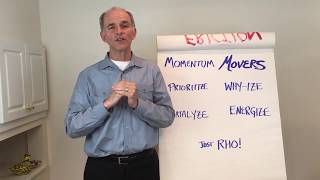
In this instructional video Patrick Mosher introduces a physics‑based metaphor for project execution, defining momentum (ρ) as mass × velocity, where mass represents the size or effort required for a project and velocity the speed of progress from point A (current state) to point B (desired outcome). He explains that, like a moving object, a project’s momentum is constantly threatened by friction—any resistance that slows or stops progress. Using a simple ramp‑and‑marble demonstration, Mosher shows how incremental friction points (represented by pieces of construction paper) cause smaller “effort marbles” to stall while larger ones push through, illustrating why projects lose speed at various stages. Mosher then categorises the sources of friction into the “7 Ds”: Delirious (confused), Distracted, Drowning, Dread, Doubt, Deprioritized, and Disagreement/Disengagement. Each D is described with concrete workplace behaviours that create resistance. To counteract these, he proposes four “Momentum Movers”: Prioritize (clarify the most important work each day/week), Y‑Ising (regularly remind the team why the work matters), Catalyze (leaders visibly engage with the team to signal importance), and Energize (celebrate milestones and heroic effort). A fifth, informal mover—“Row”—emphasises the need for steady, repeated effort, likening leadership to rowing a boat continuously to keep momentum alive. The video concludes with a call to apply these concepts, encouraging leaders to use the 7 Ds diagnostic, the 4 Movers plus the rowing principle to keep projects moving smoothly from A to B, and invites viewers to subscribe for more Change Science Academy content.
Chapters
Welcome to the Change Science Academy channel, where we explore and discover alternative ways of thinking to drive measurable value in executing our personal and organization strategies. On this channel, we look at getting from point A, which is where we are right now, to point B, sometime in the future. But this is like a realized strategy or, or an initiative or project we want to get done. And we're trying to get this done in as straight a line as possible, get from A to B. But we know it takes twists and turns along the way. Part of this is ironing out this arrow so it doesn't move around so much and we go from A to B as straight a line as possible with an energized group of people, empowered, but also with success at the end. Have you ever had a project where you started it, you got it rolling and everything, and then you came back a little while later and it just had slowed down or stalled? Maybe your team didn't know what to do next or something like that. You've had this time where you've got a project that's going and it stalls or slows down. Well, we're going to look at that today. And what I think about that is a project that has momentum that slows down. Now, we're going to look at momentum in a certain way on this channel. So momentum is rho, which is the Greek letter rho, equals mass times velocity. And mass is how big is your project. Is it like this 2-year mammoth project, or is it a project you just need to get done tomorrow or in this week? But mass is kind of an indicator of how big it is and how much effort it's going to take. And then you multiply that by velocity, and velocity is basically the distance from point A to point B, getting the task or the project complete over time, the duration it takes to get it complete. And then this little piece over here, this is just directionally— making sure we're always directionally correct, we're always heading in the same direction. So that's what momentum is, is mass times velocity. Now when we've got momentum rolling, you know, what we want to think about is how do we keep it rolling? So we're going to turn to Newton's First Law of Motion. And Newton's First Law of Motion says a body at rest will stay at rest. Now that makes perfect sense, right? It's going to stay there. If you leave it sitting there, it's going to stay sitting there. But the second part seems more perplexing because it says A body in motion will stay in motion. But that's not our experience, right? You know, when we put something in motion, we roll a ball or something, it stops, right? So the third part of Newton's First Law of Motion is it moves unless it's acted upon by an unbalanced force. Basically meaning it's going to stop when it sees something like friction. And so what we see in our world is always there's friction that's slowing things down. And the definition of friction is resistance that one surface or object places on another. So if you rub your hands together, you can feel the friction. You feel warmth or energy being created there. And so what friction really is is when one surface moves across another, it makes it slow down or stop. And that's what we're going to look at today. So what we're going to first look at is go to our Change Science Academy lab table down below. And we're going to show how that works. Now you see here, point A is where we are. Point B is where we want to be. And we've got this distance from this, which is where we want to— and how fast we get there is the velocity. Now the mass, we're going to look at these marbles as different parts of how big the mass is to get it done. So we're going to take the little pieces of the project and we're going to roll it down. Now this ramp indicates that we've got a great kickoff meeting set up. We got everybody set up, they're educated, they're ready to go, and we have a great kickoff meeting and boom, off they go. And so the little pieces of effort go across and it looks like, you know, while we got, you know, with no friction here, the bigger efforts, and then this is a big steely, this is a big heavy mass, and it comes across. And just by doing our project like this, it looks like a little bit of our effort got waylaid in there a little bit. But now what we're gonna do, and so 80% of our project got completed, but now we're gonna put a little friction in between here, right at the midpoint of the project. Let's say people get a little distracted or whatever, and it's just a piece of construction paper there. And what we see as we come across is that our marbles, the littler efforts seem to make it across. Oh, that one didn't make it all the way across. And then we're gonna take the bigger marble and see if the friction does anything with that. And this big steely that comes across, well, you know, that effort just rolls right over that, that friction point here. But now when we do a project, we're 2/3 of the way through the project, maybe we'll see some, some more resistance here. And this is just another piece of friction along the way. Let's see how our marbles work with that. Oh, the one got totally put off the mark by it. The other one made it across just fine. This is our effort getting completed as we roll across this. The bigger marble It seems to roll right through that. And of course our steely looks like it's gonna just bowl right through it. So again, we got about 80% of our project completed just by having a good starting point here. Now the last one I'm gonna put here, the last bit of friction is another piece of construction paper, but this is the last mile. The last mile of most projects are really hard to get over. People get confused, they don't know how to get over that final hump. And so when we look at that, the littler efforts are going to go past the first one, the second one. Oh, it totally got stopped by that friction in that last mile. The second one didn't even make it through that. And we look at the bigger marble coming through, and it made it right through that. And let's just see if this big massive marble goes through. Yep, it just bowls its way right through. So we can see where there's additional friction, things have a harder time getting through that friction. And so we're going to see how that works with our project teams. Now, hopefully that was amusing, but also instructional to say, you know, when we see friction, things slow down. And so what is friction for our projects and for our teams? So the second thing I'm going to look at here is what is friction? I've got 7 sources of friction. I kind of think of this as the 7 D's of friction. And the first D of friction that we kind of see out there is when our teams get delirious. And what I mean by that, they get confused. They don't know what to do next. And so a lot of times along the way, maybe halfway through the project or two-thirds of the way through the project, they get confused as to what they need to do next and they kind of need some direction. The second D of friction that we might see is people getting distracted or us getting distracted. Distraction happens when we procrastinate maybe the tougher tasks to the end Or maybe we chase a shiny penny and we say, oh, this is more interesting. So sometimes we get distracted and that causes friction along the way with our ability to get from point A to point B. The third D of friction is drowning. A lot of times our teams just feel like they're drowning. So I've been on projects when I was a consultant for 30 years. You look at a project and they're trying to move 122 marbles on the table. And they're just drowning. Well, putting additional pressure on them never works because just more pressure on a drowning team just creates more havoc and they just get more confused and it's more difficult for them. The fourth D of friction that we're gonna look at here is dread. And when I think of dread, I think of running, you know, you've got this long project. It's like running a marathon. It's 26 miles. And then mile 2, you go, hey team, Let's do a sprint. And so they sprint mile 2. And then you go through mile 3, and then at mile 4 you go, let's sprint again. And you sprint again. And mile 5, let's sprint. And eventually, your team's going to look at you and go, oh, do we dread what's going on next. So Patrick's just going to ask us to sprint another mile 7 and mile 9. So that's when dread builds up, and that's friction. Our teams just don't feel like they know what to do next, or they just dread coming into work. The fifth D of friction is doubt. How often have we doubted, are we really going to get to success? Is there success at the end of this rainbow? Is there a pot of gold? Or is doubt just doubt of leadership? Doubt that the path is the right way to go? Once people start having that doubt, they start not engaging as much and that friction builds up with them. As they go along. If you don't take care of that along the way, the doubt gets greater and greater and the friction gets greater and greater. Then the 6th D of friction is deprioritized. How many times have you worked with sharing resources with other people and you're working with some folks to get, "This is what we need to do," and they go, "Yep, got it." Then you come back a week later and they go, "Yeah, well, we didn't have time to actually do your project. We're doing somebody else's thing right now." You're like, "But we have a deadline, you agreed." That happens all the time. So a lot of times you'll see that people, what creates friction within people is the deprioritization. The last D of friction is the biggest, it's the hardest, and sometimes it's the most difficult to overcome. And so that last D of friction is disagreement or disengagement. When somebody disagrees with the approach, with the endpoint, with what success looks like, now you've got people disagreeing. I look at that as resistance, which is another scientific term. We're going to look at it in another video of this. Disagreement, that resistance can be active or passive resistance when they disagree. I always preferred active resistance because you know exactly where people stand. You know exactly where they're disagreeing with you. Actually, when people disagree like that, they're actually still involved. They're telling you their point of view, and so there's actually some agreement. There's some hope in that one. When people passively disagree, oh, that passive resistance is the toughest to deal with because you get the yeses, but you get outputs of nos. We'll talk about that at a later time. These are the 7 Ds of friction. I'm sure you've faced all of these at some point in your life, some part in your project, maybe you're experiencing it right now. Here we are, we've got these different types of friction, so what are we going to do about it? Let's go to momentum movers. I call these 4 momentum movers. I'm sure you'll have other ideas of other momentum movers you have. I'd love to see those in the comments section down below, but the 4 momentum movers I'm going to bring up are these 4, and then I've got a special one at the bottom that I'm going to bring up at the end. So the first momentum mover is prioritize. If you help your teams prioritize, what's the number 1 thing we need to do? Now, sometimes on projects you'll have a standing meeting every morning. I led projects where we had a 15-minute standing meeting every morning, and I said, what are your priorities today? This is what I think we should be doing. And they go, well, we're trying to do this. And so you work out those priorities. Maybe every morning in a stand-up meeting, or maybe you check it every week, or maybe every month. In some ways, you keep those priorities number one, forefront, so that you know what everybody's working on for today. That's leading to where you need to get to be in the long run. I really had a long time ago, over 30 years ago, I was on a project. It was aircraft assembly, and I was working on this big project. With about 20 people, and then we were all gathering for a standing meeting every morning. I remember this like it was yesterday. People were going like, "We gotta do this, we gotta do that," and everybody was bringing up all these priorities. Then the leader of the project, she said, somebody said, "Oh, what should we be working on? What's the priority?" She goes, "Everything's an A1 priority." Oh, that was an awful way to give direction to a team. Everything being an A1 priority isn't helping a team moving 122 marbles on the table and getting them all to point B. Priorities are really important to be very specific about what the priorities are for today, for this week, for this month. The second strategy for momentum moving, and I'm going to call it Y-Ising. It sounds a lot like being wise, which I really like about this, but Y-Ising. A lot of times it's really important to remind people why are we doing this. They're working on things every day. Sometimes the why escapes and you got to remind of the why. I'll tell you a little story about that. When I was working on a post-merger integration in Canada, big project, I had 22 people reporting to me. Post-merger integrations are really complex, really hard, energy-draining pieces of work. What happened is I had a Wednesday night progress meeting, my team came in, my program lead sat down and nobody made eye contact with me. You know as a leader when you're in trouble. Nobody makes eye contact with you at the progress meeting. So everybody sat down and my program lead said, "Okay, real estate, you're first." Real estate said, "Well, we missed this deadline and this didn't happen." I was just like, "Okay, wait, stop, stop, stop the meeting. I want everybody to take aside their papers and their plans and I want you to put your feet flat on the floor, close your eyes, and take a deep breath because I'm going to tell you a mini story." This company has put a $1 billion asset, the crown jewel of the company, the growth for this company, in the hands of the people in this room, the 22 of you. And that's such a privilege to be a part of that. And not only will this project, you know, it's going to help the company generate more revenue and more margin, it's going to help put our consulting company and give revenue to us. But you know what? That's not what motivates me day to day. What motivates me day to day is that in doing this project, we're going to change the way people live and work. Not only when they want— walk into these stores when we're complete, but we're going to change how consumers consume a certain type of product, not only in this industry but in an entire country in an industry. And that's just going to make people feel happier, they're going to engage with their families better and differently than they ever have before. That's a wonderful thing to do. That's motivating for me. Then when I stepped back, I said, "Okay, everybody, just pack up your stuff, go home, get a good night's rest." I got so much feedback from that meeting saying, "Patrick, I just forgot what the why was for this project. Why are we doing this?" That just helped motivate me to get back into the game. Sometimes we just need to why-ize our people and our team. The third momentum mover that I want to bring up is catalyze. A lot of times when we catalyze, what do I mean by catalyze is, you know, sometimes I go to executive sponsors or the C-suite of the company I'm working with and I go, you know, it would really do well for the team to come down and walk the halls just for half an hour and to walk up to the individual contributors as well as the managers and the supervisors and the executives and to Just ask them, "What are you working on?" And really say, "Oh, that's a really significant piece of what it means to get this project done, which matters so much to our company." And when leaders authentically engage their people that way, people feel catalyzed. They feel like, "Oh, it's that little spurt that they need to get going and say, 'Wow, this is really important.'" So sometimes I look at catalyzing a team. The fourth momentum mover that I'm going to mention is to energize teams. And when you energize a team, what I mean by that is celebrate. Celebrate the milestones as you go from point A to point B. Celebrate the mini milestones along the way. Celebrate the heroic acts that people do along the way. And that really helps to energize people as they go from point A to point B. Gives them that little extra push that they need just to say, "Oh yeah, I'm recognized for the hard work that I've done." Those are the 4 Momentum Movers. The 5th special one here, and I'm going to go back to our definition of momentum, and if you remember, it was the Greek letter row. What I mean by a Momentum Mover is sometimes you just have to row, and pardon the pun, but there it is, just row. If you're in a race and you get in a boat and you take the first thing and you say, "I've got the education ready. Everybody's got the expertise." Okay, we're going to go in the boat and we just push once and we pull back and we go, "Row!" Where's the boat going to go with just one shot like that, one stroke? Well, the boat's going to move and then that friction, that resistance is going to stop the boat. Well, part of momentum, moving that momentum, is just put the oars, put the paddles in the water and just row and then row again and then row again and keep rowing. Steady as you go so that you get from point A to point B in a very easy way with easy strokes. As a leader, what you're doing is you're putting your paddles in the water and you're giving them the whys. You're energizing them along the way. You're catalyzing them along the way. You're helping them prioritize their work. Along those lines, you're going to keep that momentum steady and that momentum is going to roll. I hope that was helpful for you today in taking a project that you've worked with and helping it move that momentum, if you would. And so I'm gonna end it here with that. Oh, if you like this little channel, please subscribe to the channel, like this episode, and invite some friends to join us. So I'll leave you with this as I always do. Learn continuously and live your life 100% empowered. Until next time.