Patrick Mosher, a consultant with 30 years of experience, launches Change Science Academy to help organizations execute strategy by blending art, science, theory, and practice. He's developed an adaptive leadership toolkit of about 13 distinct styles, applying the right one to each situation, and the channel will cover decision-making, momentum, and navigating organizational inertia.
Chapters
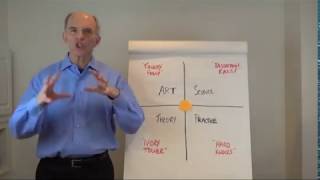
Hello, welcome to Change Science Academy. I'm Patrick Mosher, your host, and in this channel we're going to explore, discover alternative ways of thinking to drive measurable value in executing our personal and organization strategies. So let me start with a very simple model of execution of strategic initiatives. You're at position A and you want to get to point B. The best way to do that is a straight line to go from A to B. It's this blue arrow here. But how many times have you experienced experiencing right now, that to get from point A, you know, you see budget stops, you see people that aren't aligned. One of the leaders says, well, we don't want B, we want to go to C or B prime or something like that. And so, you know, the organization doesn't get behind it. There's inertia, resistance in the organization. So you actually don't take the straight line. What I've done in the last 30 years of my career is helped organizations and leaders and managers and people in organizations to take the straightest line to go from point A to point B, which is tough. Right? So what we'd like to do is start looking at some of the techniques and tips and tricks that I have, but also that you have as a collaboration to go from point A to point B. That's what we're all about. But I want to tell you a little bit about my story. So 30 years ago, I was a chemical engineer in school and I didn't have enough money to get through school, so I had to be a co-op student. What that meant is that I would work for one semester as an engineer and then go back to school for a semester. And it would be on working, on school, on working, on school. On school. And so early on when I was doing one of my work periods, I noticed that you would gather requirements and specifications to solve a problem of some sort. And you'd come up with a solution A, option A, and it met all the requirements, all the specs were met, and you were really proud of this and you'd go into a meeting and present this to leadership. And then somebody would come up with option B. And option B was messier and it didn't meet all the requirements, But then leadership would say, "Well, we'll go with option B because we like the orange." And I'd be like, "Orange wasn't part of the specs. It's not even necessary." But they say, "No, no, we're going to go with option B." And so I was befuddled by that. It was just amazing to me. And so what I wanted to do is learn more about how humans screw up perfectly good decisions. So I had a number of electives as any engineering student does, and I went back and I took a persuasion class. Now if you think about an engineering student taking a persuasion class, an engineering student, for me, I would You would take an organic chemistry class and learn everything there is about organic chemistry, top to bottom, right to left, and if you got an 88% on a test, you'd go back to the professor or the TA and find out, what was that 12% I got wrong? And they would explain exactly what you got wrong from point A to point B of what exactly that looked like, so that you took the test again and you could navigate that. When I took, started taking a persuasion class, you get a B on a test and they'd say, well, you know, you got a B because your argument wasn't strong enough. Oh my gosh. So what happened to me is taking a liberal arts, you know, starting to take a liberal arts curriculum just ripped open the right side of my brain. It was just amazing to me. And I wasn't daunted by that. I was, you know, infatuated by that. I just started learning and learning and learning more I could. And so I took a class in small group communication. And then when I finished my bachelor's degree, I went back and got my master's degree in organization communication. Wow, that was amazing. I started learning nonverbal communication, interactional pragmatics. Interviewing techniques, rhetoric, oral interpretation. Wow, I was just learning so much. And then when that finished, I was like, I still hadn't had enough of learning yet. So I went in and did a PhD in organization behavior out of the business school. And in that curriculum, I learned all sorts of things like motivation and leadership. I learned about strategic management, marketing, accounting, finance, collective bargaining. It was just amazing to me, and it was awesome. But after 3 years being in that curriculum, second child I needed to leave and earn some money. And so I didn't finish the PhD and I went into big consulting. This was about 28 years ago. And I entered that part of my career and I went into organizations. Now, I think it was perfect that I didn't finish my PhD because I went into each of these organizations as if it was this mini case study. Each organization has its own personality. Each leader has their own style in those organizations. And so it was fascinating to me to work within these global 1,000 and 4,000 Fortune 500 companies all over the world and just learn all these different ways of navigating to help companies and leaders execute their strategies. And it was awesome. Learned a ton along the way and it was a lot of fun for me. So what I'd like to do on this channel is share a little bit more with you on some tips and tricks that I learned along the way, but also collaborate with you so that I can learn some things from you as well. So as we go into that, I want to explain a little bit more about what this channel is about. So if you look at There's an art to making strategy work, and there's a science to that. But also, there's theory behind that, as well as practice. Now, if you get art too much, well then, art becomes touchy-feely in this space. So it's just the art of the thing. But if you get too much on the science of things, well, dissection kills the thing and it just becomes trivial. If you get too much in the theory of this, well then, you're in the ivory tower and nobody cares, it's not relevant. And if you get too much in the practice of this, well, then the only way you learn is through hard knocks and you're in the school of hard knocks and boy, there's too many bumps and bruises along the way to do that. So if you're out here on this, you know, you're too far out. So what we're looking for on this channel is look at the intersection of art and science and theory and practice right in the middle here, in that muddled middle where we all navigate those changes from point A to point B. So we're going to take a little bit of art, we're going to be a little bit of science, a little bit of theory, a little bit of practice. Of course, creating something like this, I was a consultant so you have to do a 2x2 matrix because that's how the world works. We're going to look at that model in the middle and we're going to investigate theory and practice and things there that will help us navigate these changes. I want to give you my first tip. Over the course of many, many years, 28, 30 years, I worked with lots of leaders along the way. There were good leaders and there were great leaders. One thing I found with great leaders was that they took their they knew their authentic best self and then they modified their style to work to meet the situation that was needed for a particular style. So they knew how to listen at the right time. They knew how to push in that last mile. They knew how to collaborate, rally the troops, and build consensus within organizations. They knew how to deploy those at the right time. It's kind of like if you have a hammer at home and you have one style and one hammer, Well, if you try to fix everything at home with one hammer, there's going to be a lot of broken stuff at home. So what you want to do is use the right tool for the right situation. Or I think about it like, like somebody who wants to get fit and they do 1,000 push-ups a day but don't do anything else. So they get really good at push-ups but nothing else. So I kind of think of leaders as being CrossFit leaders. Their style applies to different things when it's the right thing to do. And so one of the things that I learned in my navigation of these organizations is that I had to adjust my style as well to work with these executives. I'm sure you have all faced managers and leaders that you find challenging to work with. But here's what I did with that. What I did was I assumed that I had maybe 13 styles in my back pocket to use and apply at the right time that I really own very well. Then when I hit a style that I didn't quite get, a leader that I couldn't quite navigate, I didn't look at that as a challenge, as a barrier. I leaned forward into it and was like, "Wow, here's an opportunity to learn style number 14 that I can put in my back pocket." apply it at a future time. So that's part of the mentality or mindset of continuous learning, and I encourage you to do the same. Think about how you can continuously learn. So that's what this channel is all about. If you're interested in how decisions are made in organizations or not made, if you're interested in momentum in organizations, how to gain it, how it's lost, how it stalls, or how it just fizzles out and dies altogether, How to overcome inertia in organizations. How do you navigate passive-aggressive organizations? You're in the right place. Just hit subscribe on this channel and I'll see you next time. I'll leave you with this: continue to learn and live your life as a 100% empowered human being. Until next time.