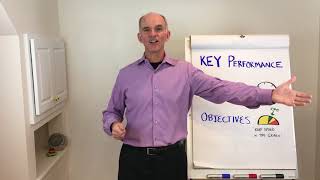
Performance means meeting expectations, and measurable ones drive results. KPIs are raw metrics like a speedometer; KPOs are the target range, like staying in the green zone. A sales team with 26 metrics saw focus collapse until only the three tied to compensation mattered, proving that too many measures dilute behavior.
Chapters
Hello and welcome to the A2B Academy channel, where we explore and discover alternative ways of thinking to drive measurable value in executing our personal and our organization strategies. In this channel, we look at going from where you are right now. Point A is where you're sitting right now, and then you have some sort of Point B. Point B is a dream and our aspiration, or it could be a project that you have to do at work. Or it could be you're a part of a big team that you have to get some big point B completed at work. Or maybe you have a campaign that you want to launch or a website that you need to build. Or maybe you just need to— your point B is getting the lawn mowed. Whatever it is, what is your point B? And getting from one point to another point, well, the straight line is the fastest way to do that. But the more complex B is, the more difficult B is, We know that it takes twists and turns along the way. We get prioritized in different ways, we get distracted by other things, people influence us to take us off the line. So part of this is how do we get from point A to point B as fast as possible, efficient, effectively, and get the success that we want. And so in this channel, in the A2B Academy channel, what we're trying to do is iron out that line. And I'm sure you've got plenty of examples of like, "Oh, I could never get to my point B," or maybe you're struggling with something right now. So that's what we're looking for in this channel is taking art and science, practice and theory, and putting that all together. And then I also bring in 30 years of my experience as a consultant to come in and say, hey, how do you get from point A to point B as fast as possible? I've worked with executives, organizations, functional areas. I've worked globally, you know, in different cultures. So part of that is to bring that to you and give you some of those tips, tricks, and strategies to get from point A to point B. Now, today, I'm very excited about today. Today, we're going to talk about performance. Performance, the definition of performance, if you just look it up, it's the fulfillment of a claim or a promise, or the fulfillment of an expectation. That's the definition you look up, but then there's an arts definition of performance. The arts definition of performance is the act of staging or presenting a play or a concert or an opera or something like that in some form of entertainment. Now, you may think that when you go to work, you're entertaining, which is great. That is a performance in some ways. But when I kind of mash those two together, I do think about when you go to work, you're playing a role because the organization, or if you're an entrepreneur, your work has an expectation of you to fulfill. As you fulfill that expectation, you're playing a role, just like you are on stage in some ways. You're performing. If I take both of those definitions and mush them together, the A2B Academy channel definition of performance is playing a role to fulfill an expectation. The key in there is expectation. What is the expectation that you might have for yourself and the expectation that the organization has of you? The expectation of your teenager or your spouse, whatever those expectations are on you, there's an expectation to perform a role. Today, we're going to talk about performance, but we're going to talk about performance in terms of performance measurement. There's an old saying that— I was a chemical engineer, and so engineers have an old saying that says, "What gets measured gets done." I totally believe that. Now, not everything can be measured. We're going to today talk about the things that can be measured. I did a lot of performance reviews over the 28 years of my career as a consultant, and maybe hundreds, probably thousands of performance reviews over the years. One of the things that you look at in a performance review is, here's my expectation and here's how the actual performance was. Then you match that and say, oh, you met it, you exceeded it, or you were slightly below it. In some ways, that's what your performance measurement is. Now, how many of us, I think you've probably experienced this as well, there were unspoken expectations. Maybe it was your spouse, maybe it was your child, maybe it was your boss. Maybe it was for yourself, there was expectations you had of yourself that you didn't realize until you got to your point B and you go, "Eh, I didn't cut it." Part of that is, what are those expectations that you have? When you go into a performance review, a lot of times you don't want any surprises, right? To say, "Oh, you didn't meet these performance expectations." Like, "I didn't even know they were there." Today we're going to talk about those measured performance metrics, those expectations that you can actually measure. Salespeople know this a lot. They're probably one of the most measured workforces on the planet because you have to pay them incentives or pay you incentives if you're a seller. And part of that is you have to measure their performance. And how do you measure it? By setting a quota of some sort, whether you meet or exceed that quota. So we're going to talk about in that is we're going to get into what are the key performance indicators. Now, I'd like you to write down a point B that you have, whatever you had in your mind as a point B, a dream, an aspiration, a project, you know, a promotion that you wanted to do, whatever it is, and then come up with and say, What would be an indicator of success for that? A KPI, what's the key performance indicator? Is it that, you know, the promotion makes $100,000 in revenue? Is it that I meet my sales quota? Is it that the lawn gets mowed by Saturday at noon? Whatever it is, what is the indicator that says I succeeded? Now, a key performance indicator is basically just a metric. So, you know, I like to think of it as, you know, driving down the street and you've got a speedometer. Now, KPI is just the indicator. It's just a speedometer. It doesn't have an objective attached to it. So, if you just look at what's the measure that you're going to look at success, not what's the objective of that, but what's just the measure you're going to use, that's half the battle right there because so often there's expectations that have no measures attached to them. In consulting, a lot of times the measures were, you know, well, the objective was to get the project done on time. What's the indicator of that? There's a deadline and did you go past it? There might be an objective of getting at or under budget. Well, the indicator for that is how much you spent in budget. So, we're going to move to the second part of this that says a KPI is the indicator and a KPO is the is how you measure that and what does success mean. So in this case, when you're looking at driving down the street, the speedometer is your KPI and then the objective is, I want to keep speed in the green. So, you know, let's just say the speed limit is 60 miles an hour, you know, you want to keep between 50 and 60. If you go a little above that, you're in the yellow, a lot below that, you're in the yellow, but if you go way over that, you're in the red. So in that way, the KPO here of looking at your speedometer, which is your KPI, is, you know, keeping in the green, speed in the green. So that's what a KPO is. KPI is the measure, KPO is the objective you need to set that says, are you succeeding? Now, in this particular example, you want to keep it between 50 and 60, but you might have a KPO that's different than that. I don't want to get pulled over by the police. Well, that gets a lot more complicated because now, well, how fast can you go that the person, the policeman who's sitting in the car is going to read you on his speed indicator and say, "I'll pull that person over or not." Is that 3 miles an hour over the speed limit? 10, 12, whatever it is? So now you're taking into your performance expectation somebody else's view of you that you can't control. So anyway, that's a good view of KPIs as the indicator and KPOs as the objective of your performance to get to point B. So hopefully that helps you look at what are some examples of other KPIs, KPOs. You might have a revenue goal for your company. Well, revenue is the KPI. And $100,000 might be the KPO, that you make $100,000. Or you might have that the measurement is free hours per week, and the KPO is, I want to have 16 free hours per week. So that's the objective. Another one might be weight. You might say, well, the pounds I weigh might be the KPI. I want to lose 5 pounds this month, so that would be your KPO. And finally, the one for me on this one is, on this channel, I'd like to have subscriptions. So subscriptions is my KPI, but I want to have 100 subscriptions in the next month or two. So that might be my key performance objective. Hopefully that helps you look at what kinds of things you're looking at, KPI versus KPO. But now I want to go to our A2B Academy lab table. On this lab table, you're going to see point A and point B, and we've got 10 marbles to get from point A to point B. Now, the KPI is what percent— now there's 10 marbles in here— what percent of these 10 marbles will make it into B? And then also, we might want to measure that by how much time it takes us to get from, you know, these 10 marbles from A to B. So the first way we're going to look at this is we're just going to take the, um, do-it-all-at-once method, and here we go. We're going to say, okay, here's 10 marbles, we're going to push them across and just go. Well, given the slapstick method here, we looked at this and said, 1, 2, 3 marbles made it in and the rest didn't. So we had a 30% success rate with just the shotgun approach to going from A to B. But it was pretty quick to do it. But let's try a different method. Now, let's create a little bit of momentum before the marbles roll, like you might be on a project. And we'll look at going from point A to point B and how many marbles make it across. If you look at that, oops, we got to put those 2 in there as well. That took us a little longer. Well, looking at this, 3 marbles didn't make it in, so now we have a 70% success rate, a lot higher than the 30% that we had before. And because I missed those first 2 marbles, it looks like it took maybe twice as much time. So, in looking at that example, it's very interesting to say, well, the shotgun method was faster, so it took X amount of time, let's just say 2 seconds, and then, but we had a 30% success rate on quality. But on the second one, we had a maybe 2X on time, but then we had a 70% success rate. So, are you looking for quality or time? In this particular instance, I would take the 2x on time and take the 70% on the quality index. So, hopefully that helps explain KPIs, KPOs, and the measurement of performance. So, I want to leave you with an example. Now, you can have too few metrics, you can have too many metrics. I was working at a local client here in Minnesota. And it was a VP of Sales. And he came to me, we were doing a Salesforce analytics piece for them, looking at their sellers and how they spent their time and whether they met their objectives and stuff. And the VP of Sales came to me and said, "Hey Patrick," very proud, I guess, "this is the perfect scorecard." So he showed it to me and it had 26 measures on it. I said, "Ah, Dave, that's awesome that you're thinking ahead." But I'm going to tell you, nobody can keep in their head 26 metrics and try to hit all of those. In fact, what's going to happen is that they're going to look at those 26 metrics, they're going to figure the 3 that are tied most tightly to their compensation, they're going to do those 3 and the 23 are going to drop off the table. And in fact, it might create more confusion because 5 people might choose these 3 metrics, 6 people might choose 3 different metrics. You're actually going to create more confusion in your workforce than guided behaviors. When you set up those kind of metrics, make sure that you figure out how many, do I have the right measures and are they going to drive the right behavior? Are these going to drive the right behavior? One of the things with that particular client in the sales ride-alongs that we did, one of the clients, the sales guy said, "Hey, my sales quota is my performance review." So he didn't care what performance rating he got because if he met his quota or exceeded his quota, that's how he got paid. And so basically he said, I got one metric that I care about. And from that perspective, it was one metric that the company cared about too. They like to think about all these other metrics, but they really rewarded for only one of those metrics. And so however they met or exceeded quota, that's what drove their performance. And sometimes that can be great, and sometimes that can be You know, kind of scary, you know, in terms of customer service and things like that. So, the point of that story is too many metrics will probably confuse people. So you have to have the right number of metrics that drive the right behaviors. Hopefully this episode gave you some things to think about in key performance indicators, key performance objectives, performance reviews, and think about your own performance, you know, and the A2B Academy performance definition being playing a role to fulfill an expectation. What are the expectations out there and can you measure those expectations? Am I going to get the website launched by a certain date? Am I going to generate so much revenue out of a certain promotion or get a certain conversion rate out of a certain promotion? Whatever your metrics are, I really encourage you to document those because again, what gets measured gets done. That's it for this episode of the A2B Academy channel. I hope you enjoyed it. I hope you got something really helpful out of this for your getting to your point B. If you like this channel, like it, subscribe, and invite 2 or 3 other friends to come see us and join us next week. I'll leave you as I always do, learn continuously and live your life 100% empowered. Until next time.
More from Patrick

Unlock Your Unique Energy: The Ripple Effect Explained! #telepathy #telepathicconnection #purpose

How Telepathy Works: Tapping Into Energy Bigger Than Yourself with Patrick Mosher (Wisdom4Humanity)

Telepathy: Unlocking Mind to Mind Communication Explained #telepathy #telepathiccommunication #love

Unlock Your True Self: Connect to Infinity #telepathy #telepathicconnection #purpose #love #mission

True Self, Soul, and the Sense of Infinity - Patrick Mosher - Wisdom4Humanity #soul #trueself #love

Unlock Telepathic Powers: Your Guide to Intentions #telepathy #telepathiccommunication #purpose

Unlock Telepathy: Release Distractions, Embrace Love #telepathy #telepathychallenge #wisdom4humanity

Serendipity & Goldfinches: A Spiritual Moment Shared #telepathicconnection #spiritualjourney #love

Unlock Your Telepathic Power: Tap Into Larger Energy #patrickmosher #wisdom4humanity #presence #love

Build Telepathic Capability in 6 Simple Steps - Patrick Mosher, Wisdom4Humanity #leadership #love

3 Words Defining Today's World & Personal Rhythm #worldpulse #today #humanity #purpose #vision #love