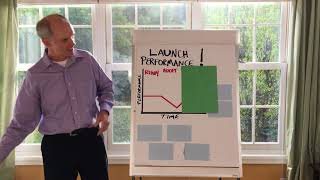
Patrick Mosher breaks down the launch performance curve into four stages: Readiness, Adoption, Business As New Usual, and Value. Most launches dip during Adoption, but six strategies—Persist, Learn, Invest early, Coach, Cheerlead, and Celebrate—help you reach your goal faster.
Chapters
Hello, I'm Patrick Mosher, and welcome to the A2B Academy channel, where we explore and discover alternative ways of thinking to drive measurable value in getting from point A to point B. Whatever your point B is, it could be a dream, an aspiration, it could be a project you're on, it could be just mowing the lawn today. Wherever your B is, we're gonna help you get from point A to point B. But you know, you've got experience of of going on the most difficult complex things when you go from A to B and it's not really a straight line. It actually is a curvy line because you get distracted. There's other influences that come in. So in this channel, we really look at ironing those things out. Now, I was a consultant for 30 years in corporate and I spent years and years helping companies execute on their strategies. And so in this channel, I take some of those tips, tricks, some of the things that I learned along the way and give them to you and to help you get from your point A to point B. So today we're going to look at the measurement part again. We're looking at how do you get from A to B as fast as you can through your launches. Now, have you ever had an experience where you had a no-show to a seminar or customers don't buy your product or, you know, people are confused when you launch a new capability Or your team is confused. Or no one hits this brand new beautiful webpage that you created. And you go, what? How did that happen? This thing is beautiful. This product is gorgeous. Why aren't people coming? So today we're going to talk about the 4 stages of launch performance and how we can have some strategies to help you get through those 4 stages so you can optimize that performance. So before we launch into that, I want you to think about your point B, your own case. And I want you to think, here's my point B, and write it down. Here's my point B, and then say, what's good when you get there? I mean, is it that your teenager's talking to you? Is it that, you know, the project is, you know, really successful? Are your customers buying, you know, more from you? You have a 10x increase of revenue in your business? Do you get the lawn mower? I don't know, whatever it is. But whatever that is, what is that measurement, that thing that moves, the dial that moves because you achieved your point B? I want you to write that down as well because that's your performance measure. And that's what says, "Hey, you're doing this because some sort of indicator is going better. It's getting good. It's getting excellent. A dream is met." Something like that. So I want you to write down what that performance measure is. Now, a gazillion years ago, I was a chemical engineer, and one of the things that I learned from that experience was how do you, how do you measure invisibles? You know, in chemical engineering, you know, you look at a flask of clear liquid and you don't know if it's hydrochloric acid or water. Well, there's ways to measure the concentration of hydrochloric acid in there. So there's ways to measure what I think of as the invisibles. Or in our case, if you said, "I just want to be happier." Well, I just asked you, how do you measure happiness? Like, "Oh, I don't know." There's no happy meters out there or anything, but what I would say is that everything's measurable to some degree. So we'll do that right now. Let me just ask you, on a scale of 1 to 10, how happy are you right now? 1 would be, "I'm miserable. I got a bad cold. I'm sick," or whatever. And 10 is like, "I'm jumping out of my skin. This is awesome." Number 2, what's your energy level right now? Do you feel really energetic? Do you feel like, you know, I'm a 10, you know, because I'm feeling lots of energy? Or are you kind of slogging through things and your energy is really low? And the third one, this one's big for me, you know, on a scale of 1 to 10, where do you see the value of this episode of the A2B channel right now? So, you know, is it a 3 right now? Is it a 6 or a 7? Hopefully by the end of this thing, we'll get you to a 9 or 10. But right now you might be going like, "Oh yeah, it's about a 6. Keep going here, let's see what happens." So you see, anything's measurable. Now I just gave you what we call subjective measures, and I like objective measures as well. But if you look at this, you know, using objective and subjective measures, you can measure just about anything. So we're going to go into what I look at as the 4 stages of performance during a launch. So here we go. I love this stuff, and you know, I told you I was a chemical engineer, so I love curves, I love the science, I love math of things, and applying them to human behavior and other areas. So go with me here a little bit. So we're going to look at launch performance. We're going to look at a graph that has performance on the y-axis and time on the x-axis. So the very first thing that you look at, the first piece of this launch is what we'll call readiness. So as you're getting ready to launch, launch is day 1, it happens here, and you're getting ready to launch, this is you building your website and you're thinking, how good does that look? And you're building your products to sell to your customers, or maybe you're getting all physically ready to go out and mow the lawn. Whatever it is, you're getting ready to launch. And in readiness to launch, there's a whole bunch of things that you're doing. You're creating a great product, you're talking to people, you're asking your customers, you know, what does good look like for you? So in readiness, you have performance, but you haven't launched anything yet, so that's why the line is straight across, because the old performance is still where it was before. But then, the next stage of this launch performance is that you launch something. And this is your launch day right here. And then you get into adoption. And I love the term adopt. I used to not like it, but now I love the term adopt because I looked it up in the dictionary and what it said was, "To assume ownership of something that's not naturally yours." And if you think about, we're creating this thing and then we shove it at people and then they look at that and they go, "That's one ugly baby." So they don't adopt it, right? So what you want to do is create something in readiness that people really want and so that they do adopt that. But what happens is, you know, when you expect something new, you know, if you're trying to establish a new habit, you put in play the first day and it's just not what you thought it would be and the performance actually goes down. You know, if you're trying to go to the gym more often and the first day you go to the gym, you come back, you're sore and you're going like, "Man, I don't know if I want to do this anymore. It really hurts." So part of this is your performance actually goes down, and this is called a performance dip or a drop. So after adoption, people are getting more used to it, you're getting more used to it, you start adopting this thing, and the next stage is BANU, Business As New Usual. Now you might have heard the term BAU, Business As Usual, but I think of this as Business As New Usual because now you are going to the gym. Now, you know, people are getting more used to using that new capability. Customers are saying, "Hey, I know how to use this website." And maybe you are selling that product with a little bit more ease. And your customer is going like, "Oh, I know how to use this product." So, BANU is a new usual. And what you're looking at is rhythm. People are getting into a rhythm with the new way of being, which is great. So now, you've launched something new. Performance goes down, but then it starts coming up the other side. And as it goes up the other side, once you cross this line from where you were before, well, then you hit the fourth stage, which is called value. And in that, you're starting to get the value of it. You're starting to feel better from going to the gym. You start to feel better about getting that 7 or 8 hours of sleep because you've got a rhythm with that now, and that value is now higher performance than you were when you started. That's the whole point. Now, I know this was really simple, but in some ways, you think about those 4 stages, you say, working through those 4 stages, well, you know, how do I get the value out of that? And some people think they're going to go right from here into value, and it just doesn't happen that way, especially with the more complex and difficult things you're trying to get done. So then I'll go through some strategies It's one thing to understand the curve and say, "Oh yeah, I kind of get it," but we'll go through some strategies too. But let me first ask, have you ever experienced that performance dip? And I'd love for you to write in the comments section down below, you know, some of the performance dips that you felt. And some of those performance dips might be things like, "I bought a new TV and I couldn't get Amazon Prime to come up on it," or, you know, "I bought a snowblower." We're here in Minnesota. "I bought a snowblower. I couldn't get the darn thing started." Or you bought an elliptical for your downstairs and it just sat there and collected dust. So what are some of those performance dips that you've seen? And I'd like to see those in the comments down below. So I'd like to go then through the strategies. And the first thing I want to start with before we go through the strategies in each of these areas, the strategy, the most important part of getting through from point A to point B and to minimize this drop in the length of this curve is a mindset that you have. And that mindset, the first one is you have to persist. Just get up, and persistence is so huge because you gotta pick up that first rock. When you're down here, man, you've gotta like go, okay, I'm gonna wake up this morning, I'm gonna get at it again and again and again and again. And sometime when you get over here, you start realizing, Hey, it wasn't so bad yesterday that it was a week ago or a month ago. And then you start picking up and picking up and you start going up this curve. So part of the first thing is have a mindset of persistence. I'm going to get to my point B. Very key. The second piece is to learn continuously. And I talk about that a lot, but part of learning is that you experience what's in here, but learning is kind of like a meta-experience of it because you're looking at yourself in it and saying, What am I learning? How come that didn't work out right? And then you, you pull that in and you learn from that. So when you're going down this part of the curve, man, you got to say, I'm learning because I want to get to the bottom of this thing and come up to the top and keep learning how to, how to get better at this. So that's a mindset through the whole curve that you need to have around this. Now, what's one great strategy in getting ready? Invest. You know, one thing about getting ready is invest in the training, invest in, you know, a good-looking product so that you don't go down as deep as you can. Because once you get in here, you can't invest anymore because you're going down this curve. So in some ways, if you invest the right time and resources with the right third parties to review your stuff, get people to own, you know, what they build. So, so if there's people going to use this, Get them involved early on so they can own what they build, so they can adopt that. So all of that is all about invest early. And then in adoption, what you want to do is you want to coach people. You want people to learn right on the spot. When I have a problem with something and I don't know how to use it, you need to have something around them. A peer coach, in fact, is best, where they can go, "Hey Bob, how does that work?" Instead of going like, "Well, there's a 911 number that you can call and you call it up and you get 17 different options." People don't like that. When they don't understand something, they want to talk to somebody they know and trust and say, "How's this done?" And they expect that person to go, "It's done like this." So coaching is key in adoption. When you get to business as new usual, you need to cheerlead people. You're coming up this side and it doesn't feel great, but they're starting to get some rhythm. Then you start going, "Come on, guys, go!" And when I think of cheerleading, I think of a marathon. By this time, in big complex changes, they're in like mile 21 of a marathon and they're just like chugging along. And that's where you want somebody to go like, "Come on, go! This is great! You've got a rhythm going. Keep going. Pick it up!" And so that cheerleading over on this side is exactly what's needed here. And then finally, when you get the value, Wow, so many times we forget to celebrate our successes. So we move on to the next thing. We go, "Oh, how are we envisioning, you know, how to make improvements on this and where do we go with this?" But part of it is to stop and say, "Hey, let's celebrate our success. Celebrate the value that we just achieved." So always remember to just celebrate those successes when you get there. So these are 6 strategies: persist, learn, invest, coach, cheerlead, and celebrate. And these things will help minimize this curve to go, you know, so you don't go down as deep and this doesn't take as long to get to value. And that's how you optimize your launch performance. Okay. What I'd like you to do is to think about your point B and just again, think about where am I at? Am I getting ready for this thing? Am I in the adoption phase and people aren't out there, you know, doing what I want them to do? Is there a business as new usual phase? Is that what's going on for you right now? And think about where your point B is and what strategy you have to persist, to keep learning, and to get to your point B. And that's what we really want for you. Well, that's it for today's episode of the A2B Academy channel. I hope you enjoyed it. And if you did, of course, like this episode, subscribe to this channel, invite, I don't know, 2, 10, 20 other people to come over and watch our videos here on the A2B Academy channel. And I'll leave you with this, as I always do: learn continuously and live your life 100% empowered and interact authentically with each other. Until next time.
More from Patrick

Unlock Your Unique Energy: The Ripple Effect Explained! #telepathy #telepathicconnection #purpose

How Telepathy Works: Tapping Into Energy Bigger Than Yourself with Patrick Mosher (Wisdom4Humanity)

Telepathy: Unlocking Mind to Mind Communication Explained #telepathy #telepathiccommunication #love

Unlock Your True Self: Connect to Infinity #telepathy #telepathicconnection #purpose #love #mission

True Self, Soul, and the Sense of Infinity - Patrick Mosher - Wisdom4Humanity #soul #trueself #love

Unlock Telepathic Powers: Your Guide to Intentions #telepathy #telepathiccommunication #purpose

Unlock Telepathy: Release Distractions, Embrace Love #telepathy #telepathychallenge #wisdom4humanity

Serendipity & Goldfinches: A Spiritual Moment Shared #telepathicconnection #spiritualjourney #love

Unlock Your Telepathic Power: Tap Into Larger Energy #patrickmosher #wisdom4humanity #presence #love

Build Telepathic Capability in 6 Simple Steps - Patrick Mosher, Wisdom4Humanity #leadership #love

3 Words Defining Today's World & Personal Rhythm #worldpulse #today #humanity #purpose #vision #love