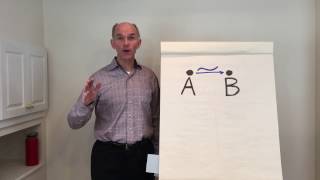
Patrick Mosher's 4D+E framework separates duration (time to finish) from effort (amount of work). By setting deadlines, dividing tasks into blocks, mapping dependencies, and adding energy to stay motivated, you can compress how long projects actually take. He walks through a spring yard cleanup to show how it works.
Chapters
Hello and welcome to the Change Science Academy channel, where we explore and discover alternative ways of thinking to drive measurable value in executing our personal and organization strategies. Hello, I'm Patrick Mosher, your host for this channel, and for 30 years I consulted into Global 1000 and Fortune 500 companies to help them get their strategies from point A to point B. What I found in my experience is that mostly this has to do with human decision-making and how we get from point A to point B is really dependent on human behavior. So the straightest line between the point between A and B is that straight line. We really hope that our strategies take that path, but so often they take a little bit of a curvy path. So in this channel, we talk about how to get from point A to point B. We use a little art, a little science, A little theory, but mostly we talk about practices, tips and tricks to get from point A to point B more efficiently and more effectively and with some energy. So today's episode really is about bending time. So if I think about time, it's about duration of to get from point A to point B. So we're going to talk about the duration of time of what A and B is, the length of this arrow. So that's very different than effort. If we estimate that a task takes 50 hours Well, we might split that task across 1 hour every day, so the duration is 50 days versus 50 hours spread over 5 days, you know, is 10 hours a day. So, some of this is just looking at effort as mass, the size of the boulders and the marbles we're trying to move, and the duration is how much time it takes us to get those marbles from point A to point B. Today we're going to talk about, in duration management, a tip that I call the 4D plan of duration management. 4D plus E. So we're going to walk through that here and look at— this is the 4D plus E, or the 4D way of managing duration. So let me walk through the Ds and the E. The first D of duration has everything to do with deadlines. What are the deadlines that we have to deal with? There might be an external deadline set for something, and that sets up how much time it takes us to get from point A to point B. But if we procrastinate a lot and we just let it go, well, that might be the most efficient way to get from point A to point B, but it's certainly not the most effective. And usually the quality of our output is much less if we procrastinate and wait until the end and get close to the deadline. So we want to manage our activities, that duration management, to get done in plenty of time to check the quality of our work. The second D of the 4D duration management is division. Division of that effort across many days. And so if you think about division and dividing that effort, I think about the setup time. And the setup time could be equipment setup time for sure, that might actually lengthen the duration. So if we split a task across 5 different places and each time it takes us an hour to set it up, well then we're taking time away and we're not being very efficient. Similarly, there's also a set of time in terms of our mindset. How many times have you gone to a task and let it go and had to come and spend some mental energy to pick it up again and run with it? So part of this is, you know, be very mindful of how you divide your time up on that 4D duration management strategy. The third D of the 4 Ds is dependencies. And I put a little yes under here. The dependencies that yes, you have some influence over. So there's dependencies that you might be able to influence other people or influence circumstances. So I suggest putting those tasks all in one area in your task plan so that you can look at that. Now, if you've got Bob who's going to try to review one of your— review your report, and you assume in duration management that that's going to take 1 week and it actually takes 2 weeks, well then you haven't influenced him well. You haven't contracted with Bob very well to get that done in the time that you need to get done for your duration management. And then, as you can guess, the fourth D of dependencies are the dependencies that you don't have control over, you can't influence. And that could be rain or technology innovations or something like that, that really changes what your duration is going to be. When I did change management work for 25 years, I looked at that and one of the things that I always put in my change plans was unplanned change actions. Meaning those things that I can't anticipate right now, but I'm going to make sure that I put time in there so when they do come up, I have a spot for them. So I'm not estimating the duration to be too short when all these dependencies come up. Looking at dependencies, I've seen people put buffers in of 10% contingency, 20%, 50%, even 100% contingency in terms of their plans. The key with this is to research these dependencies very carefully. What do you have some influence over? What don't you? And then how do you set expectations with people about the duration management based on your analysis of your dependencies and plan your contingencies accordingly? And then finally, the last part of our 4 D's strategy of looking at duration management is the E. And the E is all about energy. This is how you bend time. You really look at energy as looking at a task and changing or reframing the mindset that you have for a task. So instead of looking at it as a big mountain of of boulders to move and it's going to be really hard, which actually will increase the effort and increase the time it takes to get there. Or do you engage it, reframe it in a way that this is how I'm serving my customers, this is how I'm serving my people, or empowering my people to help. So, how do you inject energy into those, those tasks so that you can actually bend time? So, that's the 4D strategy of duration management. And now I want to go to our Change Science Academy lab table I'm going to give you an example of what that might look like. The setup for that is, I was talking to my wife about spring cleaning and spring cleaning in the yard. One of the things we talked about is, well, what do you need to do to get that spring cleaning done? We're going to use that as an example. I'd like you to think about your own activity, your own project that you're working on, and how would you use the 4D strategy as we walk through our example here. Going down to our example. Here we have point A to point B, and today's April 15th, and let's just say I asked— the first thing I asked her is, "So when do you want to get this done?" And she said, "Well, by May 1st." Okay, so that's our deadline of May 1st. And then she said— I asked, "How long does it take you to do this?" And you see here 16 marbles, so each marble represents 1 hour of time. So if you look at this, each hour is 1 hour of time, And you've got different colored marbles in here, and this is where we get to some of our division of things, because these 4 marbles have to do with cleaning up, let's just say, the gardens. And the other part is there's another 12 hours of raking the yard. So now we've got 12 hours of one type of task and 4 hours another, and we'll probably want to group the division of the task of the garden together, because there's an equipment setup for those that is required. So then I asked her, "Well, do you want to do 1 hour every day?" And she said, "Oh, absolutely not." So partly looking at this is, how do you split these 15 or 16 marbles across 15 days? And so she decided that the division of this would be nice if you saw 4 days of 4 hours apiece. So she'd spend half a day on 4 days. So now you've got your division across these 4 days of this 16 hours. Now, here's these nice bright sunny days. Each one of these Legos represent one day of the 15 days from April 15th to May 1st. So then there's a dependency here. And what is that dependency? Well, the dependency was me. So I actually have a dependency. She has a dependency on me to get something done because we have to pull up some of the garden fencing to make that work. So now there's an hour in here that I have to plan in as well. So now you've got these 4 days, you've got a dependency here, and then there's the last dependency to talk about. Unfortunately, you know, there could be some rainy days in here. So instead of bright sunny days, well, now we gotta move in some of the clouds. And let's just take some of these days that looked like they were gonna be bright sunny days, but now they're cloudy days. So now what we looked at, you know, of course it's April, so April showers bring May flowers. So we guessed that 50% of the time of the days would be rainy days. So we're going to take a look at that and say, well, now how do we spread these tasks over these remaining 8 days that we have available to us? So if you looked at it, one thing that we anticipated that there'd be some rainy days at the tail end so we wouldn't procrastinate. And because she has this dependency, she doesn't want to start out with the 4 tasks in the garden. So the first thing she's going to do for her strategy is to go look at the first days, 2 days, sunny days that she has to do the first 4 hours. So 2 half days of raking in the yard. The first 2 sunny days, she's going to get those done first. And then I've got to get my stuff done eventually in here too. So let's just say I can get mine done on this sunny day. And now she's going to take another, this day, the day after that sunny day, and create another day where she can do the dependencies on that. And now she's got almost all of the tasks done, 3/4 of the tasks done. So now all she has to do is wait for another sunny day towards the end of this, whoops, to get this done. So here we look at Getting from point A to point B, here's a deadline. We divided the task to 16 hours over 4 days. We took like type effort into one type, one day. We looked at the dependencies on me to get that done and the dependencies on rain to make sure that that could get done. And the last thing to put in here in the 4DE strategy is to bring energy to this. How do you bring the joy to cleaning up your yard? And part of that is just looking at How fun is it to clean up your yard and have so much beautiful view of both your yard and cleaning up and beautifying the neighborhood? Well, that's our example today using our Change Science Lab of using the 4D strategy of duration management, walking through deadlines, division, dependencies that you have influence over, dependencies that you don't, and bringing the joy and energy into a situation so you can actually bend time. If you would, think about your own project or activity and how would you use duration management for deadlines, division, dependencies, and energy. And if you have any ideas and you want to share them and collaborate in the space, write them in the space below. I would love to see some comments. And then if you also like this and you found this helpful, please like this channel, subscribe to this channel, and then find 4 or 5 other people to join us on the channel because we have a weekly view of looking at getting from point A to point B. We bring up tips and tricks to get there. I hope you enjoyed this episode of the Change Science Academy channel. And as always, I'm going to leave you with this: learn continuously and live your life 100% empowered. Until next time. Here we have point A to point B, and today is April 15th, and let's just say I asked— the first thing I asked her is, "So when do you want to get this done?" And she said, "Well, by May 1st." Okay, so that's our deadline of May 1st. And then she said— I asked, "How long does it take you to do this?" And you see here 16 marbles, so each marble represents 1 hour of time. So if you look at this, each hour is 1 hour of time, and you've got different colored marbles in here, and this is where we get to some of our division of things because these 4 marbles have to do with cleaning up, let's just say, the gardens, and the other part is there's another 12 hours of raking the yard. So now we've got 12 hours of one type of task and 4 hours another. And we'll probably want to group the, the, the division of the task of the garden together because there's an equipment setup for those that, that is required. So then I asked her, well, do you want to do 1 hour every day? She said, oh, absolutely not. So partly looking at this is, how do you split these 15 or 16 marbles across 15 days? And so she decided that the division of this would be nice if you saw 4 days of 4 hours apiece. So she'd spend half a day on 4 days. So now you've got your division across these 4 days of this 16 hours. Now, here's these nice bright sunny days. Each one of these Legos represent, you know, one day in the, from, of the 15 days from April 15th to May 1st. So then there's a dependency here, and what is that dependency? Well, the dependency was me. So I actually have a dependency. She has a dependency on me to get something done because we have to pull up some of the garden fencing to make that work. So now there's an hour in here that I have to plan in as well. So now you've got these 4 days, you've got a dependency here, and then there's the last dependency to talk about. Unfortunately, there could be some rainy days in here. So instead of bright sunny days, well, now we gotta move in some of the clouds. And let's just take some of these days that looked like they were going to be bright sunny days, but now they're cloudy days. So, now what we looked at, you know, of course it's April, so April showers bring May flowers. So we guessed that 50% of the time of the days would be rainy days. So we're going to take a look at that and say, well, now how do we spread these tasks over these remaining 8 days that we have available to us? So, if you looked at it, one thing that we anticipated that there'd be some rainy days at the tail end so we wouldn't procrastinate. And because she has this dependency, she doesn't want to start out with the 4 tasks in the garden. So the first thing she's going to do for her strategy is to go look at the first days, 2 days, sunny days that she has to do the first 4 hours. So 2 half days of raking in the yard. The first 2 sunny days, she's going to get those done first. And then, I've got to get my stuff done eventually in here too. So let's just say I can get mine done on this sunny day. And now she's going to take another, this day, the day after that sunny day, and create another day where she can do the dependencies on that. And now she's got almost all of the tasks done, 3/4 of the tasks done. So now all she has to do is wait for another sunny day. Towards the end of this, whoops, to get this done. So, here we look at getting from point A to point B. Here's a deadline. We divided the task, the 16 hours over 4 days. We took like type effort into one type, one day. We looked at the dependencies on me to get that done, and the dependencies on Rain to make sure that that could get done. And the last thing to put in here in the 4DE strategy is to bring energy to this. How do you bring the joy to cleaning up your yard? And part of that is just looking at how fun is it to clean up your yard and have so much beautiful view of both your yard and cleaning up and beautifying the neighborhood.
More from Patrick

Unlock Your Unique Energy: The Ripple Effect Explained! #telepathy #telepathicconnection #purpose

How Telepathy Works: Tapping Into Energy Bigger Than Yourself with Patrick Mosher (Wisdom4Humanity)

Telepathy: Unlocking Mind to Mind Communication Explained #telepathy #telepathiccommunication #love

Unlock Your True Self: Connect to Infinity #telepathy #telepathicconnection #purpose #love #mission

True Self, Soul, and the Sense of Infinity - Patrick Mosher - Wisdom4Humanity #soul #trueself #love

Unlock Telepathic Powers: Your Guide to Intentions #telepathy #telepathiccommunication #purpose

Unlock Telepathy: Release Distractions, Embrace Love #telepathy #telepathychallenge #wisdom4humanity

Serendipity & Goldfinches: A Spiritual Moment Shared #telepathicconnection #spiritualjourney #love

Unlock Your Telepathic Power: Tap Into Larger Energy #patrickmosher #wisdom4humanity #presence #love

Build Telepathic Capability in 6 Simple Steps - Patrick Mosher, Wisdom4Humanity #leadership #love

3 Words Defining Today's World & Personal Rhythm #worldpulse #today #humanity #purpose #vision #love