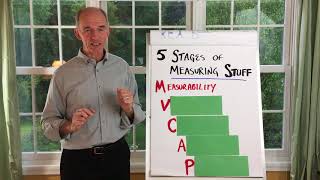
Patrick Mosher explains why measurement matters for reaching goals, using his MVCAP framework: Measurability, Visibility, Clarity, Actionability, Predictability. He shows how metrics like a habit scorecard tracking health and sleep, or red-yellow-green thresholds for sales, actually change behavior and predict results.
Chapters
Hello, I'm Patrick Mosher, and welcome to the A2B Academy channel, where we explore and discover alternative ways of thinking to drive measurable, and I mean measurable, value in executing your personal and organization strategies. In this channel, we look at where you are right now, point A, to where you want to be, point B. And that could be, where you want to be could be a dream, an aspiration, It could be a project that you need to get done. It could be the website that you need to get launched, a sales goal that you want to reach, or engagement of your team, the morale of your team. Whatever your point B is, what is that? And usually you look at the best way to get from point A to point B is a straight line, but we know that's not how that works. We take twists and turns along the way. We get distracted by things. Influencers step in that we didn't know could influence the decision. And so we get taken off the path. And so what I'm going to do in this channel is I take the 30 years of experience that I have as a consultant, as a coach, you know, trying to get executive alignment, post-merger integrations, all that kind of stuff, to iron out that point A to point B, to make it as straight as possible, to get there faster, efficiently, and with success. So today, we're going to talk about that measurable part. Have you ever gotten to a point B and you got there and you went, "Is this good? Did we succeed?" So maybe your point B wasn't really well-defined. Maybe the measure that you had wasn't really well laid out. I had a boss in the 1990s and he used to say, "Well, there's only ambiguous victories and nebulous defeats." I looked at that and I was like, "Wow, that seems really defeating." Then I was like, "Wait, wait, wait, wait, I'm not going to accept that. No, no, I'm not going to accept that at all." Because as, you know, I go back to when I was a chemical engineer 30 years ago and you had to measure stuff, stuff that you couldn't see, especially as a chemical engineer. So, you'd have to measure like the concentration of hydrochloric acid in that beaker. Well, you can't look at it and say, "Oh, it's X, Y, or Z." You can't see that. Or, you know, I was working in the glass industry and you'd have this big vat of molten glass and, you know, they'd ask, "How many light bulbs can you make out of that vat of molten glass?" It's not like you look at it and go, "Uh, 17." You know, what it is, you'd have to calculate it, you have to look at it, you have to measure things to understand exactly how many light bulbs you could get out of that vat of molten glass. Part of this is how do you measure things so that you know that you're succeeding? Now, the measure, the definition of measure is a standard unit to express the size, the amount, or degree of something. Well, now that makes total sense, right? It's how you measure something. Now, today we're going to talk about measures that are on a continuum. It's not about, you know, on/off, yes/no, 0/1, that's a different kind of variable, but We're going to look at measures that are on some sort of continuum. So that's the kind of measures we're going to look at. Now, there's an old saying, and this goes back to my world-class manufacturing days. And they used to say, an old boss of mine used to say, "What gets measured gets done." Well, you know, why do we measure stuff? Well, we measure stuff so stuff gets done, I guess. So what we want to do is track progress. So I want to ask you again. Take your point B. I want you to think about what measure moves because you attain point B. Is it more money? Is it a more engaged team, higher morale of your team? Is it healthier living? Is it better communication with your teenager? Whatever it is, what's the metric that moves because you attain point B? And because I was that chemical engineer, I believe anything is measurable. But today we're going to walk through the 5 stages of measurement, and as we go through that, I'm sure you're going to find a few nuggets in here that will help you measure your point B. But right now, if you have any troubles with understanding how do I measure my point B, put it in the comments section down below and help, you know, our community will help you look at how to measure that. All right, so let's go to the 5 stages of measuring. These are the 5 stages of measuring stuff. So measuring stuff, and I've got an acronym here, MVCAP, which you will not remember, except how I remember it is move the cap. So MVCAP is moving the cap. We're gonna walk through that here in a second, but I wanna give credit where credit's due. I worked with a colleague in 2005 at a client, Bill Wilder, and he brought this, some of this acronym to me, and I was just like, wow. This was really good because what we were trying to do in this Fortune 500 company, we were building basically an operations center for the C-suite. So they could walk into that room and look at the walls and say, oh, we're doing well. Health of the organization is good. And so what they would do in that room is they would see all the measures of their projects, their strategic initiatives, you know, how the stores did over the weekend, all that kind of stuff. They would look at that and understand exactly what was going on. Well, this was a major measurement task for us. And so Bill talked about an acronym that he brought to me, and I'm going to go through some of those today. But Bill, just to give him credit, he wrote a great LinkedIn article. You can look at it. It's called Recipe for Change. So look him up, Recipe for Change, LinkedIn. But when we go through this, I'm going to go through these 5 stages. The first one is if you think about your point B, is it measurable? You look at measurability. When I think about measurability, think about what it is that you want to move. Is it your health? Is it a project that you need to get done on time? Is it a sales goal that you want to reach? I want to tell you that some things are measurable that you might think aren't. I'll tell you a little story. In 2000, I think it was 2005, I took some coaching, a coaching program that my employer offered. It was a great thing called Quantum Coaching. One of the activities they had us do was name 5 things that you wanted to make as habits. So you wrote those things down, and then they said, "Now, measure those things. How well are you doing on that habit on a daily basis?" Well, I thought that was really good, but I kind of geeked out on it because I took those 5 things and I said, "Well, if I measure these things well, then I'll be able to form these as habits." So I put it on an Excel spreadsheet. I know, that's really geeky, but I started tracking these things on an Excel spreadsheet, these 5 habits. And then those habits became more and more. I got 5 or 6 more and all that kind of stuff. Well, 2005, I started measuring these things. And one week turned into two, weeks turned into months, months turned into years, and I'm still using that scorecard today, 12 years later. Every day, every week, every month, I record these habits that I'm trying to form, which is a way to look at it. And those 5 categories that I have on my scorecard are things that you might think aren't able to be measured. So those 5 things are my health, I've got spirituality on there, I've got relationships, I've got gathering experiences, rich experiences, and I've got service. So all of those things, I figured out a way to measure those things. So let me give you an example. On the health category, I measure how many hours of sleep do I get a night. Now, for 30 years I was a consultant and I was a chemical engineer, so I probably got on the average 5.5 or 6 hours of sleep a night for 30 years. 30 years. That's not really healthy. But when I, when I started trying to turn that around, I was like, wow, I need to get more sleep. So I started recording that on my scorecard and trying to measure every day. I look, I record on the scorecard how many hours sleep I got that night. So that's one way to start looking at, you know, measures that you think, hmm, these might actually lead to more general health. All right. So, let me move on to the next one. Measurability is the first one, how do you measure things? But the second one is visibility. So, visibility, there's measures all around us all the time, and my favorite right now is 10,000 steps. Everybody wants to get 10,000 steps in, which I think is great. Or you can measure how many Facebook friends that you have. So, there's so many things, we've pretty much gamified our world now with all All these metrics that we get badges for. So, you know, one of the things that's really important with visibility is that metric visible to you? Is it persistently visible? Because that's what will create a new habit. So, and also think about is that metric relevant to you? So, if you have an irrelevant metric and you track it, you're going to start getting off the track in terms of what behaviors you're going to start showing. So visibility, make sure that it's persistently visible to you. Now, you've got a measurable variable, it's visible to you, then the third one, you start measuring that a lot and then all of a sudden you get more clarity about that metric. And what do I mean by clarity? I usually think about clarity with 3 questions. You understand the mechanics of it. So how do you understand the mechanics? What moves that variable? So with 10,000 steps, I take a step and it moves. That's, that's pretty clear. The second one is, what are the other variables that can make that thing move? And the third question I ask is, how sensitive is that metric? You know, does it flatline and you can't see anything moving, or does it bounce around wildly so you can't tell what's affecting anything? So part of it is to find a metric and understand the mechanics of it so that you can understand what makes it move. Cause and effect. Let me give you an example of that. Let's say you want to reduce your electric bill by 15%. Well, you go outside, there's the electric meter outside your house, there's that little thing that spins round and round, and so you go out there and you look at it and you go, "How do I get that to spin less?" Well, is it spinning because the refrigerator's on, the vacuum cleaner's on, the fan is on, your computers are on, the lights are on? Or what. So it's really hard to parse out what's making that thing spin faster or slower. So that's probably not the best metric to look at, you know, root cause effect of what can make you save money on your electric bill. So make sure you pick the right metric that's clear, that you understand the mechanics underneath it. Once that's clear and you understand those mechanics, Then you can start doing red, yellow, greens. And what I mean by that, you can start setting up thresholds. Let me go back to my example of sleep. So on my scorecard, I want to get a certain amount of sleep every week. Well, my scorecard is red all week, you know, as I accumulate the hours of sleep during the week until I hit 42. When I hit 42 hours of sleep, that metric turns yellow. That means that I'm getting about 6 hours of sleep a night, which is okay but not great. That's why it's yellow. When it hits 50, it turns green. That means I'm getting 7 hours of sleep at least 6 days a week and 1 hour extra sleep, an 8-hour sleep, 1 day during that week. I get that 50 hours. Again, I know I'm geeking out on this, but I love the spreadsheet because it really is driving better habits for me to be, to to get more sleep. And I'll tell you, I'm not winning that battle every week. Last month, I got 2 weeks of yellow and 2 weeks of green. And that's telling me, oh, I gotta pick up, I gotta sleep more, I gotta figure out how to go to bed earlier. So it's driving behaviors for me, which is what happens when you get clear about that metric, about what are the mechanics underneath it and what can you do to move that metric more. All right, let's move on to the A. And the A, is actionability. And actionability, this is when the magic happens because now things move. That 10,000 steps, it's great. So the other day I was walking and I had my device on and I was walking, all of a sudden my wrist started vibrating and I was like, "What the heck's going on there?" And it said, "Congratulations, you, 10,000 steps." And I was like, "Oh wow, great." And my endorphins ran, my adrenaline goes, it's like, "I won today, my 10,000 steps day." So, which is great. So, that's about actionability. So, when you start looking at it in the course of the day and you say, "Oh, I'm at 9,000 steps. How am I gonna get 1,000 more steps in?" Now, that metric is actionable and you're starting to take action on that and that's where habits form, which is great. Now, I'm gonna bring up another example here or another concept and that's lagging indicators. Lagging indicators measure what's in the past. So, 10,000 steps is not measuring, you know, you don't wake up in the morning and go, "Woohoo! I'm going to do 10,162 steps today." It's not a predictor. It measures what's in the past. And so, it drives behaviors from pushing you from behind, which is good. So, those lagging indicators are things that measure things like sales and revenue. Well, once you measure revenue and you missed a revenue target, you've missed the revenue target. It's not like you can do anything about it because it's a lagging indicator. So that's, that's what we're talking about with lagging indicators, but the last thing we're going to talk about is kind of what many companies and people aspire to and rarely do they attain. And the last one I'm going to talk about is predictability. Now, predictability is when you have an action variable like 10,000 steps, and you have a results variable that you're trying to impact like general health. And so those have to be highly correlated. And it's interesting if you want to go out and use your search engine and type in 10,000 steps health outputs, it's interesting because there's a lot of studies out there that say it works, it doesn't work, but are you lowering your cholesterol? Are you lowering, you know, your blood pressure? What changed? What metric moves? What's the result or the output metric that moves because you did 10,000 steps in a day? So that's the key here of predictability. If you can start predicting the future, and wouldn't weathermen love that? If you could somehow predict weather with some variables, with barometric pressure or something like that. So what you're trying to do is connect the variables together. Now, I'll tell you a story. I was working with a client in their sales organization. In the sales organization, they're trying to drive revenue with their salespeople. So one of the measures, one of the action variables that they used was number of trip reports. A trip report is just when you visit a customer, you write up a report and turn it in. Well, what they were doing is that this company where they were measuring the number of trip reports. And they believed that there was a correlation, or it was related to, you know, if you visit the customer more, you're going to have higher revenue because they'll buy more. Well, you know, that seems to make logical sense. The problem with that is it drove the wrong behaviors. So what was happening is the sales guys were like— and they were confident, they were not only getting measured on this, but they were getting compensated on this. And so, you know, what happened is the sales guys, they were just having as many customer interactions as they could, whether it was driving value or not. If we had coffee with them, I put it in there and say, "Hey, I just had coffee with them." And so they were entering all these customer visits, but that's not necessarily high-quality customer visits. And so what happened is that it diluted that correlation, and so they weren't seeing the number of customer visits definitely related to the higher revenue. And that's where predictability kind of broke down for them. So this is a holy grail. I mean, predictability— when you get— when you can look at an action variable that drives an output variable, that's like the holy grail in measurement. It's great stuff. And, you know, we're constantly looking at that, you know, from an analytics perspective. Alright, so I want you to go back to your point B, and I want you to think about what measurement, what metric moves because you attain that. And hopefully something today that you grabbed about is it measurable, Is it visible? Are the mechanics of it clear to me? Is it something that, you know, it's actionable that I can see? Is it a leading or lagging measurement? And can I predict my success by doing something with this? That's what we're looking for in this, in this episode is helping you measure success of getting to point B. And if you have any questions about that, put that in the comment section down below. Now, I'll go back to the beginning of this whole thing. We said, "What gets measured gets done." So the title of this episode is, "Why do we measure things?" Well, we measure things so things get done. Well, I hope you enjoyed this episode of the A2B Academy channel. And if you did, like it and put some comments down below. Better yet, subscribe to the channel. Find 5 or 6 or 10 other friends to come over and visit the channel and watch next week's episode and watch all the ones before it. And I'd love to have more in the community here. It's a metric I want to move, this number of subscribers. So I will leave you with this, as I always do: learn continuously, live your life 100% empowered, and interact authentically. Until next time.
More from Patrick

Unlock Your Unique Energy: The Ripple Effect Explained! #telepathy #telepathicconnection #purpose

How Telepathy Works: Tapping Into Energy Bigger Than Yourself with Patrick Mosher (Wisdom4Humanity)

Telepathy: Unlocking Mind to Mind Communication Explained #telepathy #telepathiccommunication #love

Unlock Your True Self: Connect to Infinity #telepathy #telepathicconnection #purpose #love #mission

True Self, Soul, and the Sense of Infinity - Patrick Mosher - Wisdom4Humanity #soul #trueself #love

Unlock Telepathic Powers: Your Guide to Intentions #telepathy #telepathiccommunication #purpose

Unlock Telepathy: Release Distractions, Embrace Love #telepathy #telepathychallenge #wisdom4humanity

Serendipity & Goldfinches: A Spiritual Moment Shared #telepathicconnection #spiritualjourney #love

Unlock Your Telepathic Power: Tap Into Larger Energy #patrickmosher #wisdom4humanity #presence #love

Build Telepathic Capability in 6 Simple Steps - Patrick Mosher, Wisdom4Humanity #leadership #love

3 Words Defining Today's World & Personal Rhythm #worldpulse #today #humanity #purpose #vision #love