Interview with Paul Polman, Co-founder and Chair of IMAGINE, Former CEO of Unilever
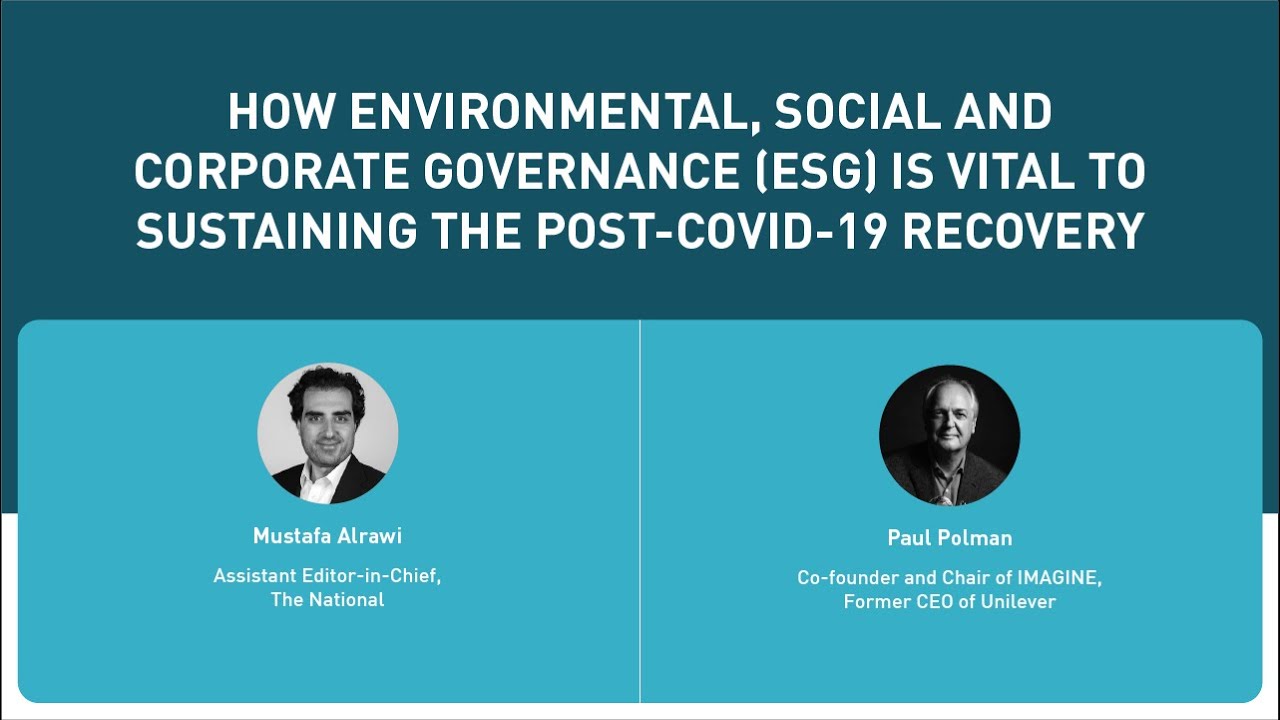
Paul Polman, former Unilever CEO and co-founder of IMAGINE, argues that ESG is a long-term business model that drives profit and risk mitigation. Unilever achieved 300% total shareholder return over a decade while decoupling growth from environmental impact. He says the next 2-5 years are decisive for climate action and capital alignment with sustainability.
Chapters
Welcome to the first Abu Dhabi Sustainability Week web series. Of course, we're all adjusting to the new ways of working and connecting online virtually, but it's important that we continue to discuss the challenges that the world continues to face when it comes to sustainability and climate change. ADSW is committed to doing just that. I'm very pleased to be able to launch this series. My name is Mustafa Al-Rawi, and I'm the assistant editor-in-chief of the National newspaper in Abu Dhabi. I'm going to moderate this session with, of course, Paul Polman. He's the co-founder and chair of Imagine, a social venture which mobilizes business leaders around tackling climate change and global— and has also been for a decade the CEO of Unilever between 2009 and 2019. That venerable publication, the FT, called him a standout CEO of the past decade. Paul and I will be discussing the importance of environmental, social governance factors in the post-COVID-19 recovery. Paul, welcome.
Well, thank you for the opportunity, Mustafa. Look forward to it.
So we're going to discuss in depth some of the issues we're facing now, but maybe we take a step back. I know we have a a very sort of learned audience, but maybe for those who perhaps don't know exactly what environment, social governance factors really are, how they've become more important, and why they're more important than ever now. From your point of view, can you kind of give us some color on that?
Well, ESG stands indeed for environmental, social, and governance, and it actually means running your businesses more over a longer-term focus, taking the multiple stakeholders into account. Still too many businesses are myopically focused on the shareholder alone, trying to maximize shareholder return, but by doing so and focusing on the maximizing of the shareholder return, it actually often comes at the expense of the other stakeholders. The other stakeholders could be your employees, could be your partners in your value chain, it could even be the planet if you want to. And as a result of this myopic focus on the shareholder alone, we have seen businesses not really fully investing in their long-term viability. So what ESG is trying to do is trying to draw attention to the enormous risks by not investing in environmental and social issues but also drawing out the enormous opportunities if you do. It is actually moving from rapidly from seeing it as a risk avoidance element to a positive opportunity element. Companies that are investing in their employees or in human rights in the value chain or tackling corruption, which would be the S from ESG, tend to be more profitable. Companies that start to think about the environmental challenges that they have to deal with, like climate change or biodiversity destruction, and try to address that with their business model tend to be more profitable. So increasingly we're starting to see that companies that run their businesses by taking their total footprint into account, by looking at all their stakeholders, and trying to optimize that are companies that are better positioned for the future.
About 5 years ago, all anyone was talking about was corporate social responsibility. Is it the same thing?
No, corporate social responsibility is actually not the same thing. Corporate social responsibility usually is a company keeping their current business model but trying to do something good on the side. Usually it's limited to their own operations only because they feel it's under their control. It doesn't take often the responsibilities you have towards your total value chain into account, and ESG is often seen as a side or separate activity but doesn't touch the core of the company. What we're talking about here by moving from CSR to the ESG model is that we start to integrate it as a total business model in everything we do, that we start to take responsibility of our global impact that we have as a business, not just on the things that are under our control. Too many companies still feel that they can outsource their value chain and by doing so also outsource their responsibilities. That doesn't, that doesn't work anymore. If you're in the food business, You're responsible for the deforestation that might happen as, as you get your supplies. You are responsible for the living standards of the smallholder farmers that grow your crops. You're also responsible to a great extent to the issues of obesity on the other side. So ESG tries to assess all these factors, internalize that into your business, and as a result make your businesses more resilient, but also more profitable in the end because you'll be able to address these issues, avoid the risks, find the opportunities to save costs, etc.
So these themes that you're talking about, whether resilience or the planet, these have been discussed and you talk about the business's impact. been discussed even on a global level. For example, the World Economic Forum that's talked about stakeholder capitalism, or even now they're talking about the Great Reset in the wake of COVID a different way of running economies, running businesses, a different way of thinking. And it kind of is the evolution following decades of globalization. Of course, when you ran Unilever, you would have been at the nexus of a lot of that globalization, of global supply chains, of of different markets, of how things work. Are you seeing this as sort of we're becoming more socially conscious, we're understanding about some of the benefits that are out there if you are a business by being more holistic, by seeing these things in more dimensions?
Well, at the end of the day, Mustafa, it's about survival. What we have seen, especially now with COVID but already before that, we've seen the enormous costs of not being in balance with, for example, the planet. Climate change is an increasing cost that businesses have to bear, the destruction of biodiversity. With COVID we have seen the social aspects of the too many people without the social safety net around them, and these are enormous costs for society. They were not apparent perhaps 10 or 15 years ago, but because of our economic growth model and having lifted so many people out of poverty, we increasingly are starting to see these limits of our planetary boundaries and they affect our business directly or indirectly. Business depends on nature for many of its activities. In fact, nature provides about $125 trillion of services, but we don't pay for it, we don't value it, we destroy nature, these costs are coming back in the business. Climate change is now well recognized as one of the most burning issues of our times and unfortunately not addressed with the speed that is needed, is affecting once more every business. What COVID has shown is also increasingly so the social aspect of it. I think COVID has shown that we cannot have healthy people on an unhealthy planet. For the— as a first step, the reason we have COVID is in fact the encroachment on biodiversity and the mixing of our wildlife increasingly with our human lives. That's why you see these pandemics like SARS or Ebola or Zika, or now a particularly nasty one, COVID. But COVID has also shown that we cannot have healthy people on an unhealthy planet. The relationship between this biodiversity destruction climate change, human health, now also the racial dimension is increasingly more apparent. It is also clear that our economic system has created gross inequalities. Increasingly we're living in a world where few seem to benefit but more and more seem to lose out. The few living on islands of prosperity in increasingly these seas of poverty. We've seen that COVID disproportionately affects minorities, people of lower social class, women. It has now a racial dimension where the death rates are 2 or 3 times higher in many places in the world. So it has brought out more than ever the shortcomings of our economic system and what ESG tries to do or stakeholder capitalism or the Great Reset is to try to use this opportunity not to fall back in the same in 5 years or 6, 7 years and spend again enormous amounts of money and human tragedy, may I say, but to start to design these global economies to be more equitable but also be more sustainable. A good example of that is the enormous need that we have for job creation to solve the issues of inequality. COVID has probably destroyed, according to the ILO, the International Labour Organization, the equivalent of about 500 million jobs. It has pushed 70 million people back into poverty. Inequality is again further on the rise as a result of COVID So that's not a good thing. And most of that is affecting the young people, and the people already in vulnerable jobs. So one of the main things that we need to do if we want to make this world function and keep this social cohesion, which is very important for businesses, is job creation. And we need to create more jobs, better jobs, more resilient jobs. And it happens to be that greening our economy and starting to design it for the future, not the past, is actually also the best job creator. Greening cities, moving to green energy, moving to out of the combustion engine to electric vehicles, retrofitting buildings, investing in restoring our natural capital, investing in education and R&D to help us with that. These are huge opportunities for business that actually create a world that is more resilient you lower your risk, you create your opportunities, and actually it gives us the job— the jobs that we need. The World Economic Forum has calculated that just restoring our biodiversity, of which we obviously depend for clean air, for clean water, for the multiple resources that are in nearly every business model, just to restore our biodiversity is an opportunity that could potentially create 380 million jobs. It would also change the cost of society from an enormous cost that we are incurring currently in the trillions. Just COVID alone was a cost of $12 trillion. We haven't sorted this tragedy yet. We could turn that around by being smart and making it a positive contribution to society. For example, nature-based solutions could be over 20% of attacking the issues of climate change, or I would argue that we will not be able to fully attack climate change if we don't start urgently to invest in nature, for example. And increasingly, there are businesses that understand that. We've seen major announcements around restoring biodiversity from companies like Unilever, or Microsoft or Walmart. We've seen global companies getting together to try to change our food system and make that more sustainable. We've seen companies making commitments to go to green energy well before 2050, which is obviously a deadline for most of us. So the thing is moving, and the good thing is we're also seeing the financial market catching on. The environmental, social, and governance criteria that you refer to are now the fastest growing investment vehicles that we see. The last quarter alone, it attracted despite COVID $70 billion of new capital. And interestingly, if we look at the ESG funds, we also see that their performance increasingly is outperforming the non-ESG funds. And that should not be a surprise. Because they represent companies that probably take care, better care of their employees, so less stress, less mental health crises during this COVID period. They are companies that more likely are more diverse, they've taken in gender diversity, probably racial starting now, so they can attract the better talent. They're also companies probably that have taken more care of their value chain, So when we see all these pressures, they have better relationships with their suppliers or their customers, and most likely they are companies that increasingly can also attract at a lower cost of capital. That's why it's not surprising that we see that companies that are operated under ESG criteria are continuing to outperform the companies that decide not to, and these companies that decide not to are increasingly under pressure and more likely to disappear. Nothing more transparent of that than in the energy sector. There are 2 industries that probably have denied a little bit what is happening in today's world. One is the fossil fuel industry, the other one is the car industry. You take the last few years and the fossil industry has now seen their market cap go down by over half. Whilst the green energy industry, companies like Iberdrola or Enel or many others now, Ørsted, have seen their market prices go up by the same amount. A clear bifurcation. You see companies like Shell or BP or major oil companies having significant write-offs and significant layoffs of their workforce because many of their investments they have made will be stranded because the transition to green energy is now accelerating. The other industry that for a long time has denied this is the car industry that frankly has tried to slow down the energy transformation. Now you see these disruptors like Tesla having a market cap that is bigger than all the other companies combined in the United States and and abroad, which tells you that the financial market is directing its capital to these more responsible companies that are better positioned for the future.
I mean, you're quite right in terms of the growing interest in the financial sectors. Exchange-traded funds have seen double the inflows into ESG-related vehicles compared to last year, but it's tens of billions rather than trillions. You've seen, for example, BlackRock's Larry Fink writing a letter at the start of this year to investors saying that, you know, we're going to be different, we're going to change. And there's certainly a shift in values. And of course, the younger generation, we see on social media, there is a real feeling about climate change, about all the topics that you mentioned that is important to them, and they don't want to be involved with whether employers or companies they invest in that don't share their values. But I mean, I guess your 2 perspectives are, when did this start to shift? When did you see it start to shift? But also, where are we in the cycle? Is this still tiny? Is it a lot of PR? Or is it genuinely— are we seeing genuine tide turning?
Well, I would say, Mustafa, to be honest, that we are seeing the tide turning. We are seeing momentum picking up. And I'll tell you in a minute why, but I also have to say that the speed and scale of which we are changing is not enough and that we also deal in many parts of society with a say-do gap. The first thing is governments are moving despite some governments trying to hold it back and continue to live in the old world or protecting their own self-interest. We now see China, for example, having made a commitment to be net zero by 2060, which is a— you're talking about the biggest global carbon emitter. We see the Europeans coming in with the European Green Deal. We see countries even as far as New Zealand starting to put into law the need to disclose your carbon risks. We see carbon pricing and carbon markets developing now in about 25% of the global emission in about 40 countries or jurisdictions around the world. So things are moving, and likewise in the private sector, we see many more companies coming together with these broader coalitions and implementing plans. The first one's obviously around climate change, where we now have about 25% of the global economy making commitments on climate change. We're very close, I believe, in 2025 or 2030 to see many of the cities in this world obsolete the combustion engine. And many car companies have already said that after 2030, they will only produce electric vehicles. We see the high emission categories in every category, be it aluminum, be it steel, be it shipping, be it airlines. We now see coalitions being formed that are setting net-zero commitments by 2050. So things are moving, and things are moving because, as you rightfully said, consumers are asking for it, markets are shifting, governments are putting policies in place, and responsible business that has anticipated this probably over the last 4 or 5 years since the Paris Agreement are starting to accelerate. Now, the reality is that we don't have enough governments that are moving, and frankly, you cannot get all of the business community to move if we don't ultimately have the right measurement systems in place, accountability systems, and to some extent, the right frameworks. For example, governments still have about $400 billion of perverse fossil fuel subsidies. Biodiversity spending in governments is about $70 billion, but there is about $500 billion in negative laws, rules, or regulations that actually destroy the biodiversity. So one of the first requirements that we need to change the world at scale and speed is to get the governments to be more responsible towards the Paris Agreement. We're far away from the 1.5 degrees and projecting still to 3 degrees today, around biodiversity, but also around some other elements of the Sustainable Development Agenda. The second thing we need to do is to change our measuring system. As long as we simply only look at financial return as the measure of success, we will continue to see many companies optimizing that financial return. I don't think it's a long-term strategy, but you can get away with it over the short term pretty well. But if we also start to broaden our accounting system to measure environmental and social accounting, for example, a price on carbon, a disclosure on pay ratios or gender equality in companies, on human rights standards in your value chain, if we start to measure these things, which we are increasingly able to, then we are also able to change behavior at scale. So these are some of the requirements that are needed, and people are working on it, and I think in the next 4 or 5 years you'll see an acceleration in both of these areas.
I mean, we need that acceleration, of course. The 2015 Paris Climate Deal was a watershed, it was a real achievement, but also to meet that target but also the Sustainable Development Goals from the UN, to meet those targets as well, we really need to see in the next decade that real coalescence of effort and energy to make that happen. A lot of this is aimed at governments, a lot of this is aimed at multinationals, but if I can talk a little bit about small and medium enterprises, because they are in many countries the biggest employers. They provide, you know, the biggest job opportunities, whether it's in the Middle East and North Africa or elsewhere. And do they— do you feel, you know, what are you hearing in terms of the SMEs, in terms of their feeling of being part of this? You know, do they have realities that mean that they can't embrace this as quickly?
No, your question is very pertinent because the SMEs, the small and medium-sized enterprises, are the backbone of the global economy. In many countries, they're actually 90 to 95% of the GDP, and the combined employment is about 2 billion people. And we have about 48 million companies that belong to the International Chambers of Commerce, and the bulk of them are SMEs. Because of COVID about 20 to 30% of the SMEs are under severe pressure and risk disappearing. That is why one of the things we're calling for with the upcoming G20 in the 3rd week of November with many of the multilateral finance institutions is that we need to support still at least to the tune of about $5 trillion the SMEs to ensure that they have a lifeline as a first priority to come out of this. Having said that, the SMEs have an advantage, which is that they are incredibly agile and they can react very fast. And where we see most of the innovations coming into greening this global economy, into moving towards solving many of the issues as laid down in the Sustainable Development Goals, we see the SMEs being very agile. First and foremost, they're in value chains of other small and big companies, and they're clearly getting the message. Secondly, many of the SMEs are very closely connected to the marketplace, sometimes much closer than these bigger companies, and can react very fast. And thirdly, with digitization and technology development, which has become more accessible to the SMEs, they can also make these conversions to this greener economy at a more cost advantageous way than what was possible before. You might not be able to solve all of the problems overnight, but you can certainly get going at an accelerated rate now and make your businesses more robust in doing so. The International Chamber of Commerce has put some programs together One of them is called Save Our SMEs, but also the SME Hub for Climate Action, and the same for the UN Global Compact, which has 14,000 small companies connected to that. They have put tools out on how to make the Sustainable Development Goals everybody's business, for example. So what the SMEs could do if you struggle on how to get going or how to go about it, or if you still live in this world that you think it's all going to be complex and you don't have the resources or that it's going to be too costly, try to connect yourself with some of these broader efforts that can help you educate yourself and undoubtedly find the solutions. The reality is more and more SMEs are moving and the ones that are moving in that right direction are benefiting. A good example of that is the food market once more where most of the growth of food is in areas like meatless or vegetarian or bio or neighborhood. And these are not actually the bigger companies in food which have struggled to grow, but these are all the new SMEs or the startups that have read the signals from the market better and have reacted faster to them.
And you raised the point about technology, and there have been a couple of clichés that have been repeated in this pandemic. The first is live in unprecedented times, everything is unprecedented. Secondly, that the pandemic is accelerating trends that were there beforehand. And in particular, as you mentioned about technology, access to technology, but are we— as we look in the next 10 years, where do you see sort of that acceleration of technological applications, of access to technology, helping specifically with ESG and how we make that even more critical to how we live our daily business lives?
So on the one hand, we've definitely seen, and as many people have alluded to, as you rightfully say, we've probably done over the last 6 months what was a trend that was there but might have taken us 5 years. And digitization of society has helped us in many areas. We can accelerate financial inclusion with digitization. We can make learning available to more people, we can reconfigure healthcare which is in clear need of repair, but we can also bring the data to our decision-making. We're now able to monitor with satellites the deforestation that is happening in places like Brazil or in Southeast Asia, we can marry that on the square meter with the concessions that were taken, we can move to precision agriculture, where by simply using the many data points, we can actually limit the use of pesticides or fertilizers and move to precision agriculture that gives us significantly higher yield with lower input. We can apply the technology to tackling karma chains, not an excuse for lowering our emissions, by the way, But we now need to do both. We need to, for example, do carbon capture at the same time as we reduce our emissions. We still need to make hydrogen economically viable, which is by all means possible if we collectively would put some effort and energy behind that. So technology plays a part. And then last but not least, with consumers. We've often seen the dark side of technology and what that does to the innovation in many of the people's lives that many feel uncomfortable with, and that is rightfully so, a debate that needs to be solved from the privacy side. But on the other hand, it is also an enormous force to drive consumer habits change, and we've seen many of the sustainable habits actually originating in the more advanced consumer groups, the early adopters if you want, that are often also very digitally savvy, get to the information, see the transparency, make the right choices. And last but not least, technology has become a great tool for advocacy, for making people aware of how it could be, for sharing solutions. The young have embraced that, and that's why I think you also see why it's so important that we embrace the younger generation, as we start to develop these greener futures that we aspire to.
So the idea of values, of thinking more about how our businesses affect people, places, and really our role in society in general, and that we follow the frameworks and the principles that we know are are good practice. You know, what aspects of that in the Middle East region, for example, do you think can CFOs, CEOs, those who own businesses can immediately learn from perhaps the missteps in other regions? And they can maybe plot a faster course because we are a little bit behind the curve perhaps. in picking up some of this ESG?
Yeah, I would not deny that you are perhaps a little bit behind the curve, but I wouldn't mourn about that. It's also a big opportunity, and then you can get more benefit from that. We have seen with plans like the Green Agenda 2050-2030 or the principles of sustainable finance or sustainable sourcing that are being developed in this region, We've seen increased investments flowing in, in renewable energy. Just the Masdar itself has invested $4.5 billion in renewable energy projects over the last 10, 12 years. So we see the region moving, but as you rightfully point out, not at the speed and scale needed. And part of that is that they have been overdependent on an economic system that is unfortunately rapidly being obsoleted. Part of it is because the business community there has been more insular from the global world than the rest. But if you want to attract financing over time, if you want to be viable with your products in a global market, you have to adapt, and you have to adapt at the speed of the best. Being second or third fiddler doesn't cut it anymore. So if we want to diversify these economies away from fossil fuel, just to be direct, and create other industries, we also need to be sure that these industries are very competitive, and that can only happen if they fully embody ESG. We're seeing, for example, deforestation go up in Brazil because the government is not enforcing things like the forest code, but as a result, we see major supply chains being challenged. The Europeans can simply not afford anymore to import products that are linked to deforestation because consumers will not buy them anymore, and that is for— that is true for the paper and the pulp and the feedstock, but it's also true for the meat and many other materials. So it seriously will affect the competitive activity of a country. We have the debates on palm oil that you have seen. Which countries like Malaysia or Indonesia are very reliant on. The reason Indonesia is moving so quickly to enforcing higher environmental standards and enforcing these moratoriums is because their economies would otherwise now significantly be negatively affected. So we are starting to see the rest of the world move at an accelerated pace, and it is key that also the Middle East actually leapfrogs, in my opinion. And you have an opportunity to do that because in many of these areas, you don't have a vested infrastructure to deal with. You can design it right, and it has to be done across all of the criteria of ESG: environmental, that we've talked enough about, social, but also governance. If companies are not run on the highest level of governance, then most likely it will not attract the financial flows either. And we've seen in many companies in the world over the last few years a great lack of governance in many areas that have put many of our investors at risk and destroyed a lot of capital that could have been employed better. There's one interesting other element to show you. That for the first time in the US shareholder meeting season, 66% of the shareholder proposals had to do with ESG, and this is the US. If it would be my native, the Netherlands, that number has always been significantly higher, but now in the US, 90% of people don't want to go back to where they came from. They want companies to take another broader responsibility and drive towards a different form of capitalism that works for all. And interestingly, companies that do are significantly outperforming again the companies that don't. So we see this movement happening. It is very important that in the Middle East you familiarize yourselves with some of these trends, with the technologies that are available, but above all with the enormous opportunities that are there. And I think companies that understand that once more and embrace these opportunities will do very well.
I mean, I don't want to put you on the spot in terms of a prediction, but given all you've just said, and for example attitudes in US shareholders, has the pandemic, do you think, pushed us into an era that we won't go back, even if there's a vaccine, you know, middle of next year and we kind of try and get back to normal life? Do you feel that these accelerants mean that there isn't a path back?
Well, you don't put me on the spot at all, don't worry about that. In the financial crisis in 2007-2008, we missed a huge opportunity. A lot of money was spent to keep the banks afloat, but people felt that banks were too big to fail and people were too small to matter. Only 2.5% of the spending at that time went to greening the economies. Some countries that did, like South Korea and some other smaller countries, actually are so much more the better for it right now. But we missed a huge opportunity. Climate change went up further, income inequality went up further, it got expressed in the polls, it gave us Brexit, it gave us the US election results, it gave us global instability. And it gave us COVID in the end with a cost that is significantly higher now than what we would have had to spend to prevent many of these issues in the first place. I would argue now that the cost of acting is significantly lower than the cost of not acting. Simply to go back to where we came from, which the majority of people don't want, is not an option because when we— where we came from, wasn't working and wasn't working either, and the costs were increasingly transparent to society. As I talk here, there are millions of people that are exposed to climate risk and are becoming refugees. We estimate at the current trend that could be up to 1 billion people. There are people drowning because of floods. There are fires as far away as Australia or the United States that we have never seen before. There is really something happening. Modern nature is sending us the invoices, and increasingly so. And it's not a battle between nature and humanity, because nature is going to win. It is a matter for us on starting to realize that we have to live in harmony with humanity if we want to put our own existence not at risk. There are currently a million species and plants that are at the point of disappearance, 10 to 100 times higher than what we've seen historically. We've lost 68% of our global species, nearly 80% of our freshwater species. How long do we need to go on before that is our turn? And increasingly, it prevents us from doing business ourselves. There is no business case in enduring poverty, and we see that all across the world. nor do I believe business can be a bystander in a system that gives us life in the first place. We have spent about $10 to $12 trillion during COVID already just to save lives and just to provide safety nets, protect livelihoods if you want to, around some people. We haven't even started spending on recovering and recovering right, and the biggest risk that I see right now is that many governments say we've run out of money, we had to spend all of this, we have to pull back now, and that would be a tragedy if we cannot accompany that with changing our frameworks, our incentives, our directions that we give to the private sector to ensure that now capital flows into the greener directions. There is an indication, as we talked, that it's starting to happen, But we absolutely need governments now to make that happen at the scale and speed. And unfortunately, we're at a very, very low point in global governance where even issues like COVID cannot be coordinated, lots of money being wasted, where issues like climate change have been politicized to the extent that millions and millions of people suffer. So private sector has a role to play, to speak up, to advocate, to drive these changes, but also to help de-risk the political process. And the speed with which we move and the progress that we make, especially over the coming 2 or 3 to 5 years, will indeed be influenced by the outcome of the US elections for a great deal, because that will be a decider how quickly global governance comes together, how quickly we have aligned policies across the world, and how we bring back responsible government to put the right frameworks and legislation in place.
We have some time for some questions from the audience. Abu Dhabi would like to know, given your experience as a CEO, What can workplaces do to be more inclusive for people of determination, people with disabilities?
Well, there are about 1.3 billion people with disabilities in this world, and 80% of the disabilities are acquired between the ages of 24 and 65. I'm heavily involved myself because my wife and I run a foundation for the blind people, and we have 24,000 blind children in school in East Africa. And in most countries, these people with disabilities are excluded from the economic process or get the worst end of the stick. With COVID again, these people were disproportionately affected, and the reasons they're excluded— it's about 15% of the world population, but most companies probably have only 1 or 2% at best in their own workforce. It's a gross inequality, and most of that is really a mindset. It is this preconceived notion that if you have a disability, you cannot function as well as people that don't, that you have less loyalty, more sickness, higher costs, less productivity. And all these myths are busted if you look at the facts. And I would argue that CEOs that understand that, that create this inclusive society will also have a more engaged workforce because the best companies in the world are the companies where each and everyone feels that they can develop themselves to the fullest potential. How would you like to be a woman to work in a company where you know you don't have any chance to get to senior management? Where frankly the senior management, usually all white males, have a gross disregard for gender? How would you want to be in a company where you are of a racial minority but where it's made clear day after day that you sort of don't count in this society? How would you like to be in that position if you're a person with disability? So whatever group you belong to, it is very important that companies create this environment of total inclusion, which also means in the value chain. How many businesses in the United States would buy from minority Black-owned businesses? How many people would actively promote the Black community into senior management? How much money is spent behind training and development to perhaps overcome some of the historical deficits. So how companies behave, how CEOs take ownership is going to be a very important part because ultimately the most important stakeholder that you have are the people who make your company function.
And we have a question from Fadi, also in Abu Dhabi. He would like to know, in your role at Unilever, what was the impact of ESG on the bottom line?
Well, when I started 12 years ago and said we are going to decouple our growth from environmental impact, which we have broadly done, and increase the overall social impact, which we have done, we got rewarded enormously. First of all, we made it very clear that this was a long-term plan. We stopped quarterly reporting, we moved compensation to the longer term, and we stopped giving guidance. But we were able to show year after year that we were outgrowing our competitors and that our total shareholder return over the 10 years was nearly 300%, well above the market and well above our competitors in our sector. So our point that focusing on the stakeholders that we need to serve, try to move your business to a positive model is ultimately also good for the shareholders, but it is a result of what you do. It should not be an objective. It is profit through purpose, not first profit. And I think Unilever has shown that over these 10 years. We reached 1.3 billion people improving their health and well-being. Things like oral care, things like hand washing and hygiene, things like women's self-esteem, building toilets, uh, most of our brands had a social mission, and the brands that had a stronger social mission were actually growing better. So we saw our innovations were more robust, having to respond to these challenges out there. Our employees were more engaged, our costs were lower, our reputation was up. So we became the number one employer brand in most countries that we operated. And all of that added up to giving these results. In fact, when business had a relatively low level of trust globally over the last 10, 12 years, a little bit higher than governments, but still a low level of trust, Unilever, on the other hand, was off the charts. It allowed us to form partnerships, to attract companies to us that we could be associated with to grow our company. And we ended up building our business from about $38 billion over that period of time to well into the $50 billion and more than tripling our market cap. So it does pay off if you do it right, if you do it smartly, if you take a little bit of time. And frankly, in those years, I have not really had to make one big compromise that made me stay up at night and not fall asleep, so to speak. So I think that is what we're trying to say most companies, if not all companies, should do. And by doing so, we create this better world for all, but also the opportunity for all of us to continue to be successful.
Paul Polman, thank you so much for your time and your insights. A big thank you to our audience for attending. We look forward to have you with our other web series that will be coming up. We'll have details of those. And a reminder also that Abu Dhabi Sustainability Week 2021 Thank
you, and John, thank you very much. Thank you.
More from Paul




Paul Polman on Purpose, Profit, and the Future of Capitalism | Enduring Excellence



Scottish Leadership Institute Net Positive with Paul Polman and Andrew Winston

