Mo in conversation with... Paul Polman
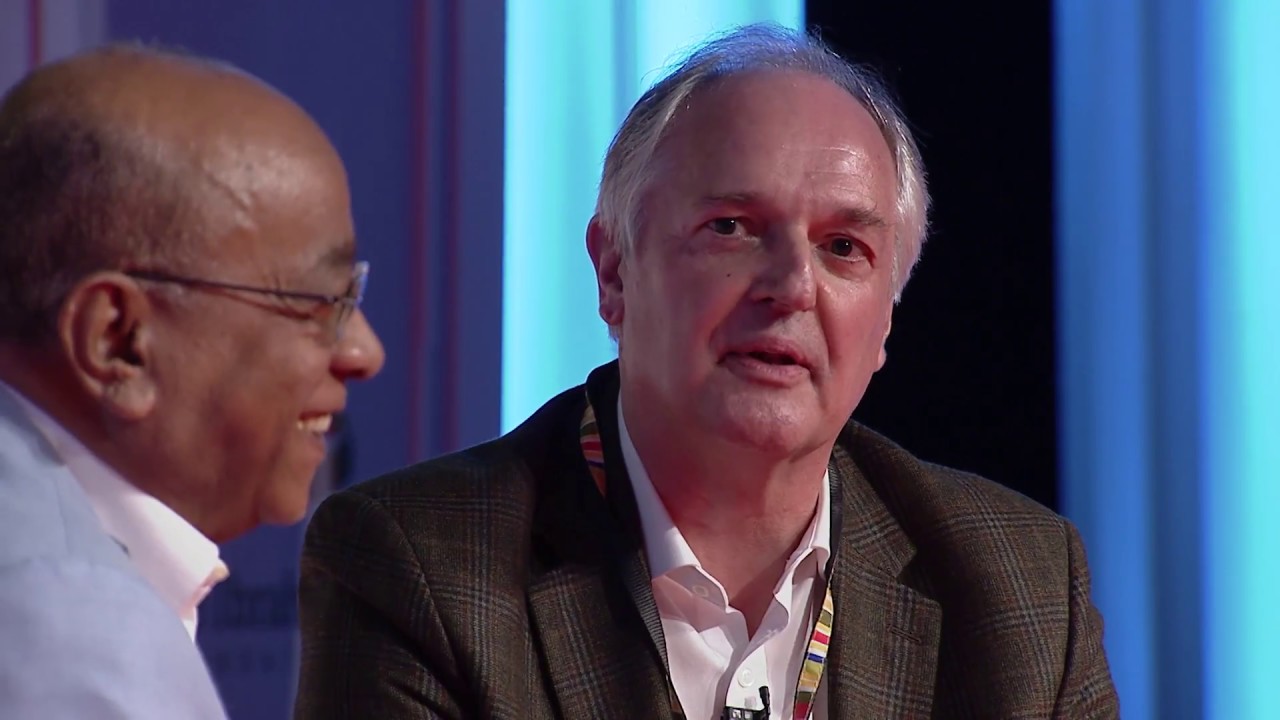
In this extended interview moderated by Mo Ibrahim, Unilever CEO Paul Polman recounts the company’s origins under Lord Lever, emphasizing the founder’s “shared prosperity” ethos of improving public health through hygiene. Polman frames Unilever as a non‑governmental organization whose purpose is to generate net positive social and environmental impact, arguing that short‑term shareholder pressure undermines long‑term value creation. He describes how Unilever embeds Sustainable Development Goals into its brands – from hand‑washing campaigns that reduce child mortality to zero‑waste factories and renewable‑energy power – and how these initiatives also drive profitability. The conversation turns to a $130 billion takeover bid, the challenges of defending a purpose‑driven firm against financial‑market pressures, and the need to reshape board incentives toward long‑term stewardship. Polman outlines an evolution of corporate social responsibility from compliance to philanthropy, cause‑related marketing, and finally “Level 5” leadership that reshapes systems, tackles deforestation, creates millions of jobs in Africa, and partners with governments and civil society. Audience members from Morocco and Ghana raise questions about consistent global standards and the future of CSR, which Polman answers by stressing universal standards, the importance of youth participation, and the necessity of expanding capitalism to include social and environmental capital. The interview showcases Polman’s vision of a re‑imagined economic system where business, governments, and civil society collaborate to achieve the SDGs.
Chapters
Before we start, let me introduce our next guest. And it's rather unusual in our conferences to have a businessman. Usually we have people involved in politics, in civil society activists, but there's a new breed of businessmen sort of appearing now who are also activists and very much linking civil society with business, with development goals, etc. And the best example around today really is Paul Polman, the Chief Executive of Unilever, and I would ask Paul to join me. I don't know where is he. Paul, oh, they are here. Please. Please. Unilever, of course, is one of the great companies which goes back many, many years. And if you look inside your kitchen, I think you'll find half the stuff there supplied by this man. He's part of our daily life, and he's trying now to be even more in our daily life. But what he's trying to do, so let us have a good chat. Paul here.
Appreciate it.
Welcome.
Thank you.
You're gonna use the mic or no?
I have a lapel mic. It seems to work.
Paul, first, yeah, Unilever. I mean, people. know their product, stuff like that. But your company is unique the way how it started. I don't think many people know about the roots of Unilever or the man who started Unilever. You want to say something about that?
In 2 minutes, and in fact, the whole idea of a different business model was probably what Lord Lever embodied with what he called shared prosperity. He used to talk about that a lot. When most of the businesses started, and many of them here, they really started to attack a problem in society. So for Lord Lever in the end of the 19th century was the problem of hygiene in the UK. It's moved to sub-Saharan Africa, but it very much was then under Victorian Britain that 1 out of 2 babies wouldn't make it either past year 1. And we forget about that. So So the poor man, he had a grocery store, his father did, 7 sisters that he had to look after. He figured out that his father was paying the salesman more than the accountant, so he became a salesman and started selling soap. People liked that. And his first soap was Sunlight Soap and then Lifebuoy. And interestingly, he called it Lifebuoy because it literally threw a lifebuoy to these people. And unlike many other philanthropists, if you want to, or high net worth individuals, Lord Lever always was hovering on the border of bankruptcy because he always believed to spend it first behind his ideas before he earned it. So he built a Port Sunlight for his workers before the factories were running. He had the plantations in Africa, palm oil, which I hate to say were probably in better state then than many of them are now. And he's the one who introduced in the UK the pensions when he became a lord in Parliament. he took his wife's name, which was quite unusual then, and that's why he became Lord Leverhulme. So this man was probably ahead of his time in many things. My last anecdote about him was the First World War when the people had to volunteer, and most of the volunteers actually came from our company. He was the first one who guaranteed 6-day work week, but he also guaranteed jobs for the women, jobs for the men when they would come back. And that's why probably a lot of them at that time fought for the country. So a different philosophy of doing business was very much his way. You know Lancaster House in the UK? Yeah. That's actually— wasn't— it was called Stafford House until he bought it. The Queen was running out of money, I think. He remodeled it for a year and he gave it back to the Queen under one condition: change it to Lancaster House because he was a Lancastrian. That's probably the only thing he did for himself.
His region anyway.
Exactly.
I mean, this is an amazing story about somebody started a great company and the way he dealt with his workers and with the people. And it's something which doesn't happen nowadays. It's a really unique example. How that affected the culture of your company?
Well, you said you're the only business person you ever invited and that's fine. I came here as a friend of yours, not as a businessman, but I've often said The— we are actually an NGO. I always make it very clear to people that we are a non-governmental organization and I actually feel good about that. So I also think that the purpose of business is not different than what Lord Lever started. It's to be sure that you're actually making a positive contribution to society. If you frankly cannot explain what you do as a business to make this a better world for all, you don't really have a reason for being here. And this myopic short-term focus that has crept in on the shareholder is really one of the fundamental issues that we need to address. The panel before here talked about democracy and all this, but underlying this lack of democracy that we see and the trend that we see is an economic system, frankly, that doesn't work for us anymore. And what makes it so difficult to be a politician, what makes it so difficult to be a leader nowadays is that we are really at the point where we have to change our economic system, our financial system, our consumption system, climate change being one of the biggest challenges that we have. All of that coming together, enormous transformations at a time that we're running out of global governance, that our technology is confusing us in many respects, and, and that makes it very difficult. So we've always taken the position that we need to be sure that all of our brands are there to solve some of these issues best captured in the Sustainable Development Goals and that we are a net positive influence on society. If we don't, then ultimately society will reject you. I think that's one of the reasons why you see the average length of a publicly traded company now has dropped from 67 years when I was born and unfortunately I'm 60 years old so I shouldn't be sitting here. But, It was— I'm also over 60 though. No, I know you are. And happy birthday still. And, but it has dropped to 17 years. By the way, on age, I always had a great admiration for Simon Peres. And I thought he was a man that bridged all generations just like Mandela did. And to cut people off at a certain age, you have to really think twice because you'd cut off those type of people which would be a shame for humanity. And Simon Peres, I think, mentioned it well when we were talking. He said, as long as your to-do list is longer than the things you talk about that you've done, you probably are a very young person. And I think that keeps us going.
That's interesting. But something in, you know, what you just talked about is really a little bit unusual. I must be frank with you. I don't think many of us I have never heard CEOs of major companies talk like this. Now, there is also a reality around you— shareholders, London Stock Exchange, Financial Times, takeover battles.
Sure.
You have been the subject of a major takeover attempt. How much was it for?
$130 billion.
$130 billion. Pounds or dollars?
No, dollars.
Dollars. How a company— it must have been easier when the company was Lord Levene's company where he controlled it to do what he likes with it. And it's wonderful what he's doing. But now you have diffused shareholders. Absolutely. Funds, institutions, retail, whatever. And how can you maintain this philosophy or element of that philosophy of a company which cares for the planet, for the environment, for the workers, for the customers, for the communities you work in? How can you maintain that when there is some people over there who believe they own the company and say, no, no, no, Paul, I wanted to extract the last dollar out of those schmucks buying our stuff. How do you navigate that?
No, and it's not easy and it is very clear that we have created a little bit of a monster that we need to get out of and the real thing that we don't probably want to discuss in depth is this global economy has about $300 trillion in assets for an economy that's only $100 trillion in assets. So we talk here about Africa and development of Africa. There's no shortage of money in this world. There's shortage of ideas perhaps of people putting that money to good use. And as a result, you see that in many places in the world there are zero interest rates or negative interest rates. So increasingly you have a bigger amount of money, especially since this financial crisis, starting to chase short-term returns. And then the reality as a result of that is that the financial market is very short-term oriented and frankly becoming more short-term oriented. There are— the bulk of the boardrooms that you now talk to, your colleagues, board members, will have quarterly board meetings or whenever they have them talking about how you can keep the barbarians out, how you make the quarterly estimate. And it's very clear to us that you cannot solve the issues of poverty or climate change or food security if you run your business on a quarterly basis. When I became CEO, I stopped quarterly reporting. wasn't appreciated by everybody in the financial market. And I also stopped giving guidance because we really have to go back to this real economy versus this foo-foo economy. But it is increasingly clear, I think, to more and more people that running your business responsibly, sustainably, it doesn't have to go into conflict with building shareholder value. In fact, I would argue that if you do this, tremendous opportunities. 800 million people that go to bed hungry, if you find solutions for them, That's a huge market. The market of green energy is becoming a huge market. Companies that operate sustainably or want to be there for the long term need to be sure that the world is in a sustainable state long term. And you need to think about that then for your business models. And often, obviously, there will be trade-offs. No, no decision is easy, otherwise someone would have taken it for you already. But like you manage everything, you have to manage these trade-offs. We are able to invest in a factory that only pays out 5 or 10 years from now. We're able to invest in people that sometimes only pay out 20 years from now. We're able to invest in IT systems that pay out 5 years from now. Why shouldn't we invest in the future of humanity? So what we then need to balance is how much, when, and, and how to leverage it. But what we find in Unilever by putting all of our brands to the service of society, if you want to, it's actually a good business case. Our brands that are even further ahead on this journey on purpose are more profitable, actually grow faster, and it's not surprising. It actually cuts costs out of your system. Most of the— we've moved all of our factories to green energy. I've never had a decision to take for a payout of less than 3 years, which is very good. And once you've made the investment, your energy is basically free. So it makes good sense. We're running all of our factories on zero waste because Because I don't think that the word waste we should accept. And, you know, the planet is 4.5 billion years old and we've done more damage to this in the last 200 years than in the previous 4.5 billion years. So why not design things in a way that makes sense? If you don't have waste, your costs go down. We find that our reputation is up. We get about 2 million people applying to us every year. In most countries we operate, we're the most desired employer so we can get the best people. Your risks is going down. Anytime you open a Financial Times, there's again a company caught with their pants down, so to speak. So if you add it all up and you believe in, in the future of humanity, then you have to run your business like that. And it's up to us then, people that run these businesses, to manage it in the and way, not in the or way, and satisfy the shorter term as much as you can and run it for the longer term. and be able to be sustainable and be able to be profitable. So real leaders manage the and, not the or. And it's not easy and it's not becoming easier, but then, you know, that's why we're here.
But really, something unique here is that instead of getting on your soapbox and preaching people and telling, you are leading by example. Here what I do. Green economy, waste, look after my supply chains, no slavery, human rights of my workers. I look after them. I look after— are you able, you find it, to demonstrate this to other business colleagues? Like, guys, here what we're doing, that's how we do it. And your company is effectively a laboratory. You guys are trying different models of doing business in a different way. And how much success are you getting in convincing other business people to follow that model?
Yeah. So it was actually Stephen Covey who wrote this book, 7 Habits, and in that book he said, you cannot talk yourself out of things you've behaved yourself into. So if we want to build trust, and we cannot do that with words, we have to do that with deeds. And we should be judged on what we do, not on what we say. And that's very much the spirit that I think more and more companies are starting to operate under. What you see is actually that on many of the areas, because technology is developing, cost of our not acting is starting to increase. Climate change would be a good example where we're at the point, in my opinion, that the cost of not acting is higher than the cost of acting. And that's a great moment to drive a tipping point. You see the financial market getting more interested in it. You see more and more companies joining, people calling for a price on carbon. I would argue that the good agreement we had in the COP21 in Paris, which bent the curve that was on 4 degrees to about 2.7, not enough but certainly bending, was partly because so many business people were calling for it. Now you see the US where The current administration has some different opinions, and that's obviously a concern. But many companies are moving ahead because they see the economic case, the financial community asking for it. So increasingly we see this happening, but some things need to change. We, we need to start— if as long as we have a financial and economic system which we call capitalism, and it doesn't matter to me what you call it, but currently we're asking the capitalists to maximize the return on financial capital. And you have to give a lot of people good credit for doing this very well to the benefit of themselves more sometimes than to the benefit of society. But if we broaden that definition of capitalism and say, why don't we also include environmental and social capital, then I still believe that the capitalists will be very well placed to optimize that and create this balance again that we need to be looking for. The balance between short and long term, the balance between man and nature, the balance between few and many. And if we broaden our definitions and focus on expanding these boundaries, we will also drive behavior. You would not find any CEO in the world, I believe, that sits here or would be on the podium or even privately would tell you, Mo, I want more unemployment. I want more people to go to bed hungry. I want more youth unemployment. They just don't accept that. exist. You have to believe in the goodness of people, otherwise it doesn't make any sense to be here. So why are people acting this way? Why do you see politicians acting this way where you focus on? It's because the boundaries that are around them make them behave that way. If I tell all my salespeople, you get rewarded on the number of sales orders you write, they're going to write millions of sales orders of one case or one product or one bottle. But if I tell them I'm going to reward you on the relationship you have with your customers, they're going to behave quite differently. So as we can move these boundaries around, and often politicians, because we have unfortunately more politicians than statespeople. Statesmen think about future generations, politicians think about the next election. And unfortunately, if you only think about your next election, you, you treat the symptoms, not the underlying cause. If you run companies like this, and you think about 100 years out or 150 years out, just like Lord Lever did, you focus on these boundaries and see if you can move these boundaries. You and I are part of the B Team, which basically says there's a different way of doing business. There's a Plan B because the Plan A clearly isn't working. So with that Plan B, we're focusing on moving these boundaries, just like you do on transparency or corruption. Move these boundaries and people will start to behave differently. And the best tool you have, in my opinion, is transparency.
Sorry, I have just again to press you on this point because we have a lot of business people around here, either successful business people or entrepreneurs starting up, and we really want to learn a few things from you. You have your board, and in the— how we interact with your board? Most of the boards will look at the CEO and say, okay, this is the result last year. If you increase our shares by 10% or 15%, we are going to give you $10 million bonus or whatever. That is the deal between the board and— You go to this board and say, no guys, it's fine. I can increase it by 10%. But what I really think is that I need to look at the long term and I make sure that in 20 years I also increase it by 10%. So I need to have a healthy workforce. I need to have a good feel in the communities where I'm doing business. So I'm going to do these things now and I may end up with 8%, not 10%. But here is what other gains which is not quantifiable in dollars. How do board react to you? How do you manage this?
See, for us it is with brands. Our business, ultimately our business is people and brands. And we have many of our brands that fulfill basic needs all across the world. And what we say is these brands are there to fulfill a purpose. That purpose cannot just be profitability. If that purpose would be profitability, you won't have a life that is longer than these 17 years I just talked about. So why are we inventing Knorr? if you want to, or Royco. We invented that to give people the opportunity to get nutrition, to attack the issues of stunting. Sub-Saharan Africa, probably many of these economies, 10, 12% of the economy is suffering in terms of its lack of its getting to its full potential. If you fulfill these needs, then you, you will be having a successful business. Take our hand soap business. 4 million children die before the age of 5. Not your children, not my children. but the ones who didn't get the lottery ticket. By simply the act of handwashing, you can cut down the incidence of diarrhea and pneumonia by about 60-70%. So we are not in the business of selling soap to make money. We're in the business of helping a child reach the age of 5. And if we do that very well, we will make money for our shareholders. And it is us that need to balance this. We cannot do everything overnight. But for example, we've reached 400 million children of handwashing. very much in line with some of these Sustainable Development Goals. And not surprisingly, our toilet soap— our bar soap business is growing double-digit. We don't sell a toilet cleaner like Domestos to make a toilet clean. That's not a very happy discussion either. But we sell that to attack the issues of open defecation. So we say we're going to build 25 million toilets. In fact, the only organization that works in Geneva that we have created is the WTO, but it stands for the World Toilet Organization. That's great. And with this World Toilet Organization building 25 million toilets, not surprisingly, Domestos is growing. So we link these stronger purposes with these brands and then we manage the profits accordingly. It is difficult because I can pick— get paid more, be seen even as a better CEO by squeezing over the next 4 or 5 years more profits out of the company. We can all do that. I understand that. It's actually the easiest thing to do. But in this case, we're talking not about the easiest wrong, we're talking about the harder right. And that's why we have 2 minutes by communicating to the financial market, putting markers out of progress, telling people that on a long-term story you are better off. Anybody that has invested in Unilever, £1 in 1986 would have £68 now. £1 in the FTSE is only £17. So doing business well over the longer term, and by the way, most of the money that is invested is invested for pension plans that are long-term plans. So linking up long-term fund generation, if you want to, with long-term liabilities is the best thing. So that is why we have to focus on the financial market. Much, much of the financial market is incentivized on quarterly beating the market indexes, which leads to dysfunctional behavior. What you call shareholders are frankly not shareholders. They are agents or managers of money, but they're not the owners of the money. So we need to get active ownership involved. We need to work with boards, make boards much more aware of the fiduciary duties towards their multiple stakeholders, not only shareholders. We need to look at incentive systems of the CEOs, which are often linked to the shorter-term return. And if we don't change those boundaries, then we will not get there. Now, I'm not pessimistic about this because it's frankly too late to be a pessimist. So I'd rather work on these boundaries and move them outwards and forwards, and that's really what we do with the B Team as well.
I hope our business people in Africa are listening here, and that is a kind of example for the new business in this new environment, and I hope really we learn from that. I hope also the story of Unilever should be widely taught in the business schools. I don't know how many business cases or case studies were wrote about what you guys are doing. No, there are not. But it ought to be. I mean, I'm going to speak to the guys at London Business School and other people. We really need to look into that. I don't know if you are free to talk about this or not, but personally I was shocked when I looked at the papers last month and I saw this massive bid by Heinz and Kraft, and I was wondering what's happening there. I mean, if you heard about this, I don't know. This is a major— firm which is backed by Brazilian big fund and Warren Buffett, which acquired assets, merged them together in the food supply business, and their business model was based on cutting cost, cutting cost, deep cutting of cost and saving money. producing some quick results and getting some share price kick-up and they had a big bid here, $130 billion, and I said, wow, how your shareholders and your board is going to react to that. Are you free to tell us something about the dynamic of this battle?
No, sure, and it has been a busy time but I didn't want to disappoint you by not being here. I know. But I will leave tomorrow morning very early, but because the story has to be written on this still. But what is happening in this world is we— the world situation is more and more unsecure. Nobody knows when the atomic bomb goes off in North Korea or what the effects of the US election are and how that will ripple through over time. The world is not in a very stable state, and we talk Africa here, but I don't think Africa has anything to be ashamed of versus many other places in the world. And as a result of this, the financial market discounts future earnings too much now. What is— what we used to promise next year, the year after, and the year after, for many in the financial market is of less interest because of that uncertainty. The second reason is this money that is around and that is basically free has given an enormous opportunity for people to leverage this up 9, 10 times to invest in companies like this, squeeze out— if you can squeeze out 1% of Unilever in the quarter, you make 12% on the year. They don't care if the company exists or not. They've made another percent in a market where the interest rates are zero. And then you have a few high net worth individuals. In this case, it's purely private equity where 2 individuals, Warren Buffett and J.P. Lehman, have a combined wealth of $130 billion. You know, don't ask me how they got that money because if you earn that much, you cannot say you did all the right things for society. You might do it afterwards, but you first have to worry if you weren't part of the problem in the first place when you got that much money. And these people can put that— these people can put that together now and sort of do their own hobbyhorses. And it nearly becomes like fun to see if I have $80 billion now, can I get to $100 billion. And indeed they did the same with SABMiller, which was a fine company, or, uh, Brahma in Brazil. And they drove this beer market to commoditization, made a lot of money doing that, but the volumes are going down. One-third of the people are out. You don't see them in any movement to change things because that would be all time lost and pennies lost to be spent there. And in fact, they are destructive forces for society. So I tried to see the UK government and the Dutch government. The Dutch government more receptive, perhaps because that's my native language. The UK government more worried about Brexit. But you have to talk these things because it's a fundamental discussion also in these takeover laws about what type of world do we want to live in. So we staffed this off. The UK environment is not in your favor. They thought it was friendly, but Warren Buffett tried to make a misplaced joke about diplomats and women and that I don't think went down so well with people that live in the real world. And it's very clear that, you know, I'm not a diplomat. You can see that from this conversation, nor do I want to be. Though we were very clear that this company had totally different business models, different cultures, and that this wouldn't happen. I think what happened to Unilever is, is the benefit of what we are doing, a company that's owned by more than its shareholders. We are owned by our employees who are very proud to work there. We are owned by civil society that we work with. We are owned by, by the different stakeholders that we try to serve. And there was an enormous uprising that came fairly quickly. People like Bono that came and said, I will write a song, or YouGov will start to collect 100,000 signatures in the UK. The unions that came up and said, we don't want to go through this because of, you know, if this is the alternative, we might have with you the occasional battle when you have to close a plant and other things, but this is not what we want. And I think this groundswell was enormous and I think it might have helped us in this case get out of this. But as a result, I had to take some measures to balance a little bit more the short and the longer term that frankly I normally would not have taken. But on the positive side, it might have galvanized us in some quicker action that a big company like ours would not do. Once you have a gun against your head, you, you know, you take different decisions than if you don't. So we'll end up being in a better place for ourselves and turn this into an advantage. I always like to think about not what happened to you, but what you do with it. And we'll come out of this okay, I hope, and the future will only tell. But at the same time, it's, it's a real fundamental question about what economy you want. And the sad thing about all of this is not all this, because I can handle this as a— this is my 9th year as CEO. So if it happens in your first year, it's not so pretty. But if it happens in your 9th year, you become a little bit more reflective. And I think about all the people we try to serve and the bigger issues that are in the world so that I don't feel pity about myself. But, um, What we really have to have the fundamental discussion. And the sad part for me is all the papers say, if these guys come in now and offer you more money now, you must be doing something that's not right. You must, you understand. So you must be underserving us. And all of a sudden, these shareholders that were sort of long-term shareholders, you deprive me from getting more money now. More money now. And there were very few people, very few articles that really get to the essence of this is that what type of economy do we want? Yeah. Do we want to have this— do we want to live in a world that is for everybody? Do we really want to get to these Sustainable Development Goals of irreversibly eradicating poverty in a more sustainable way? And it boils down ultimately to the definition of sustainability. We all have the Brundtland definition of the future for your children, et cetera, but it actually boils down to a very simple thing. If it's— If the future of your children is more important than your personal greed, you should buy into our business model and that is what we're trying to prove to people.
What's the lesson of Cadbury? Did it play any role in the discussion there?
No, it was too short because we obviously were studying everything and fairly well prepared and looked at how these people handled and it was very clear to me under the UK takeover law where you only have 28 days, which is very short, and you have to drink from a fire hose. You get 1,000 lawyers around you, but you know the weakness of lawyers is they like to tell you all the things you can't do. Oh. And the people that attack you have been preparing this for months, and you have only 28 days, and then you have lawyers around you telling you all the things you can't do. It's not a very simple position to be in. So we came to the conclusion, or I certainly came to the conclusion, The quicker you can stop this, the better it is, to be honest. And we worked with quite a lot of people, got through to the right person, in this case Warren Buffett, who with age has one advantage, that he is more and more, the older he gets, more and more concerned about his reputation. And we made very clear to him that this would not be a good thing for that. And if I would have had more restrictions, I told my board, I said, if the UK takeover law and the lawyers put restrictions on me, to not be able to do what I believe in, I resign today. And some people were telling me, this is a great thing. You have been 9 years there. You're close to retirement. Your share price goes up. You can buy another sailboat or you can be happier in your retirement. And so I said, all that money is to me, as far as I'm concerned, blood money. I would fight that for the rest of my life, which I do anyway, to get rid of those phenomena. so that we can have an economic system that works for everybody. So I was ready to resign, to be honest, but fortunately they went away a little bit quicker than we anticipated. But you never know, you know, once barbarians are at the gate, then they keep knocking.
Well, I'm really sorry that you lost your sailboat, but you're welcome to come on my boat anytime. I'll use yours. Thank you. This is really a wonderful example and it's something I thought we need to listen to in our forum, what business can do and what it should do. And that, I think, is very illuminating. And I want to give you the opportunity to ask no more than 2 questions and I'm going to give reference to business people, if you don't mind, because I think the lessons here is for our business people who really need to move up our learning curve and see how we could really become part of society, and that's good for our business in the long term.
Said Mouline from Morocco. I'm in charge of the Moroccan Agency for Energy Efficiency. But I was involved in the COP22, in the public-private partnership. It's more testimony how Unilever was involved and how Unilever in Morocco, in Africa, is having the same policy, environmental policy, like you have in the North. It's very important that we have now the same approach in the North and in the South on the environmental policies and thank you for that. I would like to mention that because really we believe that Unilever Morocco is a Moroccan company, an African company, and that even in our countries you'll have the same policies especially for environment. Thank you.
Yeah, I appreciate that but we should not take this as a compliment nor should we accept that if you run a global company that you have different standards for one part of the world and other standards for other parts of the world because we're all united in one and citizens of this world. I cannot run my factories here with less safety standards or don't worry about my waste or treatment as I would in any other parts of the world. I would not have the right to do this by, by any standards. And, and I think we need to go after companies that operate in these dual standards in different parts. The human rights and the value chain should be everywhere.
Any question from another business? Somebody jumping out there. Okay, go ahead.
Hi there. Hi, it's Tarek Mugani from Ghana. I'm kind of curious to try and understand the way I see social responsibility and how it's changed in the last 3 decades since I was a kid till now. I remember growing up in Ghana being empowered to, as children, to demonstrate against the problems we had in the ozone layer, and now discovering basically that the hole in the ozone layer is almost effectively healed over. And the shift there from power of people demonstrating on the streets all the way to when the beginning of the trend of corporate social responsibility and all that, and the shift in trend now where change and policy and the drive basically is coming from the top. So it's no more DuPont, who, you know, the producers of fridges, and it's more like CEOs like yourself as well too, who are actually in control and affecting that change. Where do you think the next evolution is going to be in terms of what was a buzzword a decade ago with CSR and environment? What's the next step? And this sort of blurred line between public, private, and especially since with the current US administration, Where do you think the next step is going to be for, I guess, corporate social responsibility?
Yeah, that's a good question. I think we went through 4 or 5 stages and I really think we're moving to the next step, which I would call it level 5 if you want to. First, we let companies survive and be on the right side of the law and that's already tough enough in many places and tough enough for many companies. Then some companies started to make a little bit more money Then they felt comfortable about it and philanthropy came. Then philanthropy, they said, well, instead of just giving this money away, why don't I link it to some of my products? So that is cause-related marketing. So cause-related marketing started to develop. And then they said, well, cause-related marketing, perhaps we can do a little bit more because my whole company is under the loop. So corporate social responsibility. And usually, I don't know if you've seen this movie Office Space, where it's a movie from the '70s where Every company is always restructuring, but the only thing the guy could end up with was a little red stapler in the basement in the corner. And CSR is a little bit like that. It's usually given to people that are close to retirement. It's page 2 of the annual report. It's one good deed that the company does, but it's not really integrated in the total company. And often the CEO is not that 100% convinced, but is willing if you give them a sheet of paper to celebrate whatever they do in CSR. We need to really go beyond that now because that's where we are in this world, which brings me to level 5, which is really leaders that— and this is where the shortage is in the leaders itself— that go outside of their comfort zone, thereby taking risks to change systems that are not only in the interest of their own company but beyond. A good example would be we are in the— we use a lot of palm oil for many of our businesses like the bar soaps or the the food products, etc. But we are working very hard to get out of the problems of deforestation, which is a big issue on climate change. So big movements to get deforestation-free supply chains would for us be very important. Africa has a big issue coming up as the population goes from 1.2 to 2.4 billion of youth employment, and it's already there, but that issue is only going to accumulate. So we want every project that we do to create employment. So we build tea plantations right now in Africa that probably create 100 million more jobs. We've created 2.7 million jobs for smallholder farmers. So we created this new vision for agriculture on how do we align a lot of the industry together to move to sustainable farming, livelihoods, land rights for women, a lot of things come with it to unlock economic systems. So the role of a CEO in the future is, in my opinion, to move boundaries beyond their companies, which is what real leadership is at the end of the day when it's— when you discover that it's not about yourselves anymore. And one of the things I think that is— will become a big skill for a leader is when they are able to participate with governments and civil society, which they've often been told to stay away from. To help de-risk. I often say my job is to de-risk the political process by helping politicians to have courage to do things, by showing them it makes good sense for their own countries, for the long term, for their citizens. They cannot do it alone, and often we blame them, which is, I think, is a wrong solution to anything. If you are not actively part of something, you have no right to blame others either. We sit here and a lot of the young people, which is a problem right now in the world, we saw it in Brexit, We saw it in the US. A lot of young people blame the politicians, but they refuse to participate in the political process. If the young would have voted in the UK, we wouldn't have had Brexit. If the young would have been participating more in the US, we would have had the blue states, not the red states. Only 2 would have been different. So we need to empower the youth, as has been mentioned many times today already, to help into this political process, to de-risk it actually for the politicians. Very much like when Amina did the SDGs and we were part of— very honored to be part of the high-level panel with Horst was here, with Graca was here and others and Ngozi. It was actually the youth and interestingly from Africa that made this quite a progressive document. When it was first written and served as an input to the ultimate Sustainable Development Goals, It had things in there like sexual and reproductive rights and governance and rules of law. And many governments were very uncomfortable about that. But when this website was created, The World We Want, and we saw 10 million people coming on that website, half of them from Africa, most of them young people, these guys said, Houston, we have a problem. We better listen. And I think we got a better document coming out of that because they actively participated. So I think if we can do something, and this is why you want more older people actually, is pulling in these younger people now. It's absolutely key.
Well, really, we thank you very much, Paul. I think we have seen example about what the business can look like, what the business can do, and this modest gentleman, if he sits here and say he created 2.7 million jobs in Africa. I wonder how many African presidents can say that. And that shows us the power of business, and that's why we need to harness business to the SDGs. Business should be part of all this process because it can be a huge force for good, and that's what we need. We need more people like Paul Polman Please join me to thank him. Thank you.
More from Paul




Paul Polman on Purpose, Profit, and the Future of Capitalism | Enduring Excellence



Scottish Leadership Institute Net Positive with Paul Polman and Andrew Winston

