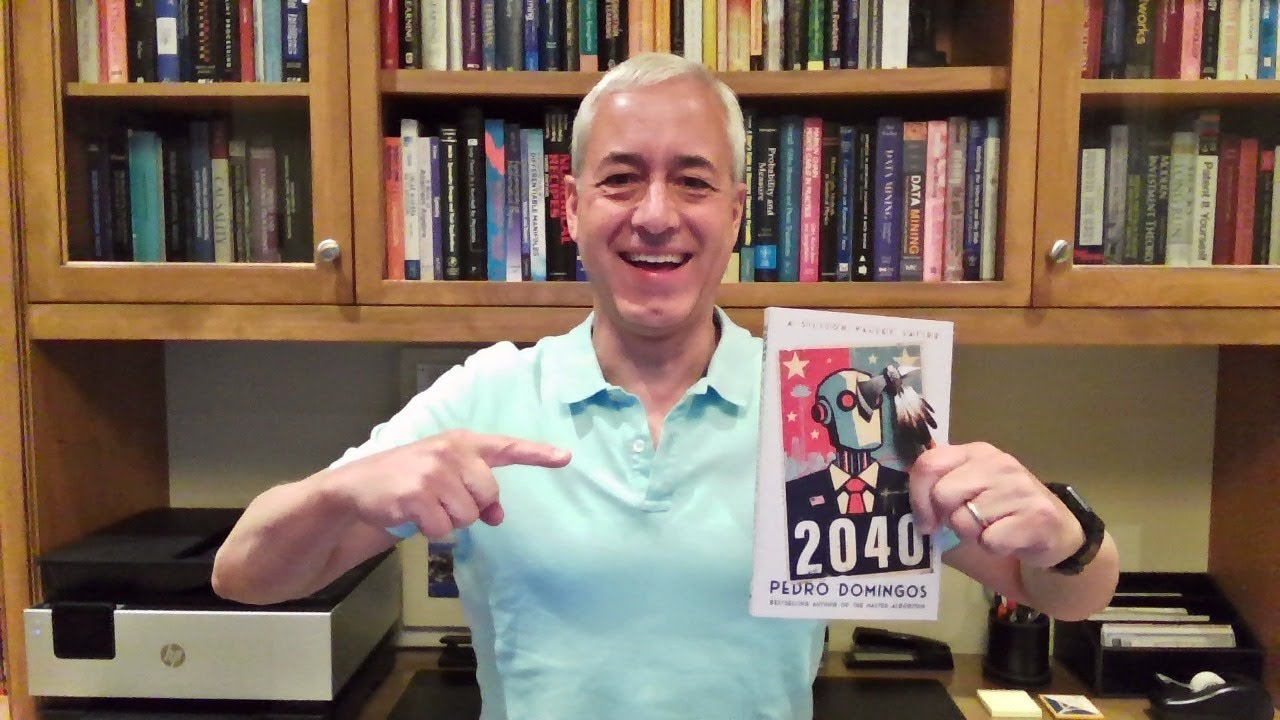
In this TEDx talk, Pedro Domingos paints a sweeping, forward‑looking vision of how accelerating technology will transform human life over the next century. He begins by illustrating how, if the current pace of progress had always existed, a 40‑year‑old today would have lived through hunter‑gatherer life, the invention of language, agriculture, the industrial revolution, and the digital age—all within a single lifetime. Using that perspective, he forecasts a cascade of breakthroughs: autonomous electric vehicles that eliminate traffic; augmented‑reality contact lenses that overlay digital content on the retina; brain‑computer interfaces that let us control devices by thought; ubiquitous 3D printing that replaces traditional supply chains; high‑speed transport that makes any global commute trivial; and AI‑driven ambient computing that anticipates our needs before we articulate them. The centerpiece of his vision is the gradual mastery of biology: from universal disease immunity to cosmetic gene editing, to real‑time control of gene expression and emotional states. He argues that as we gain the power to edit ourselves, evolution will decouple from reproduction, turning each individual into a self‑directed evolutionary agent. This will fundamentally reshape human nature, identity, and the very question of what it means to be human. Domingos concludes with an optimistic invitation to embrace the unprecedented changes ahead.
Chapters
I'd like to welcome each of you to the next 100 years of your life. What I'm going to describe may sound like science fiction, but it's not. All the technologies involved already exist in early form today. So in the next 10 minutes, I'd like to give you a preview of the next 100 years of your life. It's coming, so get ready. When we picture our future lives, we tend to assume that we'll live to maybe 70 or 80, because that's how long people live today. But most of us in this room will live far beyond that, maybe even forever, because of the progress that medicine will make in our lifetimes. Because technological progress is continually accelerating, we have a hard time picturing just how much change we'll see in the next decade, let alone the next 100 years. So perhaps, for perspective, we should first take a step back into the distant past, because that's the world that we'd have been born in if technology had always progressed at the current rate. A decade's worth of progress now is roughly equivalent to the entire 18th century, or to the entire first millennium AD, or to the 10,000 years before that, or to the previous 100,000 years. Let's say you're about 40 years old. If you're 20, just divide everything by 2. Then, if technology had always progressed at the current rate, you would have been born into the world of 100,000 years ago. Picture that. Your parents were hunter-gatherers, and all they had were stone tools and fire. When you were a toddler, the first big revolution happened. Your tribe discovered language just in time to teach you, and you started wearing clothes and making cave paintings. Just as you entered puberty, another big revolution: agriculture. Your parents became farmers and settled down. Empires rose and fell. You got married in a freshly built medieval cathedral. In your late 20s, the Industrial Revolution happened. You moved to the city and worked in a factory. Electricity, cars, television, air travel, computers, the internet— all of those things appeared during your 30s. In just the last year, you got one of the first iPhones. You're now a knowledge worker. You live in the suburbs, and you spend your free time on Facebook and playing Minecraft. Now, if that's what happened in the first 40 years of your life, imagine what will happen in the next 100. A decade from now, a smartphone will look outdated and slightly ridiculous. The computer screens, large and small, that we spend our time glued to today will have disappeared. Cities will be very quiet. There'll be no traffic jams, no traffic lights, no neon signs, no billboards. Self-driving electric cars will whisk you from place to place, speeding through intersections without ever colliding. All reality will be augmented reality. LED chips in your contact lenses will project images directly onto your retina, seamlessly superimposing computer-generated creations onto the physical world. And companies will bid for every bit of what you see, every pixel. You'll control your world not by typing and clicking, but through speech and gestures. 20 years from now, speech and gestures will be outdated. You'll control your world by thinking. Computers won't project images onto your retina, they'll transmit them directly to your optic nerve. The things you create won't be virtual, they'll be 3D-printed on demand. There'll be no more distribution networks, no trucks, no freight trains, no merchant ships. Just the pipes that pump raw materials everywhere, like blood pumps nutrients to your cells. And just like all kinds of cells build themselves out of those nutrients, 3D printers everywhere— your home, your office, shops, restaurants— will assemble the raw materials at will into anything you desire. There'll be no highways either. Self-flying planes and near-light-speed subways will take you everywhere on Earth in minutes. You'll be able to live in Hawaii and commute to work in New York and spend the weekend on Mars or Venus. In 30 years, you won't need to think to control your world. High-resolution brain scanners will sense the the electromagnetic field generated by each one of your neurons, and the world around you will adapt continuously in response. And thanks to machine learning, which lets computers predict the future based on past experience, the world will guess what you want before you even want it and have it ready for you just as the thought is about to enter your mind. Light will shine Wherever you look. Walls and ceilings will be covered in LED panels, and as you walk around, the panels you're about to look at will light up. You'll control your world the same way you control your hand. When you want to move your hand, you just move it. You don't need to consciously tell it to. You won't need to look stuff up on the web anymore because you'll just know it. When you go on a date, you and your date will create around you a world that you both like, trying different things and experiencing the results. You'll conjure up a romantic restaurant, and your date will tweak it and add a view, and you'll change the season. And that's how you'll know whether you're compatible. The idea that only a decade or two before, you know, the only way you had of getting to know each other was by talking will seem hard to fathom. All of these changes will pale in comparison with what comes next, in 40 or 50 years' time: the ability to control your own biology. We already know how to edit genes, but knowing which combination of genes to edit to get the desired result will take a while. because of the extraordinary complexity of biology. But we'll get there, step by step. First, we'll make ourselves immune to all known diseases, and then to all unknown ones. As soon as a new virus appears, its DNA is sequenced, a vaccine is developed, and your immune system downloads the recipe and starts making it. Health problems will be an oxymoron. Then we'll become as beautiful as we want to be, at which point maybe ugly will be the new beautiful. And then we'll start to control our own traits. How smart do you want to be? Do you want to be hardworking or laid-back? After a few years of being cautious, you'll decide to be adventurous for a while and then back to cautious. When you fall in love with someone, you'll change your personality to become their ideal partner. At least until you decide that it's gone too far and fall out of love again. But you'll also discover that there are trade-offs. You can't be all the things you want at the same time because some of them are biologically incompatible. If you increase your ability to focus, you decrease your ability to multitask. Become more empathetic, and you also become less assertive. So even though you'll have almost unimaginable power, you'll still have to make hard choices, and your life will be more complicated than ever. Finally, 50 to 100 years from now, you'll have the ability to control your genes and their expression in real time. If you're angry and you don't want to be, You'll be able to calm yourself with a single thought. If you're sad, just wishing you weren't will bring back joy. Your heart will beat faster or slower as you desire. Each night, you'll be fertile or sterile as you choose. You'll acquire new senses and new brain regions to process them. You'll be able to and associate them with the old ones. As our ability to communicate with each other expands far, far beyond the few words per second we can speak today, the boundary between self and other will begin to dissolve. With your new senses, your mind sharing, and the growing reach of computers into the very large and the very small, your consciousness will expand to encompass more and more of the universe until it's as far beyond your consciousness today as your consciousness today is beyond the consciousness of an ant. In the past, evolution was closely tied to reproduction. Offspring differed minutely from their parents, some did better than others, and significant change only happened over many generations. New species took eons to emerge. But in the future, evolution will be completely decoupled from reproduction. Evolution will happen within each one of us. You will evolve when you want to, because you want to. Each day you'll try out something new, and if you like it, you'll keep it. Homo sapiens, whose evolution has been slowly picking up speed, will branch out into an infinity of different species. In the first 40 years of your life, the human condition changed, but human nature did not. In the next 100 years, human nature itself will change many times over. The question, what does it mean to be human, will no longer have an answer. But then again, maybe it never did. Are we immortal? I don't know. But even if we're not, you'll live so much in the next decades that you'll feel like you are. Everything you've done, everything you've seen, is only a brief prelude that's to come. Enjoy the next 100 years of your life. Thank you.