I Answered Your Questions on How to Scale an Accounting Firm
In this solo Q&A, Peter Vander Wall—owner of Social Club Studios and the Scale Your Accounting Firm community—answers a series of practitioner questions about growing accounting practices. He walks through how firms at different revenue levels should choose marketing channels (Google Ads for modest, warm leads versus Meta ads for cold, high‑volume scaling), the need for a cold‑traffic sales process, and why LinkedIn is often a “circle‑jerk” for accountants while Instagram and YouTube reach prospective clients. He critiques the over‑focus on website redesigns, advocating single‑page landing pages paired with strong ad spend. He explains how to structure lead‑magnet funnels, emphasizing the post‑download landing page and long‑term email nurture over the magnet itself. He warns against competing on low‑price bookkeeping models, urging firms to target affluent clients and niche industries, and outlines local versus national branding tactics, including ad budgets, content, and event strategies. For sub‑$1 M firms he recommends DIY marketing, time‑audit delegation, and buying back time, while suggesting agencies only for system setup. Throughout, he ties each tactic back to firm size, growth goals, and exit planning, and invites viewers to join his community for ongoing support.
Chapters
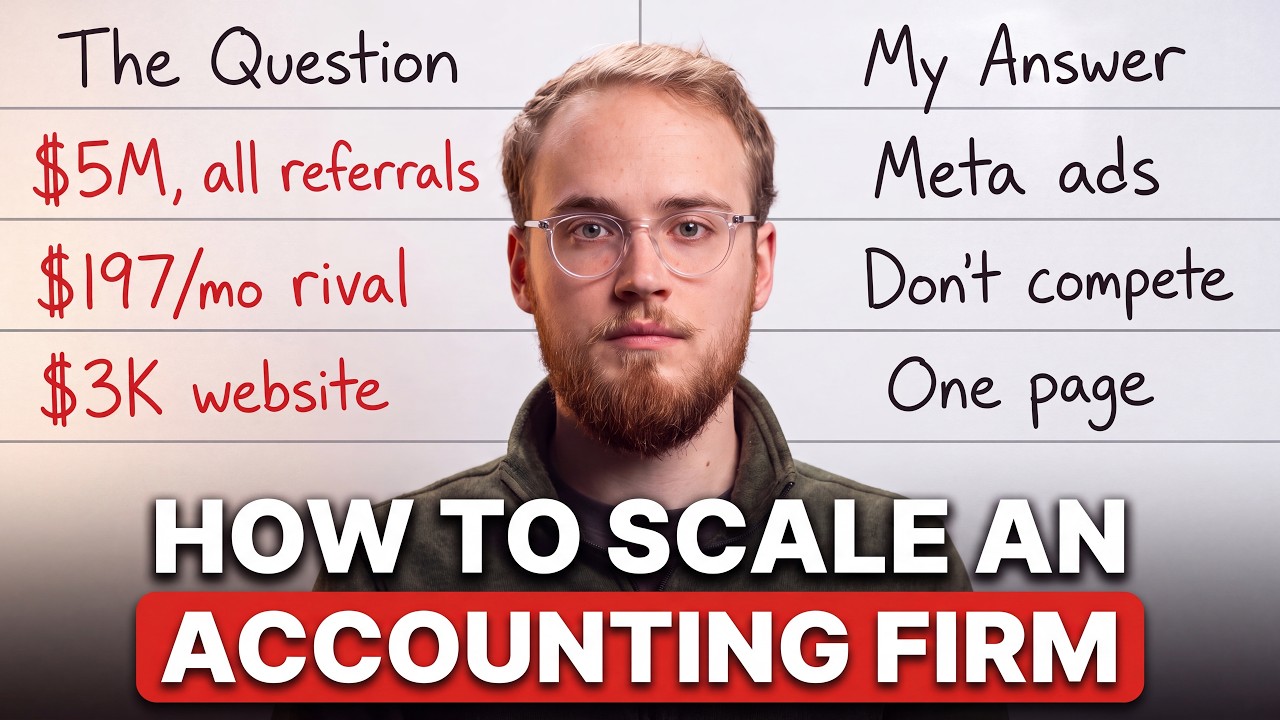
I asked you guys for your questions about scaling your accounting firms and y'all delivered. So in this video, I'm going to be answering them for you. Now, if we haven't met, my name is Peter Vander Wall. I own Social Club Studios, which is a marketing company for accounting firms doing anywhere from about $2 to $20 million a year. And I also own a community called Scale Your Accounting Firm with 450+ firms in there as of the time I'm recording this video. And so the first question says, I'm at $5 million a year and every client still comes from a referral. Some months nothing comes in. What should I actually be doing to get clients? So if you're at $5 million a year and you're still running on referrals, I'm going to guess you have probably built this firm up over an extended period of time. Like you haven't scaled really quickly to $5 million a year. Typically when I see this, the firm's been running for like 10, 15, maybe 20 years at this point, and they've kind of like organically scaled up to this level. And so you've kind of got a decision to make, right? So if your goal is to continue to scale and to do so more aggressively, then you're going to need to get some kind of marketing channel figured out. For some, maybe you're nearing the end of your career, and so your goal is to set up for an exit, in which case you also need to set up a marketing channel. So it's kind of a non-negotiable if you're— if you run a $5 million firm. The question is, what kind of marketing channel and what pace of growth do you want? So if you're just trying to get to the point where you're growing enough to like increase the exit value of your firm as an asset, then I would probably recommend lead channels that are going to be, let's say, a little bit less scalable. But they're going to be a lot better, easier to sell leads. Okay. And so an example of that would be Google Ads, right? So Google Ads are not the most scalable form of marketing for an accounting firm, but you could totally get to the point where you're spending $5,000 or $10,000 a month. You're making, depending on your pricing structure, you know, if you charge monthly, you might just break even on that first month. Or if you charge upfront packages like we teach at Scale Your Accounting Firm, then You could probably be doing like a 4x, 5x, 6x return on ad spend with Google. And these are going to be relatively easier leads to close because they're people who are actively searching for particular keywords that you're bidding for. So for example, they might be searching for very simply CPA near me or CPA for real estate investors or CPA for home service companies. Probably wouldn't be calling themselves a home service company. It'd probably be like CPA for plumbers. But you get my point. It's less scalable, but It's a great way to spend a few thousand dollars a month and, you know, make your money back and then some. Now, if you're trying to turbo scale, right, let's say you're doing $5 million a year and you want to get to $10 or $15 million a year and then potentially exit, right? Well, you're going to need something that's a little bit more scalable than, you know, spending a few thousand dollars a month profitably, right? Like we need to be able to spend like $100,000 a month profitably. And the best way that I have found to do that, like bar none, is through Meta ads. So Meta ads are going to be colder leads because what you're doing is you're getting in front of people like these people are like scrolling on their phone looking for dopamine. Right? And then they see your ad. And so you basically have to take them through an education process to get them to buy. And that's a lot harder to do for a lot of firms. You also have to like really have your offer nailed down to get them to buy. It's not going to be like selling to warm leads or referrals like you're used to. So you're going to need to set up what's called a cold traffic sales process, which is basically an entirely different sales motion whereby we can take somebody who's cold. Let's say they're, you know, they're qualified. There's somebody we could potentially sell to. They're just cold. They're not educated and they're not familiar enough with us yet. And we need to take them through a particular education process to get them to know, like, and trust us enough to where they're ready to buy. Now, setting up this system is not the easiest thing in the world. If it was easy, then everybody would be doing it and it wouldn't be that good of an opportunity anymore. But the firms who can nail this make really good money because what ends up happening is you spend money upfront to acquire the customer. You have an upfront offer so you can charge money upfront. to basically like pay back that cost to acquire a customer and ideally to be profitable on the front end too. But really where you make your profit is, as we know, like in the accounting industry, the lifetime value of a particular customer is typically really high because there is a really high cost of switching accountants. Like that's a really difficult thing to do. And so upfront you might only make $5,000, but the lifetime value of that customer could be $50,000 or $100,000 over the next 5 to 10 years. Which, by the way, that's why private equity is loving this industry right now, because if you can show, hey, we acquire clients profitably upfront, And they stick with us for a very long time after that. That's a really, really attractive asset for a buyer. And by the way, if you are a larger firm and you're looking to scale aggressively, we'd love to speak with you. Might be a fit for our partner program or one of our other offers at Social Club Studios. All right, next question. I post tax tips on LinkedIn 3 times a week. The only other people liking them are other accountants. What am I doing wrong? Okay, so this is a good one. I call this the LinkedIn circle jerk. Pardon my French, but it's true because what happens is you go on LinkedIn because you're like, oh, it's a more professional environment there, right? So we go on LinkedIn, we post like helpful tips and tricks and information about different tax strategies that somebody can use or different bookkeeping best practices or whatnot. And you'll notice if you go on those posts, you've probably seen them from— I won't name any people in particular, but there's a lot of people who do this. And all the likes and comments on those posts are from like other accountants and potentially maybe financial advisors, because guess who's interested in content all about tax tips, other accountants, and potentially maybe some financial advisors. Now, where this can be a good strategy is in recruiting. Okay, so if you have a larger firm and your main bottleneck is actually like finding good talent, then yeah, you actually want to build your brand within the accounting industry because that's how you're going to attract all the best talent. But for most people who come talk to me, their main bottleneck is lead gen and it's, it's, you know, marketing and sales basically. And so number one, in the vast majority of niches, LinkedIn is not the, the main place that you need to be spending your time because LinkedIn is not a place where most people spend very much of their time, right? Like for me, I am, I literally, I quite literally sell to the accounting industry. Like LinkedIn should be my playground. And I'll tell you, I spend maybe 30 minutes a week on that platform, right? So I can be found there for sure, but I don't spend that much time there. And so you're not gonna get much face time with me if that's the main place you're posting. Whereas on Instagram, like I would be ashamed to tell you what my Instagram screen time is. I spend a ton of time on YouTube watching long-form videos just like the one I'm recording right now. And so realistically, if you're trying to sell to me, then you would ideally want to do so on one of those platforms, not on LinkedIn. So that's number one. Number 2 though is the actual type of content that you create. And so the thing you have to understand is none of your customers actually care about tax stuff. What they care about is the problem that you can help them solve. Okay? And so you need to speak about that problem in words that they would likely use. And so instead of talking about the short-term rental loophole, right, we would talk about, hey, one of the biggest problems when you are a high earner and you start to make a lot of money in your career or your business is your tax bills just go through the roof. Like all of a sudden you're paying, you know, $100,000 in taxes and you're like, where is this money even going? Like, I'm not getting anything for this. And so one of the best strategies you can use to reduce that tax bill and also invest for the future is the short-term rental loophole. And here's how it works, right? That would be like one very simple example for, for a real estate tax strategy that we're all probably familiar with. And so in other words, we make the content about the problem that they recognize, or we use that problem that they recognize to kind of like hook them in and get them to pay attention. And then we can give them the meat and potatoes with the value, right? And a lot of times we're not even gonna like talk that much about the actual tax strategy, right? Like I find the more we actually get into educating on the strategies and how they work, the harder it is to actually get people to sit and consume that content. 'Cause it's like, it's very technical. Not everybody actually cares how the strategy works. They just want somebody who can do it for them. And so really what you wanna do is you wanna speak to those problems and those desires that they have. You wanna show a little taste of that solution, right? Just so they understand, like, how does it work if I were to work with somebody like you? But really what we're doing is we're proving that we understand their situation. The little layer I would add on top of that is the person who proves they understand the customer the best is the one who's gonna win. A web designer quoted me $3,000 for a new website. Should I build that or should I focus on something else for my marketing? Okay. This is a really common question because most firms have a website. And so kind of the first thing that you go to if you're not getting enough leads is like, oh, I need a better website. Well, the truth of the matter is one of my clients, we scaled his firm up to— we weren't quite at an $8 million run rate, but we were close to an $8 million run rate before we like actually built a real website for his firm. Up until that point, it was one single landing page. And so I've got longer videos on these like landing page best practices, but I think that's where the majority of firms should go. Especially if you're doing a lot of direct response marketing with like social media content and ads and like that type of thing versus, you know, just getting a bunch of referrals and kind of like coasting on referral traffic. One single landing page with like a headline and a video sales letter at the top, an application form somebody can fill out, ideally some testimonial videos or like a Google review widget embed or Trustpilot or whatever you use for reviews. And then potentially some like sales copy on your service and problems you solve and that sort of thing. That can do really, really, really well. And I just don't see the benefit of having a true multi-page website for the majority of businesses because you're not getting that much traffic. There's a tool you can actually use to measure this. You can either install Google Analytics on your website or whatever hosting platform you use may have analytics built in where you can actually see how much web traffic do I get. And for most firms, like it's a few hundred to maybe a few thousand hits per month. And so for just like broad web traffic, if we were getting a 1 to 2% conversion on that landing page or on that website, that would be pretty good. Meaning for every 100 visitors we get, 1 to maybe 2 of them actually fills out that application form to get in contact with you. And so like you can do that math really easily to figure out if your website is a massive bottleneck. And then the other math that we would do there is, okay, let's say we are converting at only half a percent. Well, if it's half a percent of 400 people a month, that means we're getting 2 leads a month. And so if we fix it and we get it working properly, then we're gonna get 4 leads a month. Well, how much time is gonna go into fixing it and getting it to convert properly? Like that could be a relatively large endeavor, give or take how bad your site actually is. And so you might just be better off doing that simple landing page and then taking all that time and putting it into producing content or producing ads that actually are gonna drive more traffic. 'Cause you're gonna be better off if you can get that 400 people a month to be 4,000 people a month, even if it still converts at half a percent, 'cause you just 10x'd your traffic. Whereas getting the page to convert properly and getting, you know, the right percentages there, well, you double your traffic and that's it. So I think volume is the key in most aspects. And so if you're pursuing an organic strategy like social media content, then do more content and do better content. If you're doing ads, then do more ads and do better ads. If you're doing events and conferences, then go to more events and conferences or go to bigger ones or get invited to speak on stage instead of just being a vendor booth. Like that's the activity that's actually gonna make you money. There comes a point where it makes sense to focus on conversion rate optimization, but I think a lot of people get into like fixing their website and like this dumb backend stuff. They get into that way too early, I think. Oh, this is a good one. I made a free guide to use as a lead magnet. People download it and then I never hear from them again. Should I make a better guide? All right, so this is a very common strategy. I actually am a really big proponent of this strategy if you're doing organic marketing of any kind is, having a lead magnet or even a set of lead magnets that you offer as basically free resources in exchange for somebody's contact info. So if you've ever filled out a form where it's like, put in your name and email and I'll send you this free training or this guide or whatever, that's a lead magnet. That's what we're talking about here. And so the way that you actually get that person to convert and to book a call and ideally buy from you is twofold. Okay, so number one, immediately when they request the guide You should not just redirect them to the guide when they fill out the form. You should actually redirect them to a landing page that's all about your actual done-for-you service. We'll throw up an example on screen of like what this looks like, but essentially they fill out the form to get the guide. You email them the guide, maybe you text it to them as well if you're grabbing their phone number. That's all on the back end. But then on the front end, they're going to get redirected to a page that's like, hey, before you check your email, do you want to work with a CPA one-on-one to do X, Y, and Z? And then you have your like calendar embed. Maybe you have a video sales letter on the page above it. So that's the first way that you're going to convert these people. And so that's going to be like the warmest people who are downloading the guide, right? So you might have anywhere from 10 to 25% of people who opt in to receive the guide who then actually book a call on that second page. Okay, that's number one. Number 2 then is that long-term nurture aspect. And so now we've got their email contact and so we're going to They're gonna go onto our email list. They're gonna start getting the emails that we send out there, potentially some email sequencing that I've got where they go through a structured 30-day email sequence before they get added to the main list. And so you're gonna get some calls from that as well. And basically the longer we nurture that lead, the higher the likelihood is that they actually book a call and buy from us. So that's kind of the long-term nurture aspect. The thing that is almost entirely not important is the actual guide itself. 'Cause first off, what you're gonna notice is the actual consumption of the guide is gonna be really, really low, like single-digit percent low I'm talking. People are going to opt in for the thing and then they're gonna forget about it and they're not gonna remember that. But what they will remember is you showing up consistently and giving them value. Now what can matter a little bit is the actual packaging of the guide or the lead magnet. And so what I mean by this is just very simply like how are you describing what they're gonna get out of the guide? Because there's a way you can describe it where you're going to attract very low-quality leads who are less likely book and less likely to buy. And there's a way you can describe it where you're going to attract higher quality leads where they're more likely to book and they're more likely to buy. So let's say I have a pro forma for a short-term rental and that's my lead magnet. It's like an Excel spreadsheet template that they can plug in the numbers off of Zillow or the property's performance numbers and it'll calculate a bunch of metrics for them. By the way, this is a real lead magnet we have for one of our clients. So let's say the way that we're presenting this is buy your first short-term rental the right way. Using this pro forma, okay? So who is that likely to attract? It's likely to attract people who are buying their first short-term rental, and give or take your offer and how you have it set up, like that may or may not be the right demo for you. You may actually be a lot better fit for people who already own a short-term rental and they're kind of scaling their portfolio. And so if that's the case, you might change your messaging to be something around benchmarking your short-term rental against the ideal standard, like see how your short-term rental is. Performing compared to how it should be performing, like the benchmarks that we've set from our 1,000+ clients that we've worked with. And so that's more likely to attract people who already own a short-term rental, right? And maybe that's the more qualified demographic for your offer. So just simple packaging tweaks like that can actually be really important for making sure we're getting the right people in. But assuming you're getting the right people in, the guide is not the thing that's going to get them to book a call and buy from you. It's that landing page that they get redirected to next. And it's most importantly, that long-term nurture that you do via email now that you've got their contact, like staying in front of them frequently and over an extended period of time. Prospects keep telling me they found bookkeeping for $197 a month. How do I compete with that? Well, I think we all know the company that this guy's referencing. I've actually spoken with the founder a few times. Very interesting dude. Very interesting dude. But the short answer to this question is don't. Like, I think this is where accounting firms go to die is like trying to compete on price for done-for-you services, but they're charging like software prices. So for reference, like this $197 a month company, they are a software company and they're presenting it as a done-for-you service. But really it's a, it's a software-enabled done-for-you service so they can make good margin on $197 a month. Well, you can't because you have a human bookkeeper doing all the work. So your options are one, become a software company, which I don't— you probably don't have the skills or expertise to do, or two, just compete in a different field. If somebody's looking for the cheapest possible bookkeeping solution, then $197 a month is pretty compelling. If somebody's looking for the best bookkeeping solution, then they understand that they're going to pay more for that. And so you just simply need to be selling to a more affluent audience. So for reference, to be a top 1% income in the United States, you have to make over I think it's about $750,000 or $800,000 net. I forget what the stats are exactly right now, but I know about a year ago it was about $750,000 in net put you as a top 1% earner. Now, to be even in the top 10%, you have to make over $250,000 net. So to sell somebody accounting services, the bare minimum is you got to be selling to the top 10% of the US population. Really, ideally, you should be selling to the top 1% of the US population. And so if you're, if you're selling to people who are comparing you with a $197 a month bookkeeper, then you need to get into a different pocket of people, my friend, because your firm is going to die if you try to continue to compete in this market. And so I've made longer videos on like how to sell to the affluent and how to get richer people coming inbound to you. But like ideally, that's what you need to do and that's what's going to allow you to charge not like a little bit more, you know, not even $500 a month, But legitimately like 10 times as much. You charge $2,000 a month for bookkeeping. We have a firm that they're not even a CFO firm really. They're kind of like outsourced finance team. They sell like $7,000 a month bookkeeping packages. So it's totally doable without even adding like a highly complex additional line of service like CFO, but they're selling to a totally different demo than you are. I mean, the average cost per call to get somebody to like book a call for an accounting service It's anywhere from like $100 to $300. This firm is paying $500 to $1,000 per call. But these are people who are making millions and millions of dollars a year. They have very large businesses with complex financial operations. And so they want somebody who can come in and help them simplify those complex financial operations. So it's all about the problems that you speak to. If you speak to brokey problems, then you're gonna get brokey shit and you're gonna deal with people comparing you with a $197 a month offer. If you speak to more affluent people's problems, then you're going to get more affluent people coming inbound and you're not going to be competing with somebody charging $200 a month. In fact, you may actually get people who say no because you're too cheap to the point where they don't believe you can actually deliver on this service. In that scenario, it actually benefits you to be more expensive than the competitors because that signals something. It's like, oh, if they can charge this higher rate, then they must be the best. Every firm in my area offers tax planning. How do I explain why someone should pick me? Okay, so based on this question, I'm assuming you are selling to a local market, and so there's 2 options here. Well, there's a couple of different ways you can do this actually, I think there's more than 2. So number one would be to select an industry niche, right, or some type of niche, right? So if you're selling local, instead of, you know, selling to anybody and everybody in the Crown Point, Indiana area, then you might sell to home service companies in the Crown Point, Indiana area, and so that's another level by which you can stand out, and so You're not going to get everybody else, but home service companies are, they're all going to flock to you, right? And so if there's enough of that particular industry in your local area, great. If not, then you might consider going national. There's not a lot of downside to going national at this point. Like most firms can do it, you know, tax software can handle returns in all kinds of different states. It's pretty straightforward. The other option, if you want to stay local, is you could come up with a guarantee that's better than the other local firms. So Maybe the other local firms offer tax planning and they don't have a guarantee. It's just like, hey, come in, we'll see if we can help you save money on taxes. And let's say you have a guarantee where it's like, hey, we'll save you $10,000 in taxes or we'll just refund you entirely if we can't save you at least 10 grand. And so that's a meaningfully better offer than the other firms in your area. And so you're going to get an outsized chunk of the local market share. Now, I guess the third option, and I think honestly, I would probably do a mixture of all 3 of these, but I think this is probably the most important one actually, is to build a bigger local brand than all the other guys. And so when it comes to building your local brand, you can run ads locally, you can create content locally, you can go to events and meetups locally. Those are some of the main ways that you can do it. The billboards thing, you get a lot of awareness that way, but the conversions are really not there. And it's like a general population type of audience that you're getting in front of, right? It's like anybody driving down the highway. So those aren't super effective nowadays. Physical signage, not super effective, but basically to build a local brand. So let's cover ads first, right? So depending on the size of your local area, you can probably saturate your local market with somewhere between $5,000 and $30,000 a month in ad spend. If you're in a really big metro area, it might be even more. Like if you're in Chicago, right? Like you can spend way more than that and just stay local in Chicago. But you know, if you're in Crown Point, Indiana where I'm at, I could probably saturate this local area with like low 5 figures in monthly ad spend. So that would be option 1, right? Option 2 would be content. Now, when it comes to local marketing, content is not your top of funnel. So this is not going to get you new awareness, but it is— anybody who's already aware of you is likely to start seeing your content and engaging with it. And so in other words, it's kind of this nurture mechanism. So let's say you're spending a lot of money on ads, you're getting a lot of eyeballs and impressions, and then some of those people are now going to see your organic content. Some may follow you, some may engage with the content, And those people are going to get nurtured long term. Other firms are not likely to be doing that, right? There's very few local firms that I see who are doing a good job of putting out content any sort of regular basis. And then thirdly would be events and meetups in your space, right? So it's probably not going to be like big conferences because typically that's not like, you know, big conferences, like people are flying in out of town. That's not even your local market necessarily. But the local events, the meetups, let's say you're in the real estate niche, right? Like there's real estate meetups all over the place, right? You probably find one a week that you can attend. And so that's an opportunity to go deep with a particular niche of people. There's business owner meetups. You can host your own events, which, by the way, out of all of these, I think is the best. In my local area, there's this event center that I've been trying to figure out a way to host an event there, man. It's just, it's tough because I don't do anything local in my business. So maybe not the best actual strategy for me, but there's this local event center. I could rent the entire place out for like $1,000 for the entire day. It's got room for, I think, like 50 people in it, maybe cater lunch, another $500. So it's like for $1,500 and potentially just bringing in some, some speakers who can also talk about stuff that would be valuable to the audience I'm trying to sell to for basically $1,500, I can get 50 people in a room and just indoctrinate them for an entire day, be the host of the event who always has the most status, be the person holding the microphone who always has the most status. And like, that's likely to get me some really good relationships built, if not some direct customers just right then and there when I go to actually pitch somewhere during that event. So that's kind of the 3 things I would be considering. Doing locally, I would probably start with ads. I would then move to add content in there, and then the last thing I would do would be the events and meetups. Unless there's a lot of events and meetups you're already aware of and already have access to, you could start there very easily. But if it's gonna be difficult finding those, or if you're gonna be hosting your own events, you kind of want to have some traffic already and just use this as another way to convert some of that traffic. All right, last one here, and then we're, we're gonna wrap it up. So this person says they're at $300,000 a year in revenue and They talked to a marketing agency who wants $3,000 a month to run their marketing, and they're asking, is this a good deal? Should they sign up? So I'm gonna give the accountant or lawyer answer here, and I'm gonna say it depends, but probably not, to be, to be realistic here. If you're at $300,000 a year and you're paying somebody $3,000 a month for marketing, that is about 10% of your annual revenue. Now the, the question is not, is that going to get me a good return? The question is, is that the most efficient use of capital, because at this stage, capital is a scarce resource for you, right? Compared to— especially compared to time. You have more time than you do money. And so my preference, if you're sub-$1 million a year in revenue, is always for you as the firm owner to learn the skills required to market and sell at your level. Because realistically, like, marketing and sales does not get complicated until you're doing $1 million or a few million dollars a year. It just doesn't. And so would it be better for you to learn the fundamentals and to do it yourself? And to delegate more of the day-to-day of your business? Or would it be better for you to delegate the marketing and sales, never learn any of that skill, always be dependent on somebody else to bring leads and revenue into your business, and you just spend time doing more tax returns? It's like it should be pretty clear when I put it that way. And so what you need to do is you need to delegate the lowest dollar per hour work. So I would recommend like do a time audit, get like a— take out an Excel spreadsheet, do a new tab for each day of the week, and do this for the next 10 days, next 2 weeks, something like that. 15-minute increments, and then what you did in that 15 minutes. And like, you might have a 2-hour block where you're working on the same thing. That's fine, right? Just reflect that there. And then you're gonna be able to note, okay, you know, there's this low dollar per hour work that I could probably delegate to somebody offshore for $10 an hour. Or there's this low dollar per hour work that still needs somebody onshore, but less experienced that I could delegate for $20 an hour. You'd be way better doing that. And you'd be surprised how much work you can offload from your plate. Like when you're $300 grand a year, you'd be surprised how much work you can offload from your plate for less than $3,000 a month. And then that frees up time for you to invest into learning about marketing and sales by like watching content like this, for building the systems needed and for actually running the marketing and sales yourself. Now, the one caveat I will say is it can be really beneficial to pay somebody to come in, set up the systems for you and teach you how to run it. That's actually one of the services we have at my marketing firm, Social Club Studios. So link below if you're interested in learning more about that. But you need to have the ability to run it yourself. Okay? Because that puts you in the strongest position as a firm owner. Like, think about it this way. You're technically not an accountant anymore. You're an accounting firm owner. So in other words, you're a business owner who happens to be in the accounting industry. Now, what does a business owner do? Business owners spend some of their time on marketing and sales. They spend some of their time managing their team. They spend some of their time on finance. All these different things. But what was the first thing I said? They spend some of their time on marketing and sales. You need to spend some of your time on marketing and sales and not just try to delegate the whole thing when you're a tiny firm, you're doing $300 grand a year. Like, I don't say that to try to like big bro you in any way. I don't say that to talk down to you, but just like objectively, that's a very small accounting firm. And so yes, you're going to DIY your own marketing for a while. Then it's going to get to the level where it genuinely becomes more complex or you genuinely have higher dollar per hour activities that you can spend your time on, right? If you get to a few million dollars a year, it's not going to make sense for you to be building all the landing pages and like in the ad account every day. You're still going to pay attention to marketing. You're going to be involved in the strategy level. But building a landing page is lower dollar per hour activity than some of the other stuff that you could potentially be spending your time on, right? Checking the ad account every single day is lower dollar per hour activity than what you could otherwise be doing at a few million dollars a year in revenue. So you just need to be thinking in terms of that. Like Dan Martell's got a really great book on this called Buy Back Your Time. Where he basically— there's a principle that he teaches in that book. I think he calls it the buyback principle. But the idea is you do not hire to grow your business. You hire to buy back your time and then you grow the business with all this new time that you have. And so if you're sub-$1 million a year, the most valuable activity that you can be spending time on is marketing and sales. So ideal, like the ideal setup is you would be doing 100% marketing and sales and everything else in the business would be delegated first. Before you try to delegate marketing and sales. Trust me on this because I'm— this is literally the guy who sells marketing services for accounting firms telling you that you don't need to hire a marketing agency if you're under this certain level. So anyways, that's gonna be it for this one, guys. If you want to be able to submit questions for my next Q&A video like this, then you should join our community, Scale Your Accounting Firm. It's just a dollar to join, dollar a month. And that's literally— I would make it free if it wasn't gonna let in all the third world scammers. I just need to charge a dollar because that's a lot of money to them. So join, links down below. Next time I do a Q&A video, I'll throw a post up in there and you'll be able to ask your questions and potentially get it answered in a video like this.
More from Peter






How This Bookkeeper Scaled From $30k/mo → $92k/mo in 2025 [LIVE WORKSHOP RECORDING]

