Adsorption of volatile organic compounds by industrial porous materials: Impact of relative humidity
Webinar by Prof. Darrell Williams (Imperial College London; founder/MD of Surface Measurement Systems) describing laboratory studies of VOC adsorption onto common industrial porous adsorbents and how ambient relative humidity changes material performance. The team measured single-component (water, toluene, 2-butanone, ethanol) and two-component (water + VOC) gravimetric isotherms using dynamic vapor sorption (DVS/DVA) microbalances (sample sizes ~5–10 mg) at 25°C to quantify competitive uptake. Key findings: activated carbon shows highest single-component uptake for nonpolar VOCs but its VOC capacity drops sharply at high humidity; zeolite Y maintains VOC uptake relatively independent of humidity (better real-world performance). The talk includes materials characterization (XRD, TGA, N2/BET), a defined hydrophobicity index (toluene vs. water single-component ratio used as a predictor), regeneration/cycling observations (activated carbon lost ~50% capacity on cycling), and practical instrument/measurement limits discussed in the Q&A.
Questions this video answers
May 11, 2020.
Prof. Darrell Williams — Professor of Particle Science (Chemical Engineering), Imperial College London; founder and Managing Director of Surface Measurement Systems.
About 5–10 mg (commonly ~5–10 mg per run).
Main experiments shown at 25°C (instrument operates typically between ~5°C and 85°C; sample/regeneration heating to ~200°C is possible with a preheater).
DVS acoustic sensor measures down to ~0.1% P/P0 (tens of parts per million); photoionization detectors (PID) can be used to reach parts-per-billion detection for VOCs.
Chapters
Hello everyone, and welcome to today's webinar. Thank you for joining in. I'm Rami Z. Ahmed and I take care of sales and business development activities at Surface Measurement Systems for North and East Germany. Today's webinar is about absorption of volatile organic compounds by industrial forest materials and the impact of relative humidity will be discussed. We have a very special presenter today, Professor Darrell Williams. He is the founder and Managing Director of Surface Measurement Systems and the professor of Particle Science in the Department of Chemical Engineering at Imperial College London. His work has been recognized by Imperial College with the President's Medal in 2017, the EEF's Future Manufacturing Award in Innovation for 2018, and the Institution of Chemical Engineers Geld Art Medal for the year 2018-19.
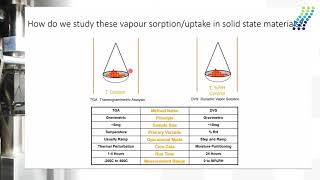
Okay, well, good morning everybody to today's presentation. And I'm going to talk to you today about some of the work we've been recently doing in my research group on the adsorption of volatile organic chemicals by porous solids. And just to acknowledge that Elwyn hunter, who's a PhD student in my group, has completed the work that I'm talking about with you today. And we're collaborating with Ivan Parkin at the Department of Chemistry at UCLA and with our industrial partner and sponsor, Procter and Gamble, and that's represented by JJT from Cincinnati. So I thought to start with, I'd just like to set a little bit of the background as to why we have this interest in volatile organic chemicals and their removal by using porous solids. I just thought I'd talk to you about some of the headlines that have appeared in the newspapers in the UK over the last 12 months, really around air pollution. And it's turning out to be a really quite an important issue. This was a paper that was this is a story reported by the British Heart foundation about a year ago, talking about the impact of air pollution not on the environment, but on health, and talking about the impact of air quality on medical and outcomes for lives. And this is a similar story in another major paper, again talking about people breathing toxic air. So really the point I'm making here is that in the past, people have been concerned about air pollution and also being concerned about volatile organic chemicals being in the air. They're seeing this as a basically an environmental problem. But what we're seeing now is that many researchers and many institutions are now seeing this as actually a health problem. It's becoming a medical problem, and that's going to make it have a big change. Fundamentally, the importance of this research area over the next few years. For example, we've seen recently that the EPA has recognized the importance of VOCs in their priorities for the financial year 2020-2023. So essentially, the presence of pollutants in the air, including volatile organic chemicals, is now becoming an area of significant interest, not just environmental interest, but of health interest. And as it becomes a clear and important health matter, we can expect governments and national authorities to become much more concerned about pollutants, including specifically volatile organic chemicals. So volatile organic chemicals are released from a wide range of sources inside the house, in industrial places, in the environment, and they can actually result in, in a number of medical problems, they can cause respiratory and pulmonary disease, they can relate to sick building syndrome, and that can also result in a number of other medical related problems. So we're seeing really now a transitioning of VOCs and airborne pollution from an environmental issue to become a health issue. And as becomes a health issue, we're going to see a lot more societal and economic importance around this area. And just for a moment, for me to talk about VOCs, what sort of molecules am I thinking about? Well, I'm thinking about things such as toluene, formaldehyde, methylene chloride, tetrachloroethylene, acetone, xylene, benzene. There are many compounds that we might see as chemists as fairly regular materials we might encounter in the laboratory. But we're not talking about these molecules being present in the laboratory here. We're talking about these molecules being present in the air we breathe in our workplace, maybe in the factory, maybe at home. And these molecules can appear in all sorts of ways you don't expect. Maybe they have a solvent in the paint you've used to paint your fence. Maybe it's a solvent that's present in a deodorant you've bought. Maybe it's a packaging of a material you've got in the home, maybe it's a solvent that we use in a manufacture of the carpet in your house. So these rare C molecules can appear in all sorts of unexpected ways, but they can, over a long period of time, in some cases, potentially have a chronic impact on people's health. And that's the backstory for what we're going to talk about today. So we're really interested in if we've got these VOCs in our environment, how are we going to remove them and what are the sort of technical and engineering strategies for their removal. And it turns out if you wish to remove organic molecules, such as the VOCs I referred to before from, from the gas or indeed from liquids. It turns out that the use of porous materials is a very common and relatively straightforward way of doing this. And the reason porous solids are successful in this process is that they have a high fraction of pore volume, they have relatively high surface areas, so they have lots of chemical sites that can accommodate VOC type molecules. Now, of course, VOC concentrations can vary enormously. In extreme cases, you might get hundreds of parts per million, or they might go down to parts per trillion. So they're very low concentrations intrinsically. But what's important to know that in a typical environment where VOCs exist, so too do water molecules. And water molecules are present in much higher concentrations, anywhere between 10 to the 4th and 10 to the 9th times higher concentration than the VOCs. So if I have a porous material that actually is competing to capture a VOC either at home or an industrial environment, then we're going to see the water molecules competing for the same sites as the VOCs. And the project I'm going to describe today was a relatively straightforward project. In the following, we wanted to ask a very simple question. If I want to remove certain types of VOCs from typical real world air, where there is a significant composition of water vapor present, does the water vapor have an impact on my choice of the best porous material? So we're going to look at a series of common industrial porous materials that are potentially usable for capturing VOCs. And we're going to see if I introduce water vapor to this equation and therefore I start to simulate the real world conditions from which I want to remove VOC pollutants. Does my choice of a porous material, is it affected by the presence of water vapor? So this is the basic premise of the research that I'm going to be talking about with you today. So some of you may be relatively new to absorption science. I'm just going to spend just a few minutes talking to you about absorption science, just to give you a brief introduction to that topic, just so you've got some idea of the context of the sorption science we're going to talk about in a few minutes. So firstly, just a little bit of a sort of introduction to adsorption science. When vapors, such as VOCs or indeed water vapor are bought into contact with a solid surface, some of the molecules will absorb on the surface. There are attractive forces between all molecules. Those same forces will result in vapor phase species such as VOCs or water vapor attaching themselves to the surface that I present. If I Present a material that has a high surface area, then I have lots of sites where my molecules can absorb. And indeed, as I increase the concentration of water molecules or the concentration of VOCs, then I will get increases in the amount of adsorption. So if you can see my mouse here, which I am, I'm just going to get a mouse. Let's have a look here. Just, let's get my spotlight here. So here you can see my adsorption isotherm. So on the x axis here is the humidity. As the humidity increases in this case, I'm looking at the increase in the sample mass due to the adsorption or take up of my water or VOC by the sample. So in other words, the more water molecules that are in the air, then the more water molecules that will actually open, the more water molecules that will absorb on the surface of material and increase the mass. And this relationship between concentration of water molecules and the mass of my sample is, is known as an adsorption or adsorption isotherm. And of course what's happening is the water molecules in this particular case are interacting with the solid. In this case it'll say it's a porous solid. And there are different phenomena that are occurring as to where the water molecules can end up. They can form monolayers on the surface of my substrate. They can sometimes form multi layers. If the material is porous, they may condense inside pores. In some cases that can actually dissolve in types of material, which is true for polymeric materials. And in some cases they can actually form a chemical reaction which we call those hydration reactions. So you can see here, this is my adsorption isotherm. And when I go up in concentration, I get the adsorption branch, and when I go down, I get a desorption branch. And you can see there's a bit of a difference between these two. And that is due to a process called hysteresis. And there are different physical explanations for them, but the most common one is due to the feeling of pores. So if I've got pores typically between 1 and 50 nanometers, then water molecules can actually form a liquid phase in those pores. We call that condensation. And this hysteresis is most commonly associated with the condensation of the vapor inside the pores of my solid. So that just gives you a bit of a background on basic vapor absorption science. So let me talk about materials characterization. I'm going to spend some time talking about a technique called dynamic vapor Absorption in a moment. But I just thought I'd give you a bit of a reference which might help you understand this technique. So a more common technique in use is the technique known as thermo gravimetric analysis. This is a technique where I take a small sample, I put it in a sample pan, and I'm going to monitor the mass of the sample. So TGA is a technique that's been around for probably 60 years at least, and it's a very common technique for characterizing solid state materials. I typically will take a sample of maybe 5 milligrams. And what I will do is I will take that sample and I will increase the temperature normally by ramping it. And I'm going to look at the change in sample mass as I increase the temperature. As you can expect, as the temperature goes up, most materials lose weight. Sometimes they dry, sometimes they decompose. So that's a classical technique known as tga. The technique that we're going to describe today is a similar technique, but different. It's called dynamic vapor absorption. It's also a gravimetric technique. It also uses a small sample, typically a few milligrams. However, in these experiments, we won't be changing the temperature during the experiment. We'll be changing the humidity or the partial pressure of mysolvan. Depending what we do, we will typically step through the actual increases in partial pressure. And we'll look at the way moisture, or in some cases organic vapors partition into my material. So in other words, we're going to look at gas or vapor sorption. So today we're going to be talking about devious experiments, because that's the technique, and then talk a little bit more about the devious method. So essentially, in the devious technique, we're going to flow a humidified carrier gas over a small sample. So here's my small sample. Typically, 5-10mg will be a common sample size. You can do bigger if you want, but we often in the studies we're doing, 5 or 10 milligrams is more than enough material. We're going to flow over the sample a humidified gas, or we'll flow over it a gas that has an organic vapor of interest, depending on the problem we're working on. And when the sample sees vapor, there will be a change in sample mass. So as a sample absorbs water, or in some of the studies you'll see today, absorbs VOCs, then what you will see are some weight changes. So on the right, I'm showing You the experimental data that comes out of a DVS experiment. On the time axis across here, you can see the blue line. The blue line represents increases in the humidity. So we're going to, in this case, step the humidity up. And as we increase the humidity, there are more water molecules present and the sample increases in mass. And the mass is shown in red, the Y axis. So what you can see here is an increase in mass. I then change the humidity. The increase carries on. So this is the basic experiment we're going to do. And from this kinetic experiment we will then obtain the adsorption isotherm. In the adsorption isotherm along here on the X axis, we'll have the relative humidity or the partial pressure of water, or if it's an organic molecule, of the molecule in question and a weight change. And do remember that in the current experiments we'll be describing today, it's all about weight changes. We're going to be increasing the sample weight as we increase the partial pressure around the sample. So the instruments we use to these experiments are briefly shown here. The first machine that we used, it's my computer's thinking a bit here. I don't want to think too much longer. Excuse me for a moment. A little bit of technology here. Right, there we go. So the machine we use for the experiments is at DVS resolution for most of the studies we showed in today's presentation. And that device allows us to measure the change in mass of a sample as a function of the humidity or the partial pressure or the organic vapor we're using. So just a brief comment here. The microbalance is shown here for measuring changes in sample mass. We have the machine in a constant temperature environment. And all the experiments I will show you today were done at 25 degrees Celsius. The sample, it's typically about 10 milligrams, is shown here. And we're going to flow over the sample, in some cases water vapor to look at water vapor uptake. In some experiments we're going to pass over the sample VOCs such as toluene and look at the uptake by toluene. And in some experiments we're going to put two vapors through. We're going to put two water vapor and toluene vapor together. So three different experiments, water vapor experiments, we're going to also do toluene and other organic vapor uptake experiments. And some experiments we put two components together. So that's the nature of the experiments we're going to be running today. So just to give you an idea what the experiments look like. Here is some data. Here is some data for. Let me just pick up the spotlight. So here you can see some experimental data for a cellos acetate. So here is the kinetic data. The blue line is me increasing the humidity for water absorption experiment and the red data is increase in mass. And from those experiments I can then construct the adsorption isotherm. So those are the experiments that we're going to run using water vapor and also toiling and combinations of them. And for some of the experiments we ran, we also used a devious endeavor similar to a resolution, except it can run five samples. It just so happens in a study we're talking about today, we did five samples. And the devious resolution in endeavor simply allows us to run five samples simultaneously using five microns. That's a way of getting a bit more throughput. And we had, as you can see, we probably ran 50 or 60 isotherms for the study I'm about to show you. So the endeavor allowed us to improve our data throughput. So let's talk about the materials we were using in the study. So we're really looking at some quite common porous adsorbent materials. The materials that you would use, they're the go to materials if you're looking for an industrial adsorbent for a capture problem. So activated charcoal, amorphous silica, 13x molecular sieves, a zeolite Y and a ZSM5 zeolite. So these are fairly standard materials that you probably have in your lab and are used for many industrial processes. Some of them are hydrophobic, some are hydrophilic, some have pore structures that are mesoporous. So pores between 2 and 50 nanometers, some have micropores between 0 and 2 nanometers and some have both. And in the studies we did some basic characterization using X ray diffraction, TGA and BET isotherms. But the main work we're going to talk about are devious isotherms. We did isotherms with water, toluene 2, butanone and ethanol. So they represent a wide range of potential VOCs at different polarities. And we did some experiments involving water with two of those specific VOCs, and those were designed to specifically mimic real world VOC conditions. So we did a bit of work looking at the characterization of the materials just to confirm the materials were what we thought they were going to be. So this is your sort of standard powder X ray diffraction for these crystalline molecular sieves and zeolite materials and these are just the TGA curves. So this is a mass versus temperature for those materials. Some of these materials gave some loss of mass around here, which is probably the removal of water. And later on there's some actual at higher temperatures, some even chemical decomposition. So these materials are behaving from a thermal perspective and as we would expect. So just checking the materials were what we were hoping to see for our study. So the first thing we did, which is important, is to characterise the materials using nitrogen adsorption. Nitrogen adsorption is a standard technique for characterizing the porosity and surface area of all porous materials. It's your go to first method and we characterized the materials in this study using that method. That allowed us to work out some fundamental properties of the material. Firstly, we're able to report, as you can see in the table, the surface to area for each of the materials based on nitrogen absorption. And you can also see from these curves here that there are some hysteresis for some of these isotherms. And these hysteresis are normally due to micropores, normally due to mesopores. So there's some of these material here is the yellow, which is the as, and also the Ac and also the 88 y zeolite. There's some mesial porosity here. And some of the materials also pick up a lot of vapor at very low concentrations and that's normally associated with micropores. These are very small pores, less than 2nm. But essentially we're able to characterize in detail the surface area, micro mesoporality of these materials. And they're good fundamental information data sets to have for your, for your solids. So now let's look at the, the main data sets. So the first set of data we're going to look at are isotherms for single components. So these are just simply one molecule at 25 degrees and an adsorption isome. We're only showing the adsorptions part of the isotherms at the moment, but we do have the desorption data, but it's not so relevant. So what we can see here on the Y axis, we've got the amount of solute adsorbed in milligrams per gram. So for example, water molecules here, if you look at here, the 13x zeolite, the molecular sieves, it basically takes up about 25%. In other words, for every gram of my 13x, I'm going to get 250mg water vapours in other words, the 13x has a very great affinity for water vapor, even at very low partial pressures. The other materials looked at have affinities, but they don't tend to pick up to higher concentration. So we're typically seeing between 10 and 25% by weight water in our material. In this case the material, the solid, is water vapor. So now we can go across to look at different molecule. We're now looking at tolium molecules and you see here quite different behavior. You can now see the activated carbon. The AC here is now actually picking up substantial amounts of the solvent. And you're seeing up to about 50% uptake by toluene by activated carbon. Whereas the previous material we saw before, the 13x has a much lower uptake, it's about five times less. So you can see now as you go from a polar material to a non polymer material, very big difference in the single component uptakes. This is just as I said, water or toluene by itself. And you can also see here, if we look at the other materials, which include my two butanone here and also ethanol, that in all those cases, when I've got something that has got some significant non polarity to it compared to water, that is, there's the most. The material that has the most uptake is, is activated carbon. So if you did a simple screening study, as many people did, and you did watersorption and organic vaporizers for these materials, you would say, well, I want to remove toluene from my air, I should use activated carbon. It's got the best performance. And that's very clear. The single component experiment says activated carbon gives me some great data. I should be really happy with that. Well, we're gonna look a bit further into this and we might discover that that isn't necessarily the best answer. So what we've done here is a table and this table shows you this is the same isotherms we just saw before. And on the right hand side here we have a summary table. And that table is basically saying how much uptake we have for these different materials. But at just one concentration, 0.005 per kilogram, which in other words 0.5% of vapor pressure. So at 0.5% in the AC material we have 1.7%, 1.7 milligrams in a gram, not very much, very low, whereas toluene is enormous. So this just summarizes the performance of the materials. So in other words, if I wanted to choose a material to take up toluene Then I would be wise to look at the use of activated carbon. That would be what you'd get from single component studies. As I said, we'll talk more about that in just a moment. So, from the single component studies that we showed before, we created a property which is a hydrophobicity index. So what we did in this actual measurement is we looked at the amount of material that was taken up by amount of toluene taken up at 0.5%, 0.005 and compared it to the uptake of water. In other words, we looked at toluene uptake at a fixed level and then looked at the uptake for water by itself and we created a ratio. And what it says is obviously the more toluene that goes in relative to the more water, then the more hydrophobic the material is. And what it really says is what we summarized before is that in terms of hydrophobicity, the activated carbon looks to be the most hydrophobic material. So in other words, we would expect that that's probably going to be the best material for picking up voc such as toluene. And when you look here, you say, oh, actually interesting. When I get to high humidities, this is 70% humidity even. I don't know, zeolite Y seems to becoming important, right? Well, we have to see. So what it says is for low humidities, activated carbon is probably going to be the best. However, it is possible at high humidities we might see zeolite Y becoming important. Well, so these are all based on single component experiments, but of course, in the real world they are not single components. In the real world, the water vapor molecules and the tolue molecules are both competing for our porous materials at the same time. So here are the critical experiments. Now we have two component experiments. I have certain humidities and the humidities are given. Oops, sorry, the humidity given here, 10, 30, 50 and 70 humidity. And what I'm reporting here is how much toluene is in my material at those different background humidities. So what you can see here, when there's no water vapor, dry air if you wish, my activated carbon AC will take up 25% totaling. Fantastic result. Just what we thought. Ah, and even at 10% or 30%, it's pretty good performance. But if I go to 70% bad news. At 70% humidity, my toluene uptake drops by nearly a factor of 10. So in other words, if I want to absorb toluene at 20% humidity, actually activated carbon looks really good. But if I go to humidity is above 50%, activated carbon looks really bad. So activated carbon may not be their go to material. So if I want to remove VOCs from somewhere in the desert where the humidity is low or that might be okay. But actually, if I look at humidities inside houses, I'm going to typically be something like 50%. And in some cases, I mean, in tropical environment, humidity is above 50% would be very, very common. So actually, activated carbon may be a bad choice. Let's look at some other choices. Well, certainly the silica material we got here, the amorphous silica, basically not much use. So we can forget that as a possibility. The 13x when it was dry, 13x looks pretty good, but any humidity 13x, you can forget it. Now, what was exciting and very interesting was zeolite Y. Zeolite Y didn't have the best performance and it took up about 125 milligrams per gram, about 12 and a half percent. However, its performance is virtually independent of humidity. So if you had a problem where you wanted to remove VOCs and you didn't know what the humidity was, or you knew you were going to have a wide range of humidity, you would use zeolite Y and you would not use activated carbon. And this reflects the fact that zeolite Y is a relatively hydrophobic material. And those hydrophobic sites are good for VOC and they're not compromised by water vapor molecules. Water vapor molecules have a relatively low affinity for those sites. So the result of that is you see superior overall performance of zeolite. Yes. And if you had not done an experiment with both water vapor and toluene present at the same time, you could not have made that conclusion. If we look here on the next, if you look here on our next overhead, we've also done a similar thing for ethanol vapor, and we see ethanol vapor not as convincing a result. Clearly that's more closer to water vapor. So the performance of zeolite white was not as exciting. And in fact, for that material, actually the best material is actually zsm. The ZSM material actually gave probably the best performance. Although generally speaking, activated carbon would be good if you had lower humidities only. But again, you know, you can tailor the material choice, but based on the environment that you believe the VOC is going to be present in. So one thing we did then is to look and see does our hydrophobic index that we've got from our single component experiments, which is shown on the x axis here, does it give us any guidance on the performance of toluene in the presence of water vapor. And broadly what you can see is for some of the species you can see for the activated carbon here there's some reasonable insight, there's some reasonable correlations, there's some correlations for the Y's. So there's generally as a direction of travel, the height of obesity index does give you some guidance on the performance when there are two components present. Not as good as doing a two component experiment, but it gives you some guidance on what you can actually expect. So and we also did some experiments where we exposed a sample to multiple cycles of organic vapors at different conditions. And you can see that many materials behave themselves quite well, but activated carbon materials didn't like the cycling. So what we can see there is that although the activated carbon sometimes look to be the best material, you may well lose some performance during regeneration. So as part of the plan of the materials to regenerate, need to keep in mind that activated carbon may lose some performance, whereas the zeolites and the molecular sieve materials maintain performance. We did lose a substantial amount, 50% to be precise, of performance with our activated carbon. So that another reason to keep an eye if you're going with activated carbon, just keep an eye that on the regeneration that you don't lose too much of your performance because that will clearly undermine the choice of that material as a long term solution for VOC capture. So just wanted to give you a briefly talk you through some conclusions now. And essentially the adsorption performance of an absorbent material for capturing varices when humidity is not present is usually far worse than when humidity is present. In other words, humidity impacts performance. The performance of zeolite Y under dry conditions for organic vapors was very average. But under humid conditions it outperformed the other adsorbents for a range of organic species. And the success can be attributed to its hydrophobic surface properties for predicting the capture of organic vapors. The hydrophobicity index can provide some good guidance on choice of best absorbance based on single component adsorption data sets. However, two component experiments provided definitive data on VSE adsorption in the presence of a wide range of communities. And the DVC instruments were able to run rather effective with these competitive water Organic vapor experiments allowed us to quantify real world performance very easily and very effectively. So to thank the people who did the work and the young gentleman in the front is Elwyn whose work we saw today. This work was partially funded by the EPSRC and support of Financial Airport and Gamble. I thank you for your time And I'd be happy to answer any questions you might have. Thank you.
Thanks a lot, Daryl, for such a nice presentation. We are now open for Q and A and we have first question from Alexander. He asks, is wood also a candidate for adsorbing VOCs?
So could you repeat that, please?
Is wood also a candidate for adsorbing VOCs?
Yes, Wood would be a candidate for adsorbing VOCs. We haven't looked at wood Wood, but it. It will take up a lot of water vapor. If you had a wood material that had some hydrophobic chemistry in it, then I think that would be interesting material. And I know that you can do things to wood to make it a bit more hydrophobic, but wood, yes, is a potential candidate in my view.
Thank.
You.
Do we have more questions? You can also unmute yourself and ask directly if you wish.
You're more than welcome to.
So meanwhile, maybe I can use this opportunity to ask a question.
Sure. Please.
You showed us Endeavor, dbs. Endeavor, yes. Is it possible to generate different humidities in each cell and run the experiment?
So the Endeavour runs the same experiment for all five samples. So essentially, if I was to dial up 10% humidity or 1% partial pressure of a vozyzitoline, all samples are challenged at the same concentration. So it runs. Its strength is its ability to provide identical concentration to all five samples simultaneously. So it will. It will give you five mass traces, but each sample sees the same partial pressure or the same humidity.
All right, so we have a couple of more questions from the participants.
I can see there's a question around the height about the hydropicity index determination. I'll read the question out. For the hydrophilicity index determination, was toiling selected as a reference due to the analyzed materials or in toiling? Or is toilin in general used for high diversity index determination? Very good question. Clearly, toluene is. I know there are other papers where toluene has been used in a hydrophobicity index. We're not the only person to use a hydrabicity index. Tolidine was also used in our case because it represents a model hydrophobic material and also represents toluene, Benzene, xylene are a relatively important class of voc. So we used it because it was pragmatically important, but also because it's a molecule that I think other people have used in high diversity indexes in other studies. Thank you for that question.
There's one more. What are the concentration limitations of voc?
So in our instrument, we were measuring relatively high VOC Concentrations we were measuring probably tens of parts per million. So that's a relatively high concentration compared to the actual environmental levels. But in terms of the performance of the material, because the concentrations are very low, that data would be very relevant. So even though you might be looking at one part or less than one part per million out in the real world, doing experiments at 10 parts per million will still give you appropriate information in terms of overall performance. The fact that the real concentrations are lower in the real world simply means that the kinetics will be slower and lower amounts of uptake. So having slightly higher concentrations of VOC means the experiments are easier to run, but the physical chemistry would be unchanged. So if I had, you know, one part per billion or one part per million, the amount of uptake I would eventually get at equilibrium will be the same, but the kinetics will be much different. They'll be much slower. Someone has asked me at the range of experiments we can operate at. So the instruments that you saw today, we'll DO experiments between 5 and 85 degrees. So that's quite a good range. And if required, we can also do experiments at higher temperatures. There's the possibility of adding a local preheater so the sample itself can be heated up to, I think it's 200 degrees. So if we want to do experiments or if we want to do sample regeneration, we can do that in the machines as well. But so we can do our standard experiments of between 5, 95, but we can also do experiments, including regeneration experiments, at temperatures up to 200 degrees Celsius.
There's one more question. In the fabrication of VOC detectors, which materials are suitable?
Can I add it again, please?
In the fabrication of VOC detectors, which materials are suitable?
So in the machine. In our current instrument, we have a speed of sound sensor that is used to measure VOC concentrations. It measures VOC concentrations in real time, and it will measure down to about 0.1% P over P naught. So that is for an adsorption study, that is a relatively low concentration. For a VOC study, that's a relatively high concentration. If you wanted to measure very, very low VOC concentrations, We are currently experimenting with the use of PID detectors, photoionization detectors, and they will take you down to parts per billion.
All right, so do we have more questions?
I'm here to answer them. If you don't want to type them in, Just. Just to unmute your microphone and feel free to ask your question.
Hi, I have a question, please. Could this have health therapy? Use this inside with 100% humidity, like inside guts, serum or blood. The free ions could inactivate the material properties.
Right, so you're talking. Can you just tell me a bit more about that? About the question? You're talking about its relevance in medical applications, that we're wondering? Yeah. Well, I mean, obviously, if you are looking to remove VOCs in any environment, whether it's a medical environment or industrial environment or domestic environment, the use of activated materials to scavenge molecules is well established. They will scavenge molecules in the gas phase. They will also scavenge molecules in the liquid phase. So if you ask me a question, for example, if I had hydrocarbons or VOCs dissolved in water, would this data help me? I would think it would, because the same physical chemistry that occurs in the gas phase, involving water molecules in the humid phase, will also be relevant to the liquid phase. So if I was designing, I was trying to choose materials to remove contaminants from water or from an aqueous phase, then I think these experiments would also give me some insight as to what materials are most likely to work.
Okay, thank you.
Thank you.
So we have more questions in the chat box. Can metal oxides be used to detect VOCs?
Well, there may be. I mean, there may be sensors out there that are specifically designed. I mean, there may well be centers out there using metal oxide films, which can potentially act as sensors. I'm not familiar with them. We said we use the two technologies. I am the technologies I'm familiar with for detecting VOCs. I'm familiar with speed of sound, which we use, which takes you down to typically tens of parts per million. I'm familiar with PID and FID sensors, flame ionization and photo ionization detectors. They will quantify materials, but they will not identify them. If you want to identify them, you need a mass spectroscopic technique as well. There are a lot of various sorts of proprietary sensors out there using all sorts of special chemistries, including metal oxides, I suspect. So they're probably out there, but I've not got any experience with them, so I'm not sure I can give you any advice on that.
Okay, so hydrophobicity index is determined by DBS single component. However, there is competition between toluene and water molecules option. Is it more reliable to do hydrophobicity index determination by DBS toluene double component?
Yes, the answer is yes. Okay. You get some reasonable guidance with the single component data, but the two component data is much better. So. So what the paper shows is that if you've Just, just got single component data. You will get a general trend and you will get a direction of travel. But the two component data was definitely superior.
All right, maybe one more quick question from Alexander. Can the adsorption of VOCs or water in space with a size of less than 10 nanometer really be described with the use of pores like condensation effects?
Yes. So when the pores, I mean, if we've got microporous materials where our pores are less than 2nm, then generally the adsorption process and those pores is ascribed to essentially condensation. So essentially, if you've got a pore that's less than 2 nanometers, because the pore sizes are getting similar to the dimensions of the intermolecular forces, molecules that go into very small pores called micropores, tend to condense in those pores. They tend to condense very easily and actually can be quite difficult to get them out of those pores. So people would generally describe adsorption processes as in those very small pores, as effectively a small pore filling exercise. So it's micro pore filling, so it's adsorption and it manifests itself as micropore filling. Does that help, Alexander?
Okay, thank you.
Could you describe how the two component DBS experiment is performed and how to, how to distinguish the amount of water uptake versus solvent uptake?
Yep. Now that, that, that, that's a, that's a good question. Good question, John. So the way we run the experiment is we will take the sample, we will pre equilibrate it with the humidity in question, and then we will expose the sample of the organic vapor and we'll then capture the uptake after we've done that. But if you, but you are alluding to a important question which is can we identify precisely the amount of cosorption that occurs? Ie, if I've got water and toluene, what happens if I've got some toluene, if I've got some exchange of materials, and that's a bit more difficult, that can be a bit more difficult to determine. And sometimes we will do that, although it did in these work. But we, sometimes we can do that by using near IR or Raman spectroscopy to identify the composition of the absorbed species. So we didn't do that in this study because in most cases the water is very strongly absorbed and there's very little exchange. But that's how we would normally do it.
Can you explain how the instrument determines the VOC absorption in binary system? If it only measures total mass. How can you decouple the absorbed water from absorbed voc?
Yeah, that's a similar question to John's question, which is a sort of the more interesting question. So, as I said, we will pre equilibrate the sample with water vapor, which we do in the experiment to start with. So basically we'll take the sample, we'll dial up temperature and humidity, the sample mass will be equilibrium will equilibrate, and then we'll introduce the VOC and we'll measure the increase in mass of the voc. But you're. But the question you're alluding to, which is an important question, is this is assuming, which in these experiments we know to be true, that the VOC does not displace the water. But in cases where the VOC displaces the water, you need to adopt a more sophisticated methodology. And that can be done by using either Raman or near IR to determine the concentration of species in the absorbed material. And we have done some work along those lines, but in the current study we did not do that.
What is the effect of temperature?
We didn't investigate temperature substantially. I wouldn't expect temperature to have a substantial effect. So the data we showed was for 25 degrees Celsius, but between probably 10 and 50 degrees. I wouldn't expect it to be much different than the data we showed. But certainly as we get closer to the boiling point of some of our VOCs, then we might see some differences in the results. She's.
So.
Someone has a question.
Yes. Hi, can you hear me?
Hi there. We can hear you. Go ahead.
Okay, thank you for the presentation. And actually my PhD thesis was quite close to this and I was working on metal organic framework under different relative humidity. And so here I have question. I totally understand about polarity and hydrophobicity and how it actually affects the absorption of different material. But I have question. You have five different type of porous material you use. I know that they belong to different categories. So we have activated carbon, which is different from zeolite and silica. But I also see molecular sieve that it's not quite clear to me which of these categories it belongs to. So is it possible to explain what does this? So there were five.
The molecular. Let me just show you that slide at the start. Okay. The materials are briefly summarized early on in the study. Let me just show you that slide here. Can you see that?
Yeah.
Basically, the molecular sieve is really a type of zeolite. Really?
Oh, it's zeolite.
It's a 30x zeolite. Yeah.
Okay, so you already did a study about zeolite. Couple of zeolite and some silicon activated carbon other than activated carbon. Also, did you see any degradation of a structural breakdown in zeolites that you choose?
These materials are uber stable. But we are, we have another project working on ziths at the moment, which are a type of moth. So we're doing work on zists and moths at the moment and they're much more unstable and in some of those materials there are signs of potential instabilities, but these materials are really, really stable, so there's no degradation. So they use sort of go to cheap and cheap all adsorbents. And we're currently looking at some more. We're currently looking at some work on a range of zips and moths and we're writing up work on those at the moment.
Okay, thank you very much.
Thank you.
How do you use DBS to assess adsorption kinetics of materials?
Yeah, I mean, so what. So essentially I just showed today all the adsorption isotherms. Okay. Of course, every isotherm we have detailed kinetics just like I'm showing some kinetics on the, on the screen at the moment for you. So those. So we will have detailed kinetics for every one of those experiments. So essentially from the mass versus time, we explicitly get the kinetics from that.
Okay, what about the hydrophilic nanoporous material?
We. In terms of the current study, the material that would come closest to that, what do we got? Probably the molecular sieves mean they're nanoporous, they're hydro. They're probably, they're the closest ones that we saw today. So they did offer some interesting performance, but they weren't for VOC capture. They really weren't sufficiently suitable for that.
Is the hysteresis is only caused by pore blocking or is it possible that it's caused by adhesion forces between absorbent and absorbent?
When we talk about micropores, we're talking about pores that are typically about 2nm inside in diameter. So they are going to allow you to capture essentially small molecules in what, two or three or four molecular layers. So I think what I would be saying is we're certainly going to, we're going to be getting condensation in those pores and that condensation is, will manifest itself effectively as a sort of pore blocking. So that, so that's. And that. And that hit. And the main hysteresis, we'll see will be due to condensation in the pores.
What type of activated carbon did you use? Because I think the results may change if the carbon used is basically hydrophobic.
Yeah, it wasn't, it wasn't a hide the one we used. Let me just see what we've got on that. It was a hydrophobic one. But you're right, you can get different sorts of hydrophobic materials and that will almost certainly impact on performance. So there could be more hydrophobic ones that could have been better than the current one we did. So you could easily imagine a study looking at four or five different hydrophobic activated Cummins and some of them may have been. So you might have got better performance than some of them. So yes, those materials are probably out there, but we didn't study them in this program.
Will VOCs replace PRE absorbed water on absorbance? It seems AC is higher, has a higher affinity to VOC than water.
Will the VC replace? Well, our view would be for these materials that the VOCs would not replace the pre adsorbed water. So that's our general view.
Is it possible that hydrocarbon conversion after VOCs are absorbed on adsorbed?
Is it possible that the hydrocarbon conversion after V is absorbed. I'm not clear what you mean by hydrocarbon conversion. There's nothing's converting here. Junifi, do you want to just clarify what you mean by that question? Because I don't think I've quite got the question at the moment. Well, maybe you can update the chat. Jonathan, tell us what. I didn't quite catch that question. Courtney's asked a question about the range for we can measure. So we're temperature 5 to 85 humidity from 0.5% to 98% humidity and for VOCs from about 0.1 0.2% pp north, which is sort of typically tens of parts per millions up to 98% pp naught. That's a quick answer, but that. So we can cover a big space there. It's been asked, is it possible to improve VSE absorption of activated carbon over water by modifying surface chemistry? Absolutely. And what we're saying really is the surface chemistry is really important here. So if you change the surface chemistry of your adsorbent, you will get much better VOC performance for capture. So yes, the surface chemistry is important. Someone's asked me here about VOC's performance. For example, will tone affect absorption of methanol? We haven't tried competition between toluene and ethanol. That would be interesting. I think the challenge there would be that. Whereas in this study we're relatively confident that when the water goes on, it's very hard to displace it. If you had ethanol tiling together, displacement would be a real risk. So that case you'd have to do a proper measurement of the composition of the adsorbed phase. In other words, you have to use spectroscopy to check the composition of your absorbed material. So that would be a little more complicated to do, but in some cases might be quite important.
All right, with this, I will conclude today's session. We would like to thank everyone for joining us today.
Thanks for listening, everybody. Take care. And if you want to ask me any questions offline, my email address is shown here, so feel free to email me if you wish to discuss something more confidentially. Otherwise, thanks for. Thanks for joining in today's presentation. Have a safe day.
If you wish to know more about DBS or IGCSEA and their applications, please visit us on our website or email to scienceurfacemeasurementsystems.com thank you and have a nice day.
More from Prof.

Webinar: Advances in Measuring Gas and Vapor Permeation Through Membranes and Barrier Polymers

Webinar: Determining Solubility Parameters of Bacterial Cellouse Through Energy of Adsorption

Online Webinar: Recent Technological Advances in Adsorption Based Direct Air Capture

Online Webinar: Surface Area of Pharmaceutical Ingredients at Real World Conditions by IGC



Hybrid Workshop: Measuring Material Vapour Pressure Properties Using Advanced Sorption Technique

PCL Hybrid Workshop: Recent Advances in the Characterisation of Pharmaceutical Powders


Using Advanced Techniques to Test the Performance of Recycled Bathroom Tissue | A video summary
