Surface Energy Heterogeneity for Coating & Adhesion Applications - The IGC Technique by Dr. Burnett
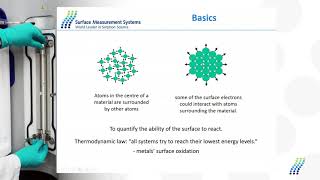
Dr. Burnett explains inverse gas chromatography, a technique that measures surface energy and its heterogeneity across powders, fibers, and plastics. IGC uses probe vapors and retention time to break surface energy into dispersive and acid-base components, helping predict wettability, powder flow, and adhesion in composites.
Chapters
Okay, Brad, thank you very much. I think I'm live here now, so everybody should be seeing my screen. And the presentation will start momentarily. So thank you for your time, and good morning, good afternoon, and good evening to all of our participants around the globe that are listening in today. Just to start the presentation and to set some framework of where inverse GC fits in the materials characterization toolbox. As I like to say, in general, these solid materials characterization techniques can use energy as a probe, heat as a probe, or molecules as a probe. All of these techniques basically look at how heat, energy, light, or molecules interact with the material, and then we can learn thermodynamic, structural, analytical chemical information about the solid material. So where surface measurement systems instruments are focused are using molecular probe techniques. So these techniques are based off of mass transfer, whereas a lot of other techniques are based off of energy transfer. So in general, we're looking at how a molecule interacts with the surface or a bulk of the sample. And then we can get thermodynamic chemical or structural information from that. In essence, with molecular probe techniques like inverse gas chromatography, which I'll be talking about today. In addition, dynamic vapor absorption, which we also specialize in. But other techniques like BET nitrogen absorption or chemisorption equipment would fall into these molecular probe techniques. Essentially, we look at. Our company focuses on vapor molecules, but this would be the same for gas molecules. We see how a molecule interacts with the surface. These can be adsorbed on the surface or absorbed into the bulk, and then how these come out. So we're looking at the interaction of a molecule. In this case, we're going to use vapors of different chemistries and orientations and functional groups, how that interacts with the surface. And as they're desorbed, we're going to measure that retention time in inverse gas chromatography. So for those of you not intimately familiar with inverse gc, the main difference between analytical GC and inverse GC is that we invert the roles of the stationary and mobile phase. In inverse gc, we have a column, typically a column. It could be a film, it could be a fiber, it could be a granule. There's lots of different morphologies we can work with, but in essence, we have a carrier gas, nitrogen or helium, and then we inject a probe molecule with, with known properties and measure the retention time of that probe molecule as it travels across the surface of the material of interest. So we still use retention time as the fundamental measurement, but now we're going to See has this retention time changes with respect to temperature, flow rate, humidity and or the molecular size and or chemistry of the probe molecule, we can then use that to back calculate physical chemical properties about the surface. So with any inverse GC technique, since the material and the column is different every time you run a sample from a GC standpoint, we have to normalize that particular sample and we do that with every experiment by using an inert molecule. In our instrument we typically use methane. Other tech instruments may use argon or krypton as an inert molecule. This measures the retention of dead volume for the column of interest or the sample of interest. And then all other probes are referenced from that dead volume, we're looking at basically the net retention time and we're looking at that net retention time and as that changes with either different molecule. So going from hexane to heptane to octane, which we'll be doing for surface energy experiments, in other types of experiments, the variable might be column temperature, column flow rate, cross sectional area of the probe molecule, or some other variable. So one quick slide on the basic fundamental equations for inverse gc, it's basically boils down to this equation here, where we have the retention volume, which is the volume of carrier gas that was used to push that sample across the surface that is directly related to the Gibbs free energy. And then that gives us access to a wide range of physical chemical properties, in particular the surface energy, which we'll be talking about today. Just to give some historical perspective of inverse gas chromatography, it is a technique that SMS did not invent, but we pioneered the commercial development of this product in the late 1990s. But this is just showing basically a histogram of number of listings in a Google Scholar search of the term inverse gas chromatography with a number of publications by year. So the technique inverse CAS chromatography has been around since the 1950s or 60s. It may have been called reverse phase chromatography or other names, but inverse chromatography you can see over the last 15 to 20 years has seen a significant increase in the number of publications per year. This is a little bit outdated, but up to 2015, you know at least about 400 publications per year with significant growth. Although it is a bit of a niche technique, it is growing and becoming more important. Today's talk will focus on surface energy, which is the most commonly measured property by inverse gc. You can measure other properties like heat absorption, surface areas, you can measure solubility parameters and whatnot but today we'll focus on surface energy. It's analogous to surface tension of the liquid and is defined by the excess energy at the surface compared to the bulk of the material. So in the bulk we have all these nearest neighbors in three directions. But at the surface we have all this free energy due to the lack of atoms on the surface away from the material compared to the bulk. Typically, surface energy is divided into two components. This is based off the folks principle and is well established both in inverse gas chromatography and contact angle and other surface energy techniques. The dispersive component is measured by the London van der Waals Lifschitz interactions in an IGC experiment. This is determined by using a series of nonpolar molecules of straight chain alkenes. The interaction of these nonpolar molecules then will give you the nonpolar or dispersive component of the surface energy. The Lewis acid base component is dipole, dipole and other short range interactions. In inverse gc, this is very often determined by the interaction of two monofunctional or monopolar solvents. So we can get the acid, which is the gamma plus number, and the base, which is the gamma minus number, combined, they give us the acid base component to the surface energy. So again, according to the folks principle, these are additive. We can get the total surface energy by measuring the dispersive components and then the acid base components. Now, what can affect surface energy? Why do people care about surface energy? What are they trying to learn when they're measuring surface energy? Just the next few slides showing some cartoons and some correlations that surface energy can have. So if you have this pink rectangle, and if I increase the surface energy of that surface, I will increase the wettability of a given liquidity. If I think of a powder, if I increase the surface energy of the particles, changing nothing else, I will increase the cohesive forces. And that can lead to things like reduced powder flow, agglomeration, sticking. But basically particle. Particle interactions will increase as the surface energy increases. Very often a unit operation could be milling or grinding or etching or blasting, and that is done to typically change the surface chemistry or reduce particle size. Now, if we ignore particle size changes or anything else and we just look at the effect of surface disorder, very often I will increase the surface energy because I am exposing buried interfaces, creating defect sites, amorphous sites and things like that. And then finally, if I'm interested in adhesion, so the interaction of two different surfaces, if we have our model surface, which is the larger particles, and If I increase the surface energy of the larger particles, I can overcome the cohesive forces of the smaller particles and I'll get better inter particle adhesion as I match the surface energies of the two different materials. This could be a fiber with a polymer, could be two powders, basically any two surfaces. The work of adhesion is related to the surface energy of the two components. People often ask what's good, a high surface energy or a low surface energy? Well, it depends on the application, what you're trying to do, what you're trying to learn about your material. Sometimes you might have a low surface energy material, say polyethylene or polypropylene or Teflon or something. And you may want to increase the functionality by plasma treating, chemical etching, sandblasting. So another surface might stick to it, let's say a paint. So think of a car bumper that's a polymer. Very often it's non polar and low energy, where the paint or the coating you're trying to put on might be highly polar. So therefore we have to increase the functionality of the surface. So therefore we get good adhesion. On the flip side, you might have a very high surface energy material, say a carbon nanotube. Other nano silicas or nanomaterials may have carbon blacks. Activated carbons may have extremely high surface energies. If you put those powders into some matrix, like a polymer with the high surface energy, those powders will tend to agglomerate and stick and will not disperse into the matrix because they want to stick to themselves. So in this case, you may want to decrease the surface energy by silanizing, by waxing, by coating, or somehow relaxing the surface such that it interacts with the other materials you want to interact with. Surface energy very often can have a direct linear correlation to a bulk property of a solid or a mixture. This is very often the case when you're looking at powder flow or agglomeration or sticking. Sometimes it can be a very complex relation, particularly if you have a multi component system, or it's ultimately a bulk property you're looking at where the surface may only play a minor role in that interaction. Or in some cases, surface energy has no relation to the final property. Much like other techniques, it does not solve all the problems, but it can give you some insight to your materials and if the problem is related to the surface. Very often IGC and surface energy are the very few surface dominated techniques that can shed some light on what these challenges might be. I did mention contact angle previously, and that is probably A bit more mainstream and well known way to measure surface energy. If you have a flat, homogeneous, non porous surface, contact angle is quite reliable and works quite well. However, if you have a powder or a granule or a fiber, or a porous surface or a rough surface, it can be very difficult to get well defined and reproducible contact angles. And in worst case scenario, like we see in these pictures here, within 1000 milliseconds or 1 second, this liquid completely swells and dissolves into this mannitol compact. So for powders and porous materials and rough surfaces, IGC can be quite useful in getting reliable and realistic data for surface energy. One other aspect of inverse GC compared to contact angle or other measurement techniques, liquid based techniques, they will give you a signal value for surface energy, which is typically an average value. Inverse GC has the ability to get a range of surface energy values over a range of surface coverages which allow you to get an energetic heterogeneity, essentially an energy map of the surface. And this is done by doing experiments at different coverages that allow you to get the surface energy as a function of surface coverage. And it can shed some light on how energetically homogeneous or heterogeneous your surface may be. As I mentioned previously, to measure the dispersive component of the surface energy, we use a few non polar straight chain alkenes. And there's a couple different ways to do this. The Schultz method or the Doris and Gray method. Either of them will give you the dispersive component of the surface energy, gamma D. Then you can use some acid base, these are Lewis acid base vapors and they can give you the acid base components. I'm not going to go into detail of all the different acid base theories. If you have questions or specific things with that, please message us or send us in the chat. But the bottom line is you inject a few non polar molecules to get the non polar surface energy, then some polar or acid base molecules to get the acid base component of the surface energy. And then once you know the dispersive and acid base components of the surface energy, you can calculate the work of adhesion, which is the thermodynamic interaction between two dissimilar surfaces, or the work of cohesion, which is the thermodynamic interaction between two similar surfaces. And then it's this very often when you're looking at a mixture or a composite or a blend, it's the balance between the cohesive forces and the adhesive forces that can be important. So moving on to some data and some examples which will take up the bulk of the remaining time here. If you've seen some SMS seminars, you might have seen this data before, but it's a classic example that we show how just changing the surface chemistry of a material can change the surface energy of a material significantly. So we have two different powders. This is a as received mannitol. And we can see the as received mannitol is energetically heterogeneous, surface energy values ranging from 50 down to about 40 millijoules per meter squared. And then we take this same sample, so same particle size, same surface area, same crystal structure, and we silanize it. So we coat it essentially with methyl groups and we've gone from an energetically heterogeneous surface. This is due to the different crystal planes within the mannitol. And then we've normalized that surface to make it energetically lower and energetically homogeneous. And this is the same for the dispersive component of the surface energy and for the acid base or specific component of the surface energy. Where again, we go from an energetically heterogeneous surface to a energetically homogeneous surface. Nothing else has changed. Again, these are the same particle sizes, same surface areas. They haven't been milled, they haven't been mechanically treated. Just by surface coating the material, we can significantly change the surface energy of this. And then this could lead to changes in powder flow or other bulk behavior. So, moving on to a different example, which the next few minutes will briefly go through some other case studies. And again, if you have specific questions about this, we do have either case studies, application notes or papers on these studies. And if you want the full details, we can give that to you offline after the meeting. So here we are looking at these are actually planar surfaces. So these are not powders, these are not strips. These are basically a flat planar sheet of material. And these were used with our film cell accessory. And these were to look at on the same surface, some just general surface treatment or surface cleaning, how that might affect the surface energy of this. So we did this with an aluminum surface and we took the aluminum as is, and then we bleached the aluminum surface and then treated it with a nitric acid. And we can see that by treating it with a nitric acid, we make the dispersive surface energy both higher in energy and more energetically heterogeneous. Same thing for a Teflon surface. We took the Teflon surface, we bleached it, and then treat it with nitric acid and we made it from an energetically homogeneous surface to an energetically heterogeneous surface. And when we look at a little bit more detail on the acid base component of these surfaces on both the aluminum surface and the Teflon surface, by bleaching and treating it with nitric acid, both of these cleaning methods have essentially increased the wettability of these hydrophobic surfaces. So the raw surfaces had a relatively low acid base component to the surface energy you can see here and here. But by bleaching and or treating it with nitric acid, we've increased the acid base or polar functionality of the surface. Therefore they would be more likely to wet than the raw material. Moving on to another surface treatment example, we looked at two variables on a AS4 carbon fiber, this is an off the shelf carbon fiber. And we looked at surface treatment. So we just looked at a sized versus an unsized carbon fiber. And then we also looked at the pre exposure conditions. So just measuring them as is at room temperature or 30 degrees C and then measuring them again after they've been heated to 120 degrees C. So on this slide it's a little bit busy, but we can see here, this is the dispersive surface energy. And if we compare the yellow and blue, these are the sized carbon fibers. And we can see that compared from the sized carbon fibers to the unsized carbon fibers, which are this red and pink, we can see that the surface energy is quite a bit lower and quite a bit more energetically homogeneous. So clearly the sizing agent passivates the surface or lowers the surface energy of the carbon fiber by coating the high energy sites. And we also make it more energetically homogeneous. We can convert these profiles to basically a population density. To look at another visual way to express the energetic heterogeneity of these surfaces, we can see here for the sized carbon fibers, with or without pretreatment, not a significant change in the surface energy. But we can see that they are energetically homogeneous as they have a more narrow distribution of surface energy sites. When we look at the unsized carbon fiber. So the raw carbon fiber, this is the data without pretreatment, this red one is after treating to 120 degrees C, we can see the temperature effects have a much larger effect on the untreated sample. Most likely because at room temperature, some of these high energy sites might still be adsorbed with water or other surface contaminants. By heating them up to 120 degrees C, we can activate these sites or expose These surface sites, such that we now get a much broader and higher energy distribution of surface sites. So we can see here both chemical treatment and thermal history can have a significant effect on the average and distribution of surface energy sites. The next study is looking at a composite. So we are looking at some filler materials in a polyurethane matrix. So we measured the surface energy values. These surface energy values were taken at infinite dilution. And we looked at a nanoclay in red. This is the dispersive value. This shaded area is the acid base component. And then looked at this nanoclay, and then it was functionalized with isocyanate groups. And we can clearly see we go from a very high surface energy material to a much lower surface energy material. On another nanomaterial, we looked at a multiple wall carbon nanotube. This is the as received carbon nanotubes. And these are after they've been oxidized. In this case, this chemical treatment increases the surface energy of the carbon nanotubes for the nanoclays. The functionalization decreases the surface energy. So we measured the individual components of these nanofillers and of the filler material itself, of the matrix material, polyurethane. And if we apply the work of adhesion and work of cohesion calculations, we can use this to predict which ones would make a better composite. What we can do is look at the work of adhesion, which is the nanotube, with the polyurethane, and compare that to the work of cohesion, which is the likelihood of a nanofill, were to stick to itself. We look at this ratio of adhesion to cohesion, and the closer this ratio is to one, we would predict better interaction between the nanofiller and the matrix, and ultimately it would make a better composite. So from these predictions here, we would expect that the functionalized nanoclay, which had a lower surface energy, would make a better composite than the as received nanoclay. On the flip side, the as received multiple wall nanotube should make a better composite than the functionalized, which had a higher surface energy, which led to a higher work of cohesion. So to investigate that further, our collaborators at NIST made the composites and did some mechanical testing of that. And here we can see that the as received nanotubes made a better a stronger composite compared to the functionalized nanotubes predicted from the surface energy values alone. And we see the same thing from the functionalized nanoclay. It made a much stronger composite compared to the as received. So we can see that the predicted behavior of the composite as measured from the individual components did correlate well with the actual composite performance. Now, clearly that's just one variable. Loading and other variables, how they're dispersed and whatnot, could affect adhesion to a greater degree. But certainly surface energy and surface chemistry plays a large role. The final study I'd like to look at is looking at some thermoplastics, and these were basically some polyolefin thermoplastics at different elastomer loadings and with different densities. And we use inverse GC to calculate the surface energy. These different polyolefins. We wanted to see how that correlated to a mechanical property of actually painting these polyolefins and measuring the adhesion of the paint to the surface. These polyolefin TPO samples were painted with a topcoat. And our collaborators at Ford at the time did some comprehensive shear delamination testing as a way to measure the mechanical adhesion. The inverse GC data would look at the thermodynamic or the predicted adhesion, and then the shear delamination apparatus would measure the mechanical adhesion. So we plotted the surface energy as a function of the attraction force. And we can see a relatively general trend is as we increase the surface energy of the polyolefin, we increase the force required to remove the paint. So higher energy, in this case led to the paint sticking better to the surface. And if we also look at surface energy as a function of micro hardness, the increased crystallinity, we can see that the higher the crystalline material, the lower the energy and also less likely for it to stick. So we can see then it could be related to the crystallinity of the surface, which then could also lead to things like swelling or dissolving or capillary forces as well. So again, we were able to use a thermodynamic property to predict a mechanical property in this coated sample. So I'm about out of time. I'm at my 30 minute limit here and I'd like to thank you for your time and attention. I'd like to thank our collaborators, particularly within sms, London, Imperial College, NIST and Ford, for some of the studies that we've shown here today. And as I mentioned, all of these are available as application notes or as papers that we could send you offline if you're of interest. So I'll pause there and I'll turn it over to Brad to see if there's questions that came up during the chat or if there's anything we can address at this time.
So there's no questions in the chat, but I am going to unmute everyone and if you have any questions that you would like to ask, now would be the time to ask.
Okay, I see a question there to look at the crystallinity again. Right. I see Pavani had asked a question, I believe, about that in the, in the chat. So this is basically measured by micro hardness, and this was the surface energy. So it was determined that the. Or you can see a trend that the higher the crystallinity, the lower the surface energy and the lower the crystallinity or the more amorphous the sample is. It might be. The chat might be the best way to do this. But I do see another question in how does the sample shape and size change the surface energy or surface area measurements? That's, that's a very good, very good question. In general, if the surface, if size is the only thing that changes, you will get the exact same surface energy. Surface energy is a energy density, millijoules per meter squared of that surface. So if I had a glass beer of 1 micron, a glass sphere of 10 microns, and nothing else has changed, I will get identical surface energy. In reality, what often happens when I have a large particle and I want to make it into a small particle by milling or grinding or blasting, I expose different surfaces and I induce disorder. I will get different surface energy values. Also, if you think of like the shape, if it's a needle like structure and I make smaller and smaller and smaller needles, the end planes make a higher contribution to the surface energy of the material. So the fundamental measurement does not affect it by surface shape or size. But in reality, very often the surface energy can pick up changes in surface aspect ratio or surface or particle size. But that's because the actual surface is changing. Not that the technique doesn't work. I think I did see another question about using nitrogen as a carrier gas. We can use nitrogen as a carrier gas. Now, all of our new instruments, by default, are shipped with nitrogen. If you have an instrument that is with helium, you would have to contact us about changing it over to nitrogen. Some of our older instruments, it's merely somewhat depending on the exact model. We used a few different vendors of mass flow controllers. There's two different pathways. One requires new mass flow controllers to be installed, and one requires just some different gas correction factors. So you'd have to contact us. You can contact us at supporturfacemeasurementsystems.com or scienceurfacemeasurementsystems dot com and we can give you that information, you'd have to look up the serial number of your instrument and we can tell you directly the two different pathways we could upgrade to nitrogen as the cost savings is significant these days.
Dan, there was a question. Can you explain again how we're measuring to work with adhesion versus work of cohesion for powders?
Sure, we can do that. So if I go back up just to this equation here. So the work of cohesion is just based on the surface energy of the one material. So this would be. If I have material A and material B, the work of cohesion would just be of material A. So the likelihood of material A to stick to itself. So I measure the surface energy of material A, I can calculate the work of cohesion. If I want to measure the work of adhesion, I measure the surface energy of material A, also the surface energy material B, and that gives us the work of adhesion. So if you're thinking about a powder blend, it's very often a balance between cohesive forces and adhesive forces. So that's why we look at the cohesive forces, which is the surface energy. It's based off the surface energy of just the one material. Let's say that's a carbon nanotube and we want to put it into some other material, starch. I'm just making up things here as we go along. But we measure the work of cohesion of the nanomaterial and then we might compare that to the work of adhesion of the filler material with the matrix material. Then it's that ratio or that blend or that balance of forces. Ideally, if you want a uniform blend, you would want the work of cohesion to be close to the work of adhesion, because on the vice versa, if the material itself is very high surface energy, the cohesive forces will be quite strong and those powders will tend to clump, agglomerate and stick together rather than being dispersed evenly within a powder blend.
Someone else had asked, do you find any significant differences in surface energy in crystalline polymorphs?
I would say we have seen that in the past. I would not say it's an across the board rule. And it's also not necessarily across the board rule that the lowest thermodynamically stable polymorph has the lowest surface energy. So there were some several papers published by Peter York's group on different surface energies of polymorphs. That was when he was at the University of Bradford several years ago. If you let us know, I can send you some copies of that if you maybe give that information to Brad or you can look it up, but surface energy of different polymorphs has been identified. But I wouldn't say that it's an across the board that they will always be different and that the lowest thermodynamic polymorph always has the lowest surface energy.
Someone else asks, is there a retrofit for older IGC systems.
By older IGC systems? The systems that were based off of the 6890 Agilent platform, there's no way to upgrade those to any of our current technology. If it's retrofitting an older, what we call the inverse GCSEA model, we can upgrade that to different mass flow controllers to work nitrogen, if that was the question. If you have an older instrument, I would recommend contacting your local person who's in charge of your territory to see if there's any trade in options. But we really, there's nothing we can do to upgrade the instrument that's based off the 6890 platform, which was our first generation instrument, which we stopped making in about 2009, 2010.
Someone else asked if we can get a copy of the webinar after this and absolutely we can.
Yeah. So Brad, we are recording this and I believe you will send out a link to the participants after the meeting once it's recorded and uploaded. Is that correct?
That is correct. Someone else asks, when would you Recommend using octane vs heptane or smaller alkane? For context, I was looking at surface energy.
Well, whenever you're measuring surface energy, you use a range of alkanes. Typically the rule of thumb is that for every alkane you go up, the retention time doubles. So if Octane takes 10 minutes to come out, Nonane will take 20 minutes to come out and then Decane would take 40 minutes to come out. So it's a balance between getting data that comes out in a reasonable time with that. Most of the time what we recommend is probably using heptane C7 up to C10. So heptane, octane, nonane, decane as a place to start and then you would have to adjust accordingly. There is some method development that would apply, but if you're looking at surface energy of powders, I would typically recommend we try to get about a half a meter squared of total surface in the column and using C7 to C10, if it's a surface area you're looking at, if you're looking at low surface area materials, you would want to use higher alkenes and vice versa. For high surface area materials, would you.
Recommend using butane or something smaller? If our powders are closer to 55.
Microns, we can run 5 micron powders as is. Our system is not equipped for butane because that's a gas at room temperature. Our instrument is only set up to inject vapors. So the smallest alkene we could use is pentane. We have used pentane. It does work. So from a practical standpoint, you can use pentane up to about dodecane in terms of your straight chain alkanes. But even if your powders are sub micron size down to one micron, we run those previously. The only thing you might have to worry about is pressure drop down the column. But we can work with you to help with those challenges. But I don't see anything that would stop you from using pentane or hexane or heptane or octane with five micron powders. It shouldn't be a problem. We've done it previously.
Are there any other questions that we would like to discuss?
Let me just, just go back to the beginning slide and just to highlight, you can message me directly or email me directly. D burnetturfacemeasurementsystems.com or if you just put scienceurfacemeasurementsystems dot com that'll go to our science team and we can answer any questions offline. If you have something that comes.
All right, well, go ahead.
Yeah, you will get the webinar recording people have asked. That'll be. We'll have to upload it and give you a link to that in due course and Brad will send out that or the marketing team will send out that information to the attendees.
Okay, well we would like to thank everyone for joining us today. We hope you found today's topic useful. If you wish to know more about surface energy and IGC, please visit our website at www.surfacemeasurementsystems.com. for more info on IGC or SEA, email inforsurfacemeasurementsystems.Com and we want to thank everyone for attending today. So thank you very much.
All right, thanks for your time and attention. Have a good it.
More from Prof.

Webinar: Advances in Measuring Gas and Vapor Permeation Through Membranes and Barrier Polymers

Webinar: Determining Solubility Parameters of Bacterial Cellouse Through Energy of Adsorption

Online Webinar: Recent Technological Advances in Adsorption Based Direct Air Capture

Online Webinar: Surface Area of Pharmaceutical Ingredients at Real World Conditions by IGC



Hybrid Workshop: Measuring Material Vapour Pressure Properties Using Advanced Sorption Technique

PCL Hybrid Workshop: Recent Advances in the Characterisation of Pharmaceutical Powders


Using Advanced Techniques to Test the Performance of Recycled Bathroom Tissue | A video summary
