Webinar: BET Surface Area Measurements by Sorption Methods at Ambient Conditions
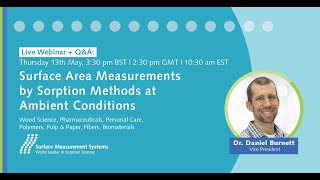
Dr. Daniel J. Burnett explains BET surface area measurement at room temperature using Dynamic Vapor Sorption and Inverse Gas Chromatography instead of cryogenic nitrogen methods. These techniques handle fragile materials like freeze-dried biologics and can detect surface areas as low as 0.1 m²/g. Case studies show how humidity and sample preparation affect results in pharmaceuticals and cellulose.
Questions this video answers
Approximately 0.05 to 0.35 (P/P0).
Micropores: below 2 nm; Mesopores: 2–50 nm.
Liquid nitrogen temperature: 77 K.
About 0.1 m^2/g.
CRM examples with certified BET values ~1.05 m^2/g and ~2.95 m^2/g.
Chapters
Hello everyone and thank you for joining us for today's Surface Measurement Systems Live webinar exploring the topic BET Surface Area Measurements by Sorption Methods at Ambient Conditions. We're very lucky today to have the Vice President of Surface Measurement Systems North America, Dr. Daniel Burnett, here to discuss this topic for us. Before we progress with the presentation, I would just like to remind our attendees a few of the house rules for the event. We would ask that everyone keeps their microphones muted throughout the presentation just to avoid any background noise or feedback disrupting the listening experience. And we would like to let you know that there will be a live Q and A at the end of the session and there are two ways you can engage in this. There is a questions panel wherein you can submit your questions in writing and then I will pose these questions to Dr. Burnett at the end of today's presentation. Or alternatively, if you have maybe a bit of a longer question or a technical question you would like to ask the doctor directly yourself, you can raise your hand and when the time comes I will let you know you can unmute your microphone and you can engage the doctor directly with your question. So just to remind you, you can submit your written questions in the questions panel for us to ask, or you can raise your hand to unmute your microphone and ask the question yourself. So please do keep that in mind with any questions you have on this topic and any questions that come up throughout in the course of the presentation. As mentioned, our presenter for today is Dr. Daniel Burnett. Dr. Daniel J. Burnett is the Vice President for Surface Measurement Systems North America and that is located at our North American headquarters in Allentown, Pennsylvania. His team works on research studies and science applications for many prominent companies. He received his Bachelor's Degree in Professional Chemistry from the Eastern Michigan University in 1997 and a PhD degree in chemical Engineering from the University of Michigan in 2001. Dr. Burnett has authored and co authored over 25 papers in peer reviewed journals across his career and presented at numerous national and international conferences. And he will also be speaking at some of the first, live and a lot of virtual conferences this summer. So keep an eye out on our website in future for how you can where you can catch Dr. Burnett speaking. So without further ado, I would like to hand over to our speaker for today and give him the reins to make his presentation.
All right. Thanks John for the introduction and good morning, good afternoon and good evening to those of you attending. So I'm just going to have my screen shared here, so let's get this in presentation Mode and. Right. Okay. So thank you very much. As mentioned, I'll be talking about BET surface area measurements by doing these via sorption methods at ambient conditions. So just as a very quick background, any classic BET measurement, which I'll get into a little bit of the background and theory in the next few slides, is based on the absorption of a gas or a vapor or some sort of molecule. So the sample of interest, as in this blue rectangle here, is exposed to some vapor or gas molecules. We're looking at how those molecules in particular to BET surface area, how they adsorb on the surface. However, it is possible for gas and vapor molecules to absorb or dissolve or swell into the bulk of the sample and then potentially how these molecules are out. So we're going to use a molecule. In today's case, we'll be talking about vapors. Some of the classic vet approaches use gas molecules, but the theory and the fundamentals are exactly the same. So for those of you not familiar, the way to get access to the BET surface area is by generating a gas or vapor absorption isotherm. There are, this is one of the older IUPAC classifications of isotherms. There are newer classifications of these, but for the general purposes of this talk, we can use this as a frame of reference. Essentially you have the amount absorbed on the x axis versus the pressure of the gas or vapor phase adsorbate on the y axis and the isotherm will give one of various shapes. These are for pure materials. Some real world materials may give a combination or some hybrid isotherm shape that's not shown in these classic sorption models. If you want to apply the BET equation, you have to make sure that the isotherm is of the right shape or size or type. So you have to have what's typically classified as a type 2 or type 4 isotherm to appropriately apply the bet equation. Unfortunately, the bet equation is a linear equation and very often can give sometimes linear results with a good R squared to isotherms that are not of the right shape. But you can get an answer. So it's very important to make sure that first your isotherm, which I'll show you some examples later, is of the right type to make sure you're applying the right equation. So the model only applies if the gas or vapor is absorbing on the sample in the appropriate manner. So here's just a general isotherm showing a continuum of different regimes. If we're talking about porous materials, or it could be non porous. But in General, different regions of the isotherm can give us different information about the geometry or structure of the material of interest. If your material is microporous, which means it has pores below 2nm or 20 angstroms, typically these features are at the low partial pressure regime. The surface area is typically between 0.05 to 0.35 P over P naught. And that's typically where the classic bet range is applied, in this region here, where the molecules begin to form a monolayer. And I'll show you that in some cartoons later. If my material is mesoporous, which means that it has pores between 2 and 50 nanometers or 20 and 500 angstroms, that's not an absolute cutoff. It can go a little bit beyond that, but that's typically what's considered mesoporous by the definition. However, it can measure some pores above that range, but that is typically in the intermediate partial pressure range, maybe from 40 up to 80 or 90% P over P knot. So, as I mentioned, the isotherm shapes, and these are based off of adsorption models only. So this is where the molecules only sorb on the surface. They do not penetrate or swell into the bulk. So just keep that in mind. And there are a wide range of isotherm models that are available. This is only a small snapshot of them. There are many, many. The BET is probably the most famous and well known and well used isotherm model because it gives us access to the BET surface area, which is used to learn about the surface area of powders or fibers or particulates or granules or films, and is quite useful to understand and fully characterize material properties. But please keep in mind that these are for surface absorption only. Here is just a. You know, the original bet model has been around since 1938, so certainly I'm not presenting on anything new or groundbreaking today. This was developed by Brunhauer, Emmett and Teller, you know, nearly, you know, going on 80 plus years ago. So it's been in the literature for quite some time. Essentially, if you generate the isotherm, you can apply the BET equation here. And from the BET equation we can get the C constant, which is related to the heat of adsorption. Essentially, the bet equation assumes that the first monolayer, which is this e1, has one absorption enthalpy and every subsequent layer has a different and the same different from the first layer, but every layer is the same after that. So the C constant is related to the heat of adsorption and then this monolayer V sub M, which is the monolayer, the amount of vapor or gas to cover the monolayer of the surface can then be directly related to the BET surface area, which is what we're ultimately trying to get and understand and learn about the materials. So, pardon my cartoons here, but basically what we can look at is as we go up in pressure, so we go increasing pressure here. Initially, the first few gas or vapor molecules will find the highest energy sites in the surface, and then they will fill until eventually we get a monolayer. So this is the assumption of the BET equation is that the molecule and the material of interest will form a monolayer. Now, this is a function of both the material and the adsorbate. So not all sorbates and not all materials will form a monolayer. So this is very important. In classic nitrogen or krypton volumetric processes, this is a pretty good assumption. And most materials will form a monolayer. However, when we deal with vapors and gases with different chemistries, this may not be the case. So this is why it's important to make sure that the material will form a monolayer, and that will be determined by the isotherm shape. So we can tell from the isotherm shape that we have the right adsorbate solid interactions, and we can apply the right equation. And then the BET equation assumes after that first monolayer, everything grows layer by layer by layer. So it's essentially like snow falling on top of a ground. It just piles up on top. And each of these layers are identical in terms of the thermodynamics. So, just to summarize the BET equation, it assumes surface absorption only. It is only applicable to a type 2 or 4 isotherm. It assumes that the first layer is filled, then grows layer by layer. And the classic BET range is 0.05 to 0.35. However, this range can vary depending on the absorbate and the surface of interest. So although this is what's typically applied, as long as the range is linear and you get a positive C constant, those are things you can vary in the P over p knot range to apply the model correctly. So we can directly measure the BET surface area of the sample. This can be done volumetrically or gravimetrically or even chromatographically, which I'll show you next. This is just a general. You certainly can get surface areas below 0.1 and well above 1000, but just to show you a range of values of most materials of what they may be. So certainly point zero one up to, you know, several thousand meters squared per gram. One thing that is critical if you want to get the absolute BET surface area, the preheating, the drying or outgassing conditions are critical. So if I don't remove all of the surface contaminants, I will not get a true surface area. However, I may want to get the surface area as the native material stands. I may not want to dry it out completely. I may want it partially hydrated. I may not want to bake the sample out to remove everything. But just be aware that I can get different surface area values depending on my drying and or preheating conditions. So as I mentioned, the output is the BET surface area, typically in meters squared per gram. You get the monolayer capacity and you get the absorption constant, which is related to heat of absorption. So there are some international standards in terms of determining the BET surface area. These standards are applicable and used for both. This particular standard is developed for both volumetric and gravimetric techniques, and they use that to get some BET standard materials. It does not require that you use nitrogen or krypton. Although nitrogen is by far the most commonly used sorbate to measure BET surface areas, as long as you know the cross sectional area of the molecule of interest, then you can calculate the BET surface area, again assuming that it has the right isotherm interaction with the sample. So, so you can use a range of molecules. You do not have to use nitrogen or krypton or excuse me, or argon. You can use water, octane, heptane, benzene. As long as we know the cross sectional area of that particular gas or vapor, then we can apply the BET equation. So although by far the most widely used technique is a volumetric technique using either nitrogen, or for very low surface area materials, using krypton, it does have some limitations. Number one, if you're using nitrogen, typically about 1 meter squared per gram, below that, you can certainly get information and values, but the error margins tend to increase. If you need to measure very low surface area materials by volumetric techniques, you typically have to go to krypton or other things. This isn't a hard cutoff, but it's the. It's a general type of you can certainly get values, but the again, the error margins tend to become larger compared to the absolute value of the material. In addition, to do volumetric techniques, you have to typically go to very low pressures, I.e. vacuum conditions, vacuum drying. So you have to expose it to the millitor, or sometimes even 10 to the minus 6 torr to completely dry out the sample. And for these low pressure conditions, if I have some fragile materials, such as, you know, maybe a pharmaceutical hydrate, cellulose, some polymers, some soft porous materials, these, these very dry or low pressure conditions can change the structure of the material. It can cause pore collapse or cake collapse or other dehydration. That may not be what you actually want to do. So just by running these experiments at very low pressures, I could change the material and I'm not getting the native surface area of the material I want to study. In addition, these techniques typically require you to push the sample down a long tube all the way down to the bottom into a certain bulb at the end. It's not insurmountable. And I'll show you. Obviously for inverse gas chromatography, you do have to put it in a tube as well, which I'll show you in a little bit. But sometimes just pushing or agitating the sample all the way down, this could crush the sample, could change the material. And some things are very fluffy and sticky and hard to get down there. And also it does have some geometric limitations, although there certainly are BET flasks and tubes of different sizes to accommodate large macroscopic samples. So those are some of the limitations. In addition, all of these experiments must be done at cryogenic temperatures because nitrogen will not sorb at room temperature, typically on most materials, or not absorb in significant amounts that we can measure it. So therefore they have to go down to liquid nitrogen temperatures 77 kelvin. And again, those conditions can be deleterious to the structure of some fragile materials. So some atmospheric based techniques that can be done and measure the BET surface area at room temperature and room humidity or elevated temperature or elevated humidity include dynamic vapor absorption. This is a gravimetric technique based on the essentially measures the we make step changes in the vapor pressure that's shown in the dotted line. And then from the equilibrium mass uptakes, we can construct the adsorption in solid blue and the desorption in dash blue isotherm. Now just to make a note, this is water absorption on a polymer film. And if I look at the shape of this isotherm, it is not a very clear type two isotherm. Number one and number two, we do have some hysteresis across a broad humidity range. So this is indicating that I have significant bulk absorption, not just surface adsorption. So I wanted to highlight this because water is typically not a very good molecule to use to measure bet surface areas. Number one, for a lot of natural or polymer or amorphous Materials, Water has a significant bulk absorption contribution. Water is highly polar. So water doesn't always like to form a monolayer on the surface. So just be mindful that again, just because I get an isotherm, it has to be the right shape, the right mechanism in order to apply the BET equation. But we can certainly use a wide range of molecules like cyclohexane or octane or nonane or other molecules that will form the right shape and will be dominated by surface adsorption instead of bulk absorption. So another technique that can be used to measure isotherms and subsequently BET surface areas is inverse gas chromatography. Inverse gas chromatography. Sample is put into a column or a tube. We inject a pulse of a vapor or gas. From the retention of that pulse, we can construct the isotherm. And then once we get the isothermic, as you see here, we can get the BET surface area. So essentially, any method to measure an isotherm can be used to determine the BET surface area as long as the isotherm is of the right shape. So some of the advantages, and to be quite frank, if all I ever wanted to do was measure BET surface area, you know, these techniques will. The volumetric techniques can be perfectly applicable to a wide range of materials, particularly rigid materials, things that don't really care what temperature they're at or what pressure they're at. They won't change with temperature or pressure or outgassing conditions. But for a lot of organic or polymer materials or pharmaceutical materials or food materials, these harsh conditions can dramatically affect the structure of the material. And I'll show you some examples of that moving forward. So the advantages of using DVS or IGC is that we have full control over the sample temperature conditions. We don't have to run them at cryogenic temperatures. We can outgass them or dry them if we want to, but we don't have to. We can do them at atmospheric pressure. We don't have to go to vacuum. Again, for some fragile or weak or flexible porous materials, this can be advantageous. We can do them at room temperature or even as a function of temperature. Unique to these particular instruments is that we can do them as a function of relative humidity. So we can look at real world atmospheric conditions and see what is the surface area or apparent surface area of the material. When I have moisture present, and this can be important when I look at hydrated materials, I'm trying to look at real world processing or storage conditions. And also I can look at water can affect the structure of materials significantly. So I can look to see how water might plasticize different materials. So as I mentioned, you know, for some materials, if I expose them to very low pressures and very low temperatures, in particular the pharmaceutical hydrates, this will completely dry them out. So I'll measure the surface area of an anhydrous form, but it becomes very difficult to measure the surface area of the hydrate. Some fragile crystals might collapse and might change form. And then we do know that some materials can change depending on how hydrated they are. Magnesium stearate is one of them. And also if I'm thinking about some flavor or food or fragrance materials, if I completely expose it to a low pressure, I'm going to remove all of those volatile compounds. And again, I'm not measuring the native material as I might want. And just to highlight that this is a paper that was published in Advanced Powder Technology, and this was using inverse gas chromatography to look at surface area pharmaceutical ingredients. It does say that, number one, they're very low, so you have to use krypton. But there's also potential risk of structural change due to the low glass transition temperature, Whereas IGC done at ambient pressure and condition reduces the risk of changing the crystal form. In addition, inverse gas chromatography and DVs have typically very easy or low sample prep for DVs, just put the sample onto a sample pan. I don't have to pack it down a column or place it down a tube. In inverse gc, I do have to put it in a tube. However, I don't have to put it all the way down the bottom. I can just put the sample into the top of the tube and then run it like that so I don't have to agitate or press the sample all the way down into a bulb area. We don't have to worry about dead volumes as much as we do in nitrogen absorption or volumetric techniques, where the volume of this is critical to the measurements. So it's not necessary to push this down into a bulb at the bottom of the sample. So I can, you know, easily pack a little bit of material at the top of the column, put it in the instrument and run it. So to validate or just to prove that both DBS and IGC can be used to measure BET surface areas, we just going to show some data on some certified reference materials. So here we're looking at a CRM170, which has a certified value of 1.05 meters squared per gram. This is using only about 23 milligrams we measured the uptake of octane of this particular reference material and this was preconditioned for six hours at 100 degrees C. And then you can see here. I'm sorry, this was the. My slide is wrong. I apologize. This is CRM171, which has a BET surface area of 2.95. I'll show you that other data in a second. So here I have it properly on this slide. So Here is the 2.95 meter squared per gram of CRM 171. And you can see here is the bet plot. And the surface area was 2.99. So very good agreement with the 2.95 meter squared per gram for this certified reference material. Switching over to inverse gas chromatography. Here is the certified reference material. This is the 1.05 that I showed previously. And you can see we get 1.01. So again, very good agreement to the literature value. Here is the same IGC results on the 2.95 meter squared per gram. And we you see 2.95. We get 2.95. And we get similar results on the DVS for both the 1.95 and 2.95 meter squared per gram bet surface areas. In general, with any BET measurement, as I mentioned previously, the outgassing is critical. If I don't outgass the samples properly, I will not get the accurate BET surface area. So when comparing literature values or certified reference materials, please make sure that you're using the same outgassing conditions that were used for that reference material to make sure you get accurate and reliable results. So very often for nitrogen absorption, it can be difficult to measure bet surface areas below 1 meter squared per gram. So to highlight some of the utility of DVS and IGC for looking at low surface area materials, I'm going to show some data on DVS on some crystalline pharmaceutical materials and the same thing for igc. So here's a metformin hydrochloride. It's small particles, less than 140 mesh. Here is the isotherm. You notice I've only collected isotherm from zero up to 45% P over P naught, because that's all I really need. All I need is absorption data between 5 and 35 or 10 and 40% P over P0 because that's what's considered the BET range. It's not necessary to measure the entire isotherm, although we do recommend it. And you can see here, here is the bet fit. We get a BET surface area of 0.1 meter squared per gram. And after several runs we get around 0.116 plus or minus 0.005 meter squared per gram. And this is using about 450 milligrams of sample. It does have a very low surface area. So we do need a little bit more than is in a typical DBS experiment. But you can see with less than half a gram of sample at atmospheric conditions, we can get the BET surface area for these highly crystalline pharmaceutical materials. This is looking at some crystalline paracetamol. This is taken from one of our technical notes. We have a full paper if you want to look at this. But this is several runs on several different columns and the BET surface area, the average is 0.28 meters squared per gram. And this is a standard deviation. If you look at all the runs here. And this was only using about 250mg of sample. So with either DVS or IGC using less than half a gram of sample, we can get the surface areas of materials well below 1 meter squared per gram and we can get them quite reproducibly. Here's looking at another paper. This was published by Darrell Williams. Those of you familiar with sms. Darrell's the owner of our company and the founder. He's also a professor at the Imperial College of London and he was using IGC to look at some freeze dried biologics. I'll show you some data later on, but we can see that this was used to analyze the surface area down to 0.1 meters squared per gram, various biological freeze dried materials. So it has the ability to measure very low surface areas. So moving on to some materials that may be difficult or challenging or have some limitations in volumetric techniques, the rest of the presentation will go through some of those applications. So I'm going to look at some freeze dried microcrystalline cellulose. And we measured the surface area by volumetric techniques. So by nitrogen data by gravimetric using the dbs. I'm sorry, not calorimetric chromatographic techniques using igc. So we have the volumetric data was done with the tristar from Micromertics inverse gas chromatography by SMS and the DBS resolution by SMS as well for the gravimetric technique. So we used identical outgassing conditions. As I mentioned, this is critical when you want to compare results to make sure that all platforms or instrumentations use the same outgassing conditions. The BET surface area by the TriStar was done at liquid nitrogen temperatures. The DVS resolution and the IGC were done at 25 degrees C, excluding conditioning. So if you ignore the conditioning time, which was 24 hours for each of these materials to keep them uniform, you can see this is the time scale. So volumetric technique maybe around a little over three hours. IGC about two and a half. DBS was a bit longer on 10 hours. So the techniques do have some variety in terms of how long it takes to measure the BET surface areas, but in the order of magnitude they're all within, you know, a day or a half a day roughly to measure the BET surface area again independent of the outgassing conditions. So here was the freeze dried bacterial cellulose that we did. This was done by Dr. Annette Condor, our IGC Product manager. So just want to thank her for these results before I move forward and also by our team in the uk. And I'll thank them at the end of the talk as well. Who did the DBS and IGC work for this particular study. So here are the octane. We use octane in the igc. This is the right isotherm shape. It has the type 2 isotherm shape. This is just a repeat of three different isotherms you can see on three different samples. You can see that they overlay quite nicely. Here is the TriStar data. Again, it does show the right isotherm shape. If you focus down here, it does have the type 2 isotherm that would be expected. And here is the DVS isotherm. Again, it generally has the right isotherm shape. And this is overlaying three different runs to see we get reproducible data on this particular material. Now, although the isotherms can be measured reproducibly by the three different techniques, the three techniques do differ in the results. In the BET surface area, the volumetric data shows a much, consistently much lower BET surface area compared to the dvs, which is in blue and the IGC which is in green. So IGC and DBs roughly around 67, 65 millimeter squared per gram. Whereas the volumetric data shows a much lower surface area area. So just to, you know, confirm these results and to look at it a bit further, we just looked at, you know, running the same material again with just over and over again with different outgassing, continued outgassing between each run. And we can see again, we see that the. This is a different material. So this is not the same one that was. This is a different batch. This was around 60. This is a different material, different batch. We consistently get the same values. But if we run the same sample over and over again by nitrogen, we see that the results are not consistent. They're consistently lower, but they're not consistent. We see both consistently lower values by volumetric data. And if we see we run the same sample over and over again, we do not get consistent results. Most likely what is happening is that this pore structure of this material is relatively soft. It's a cellulose, it's not a rigid material. So by exposing it to cryogenic temperatures at very low pressures, we are most likely collapsing the structure of this material, thus giving the low and relatively unstable surface area value. So, moving on to some rather unique applications of the particular IGC, but both DBs to look at the effect of moisture or drying conditions on the sample. So this would not even be at all possible by volumetric techniques. So you can't do bet surface area with different moisture contents by volumetric techniques, whereas you can do that chromatographic or gravimetric techniques. So one thing to keep in mind is if you want to get a pure absolute reading of surface area, you'd want to do those under dry conditions. As I have moisture present, I'm going to have water that may block or occlude or swell or do something to the material. So it may be. If we do surface areas at different humidities, it may be more appropriate to call this the effective surface area, because it's basically showing whatever surface is not being taken up by water. This is just showing you a picture, not by our work here, just to show you a picture of some water on some graphene. So we're basically looking at whatever's left over as a function of relative humidity. So to highlight that, we looked at this CRM171 sample again, which is this reference material. At 0% relative humidity, we get 2.95, which is the right value. As we go up in relative humidity, we can see that the measured or effective surface area goes down, and then we get to 90%. RH is about half of what it was. So this is a rigid aluminum material. We're not changing the structure of it. We're basically just blocking the sum of the surface as water may island or absorb onto the surface, and we get an effective surface area as a function of relative humidity. As I mentioned previously, it's not possible to measure, or it could be very challenging to measure a hydrate in its native state, particularly a weak hydrate, under low vacuum conditions. This will typically remove that hydrated water. And I'll show you a couple examples of how we can measure that in IGC and DVS by looking at some two case studies with carbamazepine and a channel hydrated. So here's some DBS data. Just looking at the water absorption of two different forms of carbamazepine. Form two forms a dihydrate, form three does not. I'm sorry. So yes, form two forms a dihydrate above 80% relative humidity where form three does not. So what we wanted to look at, we just bought some carbamazepine from Sigma Aldrich and we measured the surface area at 0, 50 and 90% relative humidity. So at 0 and 50 this would be on the anhydrous phase. Because if we go here, doesn't matter what form it is, at 50% RH and below it will be anhydrous. Whereas if it's phase two above 80% RH it will form to the dihydrate. And we can see when we go to 90% RH, we do see a relatively significant change in the surface area. Now we don't know for sure. When we see that the surface values go down slightly to 50% RH, then we go to 90% RH. When we did the DBS measurement on this particular batch from Aldrich, it did not get a full 2% weight change. So it might be a mixture of phase two of type. I'm sorry, of form two and three in this batch from Sigma Aldrich because we didn't get the full 2% to say that all of it converted to a hydrate. But we did confirm if we expose this sample to a 90% RH, it will form a partially hydrated material. Here's some water absorption on a DVS sample showing the formation of a channel hydrate. So we expose the sample above 10% relative humidity, it will be a channel hydrated. And again we can look at 0% RH, 20% RH and 60% RH and we can see how the surface area goes down when it goes from an anhydrous to a hydrated phase. Water is probably filling up some of the pores of this channel hydrate. Obviously it's a channel hydrate and see a decrease in the surface area as water. And we'll show you some case studies looking at magnesium stearate, spray, dried lactose, some avicel and some freeze dried biologics. This was from Dr. Williams paper that I showed previously. So this is taken from International Journal of Pharmaceutics. This is not our Work. This is just showing that the source and the aging conditions of magnesium stearate can vastly affect the BET surface area. This is most likely due and shown that the moisture content and or drying conditions can have a massive effect on the BET surface area of something like magnesium stearate. So here we looked at a magnesium stearate as is and this was at 0% relative humidity at 35 and 70. And then we took the same material and baked it at 100 degrees. And we can see each of these conditions provides a unique surface area. Just showing that the moisture content and the hydration state of the material and the preconditioning conditions can have a vast effect on the BET surface area. But here we're actually able to measure that and quantify that directly as a function of relative humidity. Here is a DBS results on some spray dried lactose. And just showing that as we expose this sample to higher relative humidities, it will go through a phase change. It goes to a moisture induced glass transition around 30% RH, then a moisture induced crystallization around 60% rhythm. We can see here that we know if we expose this sample to humidities, it'll go through several different phase changes. We wanted to see what was the BET surface area for this particular material as it goes through these phase changes. I'm sorry, this is not avicel, this is the lactose. You can see here. This is at 0% rhythm. We get a surface area of 1, 35% RH still around 1. So when it goes through the glass transition at 30% RH, it doesn't significantly affect the surface area. But clearly if we expose it to 70% RH as it goes from the amorphous phase to the crystalline phase, we see that a tenfold decrease in the surface area. It's not unexpected because we know that the crystalline phase typically has a much lower surface area than the amorphous phase. So here is the microcrystalline cellulose results. And we looked at the BET surface area as a function of relative humidity. In the inverse gas chromatography we're using octane at 25 degrees C as is orbit. And as you can see, the BET surface area is relatively constant until we get to about above 65% RH and then we see a rather significant decrease in the surface area. Again, this might be due to water changing the void volume or the glassy to rubbery transition. And we can see how the surface area can change significantly. Here's highlighting the paper from Dr. Williams Group on the freeze dried biologics that I showed previously. Not only did this paper show that you can reproducibly get BET surface areas for very low surface area materials, but you can also look at it as a function of relative humidity. And these are some different freeze dried biologics. And this is the surface area on the Y axis versus relative humidity on the X axis. And you can see many of these samples have a very clear transition as we go up in relative humidity, we see a rather dramatic decrease in the surface area for some of these materials above a certain relative humidity. The BET equation didn't apply, so the material might have been completely changed. So it may not be forming a type 2 isotherm anymore because the material now has very dramatically different absorption characteristics as the phase changes. So in conclusion, to wrap up hopefully, I've shown that both the DBS and IGC techniques can be used to accurately and reproducibly measure BET surface areas. We can get and measure at least down to 0.1 meter squared per gram. We have simple sample loading and sample prep. We can do this at atmospheric pressure, we can do this at environmentally relevant temperatures and or humidities, and we can study the effects of moisture on the BET surface area of different materials. So I want to thank Dr. Annette Condor for the surface area study, also the other colleagues, particularly the ones in the UK office mad, Dr. Nadiri, Dr. Manaswini and Dr. Mei Xiang Gao for the surface area work on some of the data that was shown here previously. So finally I want to thank you for your time and attention and if John can take over and direct me to any questions either in the chat and or live, I'd be happy to answer them at this time.
Thank you Daniel. That was a great presentation. Yes. Just a reminder to our audience will now have our live Q and A, so you can submit your questions in the questions panel and we can ask that I can ask them of Daniel or if you would like to ask a question yourself, please raise your hand and we will come around to you to unmute your microphone. People are submitting their questions. Daniel, we have got our first one in, so I'll just give that to you. Are there any limitations to using DBs or IGC for BET surface area determination?
Yes, I would be naive to say that you can use this no matter what. As I mentioned previously, you do need to make sure that the isotherm is of the right shape and type for most volumetric techniques with nitrogen. Nitrogen does not really have an active surface chemistry, so it almost always forms the right shape not everything, but almost always forms the right shape here with either DBS or igc, I do need to find the right vapor that will form the correct shape of isotherm. So for instance, if I wanted to measure the surface area of polyethylene, I wouldn't use octane because it's highly soluble in that. So I might want to use a hydrophilic molecule like maybe water would be good for that case or acetone or some other vapor. So not all. The only one of the limitations is that I don't always, can't always use the same vapor for all surfaces to measure surface areas. So that's probably the biggest maybe not limitation, but there is some method development that maybe need to be done on different materials to make sure you're applying the BET equation correctly to the right system. Thank you.
We have another question here from Majid Sartage and they ask, well, they firstly they say thank you for the presentation. And he says while his background isn't in surface chemistry, he does use results of samples that he sends to labs. Lab results show you two values, one based on BET and one based on Langmuir, which are different. How do I interpret these and which ones do you use and which ones are there? Should we use?
Sure, if I go all the way back here and let me just skip up to here. Yeah. So the Langmuir isotherm is what this type 1 is. It basically assumes it forms a. Oops, sorry, let me show my screen there. Okay, so the Langmuir isotherm is what this guy is right here. So it just assumes monolayer, nothing else after that. The BET equation assumes monolayer, then multi layer growth or multi layering on top of that. And those are different models. Here you can see this is the Langmuir. This is the bet. Langmuir was first. BET was basically an extension of the Langmuir model. If you want to report a surface area, I would recommend using the BET values. These are more ubiquitous, they're more widely known and it is usually the assumption when someone reports a surface area, it is the BET surface area. So if you want to be 100% accurate, you should say BET surface area, other molecule. Other models like the GAB can also provide a surface area or a monolayer capacity, but it will give you a slightly different result. So if you want to report a single value, I would use the BET values. These are the ones that are most widely accepted and frankly assumed when you report a surface area.
Thank you. Bob has asked, do you have any recommendations for sample size? To use. If you have an idea of the approximate specific surface area, what amount of area should one attempt to analyze?
Sure. I'll answer that question in two ways. If it is by IGC and you have a rough idea on the surface area, we do recommend to get at least about a half a meter squared of total surface area in the column. So if I have a 1 meter squared per gram sample, maybe half a gram per gram, maybe 50 milligrams, something like that. But you certainly, if I don't know anything, I would say in IGC use about 250mg. In DBS, I probably say maybe use about 50mg because just remember we're looking at surface absorption only, not bulk absorption. So the uptakes in general would be lower than what you might normally expect in terms of water absorption on organic material. So I would say maybe 50 milligrams by DBS and maybe 250 milligrams by IGC. Great. Hopefully that answers your question. Yep.
Another question here from Jorge Balmaceda and he asks, when doing experiments with benzene at a certain relative humidity, do you use a ternary mixture of carrier gas, water vapor and benzene?
Well, in both the inverse gas chromatography. Let me just show you that in the inverse gas chromatography instrument, we have the ability to humidify the carrier gas. So either helium or air, I'm sorry, either helium or nitrogen, is constantly flowing down the column and then we have the ability to humidify that before it gets to column. So we can constantly flow 10%, 40%, 80% relative humidity across the material. And then we inject toluene or benzene or octane. Whether a molecule we inject on top of that and then we measure the chromatograph. We use a flame ionization detector that does not quote, unquote, see the water. So we're only detecting the organic that's being injected down the column. In our DVS instrument, you'd have to use our DVS resolution instrument, which has two vapor delivery channels. This is a schematic of our DVS adventure, which is for water only or one vapor at a time. But you can again get a fixed background relative humidity of 1 of water and then you could wait until that sample reaches equilibrium at a certain relative humidity and then I can introduce a second molecule on top of that to look at that. So basically the carrier gas is essentially pre humidified and then I measure either gravimetrically or chromatographically the absorption of the Organic or secondary species.
Thank you. Dr. Samir Shaikh asks. Well, first he says thank you for the presentation. And then he asks, preheating increases surface area. So this is the same case in all organic compounds or does it, does it vary with the nature of the compound? So I think, Sorry, I think he's asking is if preheating increases surface area, is this the same case with all organic compounds or does it vary dependent on the nature of the compound itself?
In general, I mean, I would say as long as the temperature could induce a phase change. So if temperature causes some sort of phase change, I mean, if it's a hydrated material, sometimes just drying the sample can collapse the pore structure or collapse the crystalline form. So it's not a one size fits all. But if I just think of a surface, typically I would want to go at room temperature. Maybe there's water or other species that are still on it, and I heat it up to above 100 degrees C to remove all the surface water, I should get an increase in surface area. So if the temperature itself is not changing the structure of the material, usually higher temperatures of outgassing will lead to higher surface areas. So that's just due to. You're able to remove things out of pores or off the surface of the material. But there are cases where temperature could induce a phase change and therefore I'll get a decrease in the surface area after it goes to those conditions. Hopefully that that answers your question.
Great, thank you, Dan. It looks like that is our last question and it conveniently brings us to the end of our time. So I think we'll leave it there for today.
Okay, well, just, I mean, John, I believe we will be providing. I will clean up some of my mistakes. I apologize. I missed. Missed some things. And this presentation, I believe will be available on our website at some point once it's uploaded. Correct, John? Or correct me if I'm wrong, we.
Will be sending it out to all the attendees after the in the next week. So what we will do is we contact each of you with a copy of the presentation and a location to find the presentation on YouTube as well a recording of the session.
Right. I'll make sure I clean up my mistakes before we send it out to you guys. But thank you for your time and I appreciate everyone's attention.
Yes, and thank you again, Daniel. It was a great presentation. And just to remind all our audiences, we have another webinar coming up in the next two weeks and this will explore moisture sorpting and drying kinetics by DVS Analysis and that will be presented by our very own Meishan Gabriel on Tuesday, 25 May. I'd like to take the opportunity again before we finish to thank Dr. Burnett for being here today and for presenting, and also to thank our audience for being here and for engaging and for paying attention to today's presentation. If you have any queries or questions, you can send them to scienceurfacemeasurementsystems.com or if you have maybe a bit more of a logistical or a structural or webinar related question, maybe you want to arrange some research with us or arrange to do a webinar with us, please contact myself at marketingurfacemeasurementsystems.com thank you all again for your attention today, and we hope to see you soon. Have a lovely rest of your day. Thank you.
More from Prof.

Webinar: Advances in Measuring Gas and Vapor Permeation Through Membranes and Barrier Polymers

Webinar: Determining Solubility Parameters of Bacterial Cellouse Through Energy of Adsorption

Online Webinar: Recent Technological Advances in Adsorption Based Direct Air Capture

Online Webinar: Surface Area of Pharmaceutical Ingredients at Real World Conditions by IGC



Hybrid Workshop: Measuring Material Vapour Pressure Properties Using Advanced Sorption Technique

PCL Hybrid Workshop: Recent Advances in the Characterisation of Pharmaceutical Powders


Using Advanced Techniques to Test the Performance of Recycled Bathroom Tissue | A video summary
