Webinar: Capture of Hydrogen Sulphide and Sulphur Dioxide in MOFs
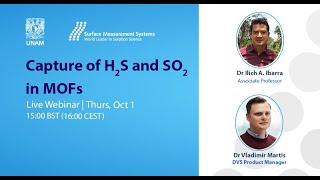
Dr. Illich A. Ibarra presents metal-organic frameworks that capture hydrogen sulfide and sulfur dioxide. MIL-53(Al)-TDC holds 18.5 mmol/g of H2S, a record for microporous materials. Adding confined ethanol to MFM-300/NOT-400 boosts SO2 uptake from 9.4 to 13.2 mmol/g through a bottleneck effect.
Questions this video answers
Vacuum at about 1×10^-3 Torr (diaphragm pump) at room temperature; no heating required.
H2S: ~5% diluted in N2 (or Ar). SO2: high purity gas (~99.9%).
Mg CUK-1 H2S ≈3.5 mmol·g^-1; MIL-53(Al)-TDC H2S ≈18.5 mmol·g^-1; PCM75 H2S ≈8 mmol·g^-1; MFM-300 SO2 increases from ~9.4 to ~13.2 mmol·g^-1 with ~2 wt% ethanol; UNAM1 SO2 ≈3.5 mmol·g^-1.
Chapters
Hello everyone.
I'd like to thank you for joining us today wherever you are, and welcome you to today's webinar session. Today's session has been co organized by Surface Measurement Systems and the Universidad Nacional Autonomous Mexico. Dr. Illich A. Ibarra. The title for today's session is the Capture of Hydrogen Sulfide and sulfur dioxide in MOFs. Our presenter today we're really happy to have a guest speaker from the unam in Mexico, Dr. Illich A. Ibarra. Dr. Ibarra completed his Bachelor's degree in Chemistry at the Universidad Autonoma Metropolitana in Mexico in 2005. In 2006, he worked at the Instituto de Nacional de Investiganciones nuclearis. Later in 2010, he obtained his PhD in chemistry at the University of Nottingham in the UK, working on synthesis and hydrogen absorption properties of porous scandium metal organic frameworks. He then took a postdoctoral position at the University of Texas in Austin, where he studied the synthesis and characterization of phosphine coordination materials. In 2013 he was awarded a Winner Grand Researcher and at Stockholm University in Sweden. In 2014 he moved to Universidad Nacional Autonomous, the Institute of Materials Research, working as an Assistant professor, and in 2017 he was promoted to associate professor. In 2019 he was awarded the Young Investigators Award in EXACT Sciences UNAM and in 2020 he became part of the Advisory Board of Chemical Communications. We're really happy to have Dr. Abara with us today and I hope you'll all join me in thanking him for taking the time to present this webinar. Just a quick run through of how today's session will go. We will have the presentation first and then our very own Dr. Vladimir Matius will take over at the end to present the questions you have submitted to Dr. Ibarra. If you haven't looked to your right, and if you're unfamiliar with the GoToWebinar system tool, you can see there is both a chat and a Questions tab. You can submit your questions in either of these and we will try to get through everyone's queries at the end of the session, but rest assured if we do not have time, we will respond to all of your queries after the session has ended. I'd like to hand over now to Dr. Ibarra and thank him again for joining us.
Well, thank you very much guys for these wonderful opportunity to talk about the research that we are doing. And actually we are collaborating with some of you by the way. So if I'm correct, let me share my screen. Right, so this is the title of my talk, fundamentally this group is interested in the capture of these toxic gases for environmental reasons that we probably don't need to really discuss very long. So going straight to the point, I would like to talk about just briefly, Knot 400. This work was part of my PhD years ago. And some of the most interesting features for us was the chemical stability of this material back in the day when we first synthesized it and laser. Something that we really found interesting is the functionality of this metallorganic framework, which is a hydroxy functional group that you can clearly see on the right side of the slide where these OH groups are hanging around in these four points inside the channel. So the really interesting thing about this functional group is that the accessibility to these hydroxy functional groups is pretty high. So in general, you will see through my talk that we are very interested in this particular functionalization because the OH group can actually do a lot of interesting interactions with different gas molecules like SO2 and H2s. So let me introduce you to Magnesium CUK1. This framework was first synthesized in 2015 and this has to do with a magnesium metal organic framework as a metal sensor. But in this case, apart from having a different topology in terms of the porosity, we have two different dimensions of the pores. We actually have sort of like similar hydroxy functional group. And the reason why it's similar is because this is actually bridging three metal centers rather than not 400. It's only bridging two, but for the effects of the functionality, this is as well something very interesting in terms of these hydroxyl functional group. Now on the left side, what we can see is a breakthrough experiment where we understood the H2S total capture of the material, which I would like to highlight is not really high. It's about 3.5 millimoles per gram. But what it was really interesting about this material is that it's pretty stable towards H2S. As you probably know, guys, H2S. Excuse me. It's actually a very acidic gas and therefore is one of the main problems for these kind of frameworks that are very sensitive towards some of them volsa, some of them acidity or very base condition, harsh base conditions. So we on the right side we can see the power diffraction of each cycle. And what we can see is that the stability of the material is remarkably high. But also we understood for the very first time actually reported for a framework that this material is actually flexible, similar to those mill materials like MIL53, where you can see the effect of breathing or also known as flexibility or soft crystallinity. There are so many terms for describing the same thing. But long story short, what we can see is that due to the interactions, pretty interesting interactions of H2s inside the material, we actually could understood how these material is flexible. And that's something that is a very important property when it comes to the cyclability of a material for the capture of any toxic gases. So after understanding the parts, we copy with simulations performed by Professor Morin Guillaume in Montpellier University. And something that was very interesting, this is one of the first studies of H2S in these kind of materials, is that on the left side you can see that there are few molecules of H2s inside the pole material and they were mostly hanging around, if that's the right expression to describe it. Inside, of course, but in the center of the pole. This is really interesting because normally the first interaction really goes for these kind of molecules towards the walls. But in this case we start to see association inside the pores. And this is something very unusual that we understood by these computational studies. And later we actually explore different systems to see a completely different chemistry. This is back in 2018, which is very. No, long ago, but this was the beginning of our group when it comes to the H2S capture. So now let me introduce you to MIL53, aluminium TDC. What a long name. Long story short, we have again two different kind of pores and again we have the hydroxy functional group that we are very interested in. Even though it's mil 53, this is not flexible, but I guess it's relatively catchy to talk about Mil53. Anyway, this is actually a very robust framework that doesn't show any flexibility. But the really interesting thing is that for a microporous materials, this Min53 TDC holds the record for H2S capture. And as you can see on the left side we have the breakthrough experiment. We have the total uptake of about a 18.5 millimoles per gram. On the right side, what we can see is that powder diffraction is telling us that basically the structure is there after cycling, which is a very important characteristic for a material. And apart from having the record, which is really interesting, we did a different experiment where by IR in C2IR H2S, we could understood the main interaction between the material and the H2S molecules. So the functionality is again telling us how these H2S molecules, and on the right side, what you can see is how these molecules start to aggregate again in the very center of the pore. When you're increasing the amount of molecules, what we can see is that these materials rather to distribute around the walls of the materials, they actually like to be concentrated in the center of the pore. This is something very interesting because this was the very first time that we had a correlation between the experiment to understand where were the preferential absorption sites and the computational calculations. So moving forward, let me introduce you PCM75. PCM stands for Phosphine Coordination materials. Yes, we like to call MOF in different fashion names and we like to use our university names. And I actually seen some people that like to use their own names, which is quite interesting, as Alan Partridge would say. But anyway, so what we have here is a magnesium metal organic framework of course with phosphine groups. And this particular framework has some interesting pore cavities. This has nothing to do with the functionality that we were presenting before with the hydroxy functional group. But something that was very interesting for us is that even though there is not breaking any records when it comes to the uptake is about 8 millimoles per gram. It was another example of flexibility. And this example of flexibility also was corroborated by computational calculations. And what we saw is that the H2s again molecules like to hang around very, very in the center of the pore. And that's because those interactions are kind of like guiding the way to move the framework in terms of the flexibility. So in general this work, what it was really interesting, it was the association of the phosphine group with this functional group, this phosphine functional group with the H2S molecule coming back to not 400. There are some people probably from Nottingham, I hope so, not surprisingly not stands from Nottingham University. So later on what we Understood was the SO2 capsule properties. And on the left side what we have is the isotherm, the SO2 isotherm from zero to one bar. Which by the way, thanks to Vladimir, Dr. Martys here, it was possible to achieve this because we wonderful have one of his machines in our Mexican lab. And it's like having a Ferrari in a desert. As long as the Ferrari doesn't break, everything is fine. Whenever it breaks, I'll be crying. But anyway, let's hope it's going to take a while. So apart from having a very interesting isotherm in terms of the reversibility, we also demonstrated that the material is really stable. The calculations, the computational calculation demonstrated that super high correlation. And it's something that you can see in the inset of the figure on the left. So the experimental and the simulation matches perfectly. So again we have a case of textbook. Hopefully one day this is going to be part of a chapter. And on the right side what we see is that the powder diffraction is corroborating that the SO2 is actually not affecting this structure of this framework cycles. At the time we were understanding about how to use the machine. So I'm presenting you 10 cycles only. But it is pretty good to understand that this material is absolutely cyclable, which is a very important property. When we became a little bit more sophisticated and daring. And of course we have lots of budget. I'm kidding. We actually go now to 50 cycles and I'm going to show you that in a little bit later. So on the right side what we have is again the computational calculations by surprise, surprise, Professor Morin, where we can see where these molecules interact inside the material. And, and also in this particular case we understood the selectivity of SO2 over CO2, which is another interesting property of this material. Something just kind of like remarkable about this is we did the confinement of ethanol, which means we add a little bit of ethanol molecules inside the material. And these molecules, what they do, they establish a hydrogen bond with the hydroxy functional groups. And what we saw is that it was an increase of the SO2 capture due to something that we actually called back in 2016, the bottleneck effect that I'm sure some of you guys are going to ask me and I would be more than happy to tell you why. From the material completely empty without ethanol, the uptake is 9.4. When you add a little bit of ethanol, you go all the way up to 13.2. Right, so carry on with this material. Of course, now that I presented so two, I'm showing you what is happening with H2S. And again I'm showing you on the left, the breakthrough experiment. And the reason why we have a breakthrough experiment is because at the minute we would wish, and we would love, and we would like of course, to have a machine that can actually measure an isotherm of H2S. In fact, if I'm correct, some of the developments that SMS is actually currently making, and I'm sure that pretty soon we will have the machine for free. Haha, I'm kidding. But at least 50% discount. Thank you very much. Thank you very much. Anyway, so showing you here, the first cycle, the uptake was close to the record of 18 millimoles per gram. We have 16 millimoles per gram. However, what it was really interesting for us is when we started doing the cycling, we lost almost 40% of the total capacity of H2S. And it was very consistent, as you can see in cycle 2, 3, 4 and 5. So we immediately thought, okay, fair enough, maybe this framework is being collapsed or partially destroyed by H2S. By running paddle diffraction on the right, we find out that actually the structure is absolutely fine. So something had happened inside the pore, something that didn't destroy the framework, but clearly reduced the capacity of H2S. And we wanted to understand what was going on. So by a computational calculation, what we found is that of course these molecules are interacting with hydroxy functional groups and again they're interacting with themselves when you are increasing the amount of molecules. However, it wasn't the full story to fully understand what was actually happening. The mystery was solved by electrochemistry. So this is the first case in the literature where we are presenting, not only we, as I say in the literature, that H2S by itself reacts with itself and then we form polysulfides inside the pores. So this phenomenon of capture for this particular material is partially physiosorption and partially chemisortion. But what it was really actually interesting is that just by doing the capture of room temperature of H2S, we could generate polysulfides that possibly, and it's something that we are investigating at the minute, can be really interesting for lithium sulfur batteries. So solve mystery solved. Now moving forward, I want to present you mesoporous materials. Bigger pore, larger porosity, but more, more than anything with a different functionality. So mille 101 chromium stands for materials Institut Lavoisier. My French is absolutely non existent, but I try my hardest anyway. So how we construct this material is with a different ligand, the typical bdc. So we use four fluorinated functional group ligand, as you can see on the left side. So what we wanted to see, like what is the influence of using something very, very electronegative inside of the material. It was a very long story when it comes to the characterization. But the fundamental part of the material is that the amount of this ligand, the tetrafluorin, is really small. It's only 1% inside the material. And we demonstrated this completely homogeneous and is well distribute and by sienen nmr. What we shown is that the material without this functionality has a very particular chemical shift. But as soon as we add this functionality, the chemical shift increases dramatically. As you can see on the left side, we are changing the pressure of sinan and we were Following Biennama. And what we see is that the chemical shift is telling us how different is a material from the one that is not functionalized. Then on the right side, what we saw is that the H2S capture is actually way higher for the material that has this functionality. So the long story short of this compound or this material is that we demonstrated that by incorporating very different groups, apart from hydroxyl functional groups, in terms of the electronegativity is something that can be very helpful for the capture of something like H2S, since the material is really stable. Of course, we tried SO two as well, and what we saw is that we have the record. It's interesting, but in these things, when it comes to captures, people really like to stand about records. But anyway, not my fault. So we stand for the record of the highest SO2 uptake for a mouth material that is stable. And this is a very important point. As you can see on the right, what we have is 50 cycles. There you go. Now we're fancier than only 10. And what we see is that it's very consistent, the uptake for SO2 and also this material demonstrated, apart from what I'm showing you here on the left, that the power diffraction is basically intact. After the different experiments that we perform with SO2, we identify the experimentally. Of course, it's something that we're working right now is the computational part, but we actually understood the mechanism of adsorption for SO2. So now, talking about fancy names, let me introduce you to the first math material coming from UNAM, my university. And of course it's called UNAM. I was tempted to call it UNAM 100 just to make people think that we actually have a hundred materials. But then I thought, nah, that's a little bit of a lie. And again, Alan Partridge would say a lie is a lie. Let's say UNAM one and that's it. So this material is a very simple material. And in fact, if I'm honest with you guys, it's a HOF material. For those that are not very familiarized with what is a hof. A HOF is a hydrogen organic framework. So it's like a 2D MOF, but not 3D MOF. So it should be stable like a MOF, but not really, because in one direction we only have hydrogen bond interactions anyway. It's a material that in principle shouldn't be very stable towards pretty much anything. And what is really interesting is that we have two different copper metal sites, oxidation states, copper 1 and copper 2. Here we go. This is how it looks when it comes to the lifts of poles that they have inside that this material has inside intrinsically. And what it was our surprise is that the SO2 pretty much, even though it's not really high, it's about 3.5, the material was completely reversible and is stable towards SO2. So this is the first example of a health material that as I explained briefly, shouldn't be really stable to pretty much anything. It was really stable towards SO2. That was back in 2019, like last year only. So another example of what else we can do with these materials is not just about the total capture of SO2. For example, so it's all about detecting SO2 because that's something very important for different areas. In fact, in a more realistic scenario, what we want to know is the amount of SO2 in a concentration of gas rather than the total uptake. But it's important to play in different regions like the very high region and the very low region. So in this case what we've done is the incorporation of an organometallic fragment to a mesopotam materials called NU1000. NU stands from Northwestern University. And presumably 1000 means that they have a thousand materials. Debatable, but that's how it's called. So anyway, we did the functionalization of this material by incorporating these metal organic compound based upon iridium. And yes, I know iridium is really expensive, but as I said, we're incorporates in very small amounts for the detection of SO2. So this is experiment in blue of the, in red of the material without any functionalization and the material, the functionalization in blue. So what we can see essentially is that the uptake is about the same. However, the shape of the isotherm is really different. And most importantly, a very low pressure like you can see in the inset of the figure on the, on the left side of the screen is way considerably higher for the material that has iridium. And this is not a big surprise because what it's essentially telling us is that the first molecules that go into the material are highly interacting with the iridium metal center. We demonstrate that it's stable, we demonstrate encyclability. In this case, I'm showing you only 10 cycles, we actually perform more. But we just wanted to emphasize that, that this material can be an excellent example of how to do an incorporation of an iridium fragment into a mof. That perhaps would be a great detector when it comes to this field of the chemistry. So if you are not that bored like my daughter by now. Well done and I really appreciate it. I'm about to go through the brief summary. So for the first example, magnesium CUK1 we demonstrated the stability towards H2S. We also demonstrated the soft crystallinity and the molecular simulation demonstrated where these molecules were hanging around inside the pore. In the case of Mil 53 aluminium TDC, we stand for the highest uptake for our macroporre materials. For H2S, we have a very good correlation of in situ FTE experiments with the simulation that also told us about where are the adsorption preferential sites, which is something very important to understand these processes. For PCM75 we have a very respectable capacity. But more than anything we demonstrated something that we call the release and regeneration of the material with solvent trigger. And it's a little bit more complex, this process. But if you have any particular questions, I'm more than happy to answer. And again we found that this material is also one of these breathing effect materials. In the case of. By the way, I forgot to mention that this is great. So not 400 now is called MFM 300 and that's because Martin Schoder decided which fair enough that now he works at Manchester University. So we should call it Manchester Framework materials. I think so anyway, not 400 is only in my heart and it would leave there forever. But anyway I should call it from now onwards and I do very respectfully MFM300. So we just demonstrated a very high SO2 uptake. The simulation demonstrated again the preferential interactions and then by confining the small amounts of ethanol, we actually increase the uptake by almost 40% which is a very good increase in the case of the same material. But with H2S. The most important and relevant thing was it was the first time that it was demonstrated the formation of polysulfide. And this is really promising, as I already said for future applications and solved for lithium sulfur batteries for MIL101 chromium, this very small modification of the material considerably increase the amount of H2S in comparison to the non functional material. And for the case of SO2 we still had. We have the record for structurally stable material in terms of the uptake. We also demonstrated the cyclability and experiments related to IR demonstrate the functionality in terms of the main assortion groups. For UNAM1 or UNAM1 is the first example of a HOF that actually survived after the SO2 experiment. Also we demonstrated that reversible. And then this is something very interesting in terms of again Another detecting material, since the uptake is not pretty high at one bar, but a low pressure is actually quite interesting. Something that at the minute we are working into the incorporation of this into a detecting device. The same case applies for iridium at Nu1000. By the incorporation of this iridium metal organic organometallic complex, we actually seen very high affinity, very low pressure. And of course this material I forgot to mention is completely stable, not only by the cyclability that we demonstrated, but also typical paddle diffraction experiments and CEM experiments. So the story that I just presented has been summarized here in this last slide. The scientific contribution. So it's about nine examples of nine different materials for H2S and SO2. And this is what we're we were doing since 2018, roughly. So also the summary can be found not only about our work, of course, but about what is being done about these particular two gases in metal organic frameworks. We actually have the invitation to this, funny enough is organometallics well done in principle nothing to do with materials, but we got the invitation to talk about these materials, these MOF materials for these kind of two gases. And I hope in the future I can come back to you guys and talk about something less nasty because I know H2S and SO2 is a little bit nasty. So I can talk about the release of ferrillate for example in MFA 300. Fascinating fact. This is the first time that it's been demonstrated a framework based upon scandium is actually non toxic. And also I could talk about the most recent work that we have when it comes to bismuth metal organic frameworks. Yes, bismuth shockingly is actually non toxic for those that have ever taken Pepto Bismol, presumably mostly in America and perhaps Mexico. I my understanding in the UK is actually non existent. But yes, Pepto Bismol is actually based upon Bismuth 3. So most importantly is that everything that I presented as the communicator that I am is thanks to this amazing group of enthusiastic people with great will to keep going up. I'm so proud of these guys. They're absolutely amazing. They work really hard and the main ideas and the main enthusiasm are coming from this group of really promising young scientific people. I would like to highlight of course the contributions of eba. Thank you so much Alfredo. Thank you so much Monica. Etc. Etc. So without these guys I wouldn't be able to talk about you. And of course the funding is a situation that makes us lies a little bit better. So in the center of this screen, this slide, you can see people that is helping to talk about these stories. Typically, the person of the group is always in the center. There it is. So I would like to introduce you Grace, who is the boss of the research group. She's a pretty young investigator, but he's doing pretty well. This actually was about a year ago now, as you can see. Well, she's grown up, so now she's two. So in Mexico, when you are two, you're legal to drive and also to do any other sorts of activities. So, guys, for me it's everything. I wanted to be on time because I don't want to waste your time, of course, and I'm more than happy to take any questions. Thank you.
Irish, thank you very much for this wonderful talk. I mean, it was beautiful. Introduction to MO for capture of H2S and SO2 and also for highlighting the capabilities of the vacuum for these measurements. So we have few questions for Dr. Elichebarra. The first question is from Carlos Ibanez. His question is what regeneration process do you use to run multiple cycle of magnesium Cu K1 with H2S?
We only apply vacuum, which is a very relatively low vacuum, is 10 to the minus 3 torr, which is basically a diaphragm pump is nothing fancy, not like a turbo pump on the room temperature. And this is something very attractive in principle to industry because you're actually now reheating the material up in order to evacuate the material from H to S. So in fact, all the processes that I've been showing when it comes to the regeneration, we've been managing to do it without reheating the sample. So that's something that is very positive because the interaction with these molecules, these molecules inside the material are pretty high, but are not that high that we actually need to heat again.
Thank you. Another question is from Monu. John, which software did you guys use to calculate absorption studies?
That's a great question. That question unfortunately won't be possibly honestly done by me properly because this is the part that we work with the computational people. My understanding is that is a Monte Carlo, basically grand canonical Monte Carlo calculations. But when it comes to the software, I actually, of course they're on the papers, right. But I actually don't have on top of my mind. But I would be more than happy to send an email with all the information about the calculations. And of course, so one of my students, Antonio, is the one that is, let's say, on top of those things so he can answer these questions best. And I will Be more than happy to give you the contact and we can contact you as well.
So question from zhm, Is there any safety strategy for working with these highly toxic gases?
Sorry again, is there any what?
Any safety strategy for working with these highly toxic gases?
Well, when it comes to H2S, as I said, it's a breakthrough system, which basically means we construct it in the lab and we have some safety procedures. But if I'm honest with you, they can be improved for sure. One of the main strategies when it comes to H2S is we do high dilution. So we only use 5% of H2S diluted in nitrogen. And when we want to double check something, of course we dilute it in argon. Nitrogen is way cheaper than argon. Now, when it comes to SO2, thanks to the equipment that we have from SMS, we have a very safe machine. And in that case, we don't really need to be worried about many things because the machine by itself is a bunker. So there is no way that something can go wrong. In principle, of course, we did a little bit of extra installations in the lab, like we have an extra extractor and we have a detector connected to speaker in case something goes wrong. But something that can elaborate a bit better is of course, Vladimir, when it comes to the safety of SO2. And I really want to highlight that because one of the main limitations of using this gas, particularly SO2, is it's so toxic in very low concentration that is deadly, essentially. But the technology of the machine is so great and so straightforward in terms of using it, that is absolutely safe to use it and to run it without a single worry.
So next question is from Neil Tanner. Can you comment on the increase of sulfur dioxide absorption by ethanol in the pore?
Yeah, so the effect is called bottleneck. And essentially what happens is that methanol, this is very important to emphasize very small amounts of ethanol. When I'm talking very small amounts, I'm talking about 2wt percent. So it's very little. So what you do is you, you incorporate ethanol or methanol, in this case it was ethanol into the pore. And that molecule does a hydrogen bond with hydroxy functional groups. So essentially what you do is like putting gates every two or every three functional groups. And those gates are actually slowing down the speed of SO2 molecules. So you are reducing the energy, the kinetic energy of SO2. And when you do that, the material by itself, the walls of the materials, are capable to Capture even more so 2. So this is something that we've been studying for the past six years with CO2 in different systems. So when we translated to SO2, it was very surprising and grateful to see that it's actually working. But fundamentally, what you do, and that's why we call it the bottleneck effect, because what you do is that you reduce the porosity of the material by just incorporating a gate called ethanol. So when you incorporate ethanol, what you do is that you are actually making a bottleneck. So the molecules have to stop in order to keep going. And when they stop, the material itself is capable to actually capture more SO2.
Question from ZHN in mill 101 sulfur dioxide paper. Why did you use carbon monoxide. No, sulfur. To study the adsorption mechanisms?
Well, first of all, I want to acknowledge how observant is chn. Is that right?
Chn? Yes.
Other person.
Yes, yes.
So I want to acknowledge. Great observation. It was something to do with the technical limitations. So to do so 2 in situ IR is something extremely challenging. So you need a very specific kit on the very specific conditions. So what we've done, it was a comparison of something, a molecule relatively close in terms of polarity to SO2. It's not the same molecule, I want to emphasize that. But in terms of the chemistry that can describe it, it can be very similar. So what we've done is using as a probe molecule to have a correlation with SO2. But the fundamental reason why we couldn't use SO2, it was for safety reasons, because as I said, one thing is used in the machine, the machine for the SO2 capture, which is absolutely safe and there is not a single problem or concern whatsoever. We're using a FDR machine in situ with SO2. That's a completely different level of risk. So that's why we did an analogy. Let's put it this way.
Okay, thank you, Richard. Second question, Another question is from Carlos Ibanez. So what is the H2S and SO2 concentration used for the uptake tests for.
H2S is about 5%, as I said, diluted in nitrogen or argon. And when it comes to SO2, it's 100%. Well, 99.9090, but is the highest that you can get from the market.
Second question from Carlos. Have you checked for stability of materials also under humid conditions, or were you experimentally collecting cycle Data under dry so two conditions?
Yeah. So for the case of MIL101 chromium, that guy is the best example that we have, is stable towards dry conditions, which that was great. And we also demonstrated bicycling but also we wanted to demonstrate that it was stable towards SO2 under humid conditions with basically is sulfurous acid when you have. Because it's very reactive, as Vladimir knows SO two with Walsa. But for that we didn't do it in the machine because then that would be like breaking the Ferrari. And that's, that's not good, especially when you're in the desert. So what we've done is that we generate in C2SO2 and then with a different sort of like camera or like another chamber, we regulate the relative humidity. So we actually combine both and then send it through the material in a different chamber. So like three chambers connected, let's say so. And then in that case we can't actually measure the exact amount of we are getting inside the material. But what we want to make sure is that stability. So you do a saturation for. Let's say like we'd run a week or two weeks or whatever where the material is exposed to both SO2 and water simultaneously and having the reaction of the. Of this acid, as I said. And then you run powder diffraction. So few, only few materials are actually stable towards both normally dry. SO two is not such a big deal for some of them. But when it comes to water, definitely it's a big deal.
We have practical question from Jan Darren Arlo Darren from NASA Ms. Research in California. So his question is about making measurements. Does one need to take special measure to avoid chemnitical attack on the instrument by H2S and SO2?
Okay, wait, but what was the question about H2S? Sorry?
Well, the question is more practical question whether you need any special measures to avoid chemical attacks on the instrument. I mean, I can answer the question. Basically the vacuum chamber is made of stainless steel. It is standard system. So we don't need. The only special measure was all the O rings are coverings.
Yeah, yeah, yeah. Well, when it comes to that, you of course need, you know, as, as, as as much as you can stainless steel. And then you need some silicon orange rings. I mean it's not that complicated, but you really have to be sort of like careful with time. Like we replace those things on every six months, for example. Right. So it's not that difficult. And of course Vladimir can elaborate better than me, but it's all about just making sure that the spare parts are completely replaceable.
Okay, that's correct. Yes. So spare part needs to be replaceable. Everything needs to be from 316. And we need to use Orings, Michel, probably from Torex Another question from Daryl is, are these MOFs electrically conductive and does the absorption of gases change the conductivity?
Well, that's a really good question because we don't know. Actually. We haven't really studied the conductivity of these MOF materials. But for sure, something that I would say is that if that's the case, this conduit should definitely change the gas uptake and the gas absorption properties.
Well, the other question is from. Another question from Darrell is about his new instruments by sms. You talk about.
Yeah.
Break to analyzer.
Well, I mean, I'm sure Black can talk about it more than I did, but I mean, as far as I know, Vlad, and please correct me if I'm wrong, I can actually use H2S in this machine as well. It should be the same principle. It's just that we have this sort of like, I wouldn't call it philosophy, but I just. Let's say that we want to play safe, so the machine itself can run even worse. It's not a problem. You can run many different things, not necessarily at the same time, of course, but you can run a set of experiments for SO2 and then H2S and then Woltziu want to. We just want to make sure that it's always dry. Our machine. That's why we only run SO two. But in fact this is the truth. Like this machine can run NH3, any nasty gas that you can possibly imagine.
Okay, we have a question from Sara. Do you have any insights into how well MOF might perform for gas absorption within liquid amines for ionic liquids or ionic liquids?
Well, I actually don't know, to be honest, because the problem with those things is that. Is that. Is that really high vapor pressure? Right. But presumably should be. What do you think, Vlad? Maybe you can help me more on this question. Maybe it's possible, right?
Yes. You can run ionic liquids. Yeah, liquid amines is difficult.
Become very high boiling point, I guess. Right? Yeah. Okay.
Okay, second question. Another question is from Niels Tunnett. Did you ever check SO2 or H2S absorption at elevated temperatures?
Sorry, at what temperatures?
It's elevated. I mean, did you check, did you the experiments of higher temperatures that went to 5 degrees?
Yes, we did, but not like very high. So all I presented is room temperature, which in Mexico is 25 about. But yes, we've done like 45, 50 max. But higher than that. We haven't actually done it. It's not a problem in terms of an axiom or so. Because anyway, SO2 is not explosive or so ever. But we really haven't found any particular reason for doing it. But maybe there is a reason that I'm missing and it would be great to explore.
Another question is from Xin Lu. This question is related to morphs. Are these mouse stable during the adsorption of SO2 and H2s under humid conditions?
All of them MIL 101 chromium.
Okay. And what about the price of oxygen?
Oxygen, yeah, it's not a problem. But when it comes to Waltz and SO two that's when it can be really tricky. So yeah, some of them are MFM300 scandium is. But some of the like UNAM1, as soon as you put waltz and SO2 it collapses. So UNAM1 is okay only on the dry SO2 conditions. So it really depends on the framework. But in general I'd say that when it comes to something made up constructed with scandium or zirconium aluminum, they are pretty stable towards both, but it's not necessarily a trend. So it's also very related to the structure itself.
So, question from Courtney Ello. What scale have these morph materials been synthesized? Second question, how would you estimate the cost of synthesis against current industrial methods for H2S O2 removal?
Right. The first question we are talking about milligrams scale. So for example, when it comes to the SO2 experiments, we can work with 25 milligrams. Not a problem. Ideally you go with 30, 35. When it comes to scaling up, I would say it's all the case of finding the best materials in terms of the cost. For example, when I presented anything related to scandium for the fundamental part is great and to understand the chemistry and the science behind it is fantastic. But the application of the scandium in the industrial scale is just ludicrous, just nonsense because it's really expensive. But the good thing about those experiments and the chemistry that we are understanding is they give us the opportunity to translate that into something way cheaper, like aluminum or chromium. In that case it's definitely possible. And there are companies, just to mention some of them in the States and I know another one in Korea, they are working on making kilograms of these materials. But again, what you really have to look for is metals that are really or relatively cheap and ligands that are also commercially available. So scandium definitely not indium. Maybe not, because indium would be better to use for other applications like perovskite for example. But when it comes to aluminium, chromium, magnesium, even bismuth, which is the last Latest thing that we found absolutely is doable. The approximate price. I would lie if I tell you a price, but it's something that is already under investigation. Well, not under investigation only. I mean, there's people now selling moth. So.
Question from Rashad Mansoor. How did you experimentally prove that H2S molecules are in the center of the pores?
Yeah, well, this is something that. That's what I was pointing out. That is really interesting because normally what happens is that I will try to. If you are seeing me, this is a pore. My hands are a pore. So when you start to do the. The capture of these gases, the gases normally like to hang around. Okay. They like to fill things up in a way, from the walls to the sensor. That's normally how it works. We've seen it with CO2. We've seen it with SO2. We've seen it with different things, but H2S is different. So the first molecules, yes, they interact with the functional groups that you have inside the framework. But as soon as you are increasing more the amount of molecules, they actually like to move in the center of the pore. And in some cases, as we demonstrated, that particular geometry or that particular sector of the framework where they are, is what is helping to react by itself H2S with H2S to generate polysulfide. So something that we are understanding, and it's really interesting for us, is that H2S is a completely different monster, let's put it this way. And because of that, we understand now that the formation of these polysulfides is also related to the electrochemical potential of each framework, because each framework has an intrinsic electrochemical potential. And that is in very good agreement with the amount of energy basically that you need to do these conversions into polysulfides. So thanks to the fact that the H2S molecules like to segregate or aggregate in the pore. In the center of the pore. Sorry, is why we have seen this transformation. Now, the key question that you're asking, and I have an answer, is why this happened. We don't really know yet. It's the first time that somebody's actually kind of like trying to understand this behavior because normally, as I said, it goes from the walls to the center. And what we see with HDS is like the first two molecules, let's say, go on the wall and as soon as more molecules are around, they like just to go in the center. They don't keep growing from the wall to the center, they actually go all the way around. So this is something that we really need to understand. We know what happens. We actually can predict what can happen depending on the electrochemical potential of the framework. But when it comes to the fundamental reason why this is happening, we're still working on it.
A question from Susan Oliveira. Firstly, congratulations for the great presentation. Elic. I would like to know if your group already tested the CO2 outtake by UNAM1.
Not yet. Definitely not yet. And talking about cheap materials, UNAM1, we can make kilos of it. It's really cheap and the ligand is incredibly cheap and the synthesis is really cheap. So we definitely need to try many more things. So we are up to, of course, collaborations. And yes, CO2 definitely is worth it to try. Absolutely.
Another question from Rachet Mansoor. So when do you expect these materials to make it to industrial applications?
Well, I mean, myself, they are already there. I mean, there are some industrial applications, but myself is not really focused on that. I just want to clarify, emphasize that our contribution is from the more sort of like basic point where we can postulate, look, this phenomenon is consistent, and then we go and talk to the engineer, the rest of the engineers, and the processing systems, etc. To kind of like go into the next level. But my understanding is that there are like at least 3, 4 companies in the world that are actually actively working now with industrial applications of mof. Like there is one in Belfast, if I remember. There is one group there that they have, they are running a company, of course, in Northwestern University as well. So there are like at least three or four companies that are actively collaborating with the industry in order to use these materials for real applications. So more than when I'm personally inspecting it, it's already happening. But when it comes to what I'm doing for industry, I'm still far. We're still far. We are. As I said, given the first insight of look, this is happening, for example, let's say that turns out that this is a great way to incorporate polysulfides for lithium sulfur applications in materials. Well, the next answer or the next question that we need to answer is, right, which one is the cheapest? It has to be something with aluminum chromium. And then Walligan is the cheapest. So we're on that stage of first understanding the phenomenon and later to translate it into something bigger.
Okay, thanks. Question from Tanushi Sanya. What type of SO2 detector did you.
Use so well, I'm not sure if that question is related to the lab or related to the iridium modification that I. That I presented. So I think that the second question would be more interesting than the first one. The first one is very simple. I just bought it. Yeah.
Next question from Tanushi Sanya Leke. What was the maximum temperature of the materials survive before the decomposition?
It really depends, but I would say for some, something like scandium is about 500 degrees, chromium is about 400 degrees, aluminium is about 400 degrees. So we're in the range of 400 to 500 more or less.
Okay, question from Ehang. So the acid nature of H2S is almost the same as CO2. Why chemical stability is necessary for H2S uptake?
Well, it's just, I mean, something that you guys have to bear in mind is that, okay, there are certain properties that are similar like that one, but when it comes to the molecule itself, there are completely different molecules. So for example, CO2 is not a polar molecule. It has a quadrupolar moment, but it's not polar versus H2S that is really polar. So of course, yes, you can compare certain properties, but when it comes to just the molecule itself, it's a completely different thing. So one of the things about H2S and the reason why it is so destructive, let's say for these materials is that immediately can break or not necessarily immediately, but it's very, very well known that it can break some carboxylate ligands. More like the carboxylate coordination with the metal center can be, can be broken by H2S and then H2S likes to coordinate and then the material falls apart. So as I said, more than the one particular property that we need to look at, we are, we also really need to look at the properties of the molecule to understand why this is happening. So the coordination of H2S is really, really, really, really high, is way higher than comparison to CO2.
And we have last question from Ehan, which is also similar question from NEO standard. Basically it's related to coadsorption. His question is, is it possible to do mixed adsorption measurements, e.g. coSO2 and also dynamic measurements?
Yes, absolutely. The machine gives you the capability. Well, the machine that we have in the lab there is SMS is definitely possible and it's something that we're already working on, like having different mixtures, CO2 and so, and we also have a little bit of ethanol and SO2. But in general, I think what is right now for us at least more interesting is to understand the pure components in order to move forward with the selectivity of mixtures.
Thank you.
Dr. Barra, I'm going to have to cut in there and say we've unfortunately run out of time for today, but I think everyone will agree that was a fantastic presentation. Anything else to add at the end there, Dr. Obarra?
Well, thank you very much, guys, for this great opportunity to talk to you. And also thank you for the wonderful equipments and kits that you have, because without you guys, I'm not sure what I would be talking about. So thank you, guys. Thank you.
That's very kind. I'd like. I think everyone would like to join myself in thanking Dr. Obarra and Dr. Martis for taking the time to share this information with us today. I see we still have a load of questions on the board that we unfortunately haven't had time to get to, so we will endeavor to get back to all of you with responses after this session. For all of you who joined us today, a massive thank you as well to you. It's really great to see such an active community involved and really passionate. Very clearly. I'd like to invite you all to our next webinar next week, which will be hosted by our Dr. Darrell Williams. And once again, I would love to thank Dr. Obara for taking the time out of his day and for sharing his findings with us.
Thank you, guys.
Thank you, everyone. And whatever time of the day it is, enjoy the rest of your afternoon or morning.
More from Prof.

Webinar: Advances in Measuring Gas and Vapor Permeation Through Membranes and Barrier Polymers

Webinar: Determining Solubility Parameters of Bacterial Cellouse Through Energy of Adsorption

Online Webinar: Recent Technological Advances in Adsorption Based Direct Air Capture

Online Webinar: Surface Area of Pharmaceutical Ingredients at Real World Conditions by IGC



Hybrid Workshop: Measuring Material Vapour Pressure Properties Using Advanced Sorption Technique

PCL Hybrid Workshop: Recent Advances in the Characterisation of Pharmaceutical Powders


Using Advanced Techniques to Test the Performance of Recycled Bathroom Tissue | A video summary
