Webinar Study of particle cohesion/adhesion & wettability of powders and formulations Prof. Williams
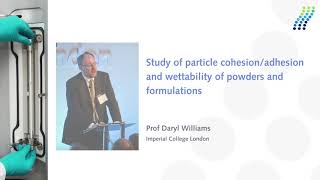
Prof. Williams explains how particles stick together and absorb moisture in pharmaceutical powders like mannitol during wet granulation. The webinar covers cohesion, adhesion, and wettability, with a Q&A session answering audience questions about powder behavior.
Chapters
Yes, thanks Sabiha, for the introduction. I hope you can all hear me and welcome to this afternoon's presentation. So today I'll be talking to you about particle cohesion and adhesion and where to build your powders. And this is going to be spoken about in the context of high shear wet granulation. So I'll explain to you quite soon a bit about high shear wet granulation. It's an important processing operation. So we're going to be talking about powders, powder surface properties and how they relate to the performance when you start to granulate powders. So just to start by reminding you about granulation, it's quite an important unit operation and manufacturing of solid state materials. But it's a process by which primary particles are going to be made to adhere to form larger multi particle entities. We call those entities granules. And this is commonly done by spraying liquid droplets onto the powder whilst mixing the powder under shear. So the most common example that you will have come across in your home are coffee granules. So if you use instant coffee at all, at all, you'll discover that actually instant coffee granules were originally coffee powders that have been granulated. So again, you take the powder, you often spray some droplets on them and essentially by mixing those, you can actually form the coffee granules that we all know. So granules are a very common form for solid state materials. And it's worth thinking just for a moment, why do we want to granulate powders? Because this is a very common operation. We want to avoid powder segregation, that is, we want to make sure the powders that when we have a mixture are uniformly distributed. We may want to enhance the flowability of a powder and granules flow more easily than small particles. We may want to produce a uniform mixture, we may want to produce dust free formulations. We also want to might try to eliminate poor content and poor content uniformity. And we want to improve the compaction property sometimes, that is, there are many cases that pharmaceutical materials are granulated as a precursor to making tablets and sometimes granules can facilitate tablet manufacturing process. So there are quite a few reasons why we want to granulate powders. And certainly it's a very common operation in food, pharmaceutical, agrichemical and many other sectors. So I thought I should just give you a very brief introduction to high shear wet granulation processes. There are effectively three steps to high shear rate wet granulation processes. The first process, the initial process, is when a droplet of liquid, which we call a liquid binder, is typically sprayed onto the power bed. And then following mixing, we form the initial aggregates, and these are called sometimes nuclei, granules. After the initial formation, then there's a process by which consolidation and coalescence occurs. So as the particles are continuing to mix in the granulator, some particles get bigger, some particles get smaller, but the granules will eventually come to some sort of standard size and shape. And also during the process of mixing, you can also get the actual attrition or breakage of granules as well. So we've got three phases of the overall wet granulation process, but today we're going to be focusing on the first phase. And the first phase is what happens when the liquid droplets, and in most cases we're talking water or aqueous based systems, the droplets of liquid make contact with the powder particles, this initial agglomerate formation. And that's going to be what we're going to focus on today. We're going to focus on will the droplets of the water or aqueous solvents, will they wet the particles, will they wet the particles very well, and what's going to happen when they do. So this is going to be the focus today, the initial process of wetting of the binder solution on our powdered materials. So I thought it might be good for me just to give you a little bit of a tutorial for the next, probably 10 minutes on some of the basic science around what happens when solids encounter liquid droplets. So the first thing to know about is about wettability. So when a droplet makes contact with the surface, there's a balance of different forces. And the two critical forces that are most important are the surface tension of the liquid. And you'll see the term gamma l v subscript. So gamma LV is the surface tension of the liquid, and the other important property is the surface energy of the solid gamma subscript sv and I'll describe those in more detail in a few moments. But when I put a liquid droplet on a flat, smooth surface, there will be a characteristic angle formed theta, called the contact angle. And that is a measure of how strong the liquid attractive forces are for themselves compared to liquid attractive forces for the solid underneath. And on the right, you can see some little cartoons which show you what looks like poor wetting, good wetting and complete wetting. And of course, what we're going to see today is that the surface chemistry of the powders has an effect on how the liquid droplets wet the powders. So surface chemistry is going to be seen to be an important factor of defining the initial wetting of the liquid droplets onto the surface of the powders. And we're going to see some of that in some detail during today's presentation. So, as I said, the surface tension is a property of the liquids. And surface tension liquids is relatively easy to measure. Lots of ways you can do that. But the surface energy of a solid gamma SV is a bit harder to determine, especially for powders. And we'll describe today how you might do it. But as I said, for powders, a little harder to do. So let me just start by reminding you about the surface energy. And the surface energy of a solid is really analogous to the surface tension of a liquid and is defined as the excess energy of the surface of the material compared to the bulk. And if you look at my little cartoon over here on the right, what you can see here is you can see my liquid. And if I'm a molecule that's inside the liquid, then I feel forces. I'm surrounded by other particles or other molecules that will actually exhibit some intermolecular forces. But those molecules at the surface, as there are no molecules above them in significant concentration, just a few in the later phase, they there's a net force that pulls the molecules of the surface into the bulk. So that's the surface tension. So in fact, it takes a bit of energy if I want to create some surface here, it takes a bit more energy to create that than if I was to move some molecules internally. So molecules on a surface require a bit more energy to be moved to create new surface area. And this relates to effectively the thermodynamics of adhesion. So essentially, when I'm creating new surface for a liquid, or indeed for a solid, I need to pull molecules apart. So any process by which I'm going to create new surface is going to involve intermolecular forces. These are the molecular forces that work that are present between all molecules and all atoms. And we'll see today that we can, in a simplified way, look at those as consisting of two components. All molecules will will exhibit some of these dispersion forces. We sometimes call them van der Waals forces. These are long range forces operate over many nanometers. And all particles, all molecules exhibit these forces. There are also some other forces present which are called polar or acid base forces. And not all molecules exhibit those. Depending on the functional groups present. Those polar or acid base forces are very much short range chemical forces. They operate typically over less than a nanometer in distance. So what we'll see later on is that things such as the surface Tension Gamma LV can often be simplified as consisting of two components, a dispersive component, Gamma D and Gamma P apolar or if you prefer, acid based components. So if I measure Gamma D and I measure Gamma P and add those together, I get the total surface tension and I can do a similar thing for the surface energy. Gamma SV S is of course a solid. For my surface that's equal the dispersive component of my surface energy plus the polar part of my surface energy. So these are the basic parameters I need to know about for the liquid that's going to be used as my binder agent or it's going to wet my powders. And I also need to know these similar properties for the powder that I'm actually planning to granulate. And what we'll see is if we can measure these properties, we have some reasonable opportunity predict the performance of our granulated materials. So let's talk about measuring the surface energies of solids. Now it turns out if you happen to have flat surfaces such as a piece of polymeric film or a piece of ceramic that's very flat, then it turns out there are two or three quite useful techniques for measuring the surface to energy of those sorts of materials. The most common technique is probably the one in the middle, which is condit angle measurement. Conduit angles are a very common way to measure the surface tension and surface energy of materials. So essentially, if I've got a flat surface, I'm going to put a droplet of liquid on it. And by measuring the contact angle for a known liquid, I can work out the surface energy and I can do a similar sort of experiment if I've got what's called a wetting balance. And this is better for thin samples that are flat, sometimes for fibers. But of course, if I've got materials that swell, dissolve or rough, then these techniques become a little bit difficult and indeed some cases quite challenging. And for powders they're very difficult, as we'll see in a moment. Another option you can use is an atomic force microscope. You can use the data from atomic force microscope to estimate surface energy. It's not an easy experiment, but it's doable for flat surfaces. It's quite challenging for particular materials, but sometimes people do report it, but it's quite difficult. So let me just briefly comment on what happens when we try to do this for powders. Measure a contact angle. So here is some data and what we've got here is I've taken some powder, a pharmaceutical powder, and I've compacted it to Make a flat surface. Then what I've done is I've essentially put some droplets of water on it to try and measure the contact angle. So this is some mannitol powder compacts that have been compressed under 400mpa and I'm going to put a droplet of water on them. And what you can see in this here is a timeless photographs that within one second of me putting a drop of water on, it's essentially gone inside the powder itself. It's actually been wicked inside the material. So it's really unclear what is the condangle. I mean, there was one for the first 17 milliseconds, but it disappears very quickly. So it turns out if you've got powders directly, measuring a conund angle is quite difficult and quite challenging. I'm sure those of you who've tried it will see on top of that, as well as the fact that the water goes inside the powder bed, we've got risks around swelling, dissolution, all complicated. So actually we're not going to do anything too much involving powders with terms of wetability, but we're going to use a different technique. So the technique we're going to talk about today is called inverse gas chromatography and it can be used for flat surfaces. But what it's really good for is doing particulates. It can do powders, it can do fibers, it can do granules, it can any sort of materials in a particular form is possible to be characterized using this technique. Most of you won't be familiar with the technique though. I am going to spend probably just five minutes introducing the technique to you in a few minutes time. But it is a way by which we can determine the surface properties and specifically the surface energy of particular materials. And it turns out it's quite a simple and reliable method to do that. So just briefly to talk finally about why do we want these powder surface thermodynamic properties. So I talked about measuring the surface energy of the powders and actually there are lots of reasons I might want to know the surface energy. If I'm interested in those particles sticking together, if I'm interested in adhesion, then the surface energy can help me understand the cohesion of powders. If I'm concerned about vapours such as water absorbing or interacting with the solid, then knowing about the surface, you can help me there. Or simple things like wetting. I've got a powder, I wish to disperse it in a solvent, then knowing about the surface energy is more than helpful. And if I Just want to know about the adhesion of my powder particles to another particle, then I also need to know about the surface energy. So there are lots of processes by which the surface energy can be useful to help understand how particular materials behave with other materials or with their environment. And for example, if I was looking at some wetability experiments, here, I'm showing on the left hand axis here I'm showing surface energy, and I'm putting a droplet on my surface. And what I can see, as the energy increases of the surface, my wettability goes up. Higher wettability, lower contact angles. So what you can see here are actually a series of droplets. This is a case of very poor wetting on a low energy surface. And this is a case of good wetting on a high energy surface. If I'm interested in cohesion of particles and particles that actually have lower energy have lower cohesion, Particles with higher surface energy have high cohesion. And if I'm concerned about materials where I may be milling them or damaging the surface, then higher energies correlates to surfaces that have had a lot more disorder, which sometimes happens when you mill pharmaceuticals. And also, if I'm looking at adhesion, ie, I have two different materials and I'm concerned about their adhesion behavior, then knowing about the surface energy of both the particles can allow me to predict adhesion behavior. So in terms of measuring the surface energy of pharmaceuticals, here are some of the reasons I may want to measure it. I'll let you read this. I won't go through all of them, but today we're going to talk about wet granulation as being the reason we need to understand about the surface properties of our pharmaceutical. But there are lots of reasons why surface properties, and particularly the surface energy, is a useful property for pharmaceuticals. So let me just start to spend five minutes describing inverse gas chromatography. We start with an explanation of analytical gas chromatography which you see at the top. So in analytical chromatography, I have a column packed with a known material. And in this case, I'm passing through that two unknown species, a blue and a red molecule. And what you can see is that my analytical chromatographic column can separate my red molecules from my blue molecules and can allow me to quantify it. So I'm using a known column to quantify the composition of two unknowns. In inverse gas chromatography, we reverse the roles. So we're going to take the powder that you want to granulate, and we're going to pack it in a Column. So that's the inverse bit. And we're going to pass through that column, some known molecules, molecules we choose, typically just one at a time. And we're going to measure how long it takes for a molecule to pass through that column. And during that process, the molecules that I pass through the column will interact, or actually they will adsorb on the surface of my powders. The powders I want to granulate in this case. And from studying how long it takes for the molecules to pass through this packed column of my powder, I can estimate properties of the surface of my unknown material. That's the basis of the technique. So essentially, I'm going to pack my materials in a column here. So you can see if we some mass flow controllers. We're going to pass a carrier gas, typically helium and nitrogen. We're going to inject some solvent molecules that could be hexane, could be ethanol. The helium will carry them through the column. They will spend some time interacting with the species we pack in our column, and eventually they be detected by a flame ionization detector. From the time it takes for the material to elute through the system, we'll determine an isotherm, and then we'll determine some physiochemical properties that you'll hear about. So this is the IGC schematic. And of course, the columns are not traditional spiral columns or round columns. We're going to have simple linear columns. These columns are typically about 30 centimeters long, and they can hold between 10 and 500 milligrams of material, more than enough for the sort of experiments we're going to do today. So packing columns is very, very easy. We're going to. Once we've packed a column, we're going to inject a series of molecules through our material. So the first molecule we're going to pass through the column is going to be methane. And methane is a gas, of course, at room temperature and pressure. So it does not want to interact with our surface. So it gives us a reference time called a T null, which basically tells me how much dead time I have in my column in my system. Then we're going to interject the interesting molecules, things like octane, hexane, heptane. Those molecules are liquids at room temperature. They will absorb strongly. And we'll see that as the molecules get smaller, with lower molecular weights, lower forces, the retention times will also get shorter. So these retention data is a measure of how strong our alkane molecules will interact with my unknown surface. And these alkane molecules have dispersion forces, dispersion forces. No dispersion will allow me to get a measure of the surface properties of my unknown powder, the powder that I wish to granulate. So what we're going to do is we're going to do a series of injections in our column. And you can see here C10, C9, C8, C7, C6. These are injected molecules. And from these experiments we do here we can actually plot the change in retention volume which is given by the log of this time times the flow rate. And we can construct some plots. And these plots will allow me to determine the surface energy. So RT log of the retention volume is measured experimentally. The x axis is a property of the actual molecules we inject. So we're looking at here, we're looking at heptane, octane, nonane, decane, and from the slope of these lines I can measure the surface energy of my material. And that's what we're going to do in this study and we'll be doing that quite soon. So the reality around granulation is that although we'd like to say we can predict granulation behavior fundamentally, the reality is it's quite a trial and error method and you can end up doing a lot of expensive and quite extensive laboratory and pilot scale testing. So it's a lot of optimization to do and it can cause quite a lot of scale up problems. So failure during scale up during granulation is sadly a relatively common experience industrial. And we're going to talk a bit about today how understanding your powders more fundamentally can minimize some of those risks. So the main part of my presentation now is really around the granulation of some pharmaceutical powders. The powders I'm going to look at today consist of mannitol powders. Mannitol is a common excipient used in the food and sometimes pharmaceuticals. And we're going to look at some mannitol powders. These powders are going to be specially modified. So we're going to have mannitol powders, different surface chemistries, we're going to use a standard liquid binder, we're going to granulate them and we're going to look at some of the properties of the materials produced. So mannitol powders, granulated and granular properties, that's the plan for today. So as I said, our focus is on the first part here, which is the liquid process. It's how the liquid wets the powder is our, is our focus on today's presentation. So let me start by talking with you about Mannitol. Mannitol is obviously, it's a sugar. The molecular structure you can see on the right, it's quite, has a lot of hydroxyl groups. It's quite a common excipient. And in our initial studies we grew some rather large crystals and these crystals were about 1cm across by 2 or 3cm long. And Raimondo did the work, was able to measure the conduit angles on each of the different crystal faces. And if you look here, just simply at the data for water to start with, you can see that the conduit angle of water is 12 degrees on the faces at the end, the 011 faces, and it's 56 or 46 on the external faces. So what it says is that those crystals actually have quite a variability in their high difficultity. So the external surface at the end wet a lot, which means they have a lot of hydroxyl groups and the other ones are more hydrophobic. So, and the idea really was here we wanted to compare wettability data with our IGC data and we'll see our IGC data in just a couple of minutes. But this is mannitol. Mannitol is quite hydrophilic, has all these hydroxyl groups. So we also wanted to make a hydrophobic mannitol material. So now let's look at. These are my hydrophobic manitol materials. So I'm going to silanize these. So I'm going to replace the hydroxyl groups with methylated groups. So now I'm going to have a much more hydrophobic material. And what we can see here is, I'm estimating here the gamma D, this is the dispersive surface energy, which I've estimated from my wet ability experiments. And all we can see is for the untreated materials, they vary a little bit from 44 to 39. But the cyanized material, as you can see, it's all basically the same. So by putting the methyl groups on all the crystal faces, I've basically masked all hydroxyl groups. Now, so my materials A more homogeneous and B more hydrophobic. That's just large crystals. But of course, in this study we're doing powders. So we're gonna do now is gonna take the same powders and we're going to characterize them using inverse gas chromatography. So inverse gas chromatography does something additional to what you get from wetability. So wetability will give you an average surface energy, IGC will actually give you a surface energy heterogeneity it'll actually tell you what the energy is at different surface coverages. That tells us how homogeneous or heterogeneous the surface is. So if I look here at the cyanized mannitol, which is the red dots, you can see here that even as I change the surface coverage, the surface has the same energy. Whereas my untreated material, my hydrophilic mannitol, the surface energy varies with surface coverage as there are different surface sites, some at the end, some on the actual main crystal facets, and they have different energies with their different concentrations of hydroxyl groups. So of course, I then compare that with my conundangle data. The conund angle data gives pretty good agreement with what I measure with my igc. So what that says is the IGC data is reliable, agrees with Conant angles. And I've produced two different materials, a hydrophobic homogeneous material and a hydrophilic heterogeneous material. And those are the two materials we're going to use to make granules. And we're going to take combinations of those powders in a moment in our granule manufacturing process. So let me talk a bit about how the analysis works, because we're interested in looking at the wetting of a binder solution with the powders that we're going to be making. So in this particular problem, we look, we have polyvinyl pyrrolidone, which is quite a common binding agent, and we're going to actually measure the surface tension of those solutions. We did that and also going to determine Gamma D and Gamma P. And we did that. And the details I won't discuss today, but they're in the paper which gives a lot more information about this work. So from some surface tension experiments on the characterize the liquid, my binding solution, it's fairly simple. And from my IGC experiment, I'm going to determine the two properties needed for the powder. I'm going to determine Gamma D, the dispersive properties, and I'm going to also determine gamma P, the polar properties. And I'm going to use hydrocarbon probes to determine Gamma D. And I'm going to use ethanol data to estimate Gamma P. And it turns out if I've got Gamma D and gamma P for the liquid and Gamma D and Gamma P for the solid, then there's a theory called folks's theory, which allows me to predict is my binder solution going to wet my powder or not? And that's what we're going to do. So in terms of wet granulation all the conditions we used were identical. Same binding content, same primary particle size fractions. The only differences were the composition of the different hydrophilic and hydrophobic mandator particles. The binder is an accurate solution of 11% PvP. And as I said, we're going to actually look at the size of the particles that are manufactured, and we're also going to look at the Young's modulus of the final materials we make. So mechanical properties of the granules and size are the two metrics we're going to look at for the material. And we're going to make a range of 100% hydrophobic, 100 hydrophilic, and some mixtures in the middle. So we get a range of different hydrophobic, different hydrophilic powders. But it's important to know that all the powders have the same density, same particle size, and the same surface area. The only difference is the hydrophobicity or high deficit of them. That's the big difference. So if we looked under an SEM at the granules, here are some photographs of the granules. The ones on the left are the untreated ones. Okay. So you can see the particles there. And these are some of the cyanized ones here. So these are typical sort of granules that get in wet granulation processes. So as I said, so what we've done is because we've measured the surface energy of the powders and the surface tension of the PvP, we were able to predict whether or not the liquids, in this case, the pvp, will wet the particles. So what we determine is what's known here as the spreading coefficient. Gamma. Liquid solid is a measure of the propensity of the liquid to spread on the surface. Now, it turned out, because we're measuring the heterogeneity of the system, in our IGC experiments, we can also measure the range, the maximum and minimum, so we get some idea of distribution. But the important things to notice here are these two numbers. So for the cyanised material, this is our hydrophobic mannitol. For our hydrophobic material, we get minus 28. And minus 28 means that the PVP does not really want to wet that surface. Well, it's a hydrophobic surface, so you would expect that. But we see here, for the untreated material, as you see the normal Manitol you'd buy, we get 1.9 positive. What that means is that the mannitol, the PVP solutions wish to actually spread on that surface. So this is a measure saying that the hydrophilic material is very compatible with my binder solution, but the hydrophobic material is not very compatible. So we would not be surprised to see some differences in how the particles, or rather the granules, perform once we've actually made the final products. So what we're looking here at is a particle size distribution for the granules. And these are quite large granules. They are actually up to a couple of millimeters in size. And what you can see is here we've got the different ratios. So we've got in the black squares, we have 100% hydrophobic material, 100% cyanised, and the white open diamonds are 100% untreated. And what you can see here is that the particles, the granules, to be specific, which are using the high definitive material, are much bigger. They're typically about two times the size, two and a half times the size. So, in other words, if I've got very good wetting between my binder agent and my particles, if all other things are the same, I will get larger particles, larger granules than I will get with our more hydrophobic material. So, firstly, high diversity, high diversity affects the granule size that we end up fabricating. And the sizes are given in slightly more detail here. And you can see here that we've got 2 millimeter to 3 and 3, 3 and a third millimeter. So basically about 60% larger for the hydrophilic materials. So the other thing we did was we're interested in understanding how strong were the granules. So we took granules of about the same size. They're about a millimeter. And we did a mechanical experiment. We squashed them, we took them between two platens and we essentially loaded them and we measured the stress versus strain and also the failure, the load, the failure at the load at failure. And by looking at the load versus displacement, we're able to calculate Young's modulus. Young's modulus is a measurement of how stiff the particles are. And that's a measurement of the material. That's a measure of the mechanical integrity of the actual grain ladder products. So if we do that, what we can see here is that the mechanical properties vary substantially. And on the next figure to be clearer, so what we can see here is on the right, we have the modulus. This is Young's modulus. So what it says here is that some of these materials have a 200 megapascal modulus. These ones are entirely hydrophilic particles. There's no solenoid particles present at all. And do remember, these particles or granules are the same size. So we've selected particles and granules of the same size in the mechanical experiment. Whereas 100% of the hydrophobic material, you can see the modulus is about about three times less. So we see that the change simply in the surface chemistry of the particles, where everything else is the same, does two things. You end up with larger particles, and on a size to size basis, we also end up with much stronger particles. So in other words, the better that your powder is wetted by your granulation fluid, the larger the granules you will get and the stronger the granules you will get. So essentially the untreated mannitol, the hydrophilic materials, are the strongest granules and again, they had the best wetting behavior. And this just shows you diagrammatically the difference between Young's modulus for the materials based on their hydrophobic content and the ones that were the most hydrophilic, which had the as received the untreated Manitol, they exhibited much stiffer properties because those particles are more strongly adhered together inside the construct, inside the actual granule. So, in conclusion, and I do realize that some parts of this work we didn't get to discuss in detail, but I'll show you the reference for the paper. It has a lot more information. IGC can be used to map the surface energy variations for powders using it. It's basically an ICEST based methodology. The IGC data on powders agrees very well with single crystal wetting studies, so we can have good reason to believe the IGC wetting data is accurate. The surface properties of powders directly affect granule particle size distributions. And the surface properties of the powders directly affects final granule compressive mechanics and particularly Young's modulus. So you can see for particles that are the same all by the surface chemistry. The surface chemistry can affect the strength and the size of granules that are made by high shear wet granulation. And thanks to Gerry and Raimundo, who were the people doing the work on this project, and AstraZeneca who funded this work a few years ago. And the paper where this is given in much more detail was published a couple of years ago now, and the reference for that will be included in the slide pack. So if you want to go and look at the paper, any more detail, you can get some more information on the calculation and other parts of the study. So I think my time is basically up. I'll be stopping now and I'll be happy to take any questions which you can direct via Your chat or as you see fit. So thank you, thank you Daryl for.
The presentation and thank you all for your attention. So we're now open to receive any questions. If you have any questions, you can send it via the chat box or you can unmute yourself and ask directly. I think we have a few questions in the chat box already. So the first one is, is it possible to measure the alkaline and acid components of surface energy, I. E. A three component method.
So you can measure more components? My experience is I'm not sure it's going to add a lot of value. Okay. It's the reality is the theories for measuring more components are there. I don't know whether they often add a lot of value scientifically that you can do them and we could have done them, although we didn't do that.
I hope that answers your question. I have another question. It's how was the polar component calculated for mannitol? Was it only using ethanol?
Yes, as I recall correctly, we made a decision to use a slightly different method than normal. We actually used the retention behavior of ethanol and some calculation. We determined the the specific retention volume for ethanol for the different materials and we developed a technique around that to determine the polar contribution. Probably not quite a standard method, but it did work quite well for us surfactants. Someone's asking here, there's a question, any common drown surfactants tend to affect wetability? Well, we didn't look at that, but absolutely. If you've got a surfactant that will change the surface chemistry or the surface tension of the fluid. So that's certainly to have an impact on the wetting ability and you'd expect that to automatically impact on the granule behavior in the granulation process. So yes, we didn't look at that, but we would expect fundamentally that would change wetting processes. There's a question about how does the packing density affect the IGC measurements. The answer is it doesn't affect them at all. In the IGC experiment, the packing of the column is factored out. The methane injection we do at the start factors out any impact of column packing. So we have. There's no issue around how well we packed a column or not. Next question from here. So right. If someone's asked spray dried particles how to make sure the organic vapor only passes the surface and not through internal voids and microstructure, it doesn't matter too much to be quite honest. We're quite happy for the molecules to sample all the surface. Okay. In fact we would prefer that because the water molecules potentially can sample all the surface. The only way thing it can get a little bit complicated if you've got materials where your probes might dissolve in. You have to be a little bit careful about that. But generally speaking, the organic vapors will sample all the surface and generally we think that's probably a good thing. I have another question about how effective is IGC as compared to AFM for measuring CAB for micro particles? Not sure what you mean by cab, but certainly in my experience AFM measurements on single particles are pretty challenging, not very easy. It's a question really of how many hundred particles you want to do and how much PhD student time you want to use. So I think, although it's possible, it's quite challenging in my view and I'm not sure it would be recommended. When measuring three components, di iodomethane had very similar retention times and methane is a major problem. Can you comment on that? Maybe the question here. In our IGC experiments we use alkane molecules to probe the dispersive components of the surface energy. In the wet ability experiments we use diatomethane to probe that. We don't use diodomethane in our IGC experiment. So that's probably either I haven't understand the question or if you have another question come back to me on that. Is this component, can this content be applied to multi component granulation? Yes. There's no reason why you can't apply it. Providing you're able to calculate the surface properties of your powders individually or of your powder mixture. There's no reason why you couldn't use this approach to try to formulate in a more complex two in a more complex and two component space that way. I had to. We have not done that. But you know, I think for example, you could either you could use IGC to characterize the components that go into your formulation or you could characterize the surface properties of some formulated powder mixtures. Either those would get you there. Okay. Which gas probes would you use for the three component method? So if we're going to do acid base probes, we're going to use some acid phase molecules, maybe some dichloromethane for example, and basic molecules toluene. Probably use ethyl acetate. So those would be my bases. And we probably need some use some chlorinated acid molecules such as dichloromethane and chloroform. Would you expect a performance in dissolution with the modified granules? Yes, we didn't do that. We would have really liked to have done the dissolution work. And in another project we're currently running, we are going to do that study, but we didn't do it then. Okay, Right. Okay. William Roy's asked could I give a little more detail on the surface coverage on the x axis of distribution the surface tension graph represents. Yeah, let me just quickly put that on the screen. I didn't spend a lot of time and I do apologize for that. Let me just go back to that. Okay, it's there. Right. So I hope you can see my screen now. So let me just explain what happens in this IGC expansion just for a moment. So what we're doing is we are injecting different quantities of our probe molecules. And most of the probe molecules we're injecting are alkanes for the dispersive cells energy. So what we're plotting on the x axis is surface coverage. So it's the average percentage of the surface that's covered by the injecting molecules. So we inject the molecules that pass through the column and typically we can sample up to about 20% of the surface. And in these studies, we're characterizing or covering about 10% of the surface. So we're able to measure this surface energy as a function of surface coverage. So what you'd expect is if we've got a small number of very active sites, they would stand out, and they stand out. At low surface coverage, we see higher surface energies for our homogeneous materials, the cyanose materials, the surface energy is independent of surface coverage. So it's basically a way of using changes in the injection sizes to probe more and more of the surface to give us some representation of heterogeneity of the surface. Right, Let me just find the chat. Sorry about that. Yeah, somebody's asked good question here. When measuring with three components, dichloro methane has very similar tensions to methane. This is a problem. So if dichloromethane. Dichloromethane has got a very low boiling point, the result is it typically goes through an IGC colon very quickly and therefore there's a problem. So potentially you've got to go up the. Go to a slightly larger chlorinated hydrocarbon, maybe chloroform, maybe a dichloro or tetrachloroethane, something like that. But you need a larger molecular weight with higher boiling point that absorbed more strongly. I think something like tetrachloroethane might work as well. So basically, bigger molecules, how complex may surface be? For example, CO crystal percent amorphous crystalline API. Well, one of the benefits of the study we just did, of course is mannitol. Mannitol is a very well behaved powder. It only forms crystalline material. You've got to try really, really hard to get amorphous material so this method can be applied to more complex systems. Although we haven't done that, so I can't say we've done it and worked. We were fortunate we chose a material that was very crystalline, so it was quite forgiving. But it's nothing in principle why you could not use this technique with either amorphous materials or co crystal materials. I mean the wetting behavior is the same whether you're wetting an amorphous material or to Co crystal or single crystal. The wetting behavior, the physics is the same.
Are there any other last questions for Daryl?
Well do feel free if you want to email any questions in. Do feel free to email me or email SMS and there may be questions you want to ask. You don't want to share publicly, that's fine, but do feel free to email us for further questions. We will be sharing a copy of the presentation, both the slide pack and I think a link to the recording very soon. Thanks everybody for attending today and I hope you found some of it useful. And thanks for hosting asw.
No reason just like to thank everyone for attending and of course just like Daryl said, if you want to know more about DVS or IGC and any other applications then we have a team of specialists who can answer your questions. So you can visit our website or email us@scienceurfacemeasurementsystems.com so thank you everybody. I hope it's very useful.
Thank you. Have a good day. Take care.
More from Prof.

Webinar: Advances in Measuring Gas and Vapor Permeation Through Membranes and Barrier Polymers

Webinar: Determining Solubility Parameters of Bacterial Cellouse Through Energy of Adsorption

Online Webinar: Recent Technological Advances in Adsorption Based Direct Air Capture

Online Webinar: Surface Area of Pharmaceutical Ingredients at Real World Conditions by IGC



Hybrid Workshop: Measuring Material Vapour Pressure Properties Using Advanced Sorption Technique

PCL Hybrid Workshop: Recent Advances in the Characterisation of Pharmaceutical Powders


Using Advanced Techniques to Test the Performance of Recycled Bathroom Tissue | A video summary
