Webinar: Vapor Pressure Measurement of Solids, Oils and Liquids with Dr. Vladimir Martis + Q&A
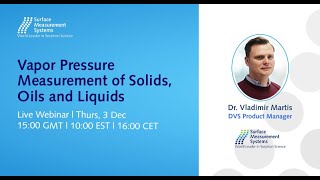
Recorded webinar (Prof. Sorption / Dr. Vladimir Martis, Jan 15, 2021) describing two primary approaches for vapor-pressure measurement: a Knudsen/Natanson effusion (vacuum thermogravimetric) method for very low vapor pressures (down to ~10^-15 Pa up to ~10^2 Pa) and a static (manometric) method for higher pressures (~10^2 Pa up to atmospheric). The talk covers apparatus designs, experimental workflows (temperature equilibration, degassing, orifice selection and calibration), data analysis (mass-loss linear fits, Clausius–Clapeyron extrapolation), and application examples (benzoic acid, naphthalene, pesticides, polymorphs, lubricating oils, silicones, oligomers). The live Q&A gives practical operating parameters: Knudsen sample masses (≈5–20 mg; oils ≈40 mg when 75% fill), static-method volumes (≈5–50 mL typical; presenter noted at least 2–200 mL may be used), base vacuum (~10^-6 torr), run times (Knudsen: can take up to 24–48 h if unknown; static: ≈1–3 h per temperature point, often 2 samples in 4–5 h; full automated multi-temp runs possible). Presenter notes limitations for mixtures (static gives total vapor pressure; distinguishing partial pressures requires coupling to MS/FID) and hardware materials (cells in titanium, chamber stainless steel) enabling corrosive samples.
Chapters
So good afternoon or good morning, you are calling in from USA or other parts of the world. So I just mentioned today I'm going to talk about the vapor pressure measurements using our unique system. So especially develop the vapor pressure analyzer to measure vapor pressure for materials and also to introduce new system you simplified for these measurements. Okay, so let's just short make short introduction to vapor pressure and then I'm going to dive in straight into the method and the examples where you can actually use these techniques. So as you all know, the vapor pressure of liquid is the equilibrium pressure of vapor above its liquid. So it's basically the pressure vapor resulting from evaporation of a liquid. Or when we work with a solid, is it the result of the sublimation above a sample in a closed container? Now the other important factor to remember, let's say if you have a fill in the test tube with water, you're filling in the pot with water again. So as you can see on this picture here, they both have got one of the intestinal small surface area and the pore has got large surface area. And we close them. So it's a closed container. We put them in the temperature valve or temperature control enclosure, 25 degrees. So the amount of vapor that can be generated at the surface of the liquid is only 23.8 torr independently of the surface area. So what I'm going to demonstrate today is that actually I'm going to measure the vapor pressure of the liquids or above it, it's a liquid using our static method. So all talk is about vapor pressures. So why we are interested in the vapor pressure materials first is mainly for agricultural industry. It was one of the first applications. So we want to estimate the amount of toxic compounds accumulated on the surface with very low vapor pressures. And also vapor pressure is very important for material safety data sheets or safety data sheets, especially when you import, export the chemicals. And it is registered, it needs to be registered by the U.S. environmental Protection Agency or European Chemical Agency. So anyone importing, exporting pesticides or the chemicals, you need to report the vapor pressure value. It is very common to calculate it the vapor pressure value. But in many cases these values are not really accurate. Especially because our instrument, as you might know, there's lots of vapor absorption measurements. Sometimes you need to know the vapor pressure distance liquids. And in many cases when I use emerits, I'm talking about very special chemicals, let's say for warfare agents or some special simulants. So the vapor pressure is not very known. And the benefits of this instrument Is actually I can determine the vapor pressure and then use it. If let's say for drilling or operation of a pumps we're using the lubricants. So basically we want to reduce the frictions. And again the vapor pressure is quite important. Plays an important role in removing the vapors from the streams or when you're compressing the gases. So you want to know what's effusion rate or evaporation rates of these oils. And lastly the example will be understanding the efficiency of degrees of organic solar fields during the manufacturing process. So this is again the progressive reduction of additives like plasticizers and absorbers as a result of evaporation from the surface. So as you can see it's all about the evaporation and how it's going to affect minor process. And I haven't mentioned but also in the pharmaceutical industry we can focus on the different polymorphs so we can able polyformation polymorphs form A and then polymorphs with form B. I can disagree between these two polymores by just measuring the vapor pressure. And the results are very clear. So in these reports whether we the methods we're going to introduce, they are all listed in OCD guideline for testing of chemicals. So I just took the screenshots of the typical methods for the vapor pressure measurements and today which are listed in the guidelines and as you can see there are several columns highlighting the substance, repeatability, reproducibility and range. What is clear from this table that you cannot use one method for maple pressure measurements to estimate the whole for a whole range of the vapor pressures. That's why today we focus on the static method which goes about from 10 Pascal up to basically 10 power 5 Pascal atmospheric pressure. And we're going to conform fusion method or Natson method is gran thermogravimetric method. This go from very low from 10 minus 10 or 10 minus 20 Pascal in our case up to let's say 100 pa. This Natson effusion method can be used for the pressure oil of oil, pesticides or lots of materials. And I will show some examples of these. I'm not going to go into details of the other methods because it's not important for this talk. Okay, now let's go more straight to nuts and effusion method if you are all familiar with thermogravy metric measurements. So this is very similar to TGA but this is let's say call it vacuum tga. So what we're doing in nuts and Effusion method. We keep the material or your sample, solid oil or grease is held in a cell called a Natson cell with a normal orifice. This is the hole here. And we measure the effusion rates through the hole by sublimation or evaporation under the vacuum. Okay, by measuring the evaporation rates we observing the mass loss rate at a constant temperature. One of the key for the key parameters is the temperature. The temperature needs to be constant. That's why we always allow at least minimum of 2 hours for good temperature equilibrium. So this is the whole principle nuts and effusion method. It's very similar subsystem. Now from this effusion rate, basically time versus the change in the mass or mass loss rate, we can calculate the vapor pressure using the equation here. So the P is the pressure. R is the universal gas constant. T is the temperature of the experiment. So let's say imagine this is doing a 25. So this is the effusion rate at 25 degrees m is the molecular weight of a substance DM, DT is the effusion rate. So basically we fit the straight line to the muscle's rate and that value is fed into the equation. A is the orifice size. So orifice size is calculated usually determine. We have a rough idea about orifice size when we manufacture the nuts and cell. But we also calibrate or the orifice size using the benzoic acid, which is our reference material. So if you look at the equation here, the only variable here is the temperature and the effusion rates or the MDT value here, all these are the constant. So when we measure the vapor pressure, we always have to measure vapor pressure at at least at I would say five temperatures. And in the limited temperature range. The local of the vapor pressure of the fuel substance is a linear function of the inverse of the thermodynamic temperature according to this simplified Clausi's clipping equation. So why do we need this? So from this simplified Clausi's clipping equation that I can determine extra polar y vapor pressure values at different temperatures. And this is also worried for not only pure pure components, but also for some of the multi components materials. Now let's look at the scheme of the system. So as I mentioned, it's very simple. It's thermogram metric system, very similar to ga, but it's working in the vacuum. So you have the sets of the pump to generate very high vacuum. So we go down to 10 -6 for millibar. You have the one vacuum pressure gauge the incubator is the temperature enclosure. So we heated up the sample, including the balance and the preheater. Everything is exactly the same temperature. And the sample is loaded at the left hand side. So for the measurements using our SMS Ultra balances this 0.1 microgram resolution. And the enclosure temperature is 5 to 85. So if you work with let's say pharmaceutical powders or silicones. So the enclosure temperature range is sufficient to measure the vapor pressure of these substances. Because you can't go too high, your sample will evaporate and must go back to silicon. Must go back to zero. If you work with the oils, let's say mineral oils, which are using, let's say the vacuum pumps or for drilling, then we need to go up to 400 degrees in order to determine the vapor pressure. So this is the setup, typical setup for vapor pressure measurements on the other side, the reference side. So we use some counter weights as we will show. So what the system looks like. So you have a set of the pumps outside, it's fully automated, controlled by the computer. Then you have the temperature enclosure use incubator585. And then you have the vacuum stud inside pressure cages and the temperature controllers here for Europe for preheater and for the oven itself. Now what the nuts and center looks like. So if you come with the tga. So basically from the balance beam we have the suspending hang down wire. And then this is where is sitting our nuts and pulse and cell in the metal pan. So nuts and cell is got two parts. It's got a cap and the lead. Okay. So at the bottom of the cap you load about 80% by its volume. You cannot overload it because you need to have space above in order the vapor nuts and equation to take place. So you cannot overfill it. Otherwise it won't work. So this is the lid. But if you look at the inside view, so basically this lid you just screw it in on top of the cap and here's the top view. So what you see here is a small orifice which is, which can range from 100 micron up to 500 microns depending on type of material. So if you have highly volatile substance, so you're going to use, you can use very small orifice lower temperatures. If you have substantial which are less volatile then you require high temperature. So you can use a higher felt. So this is the trade of which one to use. And this is how you suspend from the balance. So to access this is very easy. You just under this one clamp and you get Straight access to the cell. It's. So now let's move to the actual real data. So the experimental part of nuclear. So here we look at the typical vapor pressure data of benzoic acid. So obviously here solid red line is the mass readings. Solid blue line is the temperature of the inclosure or incubator. Solid yellow line is temperature of the preheater. In this case, using the preheater temperature just to monitor the temperature of the sample preheater is very close to the sample temperature. And as I said, as you can see here, at each stage I wait three hours. The reason is if you look at the preheated temperature, you need at least 80 minutes for the temperature of the sample to reach the set temperature. Okay, so this is very important for this correct evaporation rate that the sample is at the correct temperature. Once the sample is at the correct temperature, we observe the muscles and what you can see here, as we step up the temperature, you go to a much higher temperature. The muscles is linear and faster. So as you can see, the mass loss rate changes with the temperature. Higher the temperature you got, the higher mass loss you have. Now bear in mind that you cannot go beyond decomposition temperature. You still get the temperature mass loss, but you cannot use this data for vapor pressure calculation. Now from this mass loss data we calculate vapor pressure which is very simple. You select the region before the temperature was change. So let's say you take last 60 minutes and the software fit the straight line which and then we obtain our fusion rate which is then fit into the equation. And the software automatically calculates the vapor pressure at each temperature. So you repeat the iteration at each different temperature and softr automatically construct the logarithms of vapor pressure versus inverse temperature temperature in Kelvin. And from this temperature here which displaying the vapor pressure advantage temperature, we can extrapolate the values for different temperatures. Let's say for 5 degrees Celsius, because the vapor pressure as you know, is only a function of the temperature. Also from the slope of this line we can determine heat of vaporization or sublimation. If you look at the absolute values here. So we have the evaporation rates here in this column DMDT milligrams per minute temperature is the first column. Then we have the vapor pressure determined using our method. And then I compare vapor pressure measurement values determined from literature. And as you can see, there is very good agreement between these two techniques. As you can see, if you look at the vapor pressure values, there is slight error between the measurements. It's never going to get exact same values but this method in my view provides very reproducible data for the vapor pressure measurement. So as you can see there's excellent agreements. Now the software also automatically generates the report what I show you below. So it records the orifice size value. This is important if you have the different type of orifice cell, so you know which cells to use and also the molecular weight of sample. So as I said is required work to weight. So then you get your vapor pressure values including your slope, intercept and absolute value of the vapor pressure and evaporation rate. So this is automatically coming out of the software, all the information, what you need, if you need, you can change the logo to your own company. So here's a typical vapor pressure report generated as a software. So the vapor pressure measurements are extremely simple but there is few considerations like loading of the sample is very critical. And because if you don't get loading correctly especially how do you put it in? Or you have like excess on the sample size. You might get another example of the vapor pressure is a vapor pressure of naphthalene. So this was done at 25 degrees. So this blue line, what you see here, there was change of the temperature from 0.21, it was solid temperature for over 500, 400 degrees. So you get a nice linear mass loss and be reported. I measured vapor pressure of 11.08 Pascal. The Environmental Protection Agency deposits 11.6 Pascal. So another example of vapor pressure as I mentioned earlier is for pesticides and fungicides. So this is for the manufacture of these chemicals and also for the agricultural industry. And here we look at the in this table we look at the vapor pressure material like ametrin, bifentrine, minchlorac and azoscoping. As you can see, SMS natson method creates reproducible comparable value to literature. But this is also our reference material. So as you can see the method is very well reproducible. And here's the value to compare out the data. Again here's just typical effusion rate for bipedrine at 65 degrees. Yes, you always obtain these nice linear mass losses at the temperatures. The other example will be vapor pressure of polymorphs. So this is maybe the polymorph of this sample scan for pharmaceutical industry. So I measured two polymorphs, one is for main, the other one is for B. As you can see here. Again the measurements was done in the narrow temperature range from 35 degrees to 100 degrees for Polymorph A and from 35 to 80 degrees for Polymer B. First question why the temperature is different? Because polymorph B x evaporated above 80 degrees, I couldn't get any data. Also now first striking difference is if you just start comparing the data at 3545, what you see there are huge differences in the differences are quite small. But as you go up above, let's say 50 degrees to higher temperatures, you see the differences in vapor pressure are quite significant. So you can see clearly differences between these two polymers. From this data and then from the slope of the value you get the heat of vaporization. So this is another example of vapor pressure measurement. The other big example of the vapor pressure of lubricating oils. So what are the functional requirements of the vacuum pump oil or in terms of mineral oils is lubrication, cooling, corrosion, flushing the contaminants in. One of the key requirements for the oils is basically low vapor pressure. The reason is the vapor pressure of the oil determines the vapor pressure that can be attained by the rotary pump. So typically vapor pressure of the oil at its operating temperature is about 1 millitol. There's also the lowest vacuum that can be reached using the rotary pot. So for this it's very important to understand when the oils are produced certain bonus polyselation what's the vapor pressure of these oils? So this we need to measure. So I will show a couple of examples of the vapor pressure of all these oils which belongs let's say to group of Krytox oils. So vapor pressure in this case was measured in the broad temperature range. So I went from 60 degrees all the way to 230 degrees Celsius. And as you can see here, in the mass loss rate initially at lower temperatures you don't observe any mass loss rates. You only see the changes with the mass due to the changes in the temperature of the bullumps. But as we reach the high temperatures so above 100 degrees we were able to actually determine in the vapor pressure of the oil in a temperature between 100 and 230 degrees. So as you can see from this data I was able to determine the vapor pressure of the oil A the same if I got the vapor pressure of oil C. Again there are no mass losses below 70 degrees. So you need to go in this case much higher temperature. So the vapor pressure range for this oil was from 205 degrees up to 260 degrees. So that is significant. These oils got much lower the vapor pressure and the oil A. So there are significant differences between these two oils. And this method was able to generate this differences of the oils of the vapor pressure and this curve, this curve which gives classic leaping constant. We can actually extrapolate the vapor pressure of oil for 20 degrees then. And then we can actually compare the differences which goes down to 10 -12 or 1015 Pascal. The other example of the vapor pressure is silicon sealants. So here is just basically sealants with different colors. So again we can measure the silicon sealants. I did. And so in this case both in the temperature range 25, 25 degrees. As you can see, I was trying to go all the way up to 50. Temperature was too high. All the supplied before actually reach the temperature and you get very nice linear relationship. So I was able to determine that silicon's got vapor pressure about 3.3 LV Pascal at 25 degrees and about 35 degrees about 8.3 Pascal. Now since we have the new system which allows us to go to 5 degrees, so I could remeasure it. I measure actually at much lower temperatures. So I can two more at least can get two more points for this material. Also there are some other applications like basic chemicals like stabilizers, chemical intermediates, which is for the coating applications. Then we need to know the vapor pressure. All this especially when you're working with the CVD techniques. And here we can. One of these examples of these chemicals is three isopropanolamine. Again it did vapor pressure of this narrow temperature range from 40 degrees up to 90 degrees. We get a very nice linear relationship. And from this linear relationship I am able to extrapolate the vapor pressure 20 degrees. Because if you look at the most material data sheets, so the vapor pressure is typically given at 20 degrees or 25 degrees. But if the vapor pressure is too low, it's very difficult to actually measure it. It's impossible to measure low temperatures. We must have to go to much higher temperatures in order to get these values. Molecular weight is about 335. Now I move to different methods. So this Nazi effusion method covers very low vapor pressure. So we go down to 10 -15 Pascal up to 100. Now our static method is very different. So this goes probably from 100 pa up to 103,000 Pascal. So in this method, it is direct method. We measure directly the pressure. Okay. As I show in the first example of is the water. So I'm going to measure the vapor pressure of the molecules above the leak. So the vapor pressure at thermodynamic equilibrium is always determining a specific temperature. And this static method uses simplified apparatus. So I need some reservoirs in this case I'm going to use the flask. I need a vacuum light pressure gauge and some sorts of the pressure control for automatic experiments. What it means. So I'm going to use our DVS vacuum system which looks very similar to our VPA system. But the only difference is that these systems allows you to do starting method, not any fusion method and also vapor gas absorption measurements. So 3N1 is very unique setup. So when we do the starting method so you can ignore the balance. So what we do, we connect the mass flow controller to the flask. We fill up with the solvent of the substance we want to measure. So in this case I can use the two substances at the same time. Again you have the temperature enclosure for measure for controlling the temperature. So in this case between 20 to 70 degrees. And you have a valve which can be closed to release the measurements. And then you have such a pump and a vacuum pressure gauge and two gauges to measure absolute pressure inside the vacuum chamber. Okay. So typically when you connect the flask, you need to degas the flask. This is done by opening this valve and pulling the vacuum and removing the air from the flask or all the molecules above the liquid. Once we've done that, then I close the valve here and the pressure inside the vacuum chamber will raise up to maximum level till you the plateau. And this is the event pressure plateau. This is the saturation pressure of the solvent. What it looks like. So here's the stump is exactly the same some using the vpa. But in this case we're using only these two flasks here. So this is where I'm going to put my solvents or any substance. And you have the two gauges to measure the up to pressure. And here's another gauge. The valve opening. Connect the valve which isolate the pumps from rest of the vacuum chamber. A very simple system. And as you can see here, all is house inside the temperature control enclosure, which is very important. Before you do any of these measurements, you have to wait at least a couple of hours to get everything at a constant temperature. Now so here's the example that we can measure. This system allows us to measure two samples sequentially. So what it means. So the both samples can be sitting at 25 degrees for a couple of hours. Then I'm going to discuss the gas sample number one. So basically I pull the vacuum, remove all the air above the liquid. Then I close the valve. I will directly measure the vapor pressure of the substance number one. When the experiment is completed, wait a couple of wait to Remove all the molecules and then I repeat the process on substance number two. Now let's start with the simple experiment. So I'm going to show the data now for wave propulsion cycle hexane at 25 degrees. So initially what you see here, so we have received a 0, 0 corresponds to basically so there was no, there was just only the vacuum. So nothing was happening. Then you see this small dip here, what it means I opened the valve, I was degassing about 10, 15 minutes. I was putting vacuum directly on the solvent. Then I closed the valve and the pressure inside the vacuum chamber was raising up to desaturation pressure. When I reach the heat of oxidization is equal to heat of condensation. And this stage here, the saturation pressure of the cyclohexane was 98.34. As you can see there is nice plateau. And this is the maximum pressure I was able to actually measure. So the saturation pressure cyclohexane at 25 degrees is 98.34. So it's very simple. Expert did the same thing for cyclohexane. So initially you degas the solvent for 15 minutes. Then you close the valve and the pressure will rise up to till you reach the equilibrium between the liquid and vapor phase. And in this case at 40 degrees, I measure the saturation pressure of an EC10, 31.9 12. Again you get very nice flat line. So there are two important parameters. It's good temperature control, you need to, the system cannot leak and you need to have a good vacuum level, a good pressure measurement. So again the last example is actually I'm going to look at the vapor pressure or mixtures of oligomers with different molecular weights distribution. So the static method is very useful for measuring vapor pressure of molecules which have, which are not pure components. So here I show example when I measure two samples, one after other. Okay, so initially we'll sample again this table. You see when I was putting the vacuum on the sample degassing step close the valve. And this is as I said, is the mixture of different oligomens. So the pressure is up, pressure is up. As you can see what you observe, the line is not as steep. So when you have the mixtures it takes the time to pressure for the pressure to rise. So in this case, for this sample number one, I measure saturation vapor pressure at 50 degrees at 4.92. Okay. Then I went back to zero. So I basically evacuated the chamber. So I removed all the molecules from sample one, then opened the valve on my flask so I degassed the sample number two for 10, 15 for 15 minutes. Close the valve and again I see observing the pressure raising up for the sample number two. In this case, the saturation pressure of sample number two is 1.12. So as you can see, this system allows you to easily measure two samples one after other without actually changing the sample. So it's relatively easy the system to measure and it can operate 10 to 70 degrees. So that would be all from my side. As you can see, it was a very simple methods for determining the vapor pressure. And I would like to thank you for your attention and your time and I'm happy to take any questions you might have.
Thank you very much, Vlad. I think everyone else will join me as well and thanking you for a great presentation. We have a few questions starting to come in, so I'd also like to invite everyone attending and listening to. Please submit your questions in the panel to your right. The first question we have Vlad, is what is a typical amount of a sample for the Knudsen and static method?
So in the case of the Knudsen method, typically we use between 5-20mg of sample depending on the density. So let's say if you work with oils, if you fill up the cell about 75% it gives you about 40 mg weight solid about 20 mg. In the case of static method, so we use about 50 milliliters of the liquid. We can use even the less depending how fast. So we use we need at least between 2200 milliliters of the liquid for the starting method.
Great. Another question we have here is what is the base vacuum of the system?
So in the case of the static method, one of the key one of the requirements by obviously the guideline or regulation is that you need to have the good vacuum. They refer to high vacuum, ultra tor high vacuum. So in our case we go down to 10 minus 6 torr which is a good vacuum for these measurements and which is required by the guidelines for starting vapor pressure measurements. Also for the Natsen effusion and vapor pressure measurements.
Great. We also have a question here is what is the typical length of the experiment?
So the typical length of the experiments, if you are interested, if you know the temperature range for the when the sample is going to evaporate, I would say it's about 24 hours. If you don't know, like in the case of the oil would I measure because I didn't have any idea about the evaporation rate. So you can go actually through the whole temperature range and then you can go up two days. Once you determine the evaporation range is the measurements could be done within 24 hours. For NATS and effusion method. In the case of static method is the experiments are much faster because you typically if you will get 25 degrees, you pour the solvent, you wait for an hour for good temperature equilibriums, you do outglassing and depending whether it's the pure substance or is it a mixture. So we're saying about one, about three hours per sample. So you can do two samples in about four to five hours. And so you should be in the static method. You should be easily. You can do several actually measurements. So benefits of this, because it's fully automated, so you can set up the methods and run it for 24 hours and you can do actually vapor measurements at 25 degrees. Once it's completed, software will automatically increase the temperature to 50 degrees. As I show in my examples. You wait there for three hours and then automatically repeat the procedures on each sample. So I think the static is quite powerful for these, for measurements of the vapor pressure of the liquids, because you can do lots of experiments in relatively short period of time.
Great. We have a few more questions coming in now, but there are two people with their hands raised. So I'd like to give them the opportunity to to unmute themselves and ask their question directly. So first, if you're listening, Salvador Escopedo Salas, if you would like to unmute yourself, you're welcome to ask Vladimir a question directly or else I can ask on your behalf.
Hi, Vladimir.
Hi.
I just have a question. So how actually your system is operating when you have immiscible liquids that you know, when you have a pure system, obviously it can work perfectly in a static method. But when you have two immiscible liquids and they are quite diluted, how do you predict well enough the vapor pressure of this mixture?
Yeah, this is always a tricky one. But vapor pressure, the oligomers, the example of the oligomers, what I shown are actually the mixtures. So you always predict the vapor pressure of the highly volatile compounds. And one thing, what you notice for these mixtures, when you repeat the same experiment on the same sample, let's say 25 degrees, couple of the time, the vapor pressure will change as a result of this. So you can use it for the vapor pressure of these of the mixtures as well. But you always measure the vapor pressure of these highly volatile compounds first. Yeah. Okay.
So you can analyze separately first and then test.
Oh no, you can. I mean the only way to do it that you would have to either connect it to FTRI or mass spec. If you want to do complete analysis of the products, what is there? You can't really provide analysis.
So basically yeah, the system is perfectly useful for samples that are like mixtures but miscible and in pure form. Right?
Yes. So it gives you the. I would call it the total vapor pressure. So I cannot give you the vapor pressure of the each components in the mixture. So the mixture of the. If you have the let's say sample which is the mixture of different molecular weights. So I won't be able to do that. I give you the total vapor pressure of all. But if you. Let's say if it's the mixture of different compounds. So what's going to happen? The highly volatile compound they going to be actually removed. Maybe during the outgassing process. They will go first. Okay. Yeah, I'm going to just measure vapor pressure, those ones.
But how do you warranty because based on your configuration you have your sample that. Imagine that you have two very high invisible components like water and oil. So the vapor pressure of the oil will always going to be predominant in your system. Right. So you won't really see the total vapor pressure but pressure, the partial pressure only of one of the components. How do you warranty that vapor pressure is fully the mixture of those? You don't have a steering unit in your sample board.
I would say I didn't really. That's a good point. You are right. We don't have the steering in the bottom. But we could have the steer that. Actually we could steer it. I have not done measurements. Let's say water, oil, the mixtures like this. Okay. I did lots of vapor pressure of the mineral oils or let's say oils for the vacuum pumps or take generally I think the. That say. Let's say they are Krytox type of the oils. I think there's a trade name for these type of oils. Yeah, these oils got like molecular waste vary from let's say 30,000 watt per gram to 10,000 mole per gram. So they are built of the different molecules. So we can measure vapor pressure of these ones. But if you like let's say mixture water and oil. I'm not sure because the vapor pressure of the oil of water is going to be very high compared to oil. Yeah. So that's going to be very difficult to measure. And also actually if we're going to. Okay, that could be only possible. Having said that if you have the mixture of water and oil. I would not actually if you if you were measuring the static mode. Okay. That the vapor pressure will be dominant by the water at that temperature because the oil of vapor 75 degrees is about 0.1 pascal roughly or 1 milli tor. So we won't be able to really measure it in the static mode. So what are we going to. I'm going to measure it's going to be vapor pressure of the water. Now if I measure this same mixture in nuts and effusion method. So what's going to happen? You have these mixtures. If we can get perfect mixture, I can load that mixture. But initially I am going to evaporate all the water because the oil. In order to get any muscles effusion rates from the oil itself, I need to go to much higher temperatures above 100 degrees. And while I'm going to go up, what you're going to see, you're going to get sharp muscle losses initially which can be initially usually let's say first 5% is due to impurities, but the other sharp load muscles is going to be due to evaporation of the water. So once I evaporate all the water, then I'm going to measure only the vapor pressure of the oil again. Okay, you see what I mean here? Because the, because the boiling point like the vapor pressure of these two compounds are extremely, let's say an extreme end. So let's say water 25.23.8 Torr and the vapor pressure of the oil at 25 degrees is usually. Let's say that the crytalk soil. When I show some example, we're talking about the 20 degrees extrapolate about 10 -6 Pascal. So it's extremely different vapor pressure. So internal. Basically.
Yeah. You have to find an alternative way to measure. I mean this is just when we're talking about like two pure immiscible like components.
Right.
But there is also like pseudo mixtures that there is a fusion of for instance water and let's talk about petroleum.
Right. Or crude oil.
So which it has a mixture of tons of different components that make probably the analysis of that vapor pressure even a bit more difficult.
It does. But from my. I didn't show the data like when I mentioned sorts of these oils. One one thing is when you measure vapor pressure, you reach the point even if you go up in the temperature, the vapor pressure is not going to change. So we only measure usually vapor pressure or a highly volatile compound or the compounds they're going to evaporate so some of the oils like I only showed the data in the range, let's say from 250 to 60. But in reality I went all the way to 350. What do you observe? The vapor pressure doesn't change the effusion rate. The sample is losing the mass, but it does not contribute to the vapor pressure actually itself at all. And.
Well, thank you for answering that. So yeah, just another question regarding the vacuum process. So when you actually generate a vacuum is to eliminate the. The air inside the chamber.
Oh, so you're talking about Natson or a fusion method.
Well, I think in the new sense.
Right.
So you use the vacuum.
Yeah. So basically in nuts and method using the vacuum like when you measure these oils. So the one of the requirements of being using the vacuum to pull the molecules through this hole basically to measure the effusion rates.
And when you have. No, no, no, sorry. So finish.
So when you have the vacuum as a result of these. When you're pulling out these molecular evaporates, you help in the evaporation process. So basically you're observing the muscle. That's why I'm using the vacuum. Okay.
And this actually vacuum doesn't really affect the vapor pressure. You will take some of the. Imagine that you have a sample that you don't know the vapor pressure. Right. So you will start vacuuming that the sample will really gonna be affecting. If you have, I don't know, components with a low vapor pressure that might. This vacuum will take away some of those components and then you will just get some of less vapor pressure measurements for the sample that you're analyzing. So you won't have the total vapor pressure, but like just I would say partial measurements. Is that actually that vacuum affecting the sample content of volatile compounds?
Yes. So if you have highly volatile. So the vacuum actually enables to evaporate of this compound much faster. So they're going to be using through that hole very fast. Also if you had a bigger hole, that's going to speed up the process as well. But one thing to remember for not send effusion method. The vacuum is just basically is the driving force is providing the force for the molecules to travel. Yeah. The actual vapor pressure calculations are done on the mass data. Yeah. So the vacuum is throughout the experiment changes slightly, is maintained 10/5 tor, 10/6 torr. But the actual measurements or the calculations requires only knowledge of a mass loss rate or effusion rate at different temperatures. So not really. I would say it's not important. It is required as a Driving force but is not, is not used in any other. In any calculations. If you look at the other equation. So when you come to his equation, when I calculate the vapor pressure, I don't need to enter the vacuum pressure value anywhere.
Okay, I saw.
Hi guys. I think if I could just interject here. I think we have. We have a lot of questions stacking up. So I think we will have to move on to the next question, I'm afraid.
Yeah, no, it's okay. Thank you very much for your time and very interesting.
Thank you for. Thank you for your engagement, Salvador. So Vlad, we just have a question from Annalisa Konju. She asks, do you have experience for measurements on molten salts which are quite corrosive?
No video. I have not mentioned any molten salt. But if it's the corrosive, our system can handle it. Because I would just to make it clear, the cell, the nuts and cell is made of titanium. And the chamber, everything is made from stainless steel or white and or colorless steel. So we can handle toxic or corrosive vape solids or vape liquids.
Great. We have a question from a Carla Izari. She asks, is it not necessary to freeze the liquid before vacuum for static. For the static method.
That's a very good point. Yes. So you can freeze the liquid. You do this degassing of the liquid so you can purify. So there is one other way to do it. I have not freeze the liquid. And the reason is it doesn't make in my view any huge difference. But if you have access to liquid nitrogen, yes, you can do it. You can put basically tray this liquid nitrogen under the flask and boil the liquid prior to the measurements as well.
Okay, great. We have a question here from a Luisa Ecky. Now let me preempt this by saying I know Luisa has had her hand up for a while, but just so we can get through all the questions, Luisa, I'll pose your question to Vlad and then we can possibly connect you guys afterwards to have a more full discussion. But Louisa asks, I want to calculate the solvent vapor concentration in my setup an Erlenmeyer flask. Is that possible with the vapor pressure of the solvent in my case toluen T O L U E N E.
I never been asked this before. I gonna look into it. I'm gonna get to you offline of this. I'm not sure. Yeah, so as I'm. Yeah, I'm gonna have to look into it because the system provides the vapor pressure values. So I don't know if it's gonna help yet. Let's just discuss it online or we can have another discussion about it. We need to look into it.
Great. Well, Luisa, we'll connect with you after this presentation to kind of explore that more fully. A question here from Sarantha Pereira. Why do different polymorphs have different vapor pressures? Can we compare the DVS results with other techniques to compare the different polymorphs?
Oh, it is a good question. I am not the expert on the polymorph or this pharmaceutical materials and there was expecting to be differences. I mean I don't know much about this material. So that was one of the material I did it in the past. So I don't know. I mean I would expect the material behavior will be different if you do, let's say some other technique. So I would not expect violation have the different vapor pressure.
Okay, great. And another question from Annalisa Konju. She asks, is it possible to couple the system with a mass analyzer, for example, to determine the partial pressure of a mixture?
Yes. Yeah. We can attach it to mass spec and analyze it. We'll discover the sample. Great.
Thank you. I think that looks like all of the questions we have for today. So I would like to thank all of our audience for taking the time to be with us today and for submitting so many engaging questions. Anyone who we who didn't have their queries answered though I think we got around to all of them. Anyone who we need we will contact for a fuller discussion. We'll do so after this session. Is there anything you would like to add before we finish for the day?
Vlad?
No.
I would like to thank you to all our participants who join me in this webinar. So this is the first time we introduced this technique and then I'm still looking for the new opportunities that you can actually employed in the industry. How we can use. So if you have any other useful suggestions or calculation you could actually use for the which could be used from these measurements and for deriving of your constants here, just feel in touch. So once again, thank you very much for your time today.
Yes. And I'm sure the audience will join me in thanking you as well, Vlad once again for a fantastic presentation. As Vlad said, you're all very much invited to suggest. Connect with us for further suggestions on how to employ this method. So please do so@scienceurfacemeasurementsystems.com Our next educational webinar will be coming up in two weeks time and that is titled Inverse Gas Chromatography the chicken feather mat characterization. This is a fantastic new piece of research we've conducted with Dr. Kane Chinois at the Imperial College London. And this will be exploring the use of chicken feathers and other such other such materials as a oil sorbent for use in kind of treating chemical oil oil pollution and oil absorption. That'll be taking place at 3pm GMT on the 17th of December and you are all invited. Once again, I'd like to thank you all for joining us today and we hope you have a lovely afternoon or evening, wherever you are. Thank you and take care.
More from Prof.

Webinar: Advances in Measuring Gas and Vapor Permeation Through Membranes and Barrier Polymers

Webinar: Determining Solubility Parameters of Bacterial Cellouse Through Energy of Adsorption

Online Webinar: Recent Technological Advances in Adsorption Based Direct Air Capture

Online Webinar: Surface Area of Pharmaceutical Ingredients at Real World Conditions by IGC



Hybrid Workshop: Measuring Material Vapour Pressure Properties Using Advanced Sorption Technique

PCL Hybrid Workshop: Recent Advances in the Characterisation of Pharmaceutical Powders


Using Advanced Techniques to Test the Performance of Recycled Bathroom Tissue | A video summary
