Webinar: Water Sorption and Gas Adsorption Measurements on MOFs
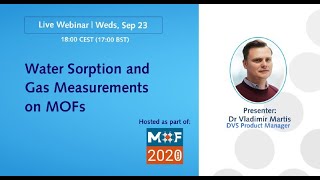
Vladimir demonstrates vacuum gravimetric dynamic vapor sorption to measure water and gas adsorption on metal-organic frameworks. The webinar covers DVS equipment and procedures, then shows real applications: water and CO2 isotherms on MOF-74 variants, SO2 adsorption on MFM-300 and MIL-101, and competitive CO2 uptake on pre-saturated samples.
Chapters
John, thank you very much for nice introduction and I also would like to thank you to all of our participants who are joining this live webinar this evening. So I hope you can all see my screen now. Okay, that's great.
Glad we can see you.
Good, great. So. So today I'm going to talk about the voltage option gas adsorption measurements on moles. So briefly during this talk I would like to talk about Javier give introduction to absorption science. Then I will focus on water and CO2 adsorption measurements on magnesium of 74 and functional OSMOF 74. I also like to give examples of toxic gases adsorption. So we will show example of so twosorption at 25 degrees and also cycling experiments. And lastly I will show example of the binary cause option water CO2 on one of the materials. So there is several characterization methods to characterize the metal organic frameworks. So as John mentioned, so in the past I use the energy so in particular X ray so did lots of X ray absorption spectroscopy and X ray diffraction to look at the structure of the materials. We can also use the heat so in particular colorimetry or TGAs to look at the materials behavior. But interior stalks we would like to focus on molecules as a probe. So in this way we're going to look at the absorption technique and which will provide information about thermodynamics chemical. So we use the matter to probe study of materials. So some of you wonder why we would use probes as molecules to characterize metal organic frameworks. One of the main benefits is that we can actually study molds under real conditions. This go back to origin when the mole phosphorus introduced there were very promising applications. And when the industry start using the morphs they soon after they find out that actually morphs are not stable under real conditions mean ambient temperatures under vacuum. So they need to be kept in the specific conditions. So one of the reason is now to offer the actual measurements. We can actually look at the stability of morphs partially in the presence of humidity which is very critical for stability of these materials. And also when they exposed let's say to CO2. So we don't want the mold to change the structures. So the probe molecules provide information about the ambient high temperatures. So we can look at these also pharmaceutical equilibrium and study dynamic processes. So vapor sorption can occur in several places. So we can have it on the surface. So we can have surface adsorption which is typical with very low adsorption, very loads of let's say very low uptake it can become in the pores we can between the particles. So when we observe the condensation, then it can be interposed or macropores. Or some of the molecules can be sorbed into the bulk or there will be chemical reactions and they can form mete hydrates. When the probes react with the solid surface, they can weakly adsorbed to the surface or they can penetrate into the bulk of the materials and so the rest of the molecules coming out of the adsorption process. These processes of interaction of molecules with the solid surface can be described by adsorption or an absorption. When we talk about the absorption processes, we always refers to physisorption and chemisorption processes. And in terms of absorption we refer to bulk absorption. So Matthias goes into the bulk of the materials or into the lattice structure within, where it can form different. Where it can format the let's say solvates. In this story we only focus on the fisorption process. We're not going to solve physician process. It can be described biweekly absorbed molecules. And it can be physically because of molecules can be regenerated. When we talk, molecules actually react with the bonds of the materials and they can transport from one species to the other species. So we can from. So what other question is like what can actually learn from these vapor gas absorption measurements? One of the most important answers from these measurements is the stability of the moles in the presence of water or CO2. And it was demonstrated by several researchers, let's say from Georgia Tech, that actually and also by Stefan Gaskell, that actually stability of moss is critical for development of storage of these materials. Because some of the mobs collapse when they were exposed to the water. Or some of the moles actually change the chaos structure chemically when they expose a small amount of CO2, let's say from the air. We can also obtain information about the total gas adsorption capacities at different temperatures. And so if you collect isotams in a broad temperature range, we can obtain information about the heat absorption. We can look at the adsorption at very low concentrations, making it out of PPM levels. So this is important for carbon capture or removal of volatile organic compounds from the air. We can also look at the information about the kinetics. So we want to calculate diffusion coefficients. So we want to know how fast these molecules can be absorbed by moles. And it also provides information about this vapor and gas solid interactions. And lastly, we can calculate which is surface area of these materials. If you use liquid nitrogen, which is most common Techniques to actually determine adsorption isotherms. So the interaction of solid or morphs with vapor molecules can be described by the adsorption isotherms. So the adsorption isotherm is basically a relationship between the amount of vapor gas absorbed at different equilibrium pressures at a constant temperature. So on the right hand side we have the picture of watersorption isotherms on carbon at 25 degrees. What we see here we have the two cycles. So we have the adsorption branch which is shown by green and red line and desorption branch which is shown by solid, pink and blue line. So what you see on X axis we have a relative pressure which is described as p over p0. So p0 is a saturation pressure of absorpted air operation temperature. On Y axis we have a change in the mass or the amount of absorbed. So what we see here, so during the adsorption process we actually step up the concentration of the molecules and as a result the amount of the gas adsorbed or vapors in this case goes up. So the sample is gaining mass on the desorption branches. We actually step down the amount of the vapor molecules and the weight can go down. Now the giz, the hysteresis is basically the gap or the offboard you see here is called hysteresis. Basically that's the difference between the adsorption and desorption isotopes. Now during these adsorption phenomena several processes occur. So you have the monolabsorption, you can add a multi layer sorption, condensation, bulk absorption and hydration reaction. So here we look at the type 4 isotames which can be described by local adsorption but also decombination in the pores which is demonstrated by huge sterisis in the pores. Now the group, the adsorption isotopes can be grouped into the IUPAC classification into the six main groups. So you can have one for macroporous, nonporous, weak substrate, mesoporous and layering. Now there was also a new grouping released recently by Martin Stomas and co workers where go more into the detail and explain different interaction of these vapors or gas molecules with the solids. So typically we look usually for the most, we look at the type 5 isotames or type 3 depending on the chemistry, how it was dissolved. So microporous are usually typical zeolites. So they have the finite adsorption. And type 4 is described by the capillary condensation. It is going to describe all of them. Now how we can actually collect the adsorption isotope. So there are two main techniques to actually collect to obtain the adsorption isotherm. So one is the volumetric adsorption apparatus. So basically historically adsorption isotames were collected using volumetric method molecules in liquid nitrogen. And from this data is very powerful data which gives information about the porosity and also about the surface area. So it is one of the go to techniques to obtain, let's say the surface area and poor volume of the materials. The other way to obtain the adsorption isotopes is gravimetric gas vapor adsorption apparatus which will be shown in this talk. And this is basically complementary to volumetric system, but is mainly focused on actually understanding or behavior of these materials under more realistic conditions. So when you want to use these materials in the real applications, so once you've done your porosity characterization, then you should go for the gravimetric vapors option analysis to understand how these materials can behave in real conditions, how much can be, how it can be used for the gas adsorption. On the other applications in this talk we focus on the vacuum gravity metric absorption analyzer. And the reason is because molds or coaxial zeolites, they need extensive outgassing which is not always possible using traditional methods like the flowing of nitrogen at high temperatures. Also the system guaranteed a clean environment for air sensitive or moisture sensitive samples. And as I mentioned, this was already demonstrated that in our apparatus we can do in situ out gassing and regeneration of the samples and which is actually very powerful. So we don't. Once you load the sample into your analyzer, you don't have to remove it. So you can get the data institute. Also when we do water vapors option, there is no carrier gas, so driving force. So the vapors like water organic vapors, if you study the VOCs are generated by liquid itself at thermodynamic equilibrium at experimental temperature. So the driving force for the molecule is actually vacuum which is actually pulled from the flask into the system and then in order to get them into direct contact with the solid material. And this give us understanding of a pore structure of these materials, in particular the pore size area. So we can actually allow the molecules small enough to go into the pores or the cages of these materials. And this help us to actually design better industrial processes. And lastly it actually allows, so this is dynamic method, it allows us to reach the equilibrium very fast, which is demonstrated even compared to static or dynamic ambient pressures, you get much faster than the vacuum so how dynamic vapor absorption or DVS works. Typically, as you would expect, you load like in your, let's say thermogramimetric analyzer sample into the metal pan. So it can be either your powder or granules. And in short stage of all these measurements, either the gavolumetric or gravimetric is outgassing of the material under high temperature, high vacuum. So for this we close the upstream, we put high vacuum 10 -6 millibars high temperature and we completely clean the pores or cages of the materials. Once we remove all the materials without gust, then the sample is cooled down to absorption temperature. And then we introduce probe molecules using our muscle controllers. So for these we close the downstream, open the muscle upstream and introduce PRO molecule interest, either water or CO2. And then we wait for the interaction of this PRO molecule with the sample. And when we reach the steady state, we're going to get a constant flux or water or gases over the sample in order to reach nice mass equilibriums. If you look at the right hand side, so I'm showing some graphs. So basically on X axis we have the time and Y axis the weight of the sample. So data here. Solid red line is the mass of the sample. Solid blue line is relative pressure. So what we see here as I described, so initially the material is outgassed. So this sample lost by weight 5% during the outgassing sample outgassing stage. Then we introduce water vapor in the control model at very low concentration, about 0.1% pop node RH and we wait for the mass equilibrium. So the mass equilibrium is this actually solid red line which you're reaching actually the plateau during the mass, the mass equilibrium was reached, they move to the next or higher relative pressure state. So as you step up the relative pressure we observing the gain in the mass all the way up 90%. And when we step down the relative pressure we observe mass loss. And from the equilibrium pressure points, from the equilibrium mass data points we can calculate the adsorption isotope which is shown here where we actually compare the. Where we plot change or mass gain or weight against the different relative pressures. So, so this is the typical absorption behavior of zeolites when we observe small hysteresis gap due to the condensation in the pores. Because the material made of the clay in the decomprensation of adsorption. Right, so you tell adsorption resorption, it can be described by nicely by type 1 isotherms and PTD let's say can be by Ryu Silang Mir or lime meal isothere. So this is a typical basic principle of dbs. So what it looks like on the right hand side we have a picture of DVS vacuum. So you have a set of the pumps which serves as the basically force to put your molecules and also put out gassing. Here's got the temperature enclosure. So the temperature enclosure defines your absorption temperature. So we can generate the vapors in the temperature range 20 to 70 degrees up to 90% pop zero. Then we also have a high temperature P around the sample. We can go outglass the materials up to 200 degrees. We can also perform the adsorption. Let's say water vapor up to 150 and gas up to 400 degrees adsorption. And what you can see here is a small flask. This is where you're going to put your water organic solar. All right. SR is just basically scheme and I'm going to spend a couple of minutes on these because especially for co adsorption. So this system allows you to do two vapors, two gases or one vapor, one gas. For this we have the two muscle controllers which are used to deliver vapors and gases to the sample. And when the vapor and gas enter the vacuum chamber it's equally split over the sample side and reference side. So what we see here, this is the vacuum chamber and the dome. Here we have ultra balance. So it is symmetrical balance. And the front bulb is being suspended to hang down wires. One on sample side, one on the left, one on the right for sample reference side. On the exit side we have a butterfly valve which actually control the residence types or amount of molecules inside the vacuum chamber in dynamic mode. And on the exit side of the valve we have the sets of the pumps. Now the pressure is directly measured by two patterns Centauri and thousand torpedoes. So this is a typical setup which allows you to work in dynamic mode and also in the static mode. Basically in the static mode these valves always close and it will work like in the case of volumetric systems that we use mass flow controllers to inject the amount of water or gas molecule into the chamber. And then we wait for the mass equilibrium. So I mean the pressure drop below septuagint. We're going to refill it. Now these are the insights of the picture of the vacuum stand and what I will show you set up especially for cards option. So what can you do? This system allows you to study water and CO2 so it allows you to do water pure waters option isotames it allows you pure CO2 option isotames but also I can mix these two pro molecules together. I perform both CO2 in dynamic mode and the static mode. So what you see the sample is sitting here on left hand side. Now to get access to the sample you under these two clumps this drops down and you can get access in TGA to metal pipe. So this is very important. And as you can see this is also inside the temperature control enclosure. We call it incubator or imagine it's like oven which control precisely temperature. We don't have an issue with the condensation but it also is defined is used to actually generate the vapors in these at this temperature. Now as I mentioned, so there are two operation modes. One is dynamic mode. The benefit is when we can go very low absolute pressures we can go down to 5ml. So this allows you to do. Let's say Water's option is 60 degrees at 0.02% RH. We can do single dual component adsorption and also resident on control the starting mode which is powerful mode if you have right type of moves to study actually the absorption processes at the constant loading of let's say constant loading of the water vapor. Now let's move to applications. So one of the first applications we're going to look at the water vapor and isotame and CO2 adsorption isotames up to 1 bar of loads of so and this is very useful for current climate. So basically there is a huge interest to study the carbon capture. There is a rise of carbon dioxide in atmosphere and which is a major factor for increased global surface temperature. As you can see the projectories is if you are not going to do something about this, it's going to keep going up. So for this there is a need to actually develop the processes or technologies to reduce CO2 in the atmosphere. So there is already several processes considered like amine scrubbing technologies for CO2 capture and sequestration, direct air capture or CO2 capture from the air. There are already some commercial devices available or in this talk we're going to focus mainly on absorption based processes using the MOFs operating in the pressure and temperature explain mode. So this is the most interesting for us. So today we're going to look at the morphs. So there was a lot of excellent work to give introduction to the morphs. And I just want to highlight benefits why we want to Study morphs for CO2 capture because of data very high surface area and then and mainly because they the ability to actually to study to the tune the pore structure of these materials. So this is the most powerful techniques for the box. So in this work we're going to functionally we're going to focus now on magnesium of 704, which was actually one of the first reported for CO2 capture because it's got higher adsorption capacity. And what we want to do, we want to increase the amount of amine units available for CO2 absorption by actually by functionalizing this magnesium of 74 using plesaroethylene pentiamine. And the aim of this work, what I'm going to talk today is actually so we can now focus on water CO2 adsorption measurement and CO adsorption measurement. First, before I go further, I would like to highlight one of the things I'm going to talk about is like watersorption as I mentioned in my talk, but also want to show the effect about gassing. Okay. So one of the powerful things about EVs is that they can actually monitor in label in real time the outgassing of the material. So here we look at one of the moles which was initially outgassed using only high vacuum 10 minus 6 torr. As you can see, you get certain mass, mass loss and dry curve suggests the material is already outcast. And what would you do now? You would introduce your problem that you will start collecting isotope. But what you can see, I increase the temperature using the preheater at 250 degrees. As a result my mass was actually much higher. And this suggests the material was not completely outgassed. The reason I mentioned this is actually is very simple. Because the outgassing of the materials a huge effect on adsorption capacity and also the stability of the materials. And the reason is you can if you outgass at low temperatures, your adsorption capacity might be too low. If you go outgass materials at high temperature, especially in metal organic formworks, you might destroy the structure. So in our case we have to using this high the vacuum type preheater to actual materials. So we will be going to look at the outgassing of temperature on the MOF 74 for adsorption isotope. So here's a kinetic plot. So basically what we're looking here, we are looking at this plot around gassing some of 74, 150 degrees. So as you can see is huge muscles almost 55, 8%. And we get nice plateau at an controlled manner. We introduce water vapor which is demonstrated by this solid blue line. When you step up the pressure up to 90% pop zero. And then we wait at Each stage for mass equilibrium. And from these equilibrium points then we construct the isotope. Now what you observe here. So if you outgass this magnesium of 74150 degrees, you get huge adsorption capacity. And compared to MOF outgass at let's say 250 degrees, which is shown in line green. So basically what you see first likely observation is that the MOFs outgas at 250 degrees suggests that the structure was little bit distorted or collapsed because the adsorption capacity is much lower. And also the desorption, when we perform the desorption steps, lots of water gets trapped inside the matrix of the material. So water is not coming out. Whereas if the materials is outgassed at 150 degrees, the adsorption capacity is higher. But also dissoption of molecules is much more of the water molecules coming out of the material. Now we've done the same work on these functionalized MOF 74 at 25. So again we've done the anode Gaussian 120, 150 and 250 degrees. And we see relatively different absorption behavior. So we again look at the kinetics or dimensions. So we can calculate basically diffusion coefficients how the fast molecule into the molecules. So we again step up the pressure from zero to 90 and we go back to zero. So you see the nice equilibriums. And again what we see again the huge effect on outgassing. Where you actually see the functionalized molds got much smaller hysteresis gap. So the adsorption branch is shown in green, desorption in the pink. So the gap is very small. Very similar to let's say what you get for like some zeolite shape. These clays materials could compared to same material outgass at 250 degrees. Again we see huge hysteresis gaps. Water is not coming on the materials. So the actual structure of material was usually affected by the outgassing of the conditions. So the message from this is outgassing of the moss is very important, but is also very critical. The choice of the temperature for the outgassing of the materials. Basically as you can see here, you can see you can get very different adsorption capacities for the same material depending on outgassing temperature. I would like to mention not too many researchers mention the outgassing conditions and temperatures. Because then it's very difficult to compare from one morph to the another. Because if we didn't start it from the same starting point, now this morph also now we can Employ let's say modeling. So we can use Langmuir to feed the data and we can get the language constant modeling. So we also look at the adsorption capacity of moles using the CO2. So now I'm not going to go into the kinetics. As you can see if you go to functionalized molds with much higher adsorption capacity compared to original MOF 74 for CO2. So we look at the CO2 adsorption isotames up to 1 bar. Now we also actually again look into more in details. So first we look at the MOF 74 outgassing capacity. So basically you get about 68% uptake. Now when you add the excess of the amine which is demonstrated by this green line and outgassing as 150 and 115, we get much lower. So basically, if you fully saturate this MOF 74 with the Amines, you your adsorption capacity for CO2 is very low. I mean one would expect that it might go up when you put more amine side you might see clear more CO2 site, but that's not the case. But then if you have actually less than 1% amine and you use the same old gassing conditions, what we demonstrated here, you actually adsorption capacity usually improve by factor of six. So in this case you get almost 28% absorption capacity compared to 4, 8% and you have axis of the amine. So as you can see again. So the effect of outgassing and the functionalization of the mole is huge Depending how you prepare your material and how you go outgassing material. So now we're going to move to the core adsorption measurement in dynamic mode. So the way we done this I will show. So we flow over the sample mixture of water CO2 and even up to 23 TOR. And then we look at the effects kinetics and then we can look at the effects of water CO2 mixture. So for these mixtures we see only slow slight improvements for functionalized morphs as is demonstrated by the isotames here at the bottom. So it's very difficult to comment, but the effect the improvements we see when you add a mixture 2 to 1 water CO2 water for CO adsorption that actually functionalize more does not share shows that the sum of the water ocean does not stay inside the matrix or the material compared to original MOF 74 where we see observing the hysteresis graph. So the conclusion is actually that angelization improve the accessibility of CO2 or accessibility CO2 but also improve the water performance. It improves also the CO2 adsorption capacity of water in the presence of water. If you use only 1% of Amines, if you use saturate completed morph of these amines and actually some of the CO2 site will be excluded from the adsorption process. My next application will be adsorption of toxic gas in our morphs. So here I'm going to look at the MFM 300 morphs which was actually prepared by Rijabara group from Unam in Mexico. And we want to focus on so twosorption at 25 degrees up to 1 bar. So once again the materials was outgassed at 25 degrees. And so you can see we get a new beautiful mass equilibriums at different pressure steps when we step up the pressure of CO2. So we use the pure CO2 so we go from very low concentrations up to 100% CO2 at a 1 bar. And what we observe, we actually make a nice type 1 isotherms here. And the adsorption capacity of these moles like 9.4 millimole per gram. Now we also look at the. Well as I said, the stability of the material and the cycling or adsorption performance is very important as well as regeneration capacity. So what we've done here. So basically we cycle this NVMe MFM 300 scandium modes at anti high vacuum. So regeneration was done 10 minus 6 Tor for 30 minutes. And then we introduced Pure SO2 and we've done the 10 cycles. And as you can see the adsorption capacity of these MMF mobs does not change. So the capacity Same is in 9.5 plus minus 0.15 millimole per gram. So it's indicative to our results. So MOP is very stable for in the presence of toxic gases and it remains actually is retained its adsorption capacity. You can do similar studies using let's say mil 101. So in this case we can keep the water pressure constant 5.6 kilopascal. And then we just vary the temperature of the sample between 40 and 140 degrees. And as you can see after 20 cycle the adsorption capacity of moles goes down with a number of cycles. So this is one of the reason the that are still more used in the industrial scale because the adsorption capacity doesn't change with the number of adsorption cycles. And lastly I would like to introduce you about the binary competitive adsorption of CO2. It's constant loading of water vapor. In this case I'm going to show the ZIM sample of zeolite in order to quantify the amount of hrsorptomolecules. So what I will talk you through now is very simple X plane which can be done in the starting mode in our DVs. So basically first stage is outgassing of the materials, high temperature vacuum. Then you leave the material equilibrium at constant pressure of water vapor. So in this case we use 1.845 volume percent water vapor. We wait for the mass equilibrium. When the mass equilibrium is reached, I bring CO2 a smoke on top of it, CO2 in small concentration by using second MLC and wait for mass equilibrium again. And now from this data, if I subtract my initial water uptake, I can actually calculate here to absorption capacity and we can obtain this kind of graph which tells you that at constant loading water vapor at 1.845 volume of water I can get about 10 volume 10 weight percent of the CO2. So it is a powerful method which can be used for certain morphs as long as they have the correct chemistry. Because there are a few assumptions we have made. The water cannot replace the CO2 and there are no interaction actually CO2 with the material. So we don't want to add any chemist option taking the place. Now this brings me to the end of my talks. So as you can see the DBS is very useful, a powerful method for obtaining single components and multi component option isotope at different temperatures. And also for studying the watersorption gas adsorption isotherms. So if you employ comply the DVS method with simulation techniques like ist, you can get a powerful data set for designing of the industrial processes. So lastly I would like to thank you to my collaborators, Professor Dara Williams from pl, Koj Lombong, Alan Hutton, Leh Bromberg and Akshay from mit. And also Ilici Bara and Jorge Basmata from Munampo help with the IST simulations. And also if you are interested, I would like to invite you to our tomorrow session and I'm going to talk about the design of automatic experiments in DVS using DVS biocontrol software. And you can see how we can easily set up this kind of experiment of study of metal organic frameworks. Now thank you for your attention and if you have any questions please is the time the floor is open for the questions.
Thank you for. Thank you for a great presentation there Vladimir. Do you think we have some time to answer a few of the questions in the chat?
Yes, we have time to ask a few questions. I'm very happy to answer if it's not too late.
Okay, great. There's been several questions submitted so if you have a look in the chat scroll, you'll be able to see them labeled if you just want to address them there.
Okay. Okay. So we have a question from Victoria Kulova. She had question is does CO absorption H2CO2 measurements using DEVS request first presaturation of sample with water vapor and then CO2 absorption. That's correct. You actually got it right. So in this example I show two examples. In my last example, in my last example in the starting mode, basically as I described, I need a pre saturation with water vapor and then I Pre introduce the CO2 on top of it. Also your second question was whether I can feed water and CO2 at the same time. That's correct. So in my previous example I am able to feed water and CO2 at the same time. But now when we do this, the challenge is and I can control pressure inside the chamber, that's another problem. The challenge is when we feed both water and CO2 at the same time and maintain the pressure is to actually quantify amount of water and CO2 absorbed because we can measure, so this is the gravimetric method and we measure only one mass. So I can't tell from the mass data how much water CO2 absorbed. So for this in order to quantify it we have to either employ ist. So we use these simulation techniques to actually determine the amount of water CO2 absorbed and then we compare this data with real experimental data or the other option is we are looking at it together with our collaborators and NASA. You know, we would like to edit up let's say FDRI to actually quantify in the real time. So we need some another detector to do this. So the other question is from Daniel. So how do you deal with selectivity, permeability trade offs and therefore in the effect and efficient separation of CO2. This is very good questions. So in terms of the selectivity, the way we deal in our case is we look at the structure of the materials and we look at the opening. Like in the simple example, one of the simplest way to look at is basically we look at the structure and opening of the cages of the pores and then you look at the kinetic diameter of the PRO molecules and simple way to do it if you have the two, if you have the probe molecules which have a huge kinetic diameter, so they might be too big to go inside to the pores. So there's one way to actually deal with selectivity. Basically if the molecule is too big to go into the pore, so it's going to be excluded from the absorption process if it's small enough or the pore, or the pore molecule is the kinetic diameter is similar to the pore size. So then in this case going to go straight into the pore. So we cannot get the huge adsorption adoption uptake. So it's very challenging in the process for us to actually determine the circuit separation. Again, if you want to look at the separation, we have to employ the again the simulation techniques to actually look more into the detail. But simple way would be just look at the chemistry of the materials and the kinetic development of the materials to look at physically. But this action is going to be excluded from the adsorption process or not. Also the other question is from. Sorry, if I can promote wrongly from Payman Moghadam, can you also perform the adsorption of toxic chemicals sulfur capture? Yes, you can perform the absorption of the sulfur sulfur chemical toxic chemicals. So we can perform the H2S adsorption. We can do so two adsorption, as I showed in my examples. And we can do also the ammonia absorption. So we can perform all these measurements in our system.
Okay, fantastic. I think that's all the questions we have. Vladimir, is there anything you'd like to add at the end?
Yes, thanks. I would like to thank all our attendees for listening in to today's webinar and if they have any questions, please don't hesitate to email me or contact us. We are also open for collaboration, so if you would like to perform some measurements. So I'm happy to do it for you. So please keep in touch and don't hesitate to get in touch with us. We are here ready to help you and help you with all measurements. Thank you very much.
Thank you, Vladimir. I'm sure everyone will join me in thanking you for a fantastic presentation. We would like to now announce the winner of our raffle. This is the giveaway offer we've been running through our MOF app. And this is for the free sample analysis of up to five samples. So thank you all for submitting if any of you are listening in. And the winner of our giveaway has been announced as Patrick Fritz from the University of Fribourg. So we will be contacting Patrick to arrange that. So congratulations to Patrick. I would also like to invite you all to attend our live product demonstration tomorrow at 4:25 European time. This is to demonstrate our control software, a fantastic program we use to design, plan and automatically run experiments. So it's a fantastic tool for laboratories, especially those running long form experiments. So we invite you to join us all and find the location for that on our MOF on the MOF Portal app and join us tomorrow at the afternoon networking session. I would also like to invite anyone who has any questions or any queries or who just like to get in contact to contact any of the Surface measurement team through the MOF Portal app. I'd like to thank you all again, all once again for joining us and I hope you really have a lovely evening and we look forward to speaking to you further. Thank you all.
More from Prof.

Webinar: Advances in Measuring Gas and Vapor Permeation Through Membranes and Barrier Polymers

Webinar: Determining Solubility Parameters of Bacterial Cellouse Through Energy of Adsorption

Online Webinar: Recent Technological Advances in Adsorption Based Direct Air Capture

Online Webinar: Surface Area of Pharmaceutical Ingredients at Real World Conditions by IGC



Hybrid Workshop: Measuring Material Vapour Pressure Properties Using Advanced Sorption Technique

PCL Hybrid Workshop: Recent Advances in the Characterisation of Pharmaceutical Powders


Using Advanced Techniques to Test the Performance of Recycled Bathroom Tissue | A video summary
