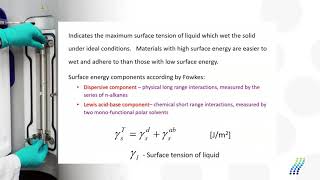
Prof. Sorption explains surface energy as excess energy at a material surface, split into dispersive and Lewis acid-base components. Higher surface energy increases wettability and particle cohesion, making powders stick together and flow poorly. Milling, etching, and blasting all raise surface energy by exposing new interfaces and defects.
Chapters
Surface energy is the most commonly measured property. By inverse GC you can measure other properties like heat absorption, surface areas. You can measure solubility parameters and whatnot. But today we'll focus on surface energy. It's analogous to surface tension of the liquid and is defined by the excess energy at the surface compared to the bulk of the material. So in the bulk we have all these nearest neighbors in three directions. But at the surface we have all this free energy due to lack of atoms on the surface away from the material compared to the bulk. Typically, surface energy is divided into two components. This is based off the folks principle and and is well established both in inverse gas chromatography and contact angle and other surface energy techniques. The dispersive component is measured by the London, van der Waals and Lifschitz interactions in an IGC experiment. This is determined by using a series of non polar molecules of straight chain alkenes. The interaction of these nonpolar molecules then will give you the nonpolar or dispersive component of the surface energy. The Lewis acid base component is dipole, dipole and other short range interactions. In inverse gc, this is very often determined by the interaction of two mono functional or monopolar solvents. So we can get the acid, which is the gamma plus number, and the base which is the gamma minus number. Combined they give us the acid base component to the surface energy. So again, according to the folks principle, these are additive. We can get the total surface energy by measuring the dispersive components and then the acid base components. Now what can affect surface energy? Why do people care about surface energy? What are they trying to learn when they're measuring surface energy? Just the next few slides showing some cartoons and some correlations that surface energy can have. So if you have this pink rectangle and if I increase the surface energy of that surface, I will increase the wettability of a given liquid. If I think of a powder, if I increase the surface energy of the particles, changing nothing else, I will increase the cohesive forces. And that can lead to things like reduced powder flow, agglomeration, sticking. But basically particle, particle interactions will increase as the surface energy increases. Very often a unit operation could be milling or grinding or etching or blasting. And that is done to typically change the surface chemistry or reduce particle size. Now if we ignore particle size changes or anything else and we just look at the effect of surface disorder, very often I will increase the surface energy because I am exposing buried interfaces, creating defect sites, amorphous sites and things like that. And then finally, if I'm interested in adhesion, so the interaction of two different surfaces, if we have our model surface, which is the larger particles, and if I increase the surface energy of the larger particles, I can overcome the cohesive forces of the smaller particles and I'll get better inter particle adhesion as I match the surface energies of the two different materials. This could be a fiber with a polymer, could be two powders, basically any two surfaces. The work of adhesion is related to the surface energy of the two components.