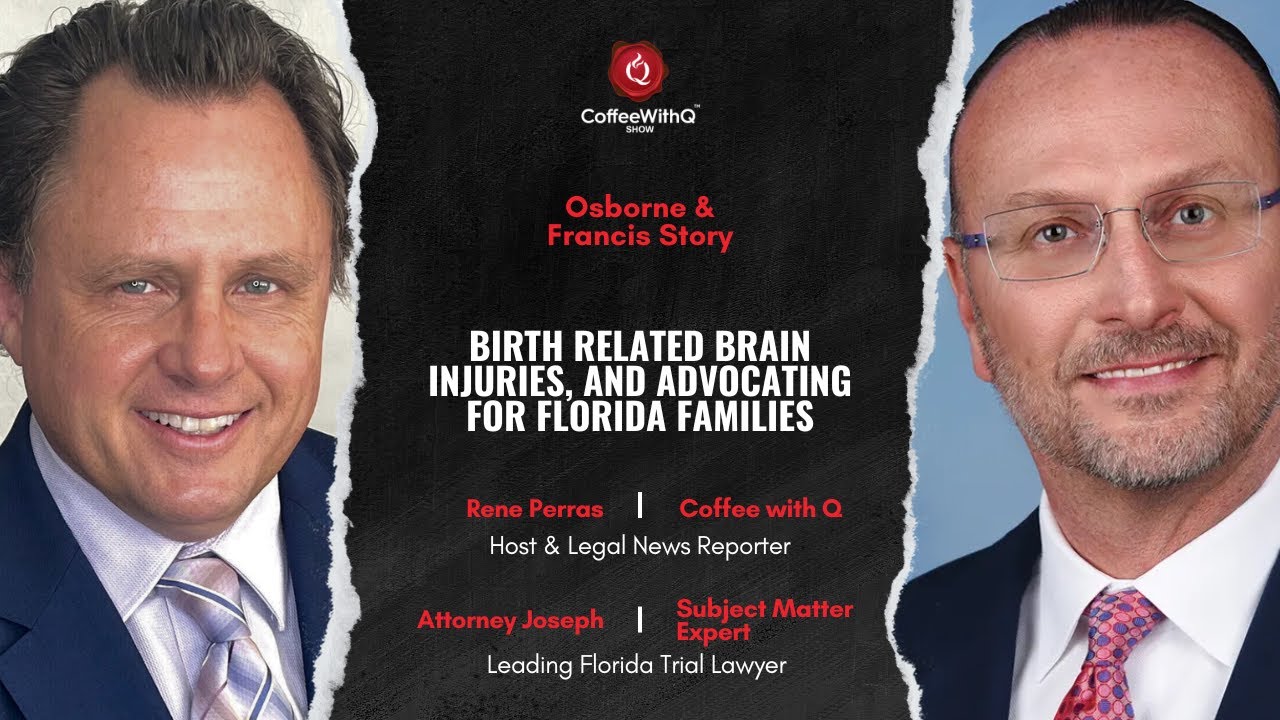
In this episode of Coffee with Q, legal reporter Renee Perron interviews seasoned Florida medical‑malpractice attorney Joe Osborne about birth‑related brain injuries. Osborne explains that hypoxia—insufficient oxygen to the newborn’s brain—during vaginal delivery is the leading cause of such injuries, citing risk factors like prolonged labor, breech presentation, first‑time mothers, placental separation, and loss of fetal heartbeat. He describes how early signs may be obvious at birth or may manifest later as developmental delays in cognition, motor skills, speech, or emotional regulation. Osborne highlights Florida’s protective statute that allows parents up to seven years (or more, depending on circumstances) to file a claim for developmental‑delay injuries, emphasizing that delays can surface years after birth. He outlines families’ legal rights, noting the complexity of proving medical negligence, which often requires fetal monitor analysis, placental pathology, arterial blood gases, and expert testimony. A central theme is the “decision‑to‑incision” window: rapid conversion from vaginal delivery to cesarean section (ideally within 10‑15 minutes) can prevent catastrophic outcomes, and hospitals must maintain a “trigger finger” to act swiftly. Osborne shares a poignant case from two decades ago involving a twin delivery where delayed cesarean conversion led to severe brain injury in the second infant, resulting in a settlement that funded lifelong care. The interview concludes with contact information for Osborne’s firm.
Chapters
Hello and welcome everyone to another episode of Coffee with Q. I'm Renee Perron, your host and legal news reporter. Coffee with Q is dedicated to helping consumers find justice. Today we have the pleasure of speaking with Joe Osborne, a seasoned and accomplished medical malpractice and trial lawyer with extensive experience in advocating for patients' rights. Today's show will be focused on potential complications arising from birth-related brain injuries that women and their families are facing in Florida medical facilities. Joe Osborne, our guest, has specialized in this area for nearly 30 years. Welcome, Joe, and thank you for joining us today.
Thank you, Renee. It's a pleasure to be here.
I, I didn't realize that birth-related brain injuries and complications could be such an issue today for Florida families. What are some of the common causes of brain injuries in birth-related cases?
The main cause and the main issue that we see that results in very poor outcomes for children during the birthing process is hypoxia, or lack of oxygen to the brain, during the course of vaginal deliveries. And that is probably, and is, the number one issue that that medical providers and families are faced with when something like this happens, which ultimately, if not handled correctly, can lead to catastrophic outcomes. And some of the underlying causes of that hypoxia, you know, occurs during the birthing process, and obviously it's variable. But for instance, in some of the cases that we have handled, we have seen, for instance, a lack of progression of labor. During the vaginal delivery. So, you know, where a labor course is expected to take maybe 6 or 8 hours with induction of Pitocin or other induction agents, that the process just seems to take longer. And whether it's lack of complete effacement or cervix isn't responding or just labor's taking much longer than anticipated, babies can get in trouble. during the course of the process. Breech presentation, where children actually get stuck in the birth canal because of the position of the baby that goes unrecognized, can cause issues with hypoxia and lack of oxygen. Then especially in first-time moms who have not had the benefit of having gone through a complete vaginal delivery, typically labor can be prolonged in first-time mothers. And even with induction agents, it can be a slow and deliberate process and requires very close and tight medical monitoring, both of the baby's fetal heart rate, oxygen status, and of course of the mother. And then there are emergencies that occur during the course of the delivery process. That can be a separation of the placenta from the child, which again can interfere with ability of the baby to be oxygenated correctly, or a loss of fetal heartbeat during the course of the delivery process, which of course is also potentially a medical emergency.
Everything is so brand new when you're a first-time parent and you're, you're in that birthing room. Thank God all, all of my children were born, uh, um, without any issues. Yes. How can parents recognize early signs of brain injuries in their newborns?
Well, it all starts with a recognition of what's called developmental delays. Typically, when you see brain injuries that result due to hypoxia during the birthing process, some of it can be very clear and catastrophic and evident that the child is very acidotic when they're born. They have very significant physical characteristics indicative of a recent brain injury. It's a very prolonged situation where there is a lack of oxygen to the brain, and those can be extremely apparent. Other times it may take some time to go by and the brain injury may not be as readily apparent as it is in some other circumstances. And in those situations, you really kind of focus on the child and whether or not they develop what we call developmental delays, meaning that over time, whether they're cognitive delays, physical and motor skill delays, speech issues, emotional control issues, Those are things that over time and, and, you know, as parents are raising their child, they start to see issues and there's no real clear explanation. And, you know, when we go back and look at some of the medical records and figure out what happened, we're able to make ties to some of these developmental delays and typically, uh, substandard oxygen levels during the course of the labor and delivery process.
When it comes to developmental delays, How long are we talking about, generally speaking?
Well, in Florida, we have a very, very friendly statute which says that parents have up to— and it really kind of varies, but at a minimum, up to 7 years to bring a claim if there's a developmental delay that occurs. So, you know, you may not see anything for 3, 4, or 5 years. You may think the time has passed, but we have a protection statute for parents who don't see delays for a while. Sometimes kids are, you know, obviously as they're learning and growing and maturing, you don't necessarily see things right away. But our statute provides protection for parents in these situations where if there is a delay and it can be tied back to the birthing process, they can still bring a case.
Yeah, you've talked about the statutes. What other legal rights do families have when dealing with brain injuries caused by medical error or negligence?
Well, they have plenty of rights, and that's why lawyers like myself who specialize in these cases become critical to the process in terms of the evaluation of whether or not there has been a birth injury-related— whether it's a birth injury-related case and can it be tied to the nurses and doctors and hospitals that were involved in the process. We have handled over the course of, like you said, 3 decades, we have handled a number of these cases. They are very, very, very complex in terms of both medical negligence causation and damages issues. We deal with super high-level issues involving fetal monitor strips, placental pathology, arterial blood gases, and obviously work with very high-level experts in order to tie some of this together. So families have legal rights in Florida. There are claims that can and should be pursued. But they are complex and it's extremely important to have someone experienced on your side to evaluate your case for you.
Have the number of birth injuries been on the decline as medicine has improved over the years?
It's really hard to say. I think if you look at the statistics, you know, what happens is where hospitals and nurses get in trouble is a mom comes in, she wants to have a vaginal delivery. And something goes wrong during the course of the vaginal delivery, like some of the things we've been talking about— a lack of progression, loss of fetal heart rate, potentially an emergency, something with the placenta. And then there is kind of this failure to timely convert from a vaginal delivery to a C-section, because a C-section obviously gets the baby out very quickly. And I don't know that there's been any change in the numbers of C-sections versus vaginal deliveries over time. But I think there has got to be, on at least the part of the doctors and the hospitals, a quicker decision, or quicker decisions I should say, to convert. Converting from vaginal deliveries to cesarean sections can save a child's life. It can prevent the ultimate outcome here, which is what we're talking about, which is a birth-related injury. They always say decision to incision can be accomplished within 10 to 15 minutes in a hospital. And it's being attentive and having that quick trigger finger to say if something is going wrong. You're looking at the fetal monitor strips, there are oxygenation issues with the child, medications and things are being delivered to try and improve the oxygenation status of the child, repositioning the mother. They're all conservative things that can be done to try and increase or improve the clinical scenario here. But ultimately, it comes down to that decision-making. And it's the decision-making that becomes important from a timely perspective, and then where I really should say a timing perspective, to make sure that if it— if there is a problem, it's no different than your little kid drowning in the pool. You know, how quickly are you going to jump in and save them? And if you— if you wait too long, that can have catastrophic— yeah, can lead to catastrophic results. If you do it in a timely manner, Disaster is avoided. So it's really letting— it's making sure that the doctors and nurses are educated and they have that quick trigger finger that if there's a problem, you jump in the pool, you get the kid out of there, you do a cesarean section, and typically all is well if that's done the right way.
I like how you phrase that, decision to incision.
Yes.
The downside is horrific if it's not Done quickly.
Right.
Is there a particular family that comes to mind that you helped with your experience?
Yes. One of the very first brain damage baby cases I handled, this had to be 15, 20 years ago, actually involved a twin delivery where the first baby came out totally fine and the second child, like we were talking about, got in trouble. And there was a very, very slow reaction to converting the delivery of the second child to a cesarean section. And the fetal monitor strips, the nurses, the doctors, everybody just dropped the ball and kind of got focused on the delivery of the first child. Not going to say they forgot about the second child, but clearly the priority in terms of identifying the recognition of what was going on with the second child. Um, was not up to standard. And we ultimately ended up with a second child who was delivered that was catastrophically brain injured. And it was such a sad situation for the parents because they had these 2 beautiful children that looked exactly alike that, you know, and this is your typical scenario where all the prenatal visits, everything working up to the actual delivery process with mom had all gone wonderful. So, you know, there was no, There was no— nothing bad was expected. And ultimately, this poor family was left with one beautiful child and the unfortunate son who ended up being second and ended up being catastrophically brain injured, needed 24-hour care. And ultimately, we had to do all the things we do in these cases, and we were able to get a settlement for them and take care of that child for the rest of his life. But it was a super sad outcome and really sad for both him and the family.
Was the, was the outcome evident immediately in this particular case, or did it take a while to figure out that there had been—
He almost died in the hospital. I mean, he was catastrophically brain injured. In the hospital, he went right into pediatric ICU. He had a massive seizure. Um, he, they had probably— he couldn't breathe on his own. Uh, the, what they typically do, we'll do an MRI of the brain within a certain time frame, which will show all the areas of Potential injury to the brain from hypoxia. The arterial blood gas showed that he was severely acidotic, which meant that he was not getting good, proper oxygen and carbon dioxide exchange, and he was catastrophically injured from the moment he was born.
To find out more about Joe Osborne, Florida trial lawyer with Osborne and Francis, you can visit www.realtoughlawyers.com. Or you can call Joe directly at 561-301-3292. Thank you, Joe, for coming on the show, and your experience with us today is always stellar. It was certainly helpful for me, and I'm sure for your audience as well.