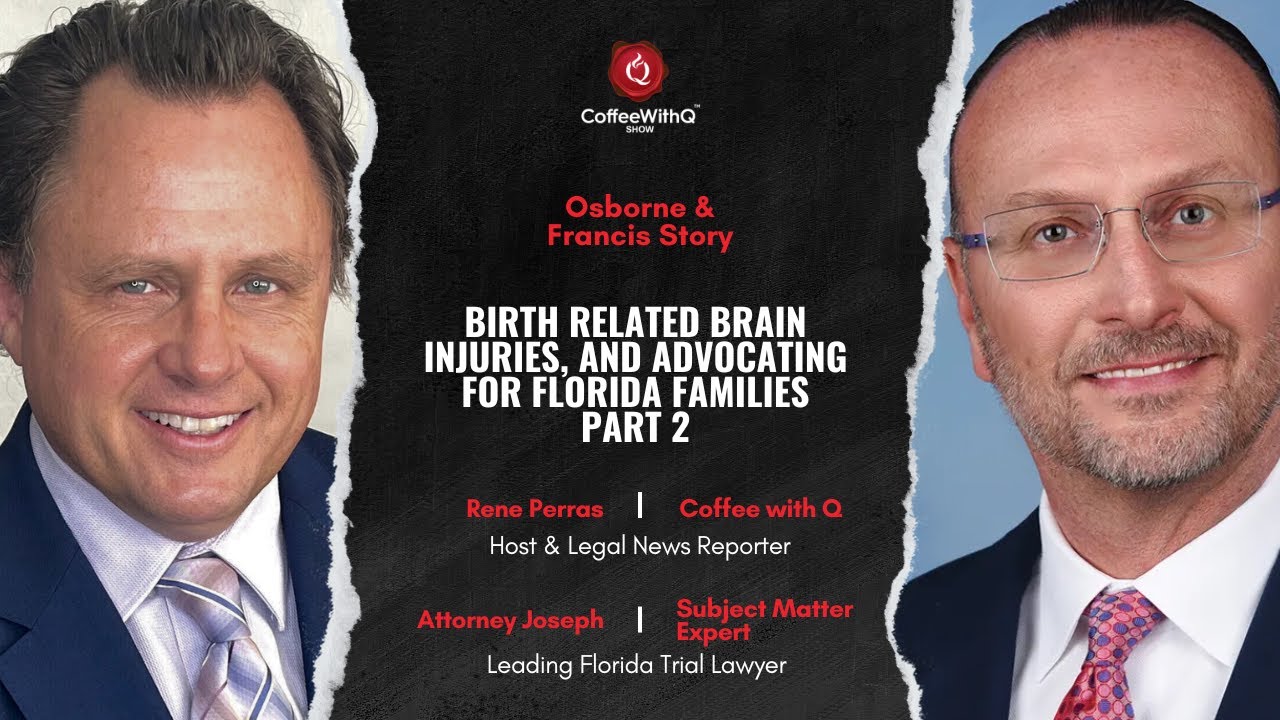
In this episode of Coffee with Q, host Renee Parra interviews veteran Florida medical‑malpractice trial lawyer Joe Osborne about the challenges families face when a child suffers a birth‑related brain injury. Osborne explains how the state’s Neurological Injury Compensation Act (NICA) can block claims and outlines the legal tactics his firm uses to contest NICA jurisdiction, such as proving non‑participation, lack of proper notice, or that the injury did not occur during the covered labor‑delivery window. He discusses the core causation hurdle—distinguishing a bad outcome from medical error—highlighting the complexity of hospital environments, fetal monitoring, and the need for expert analysis. Osborne describes the short‑ and long‑term effects of neonatal hypoxia, ranging from severe physical and cognitive impairments to subtler developmental delays that may emerge years later, and stresses the critical 7‑year statute of limitations for filing suits. The conversation turns to hospital protocols, emphasizing rapid decision‑to‑incision times, the increasing willingness to perform cesarean sections as a preventive measure, and the importance of pre‑delivery counseling about potential complications. Osborne shares a recent case where a nurse’s improper instrument insertion caused placental disruption, delayed emergency response, and resulted in catastrophic brain injury, illustrating the real‑world stakes of these issues. The episode concludes with contact information for Osborne’s firm.
Chapters
Hello and welcome everyone to another episode of Coffee with Q. I'm Renee Parra, your host and legal news reporter. Coffee with Q is dedicated to helping consumers find justice. Today we have the pleasure of speaking with Joe Osborne, a seasoned and accomplished medical malpractice trial lawyer with extensive experience in advocating for patients' rights. Today's show will be focused on potential complications arising from birth-related brain injuries that women and their families are facing in Florida medical facilities. Joe Osborne, our guest, has specialized in this area for nearly 30 years. Welcome, Joe, and thank you for joining us today.
Thank you for having me.
You know, we're going to talk about birth-related brain injuries. What is your approach when representing Floridians in these complex cases?
Well, that's a great question, especially in Florida. Uh, when a family comes to me with a potential birth injury case, one of the first things we have to look at is something called NICCA. NICCA stands for the Neurological Injury Compensation Act in the state of Florida, which, um, was set up by the legislature back in the '80s and '90s in a way to limit and inhibit families from bringing claims when their children are hurt during the birthing process. NICAA is very complicated, it's convoluted, and if NICAA takes jurisdiction over the case, it can literally prevent you from bringing a claim. And one of the things that we do and that we've done in the past in terms of helping families get around NICAA is we attack it and we take the position that it does not apply in the case. And we have several— I shouldn't say defenses or attacks to the program that we can make for the family that at times work. So for instance, the providers who are involved in the delivery typically have to be participants in NYCHA, and we may be able to show that they were not fully active participants in the program that the state is holding, therefore it doesn't apply. That sufficient notice was not given by the providers, even if they are participants, to the families such that the notice failed and that NICA shouldn't apply. We can attack the program based upon what happened to the child in terms of the outcome and using experts attack the requirement the injury occurred during the labor and delivery and/or resuscitation process. And we have medical arguments we can make around that to try and destroy the jurisdiction of NICA. What happens is if NICA accepts the program— oh, I'm sorry, if NICA accepts the case and says you can't file a case because this is a NICA claim, the parents are limited to a $100,000 recovery per parent. And the benefits that are paid to the child are basically a secondary payer option. They just pay They pay for healthcare that anybody else doesn't cover. So if Medicaid or private insurance companies are already paying for it, the state gets to keep the money in their coffers. It's really kind of a— it's really a program that has real no benefit for families and is really designed to kind of limit lawsuits. But as a Florida potential birth injury case, one of the first things we have to look at is MICAH. And you really need an experienced lawyer to to make sure that the navigation of it is done correctly from the beginning, because we have handled it from all aspects—from full Nike hearings to trials to beating it to losing in it—but it's something that has to be done in these kinds of cases.
Sounds very unfair for Florida families. Yes, it certainly is. What challenges do families? other than NICU typically face when pursuing a brain injury lawsuit?
Obviously, you know, just kind of flowing from our last answer, NICU is certainly number one. But number two, I think it's really— it really is a causation issue. It's really— there are so many things obviously that can go wrong at times, um, during, uh, either the course of a pregnancy or during the course of the birthing process. The families are just so many times faced with with questions about what happened, you know, how did this occur? And a lot of times between the doctors and nurses that are caring for the mom and the child, there just are so many more questions than answers. It's such a complicated and complex thing. Meaning you would think the birth of a human being going back to the beginning of time, you know, is something that maybe over time would become more understandable. But in a hospital setting, especially for the average person, Between the machines you're hooked up to, the fetal monitor strips, the various doctors that see you, the various nurses that are involved, you know, when something bad happens, it's really hard to kind of get straight answers or figure out what happened. And I think that's really the biggest challenge, to know, hey, did something go wrong? Was this just a bad outcome? Was this just bad luck? Did somebody do something that— or fail to do something that would have prevented this? And I think me and my team and the experts that I've worked with in these, in these cases, a lot of times we really get to the bottom of it and can give people answers. And, and the answers are— sometimes they may, you know, they may provide answers and say there's no case and this is what happened. And sometimes we can say, look, there's a real problem here and it forms the basis of a lawsuit and, and we can help you out. But I think one of the great things we do in terms of this is at least get people answers. And a lot of times, answers lead to real recoveries.
Well, it sounds like if there is an issue or some kind of bad outcome, that a family should find out, consult an attorney, and find out, was it just a bad outcome or was there actually some kind of error that occurred?
That's right.
I think that makes sense. Can you explain how brain injuries can affect a child's long-term development?
Sure. Well, there's both short-term and long-term development depending upon the extent of the hypoxia. Hypoxia means lack of oxygen to the brain or insufficient oxygen to the brain, and those require, or, you know, ultimately can lead to very, very devastating consequences for a young child. And they can be across the board. They could be physical, it can be mental, it can be cognitive. It could lead Ultimately some speech issues. And, and, and brain injuries, while children are kind of resilient and they do have an opportunity to recover from some of these, uh, insults depending upon its severity, um, the ultimately the outcomes can be devastating. Um, it's, it's not— we've seen in cases, uh, children require 24/7 care. They will never go to normal schools. They will never have normal lives. They probably have shortened life expectancies based upon the injuries that are suffered. And then other injuries we have seen that are more subtle, that not till maybe 3, 4, or 5 years old, we start to see significant behavior and emotional problems and control. We start to see, hey, how come my child's 3 or 4 and they're not walking yet? How come my child is 5 years old and can't—
Walk.
can't say ABC and has— you can barely speak. And so sometimes they're more subtle than that, uh, more, you know, in terms of, um, comparing them to people or kids who are catastrophically injured at the time, and it's readily available based upon the medical testing once the child is born. But these are all things that need to be watched and monitored and, and certainly evaluated by parents, uh, so that we can potentially ultimately connect it back to something that may have occurred during the birthing process.
And with the statutes of limitations, you have to identify that within 7 years?
7 years, yes.
Has the hospital or medical protocol improved for women, uh, when delivering babies?
Um, that's a really, really difficult question, I think, to look at in general. I think you're going to have various, you know, certain hospitals That probably have improved. We talk about decision to incision from, you know, recognizing problems during the course of labor and delivery and converting to cesarean sections. I think OB-GYNs are more readily willing to say, let's just do a cesarean section to begin with. Meaning that, you know, certain women may want to have— I'd like to try to, you know, deliver my child naturally. And I think upfront, Given maybe certain situations or clinical scenarios that exist in the pre-delivery phase or pre-labor phase, C-sections are being offered more readily available as a first line of treatment. And I think that, look, C-sections come with risk, it's surgery, but at the end of the day, your child ultimately, the risk of a child developing hypoxia or brain injury during a C-section is basically zero. And ultimately, it's probably the safest way for the child. Thousands and millions, thousands and thousands, millions and millions of children get delivered vaginally without any issues. That's, you know, that's not— it's not a mistake or an error to recommend or allow that to happen for a woman to deliver her baby. But if it's going to be a vaginal delivery, you just have to have a super heightened sense of awareness that if there's a problem, converting to a cesarean section and doing that quickly in a hospital is something that needs to be done. The hospital has all the facilities, C-section rooms are ready, everything is set up to happen quickly if a problem occurs. It just needs to be recognized and occur if something does go wrong.
There are many visits that families have with their doctors before delivering their babies. I'm not sure if this happens or not, but Do they have discussions of complications and what the doctor is planning to do if they experience certain things?
Absolutely. Every OB-GYN makes a mom sign the consent for cesarean section before the delivery is planned or before the expected due date. And those issues are discussed. So it's something that going into the process, Typically, all scenarios are discussed and planned for. It's just reacting accordingly. Sometimes it becomes about reacting to the information and what's happening on a moment's notice, as opposed to, you know, not necessarily doing the right thing in a timely fashion. Again, this all comes down to minutes. Minutes can matter. Again, it's like your little one drowning in the pool. Minutes matter. Once you start— once you cut off oxygen to the brain or there's insufficient oxygen to the brain, you know, within 2 or 3 minutes, the wrong decision or being distracted can all, you know, can prove, you know, devastating. So it's just making sure those kinds of things don't happen.
That makes so much sense. Maybe there's one particular case, uh, of a family in Florida that you helped that had these types of issues occurring.
Yeah, we actually had a recent case where we represented this poor mom. It was her first child, it's a daughter. And during the course of the birthing process, a nurse inserted a medical instrument into the vagina to check on something. And unfortunately, when she inserted it, she did it incorrectly, which caused the placental or the placenta to disrupt and also cause placental bleeding. which came out the vaginal canal. And obviously when that occurs, that means enough blood and oxygen is not getting to the baby. So it was a medical emergency. Unfortunately, that nurse, instead of calling a code right away and calling for help, tried to cover it up because she didn't want to get in trouble and clearly had caused this issue. And there was a significant delay in Recognizing what happened and, and then ultimately, uh, getting the child out. Well, because of all that, the child ended up catastrophically brain injured, and we ended up representing that family in that case.
You must, you must, uh, meet a lot of families with these type of, um, you know, sad situations. I commend you for, for doing what you do.
Thank you.
To find out more about Joe Osborne, Florida trial lawyer with Osborne and Francis, you can visit www.realtoughlawyers.com, or you can call Joe directly at 561-301-3292. Thank you, Joe, for coming on the show, and your experience with us today is always amazing. Uh, it was certainly helpful for me, and I'm sure for our audience as well.