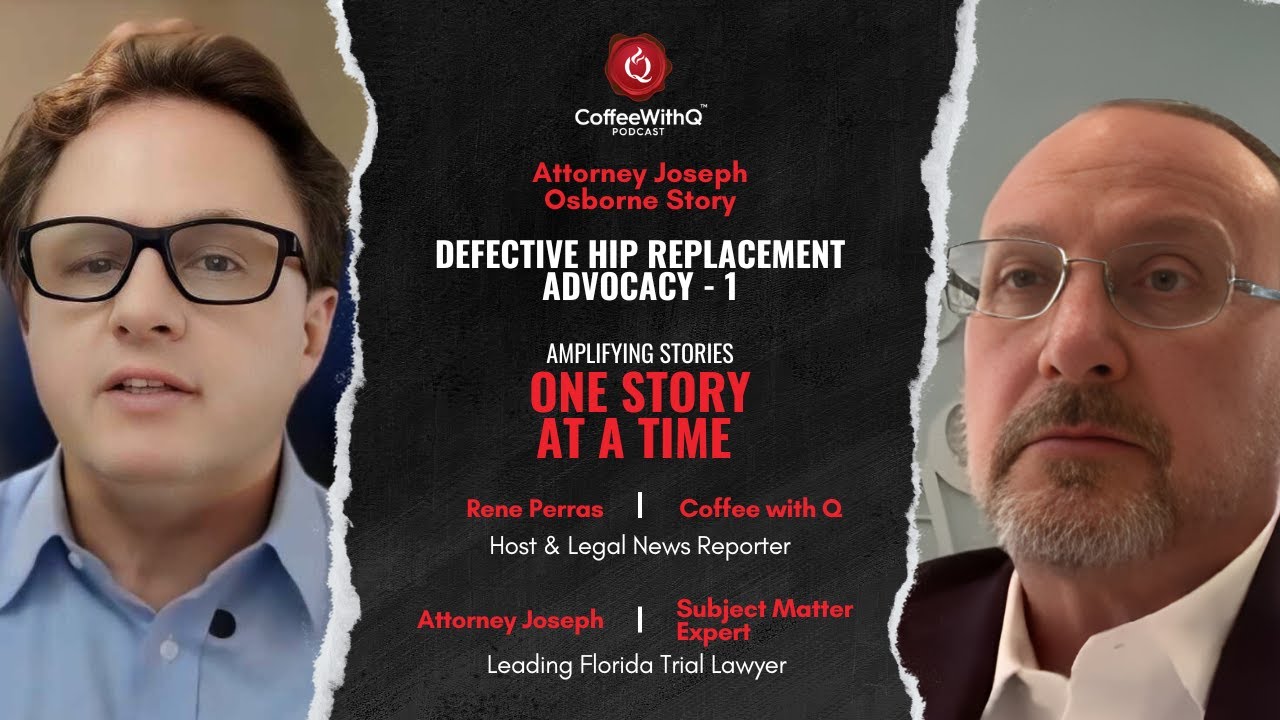
In this Coffee With Q News interview, legal reporter Renee Perel talks with seasoned trial lawyer Joe Osborne about the challenges and strategies involved in litigating defective hip implant cases, particularly those involving the recalled Stryker V40 femoral heads. Osborne outlines the practical steps patients should take when they suspect a device failure—informing their surgeon, documenting symptoms, complying with removal recommendations, and ensuring the explanted device is preserved as evidence. He explains the concept of mass tort litigation, its efficiency benefits, and how his firm coordinates thousands of similar claims under a single judge. The discussion covers how strategies differ between individual and mass‑tort cases, the importance of obtaining individualized settlement authority for each plaintiff, and the ethical considerations in negotiations. Osborne emphasizes the critical role of scientific and medical experts—biomechanical engineers, FDA specialists, orthopedic surgeons—in building a strong case, and describes how literature and failure‑rate data trigger investigations. He also clarifies what bellwether cases are and how they serve as representative trials that guide settlement values. Throughout, Osborne stresses the broader mission of holding medical‑device manufacturers accountable and protecting patients, while providing contact information for his firm.
Chapters
My name is Renee Perrot, legal news reporter for Coffee with Q News, a platform dedicated to shedding light on crucial legal matters through discussions with subject matter experts who impact our society on a daily basis. Today we'll be discussing with subject matter expert Joe Osborne, attorney and counselor, about his successful fight helping his clients who were catastrophically injured from defective hip implants, and how this litigation continues to help everyone. Joe's legal career began in a modest setting, working from a small office off a card table. These humble beginnings instilled in him a sense of determination and a drive to build a law firm that could level the playing field for individuals facing tremendous odds. Helping ordinary people navigate the complexities of medical device failures, individual personal injury cases, and other legal challenges. Our aim is to give our audience professional insights and analyses, making complex legal issues straightforward and easily understood. Welcome, Joe. Hope you're having a great day.
Thank you, Renee. Pleasure to be here.
Great. Our discussion today should help patients in need of replacing their hips, knees, and shoulders make a more informed decision. Along with the medical community who perform these joint replacement medical procedures. The future reliability of all medical implant devices and safe implanting surgeries are a foremost concern for everyone involved. Our story begins with the hip implants like the Stryker Lift Anatomic Cobalt Chromium V40 femoral head cases and others that were recalled. The failure was due to the implant device releasing toxic medical particles into patient bodies. Thus began the medical and legal scrutiny surrounding defective hip implant devices and the related hip implant surgeries. Without any further ado, we're going to start our discussion today, our conversation with Joe. What are the initial steps that must be What steps should be taken to help people who are living with a failing medical device, such as those who experience issues with the Stryker hip implant?
Thanks again, Renee, for having me. But some of the initial steps that a plaintiff or patient should take when they think they have a case involving a failed medical device include a few things. First and foremost, if they believe the device is causing them problems, whether it's through symptoms or other complaints, they should go back to the doctor who put the device in and make sure that the doctor is aware of those complaints. It's important for the doctor to note in the medical records and to document any problems the patient may be having that specifically are related to the device. And certainly, if the physician or surgeon recommends that the device needs to be removed through surgery because it's causing more harm than good, then the patient should comply with that recommendation and have the device removed surgically. Patients don't want to have surgery, certainly if you've had the device recently implanted and you're expecting that your life is going to get better after receiving such a device. But if your doctor suggests having it removed, Then you need to have it out. And that, that's typically only done through surgery. And then lastly is if, if that recommendation is made by your doctor and the surgery is performed, it's important that the hospital preserve the device. So typically when hospitals take a device out of a patient, they have no use for them and they get discarded. But here they can become important pieces of evidence in a litigation, in a case. So there are steps that need to be taken both with the hospital and with the doctor so that device, that device which, um, you know, you believe failed, is preserved and can be used as evidence in the case.
Preserving the evidence. I never thought about that. Make sure you, you hold on to it.
That's exactly right.
We hear a lot about mass tort. What is a mass tort defined in layman's terms? And how has your extensive experience helped shape your strategy in handling complex defective medical device litigation?
Well, mass torts are essentially the organization and collection of individual injury cases that all involve very similar issues, as in this case, the Elfit V40 Stryker cases. All the cases involve the failure of a medical device, and specifically Stryker's V40 heads, as it pertained to the hip implants that were provided to the patients and plaintiffs in those cases. And the cases get consolidated as a mass, meaning they get collectively organized in front of one judge for lots of reasons. And I'll give you a few of them. The first is that it's efficient, meaning that you don't have hundreds, if not sometimes thousands, of cases being prosecuted against the same defendant all across the United States with different judges, uh, with different rulings. And they're bring— it brings some uniformity to the process so that, uh, uh, one judge is making decisions, one judge is deciding how the case is going to go, and it has an impact to, to, to the extent that it benefits all plaintiffs And can be cost-effective in the sense too that when discovery and depositions and things of that, you know, happen— for instance, when you depose the key Stryker engineer who designed the implant, he can be deposed one time. That deposition can be used in all hundreds or thousands of cases, however many cases there are, and each individual plaintiff doesn't have to spend the money and the attorney time to go ahead and, and get that work done. So it's all about efficiency. It's coordination, consolidation, and ultimately provides benefit to everybody because everyone gets the same work product and everyone shares in the successes of the litigation as the cases move forward.
Does your strategy change when working with many cases or compared to working, let's say, on just one case?
It can. It depends on the case itself. But a lot of times, you know, Really what we're doing is we're trying to create risk and making the defense uncomfortable, understanding that as we expose what happened in terms of the design of the product, the engineering of the product, the FDA approval of the product, what the messaging was in terms of the, you know, licensing and regulation of the product, as we start to uncover some truths which typically are found in these cases, meaning that if a product is recalled, And it caused a lot of harm to people, that typically means there was something in the backstory before the product even got to the market that was a problem that either the company ignored, the FDA ignored, or both. So as we get through that process and we start to depose and investigate documents and materials and talk to witnesses that were involved both in the licensing, you know, component of the story of the product, as well as how the product was designed, we typically find issues. And that can happen in an individual case where we're representing one person who was severely injured by a product. And it certainly has happened in our mass tort settings where we're representing hundreds and hundreds of people.
Working on, on many cases at once, are there challenges that can arise when you're negotiating settlements in these cases? And how do you ensure that such settlements are always at your clients', uh, you know, their, their particular interests? What do you do?
Well, when negotiating settlements in mass tort cases, it's experience, experience, experience, because there are a lot of pitfalls that, that lawyers can encounter, both, um, in, in the fashion of how the negotiations are approached as well as ethically. And And it's very important that, you know, as you— you know, I've been doing this for over 20 years and I've negotiated many, many settlement deals. We make sure we get individual authority from our clients, meaning that each client's case is different, even though it's consolidated for purposes of discovery. And on the liability side, each client has their own causation and damages story. You know, how long somebody had a hip implant, how ultimately it failed. How it ultimately affected their lives. So it's important to get individual authority and make sure that each client is treated in an individual ba— on an individual basis when it's time to resolve their case. And I can tell you, in every settlement we've ever done, we've, we've done that analysis for each client, and we've made sure that we've gotten an individual number for each client so that at the end of the day, we can do the best job we can. to satisfy, you know, what they've been through and ultimately bring a happier result to the case.
This other question we were discussing before is the importance of scientific and medical evidence in building a case against medical device manufacturers. And how do you collaborate with experts in these fields?
The scientific evidence and the experts is everything in a products case. in a mass tort case. And typically we get tipped off about problems with medical devices from the literature, meaning some doctor who's put in— let's say, let's say on the Stryker product— some doctor who maybe has put in 200 of these things starts to see what we call a failure rate, meaning people coming back to him, patients coming back to him, where instead of these patients having great success for 15 or 20 years, within 2 or 3 years. They're coming back with problems and issues. And the failure rate, which typically should be somewhere about 1 to 2% for a good, well-studied, safe, and effective implant, ultimately ends up being 10, 15, or 20%. And the literature captures this, and case reports capture this. So the literature often is the initial kind of voice of where you start to see problems and where the scientific community starts to get tipped off of specific problems with individual implants or products. And then, of course, our experts, as we hire them, whether they're biomechanical engineers or FDA experts or orthopedic surgeons in the, in the hip, hip implant setting, they use that scientific literature to, to help formulate their opinions. Meaning that if they're analyzing an individual case, they can rely on the literature to say that they They believed that the failure in a particular case was due to the device as compared to something else. And oftentimes it's the literature that is really the legs or forms the basis for those opinions.
Maybe you can explain what a bellwether case is and the importance of bellwether cases, and maybe one that helped influence one of your settlement talks.
Sure. The bellwether cases are extremely important to the settlement process because, let's say for instance, again, in the Stryker setting where hundreds and hundreds of cases were filed, it would be virtually impossible to try all those cases over time. So what both sides do is they work with the judge to find what we call representative cases, meaning cases that are not outliers one way or the other. Meaning not the best defense cases, not potentially the best plaintiff's cases, but something in the middle that's representative of what we believe the population to be of the cases that exist. And to try representative cases such that if we try a case and we win and a value is assigned to the jury, you know, by the jury to that case, it helps provide some guideposts as to what the value of the overall litigation might be. If we try that representative case and we lose and it's a zero, then it may make us rethink what we believe the value of our cases are. So oftentimes in cases that go on for a while, many bellwether cases are tried because you're kind of marking up wins on both sides. And ultimately it gives you some insight as to not only what you think the case is worth, but what the community thinks and what juries think. Or, you know, juries think the case is worth, and that ultimately becomes the most important.
Okay, in summary, for nearly 35 years, Joe has represented thousands of families and their loved ones successfully, people severely injured due to some form of negligence by either an individual, a company, or a large medical device manufacturer. The goal is to hold medical device companies accountable for their bad acts so they fulfill their responsibility to the consumer first and shareholders second, but most importantly, they honor the principle of doing no harm. Joe, thank you for sharing your insights today. Your expertise sheds light on the critical issues surrounding defective medical devices and what happens when they fail, and the broader implications to our society. It has certainly been helpful for me and for the audience. Uh, Joe Osborne's career as a lawyer has been spent helping ordinary people navigate the complexities of medical device failures and individual injury cases. To find out more about Joe Osborne, Florida trial lawyer with Osborne and Francis, you can visit www.realtoughlawyers.com, or you can call Joe directly at 561-301- 3292. Joe, thank you.
Thank you, Renee. Again, thanks for having me.
Uh, this has been this week's legal news story for Coffee with Q News, where we shed light on important legal matters and discuss legal topics that impact our society every day with the help of our subject matter experts. Tune in next time when we'll finish our second of our 2-part story of the catastrophic hip replacement nightmare If you're a legal subject matter expert and you have an important story that needs to be told, then you can contact me, Renee Perel, legal news reporter with Coffee with Q, at 800-980-4LAW. Wishing everyone a great day.