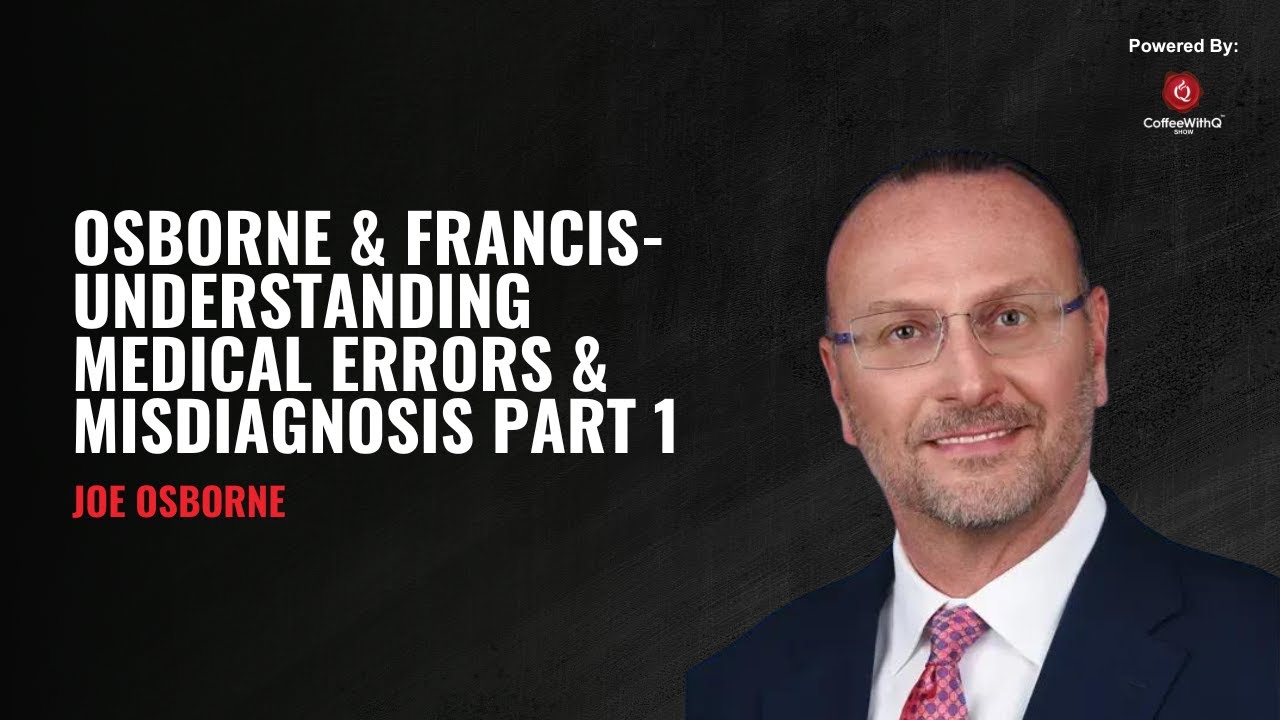
This content was created by Qamar (Q) Zaman. This content was uploaded by Qamar (Q) Zaman. This is a YouTube interview titled "Boca Raton Medical Errors & Misdiagnosis Lawyer Joe Osborne Explains on Coffee With Q" (created 2024-12-08). The episode is part of the Coffee with Q series and is hosted by Renee Perrot, a legal news reporter, with guest Joe Osborne, a medical malpractice trial lawyer. They discuss types and causes of medical errors and misdiagnosis, legal distinctions between errors and malpractice, a specific catastrophic surgical error case, prevention and mitigation measures (follow-up systems, communication, overreads/second opinions), and Florida statute-of-limitations/notice issues. The segment also includes contact information for Joe Osborne and is aimed at helping consumers understand legal recourse around medical mistakes.
Chapters
Hello and welcome everyone to another episode of Coffee with Q. I'm Renee Perrot, your host and legal news reporter. Coffee with Q is dedicated to helping consumers find justice. Today we have the pleasure of speaking with Joe Osborne, a seasoned and accomplished medical malpractice trial lawyer with extensive experience in advocating for patients' rights. Today's show will be focused on understanding medical errors, misdiagnosis when dealing with healthcare facilities and medical professionals. Joe, our guest, is an expert in this area of law. Welcome, Joe, and thank you for joining us today.
Of course, thank you for having me.
Wonderful. Um, I guess to jump right in, maybe we can have a little bit of an introduction to medical errors. Can you explain what constitutes a medical error and why they occur in the healthcare system?
Sure. Medical errors come in all shapes and sizes, meaning that when we see errors committed in the medical community, they can involve, you know, the misinterpretation of studies, the lack of appreciation of significant clinical findings, the misdiagnosis of certain medical issues and health problems. Lack of communication from healthcare providers to patients, failures to follow up, failure to follow up on testing that may be important to make a diagnosis. The key is, is that not all medical errors constitute medical malpractice. Sometimes judgment calls or, you know, bad things happen from a progressive disease or illness. That isn't necessarily malpractice. Medical malpractice that flows from medical errors really involve what we call a deviation or a falling below the standard of care. And that's where a doctor or a hospital or a nurse commits either an error in doing something wrong proactively or fails to do something that other similar healthcare providers identify as being neglectful or negligent. And it's something along those lines from the standpoint that rises to the level of You know, we deem to be negligent care is really where medical errors form the basis of a potential legal claim.
How do medical errors typically impact patients and their families, and how common are they?
Medical errors are something that happen every day in a health setting. in doctors' offices, in hospitals, in your surgical centers. But again, not all medical errors are malpractice. There are things that happen in medicine that just sometimes are judgment calls. Doctors and hospitals do the best they have with the clinical information provided. That may be the subjective information they have on clinical exam, the objective information they have from data and testing, and they make judgment calls that ultimately may turn out to be not right. And that not necessarily is an error, but is something that with the best information given, they make the best decision possible under the circumstances. But medical errors, real medical errors where tumors are missed on X-rays, stress test results are read incorrectly, Something on your skin that should be highly suspicious for melanoma is missed. Things that really can impact a patient's overall ability to diagnose and treat something early, or they're the recipient of bad treatment, really, really are the medical errors that we concern ourselves with.
Can you share a case where medical error had significant consequences, and how was it addressed?
Legally? Sure. Um, I had a case not too long ago where, um, you know, unfortunately a surgeon, uh, who, uh, had been— well, he was a small— he was like a small aircraft pilot in his spare time, and he had been involved in a very rough landing. Um, call it a plane crash where he was hurt in the crash. He had actually hurt his neck and his arm in the crash. And he failed to disclose that to the hospital they worked in. And my client went in for a valve, a simple valve replacement, into this hospital. And during the course of the surgery, the witnesses in the operating room identified the patient— I mean, the surgeon being in extreme pain— and committed what they called therapeutic misadventure, where he had taken a scalpel and incredibly punctured the heart of my client during the course of the surgery and, uh, directly testified after the fact that he shouldn't have been in the operating room. He was in too much pain. And, uh, you know, my client was the victim of that. The medical examiner ruled it, uh, the cause of death to be medical therapeutic misadventure, uh, and the doctor was deemed to be the direct cause of the patient's death. We brought that suit both against the hospital and the surgeon, uh, for the hospital for failing to supervise that, and it led to obviously a catastrophic award.
That's an interesting case, puncturing a heart. Is there a way to prevent medical errors? Is there a standard of care? Uh, what measures can hospitals and healthcare professionals or providers take to minimize the occurrence of medical errors?
Well, I think what's important is that follow-up systems in the healthcare setting are extremely important. So if you go in for a test and there's a question about one way or the other about a diagnosis or a problem, oftentimes the communication to the patient of the need for follow-up testing, follow-up interventions, other medical consultations are extremely important. And we often see cases where, let's say in a lung cancer case, someone has a chest X-ray and there's a suspicious finding on the chest X-ray, but the patient never receives that information. It's not communicated to him or her. And months and months and months go by, and then ultimately there's a problem that's diagnosed as being a lung tumor. And when we go back and look at, you know, the prior care, uh, here was this X-ray that if it had been communicated to the patient, perhaps you need follow-up films, Perhaps you need a biopsy. Perhaps you need to go see a pulmonologist. Those types of failures to communicate with patients oftentimes form the basis of malpractice cases for us because it's lost opportunity. It's lost opportunity for patients to receive treatment, to get further diagnosis, and ultimately to initiate care in a timely manner to give them the best chance to treat their disease. So the follow-up systems within the hospitals and the doctor's offices become extremely important because when things fall through the cracks, They can have devastating consequences for patients and the facilities. The other thing that we suggest are overreads. Again, using my lung cancer example, you know, if a radiologist reads a study, have it overread, have somebody else take a look at it. The overreads themselves oftentimes pick up things that an initial review may not. And in a world where time is of the element in terms of lots of diseases that we live with, on a daily basis in this world, whether it's heart disease or cancer or other similar disease processes, oftentimes, you know, timely, quick management and intervention becomes important to give patients the greatest chance of long-term survival. So overreads where you have a second board-certified radiologist, in my example, look at a film, you may get a second opinion about what's there and what the proper management plan might be.
Is it clear for people who've gone through some kind of surgery that there was an error? Is it sometimes not as clear as one might think?
Oh, absolutely. I mean, in our statute of limitations, we have what's called a notice provision, which says that you have to bring a medical malpractice case in Florida within 2 years of when the malpractice was committed, or 2 years when you're— or within 2 years of when you're on notice that a problem occurred. So in my lung cancer example, that victim or that individual patient may not know, or wouldn't know under, under the scenario I gave, that the chest X-ray from months before had a suspicious finding on it. Oftentimes it's not till later, many, many months or sometimes years later, when the disease process actually advances. And there's a diagnosis that we look back at the medical records, so we look back at the screening, we look back at the testing and say, haha, this was missed a long time ago. And, and patients aren't going to know that a lot of times, unfortunately, until it's too late.
To find out more about Joe Osborne, Florida trial lawyer with Osborne and Francis, you can visit www.realtoughlawyers.com. Or you can call Joe directly at 561-301-3292. Thank you, Joe, for coming on the show. Uh, your experience with us today is, is always, uh, impressive. It was certainly helpful for me, and I'm sure for our audience as well.