Dallas Federal Criminal Defense Attorney John Helms Key Takeaways from Coffee with Q
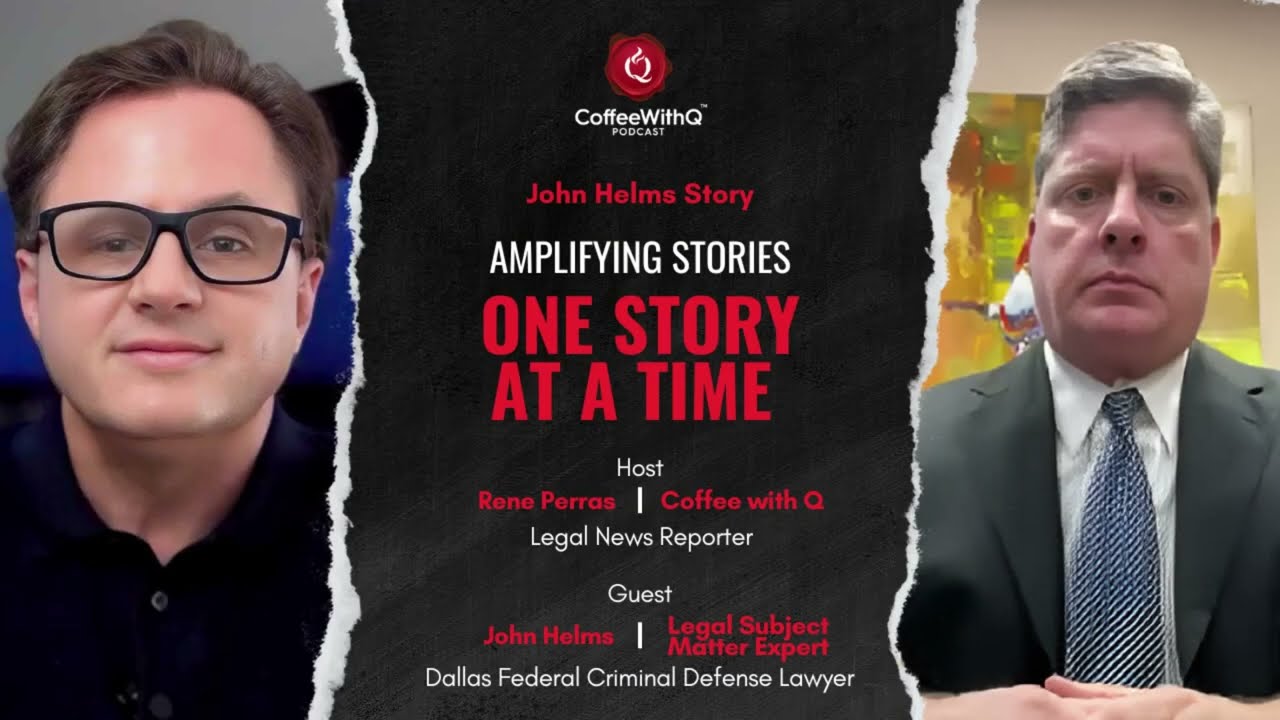
In this Coffee with Q interview, legal news reporter Renee Perrault speaks with veteran Dallas federal criminal defense attorney John Helms, who has over 30 years of experience, including time as a federal prosecutor. Helms explains how drug quantity determinations affect the specific charge, mandatory minimums, and sentencing guidelines in federal cases. He describes how his former prosecutor background gives him insight into plea negotiations, evidentiary strategies, and sentencing considerations. The conversation moves to recent DEA seizures of methamphetamine and fentanyl, noting a steady level of law‑enforcement activity but a marked increase in fentanyl influx. Helms highlights the growing use of surveillance technology—drones for aerial monitoring of transactions and tethered blimps used by Border Patrol near the Mexico border. He discusses why federal drug acquittal rates are low, citing thorough, long‑term investigations and tactical arrests. The interview then covers trial practice, emphasizing the need to preserve errors for appeal through timely objections and the role of appellate counsel. Helms shares a recent case in the Eastern District of Texas where a client faced a methamphetamine indictment; through strategic pleading and character evidence, the client received probation instead of a multi‑year prison term. The episode concludes with Helms’s contact information and a summary of Dallas’s drug‑related challenges.
Chapters
Welcome everyone. My name is Renee Perrault, legal news reporter for Coffee with Q, a platform dedicated to shedding light on crucial legal matters and discussions with subject matter experts who impact our society every day. Our aim is to educate and inform our audience through professional insights and analyses Making complex legal issues become straightforward and understandable. Today, I want to welcome John. It's great to have you here, and I'm sure that today our audience will benefit from your expertise as an attorney. And you've handled many federal criminal defense cases and appeals, especially those involving controlled substances or illicit drugs. Welcome, John.
Thank you. Good to be here.
Okay. John's expertise and tenure consists of 30-plus years as an attorney, 25-plus practicing as a Dallas criminal defense attorney, 3 of which as a lawyer in the United States Attorney's Office, as a federal prosecutor for the Northern District of Texas, where he never lost a trial or an appeal. Truly impressive. So without any further ado, I guess we'll start today. Could you help our listeners understand the significance of a drug quantity determination in federal cases?
Sure. There are 2 ways in which a drug quantity can affect a case. The first is in federal cases, the charge, the, the law that you're charged with breaking, is going to deal with a certain quantity of drugs. And the way it works is the higher quantities will have a, maybe a mandatory minimum sentence and a higher maximum sentence. So if you're charged with a small amount, a very small amount, you might not have a mandatory minimum sentence and you might have a maximum sentence of 10 years. But if the quantity is higher and you're charged with that higher crime, you might have a 5-year max mandatory minimum or a 10-year mandatory minimum, and your maximum might be 40 years or it might be life. So the quantity affects the charge. The charge affects the minimum and the maximum penalty that you can get. So that's one way. The other way that the quantity can affect things is that in federal criminal cases, judges are required to consider what are called the federal sentencing guidelines when they decide someone's sentence. And the higher the quantity of a drug, the higher the recommended sentence is going to be that the judge gets from these guidelines. So it can affect the charge and it can affect the recommended sentence that the sentencing guidelines give to the judge.
That sounds like a complex process. How does your experience as a former federal prosecutor help navigate these challenges when defending your clients?
Well, first of all, I have a sense of what prosecutors are looking for in terms of a possible plea agreement. I have a sense of what prosecutors will do to try to prove their case in a trial. And I have a general sense of what kinds of strategies work in federal drug cases and what kind of strategies don't work in federal drug cases. And I also have a sense from being a prosecutor of what kinds of sentencing options might be more or less appealing to a judge, because I've argued both sides of those issues. And so I have a good sense of what kinds of arguments work and what kinds of arguments don't, and I can anticipate what the prosecutors are going to do.
Moving on to the broader topic of the current drug threat in Dallas and surrounding areas. Recently, the DEA's Dallas Field Division announced significant seizures of methamphetamines and fentanyl. Do these enforcement actions reflect an increased level of drug incidents within the Dallas-Fort Worth community?
I think periodically the DEA will announce large seizures. I haven't noticed an increase or a decrease in law enforcement activity in recent years. I would say it's generally been about the same other than during COVID When COVID was happening, law enforcement activity was definitely down. But what I would say is that law enforcement activity is very steady. And they are well-funded and very well-organized, and they are constantly trying to prevent large quantities, even smaller quantities of illegal drugs from being distributed around this area. So naturally, when they get a large seizure, they're going to announce it not only so that people will know what they're doing, but also so that those who might be involved. Or might be persuaded to get involved will know that if they do, there's a good chance that the federal government will be on to them. I would say, though, that fentanyl cases in particular have increased significantly in the last couple of years. I think that's because the amount of fentanyl that's coming into this area has increased. I don't think it's because of more law enforcement activity. It's just that the amount of fentanyl coming in has just ballooned over the last few years.
You just mentioned about how law enforcement is extremely well-funded. And, you know, we are inundated with technology today. Has law enforcement started to utilize some of the latest tech for surveillance and investigations? One comes to mind with drones flying overhead and things like that. Maybe you could share your insight regarding that.
Well, the answer is yes. I'm seeing a lot of drone videos lately, for example. It used to be that if the DEA wanted to do aerial surveillance, they would have to use a plane or maybe a helicopter, and those were easily seen. And so they didn't use those very much. Now I'm seeing a lot of drone videos, and, and they use those especially when they know there's going to be a transaction. And they will want to have the drone up so that it's, it's taking video when the transaction happens. And then they can also use the drone to follow a vehicle, a car or truck, to see where they go. So it's, it's interesting. You, you get reports, you get written reports, and sometimes they'll say, you know, Agent so-and-so observed this happening and observed the car You know, take off and go this way and then end up at this place. And you might be thinking from the report, well, did they really follow that car all that way? And oftentimes the answer is Agent So-and-so is operating the drone. So Agent So-and-so watched all this happen from the air. And so that, that can be a very powerful tool for law enforcement because it allows them to follow vehicles without the person having any idea that they're being followed. And also, it can give them great evidence because it can actually show from the air 2 people meeting someplace, one getting drugs, the other giving money, and then they take off, and then the drone can follow the car. So we are seeing that a lot more.
Well, that's, that's really interesting. It reminds me of my days on the highway when you see the signs on the side of the road where, you know, there's law enforcement with planes making sure you're not speeding. And I was always trying to look up to see if there was somebody checking how fast I was going. So they've eliminated the planes, but the drones have taken over. That's, that's really quite astounding.
Well, actually, this is not the, the DEA, but If you're down near the Mexico border, you'll see these blimps that are tethered to the ground but are way up in the sky. And Border Patrol uses the blimps to track activity in remote areas near the border. And you can see the blimps way up in the sky from the highway. So that's one thing Border Patrol does.
Would it be fair to say that the rate of acquittals are much lower when it comes to federal criminal cases, and why that is, and what advice would you give to someone facing federal drug charges?
Well, the answer is yes. The rate of acquittals is fairly low in federal drug cases. That's for a few reasons. One is that in federal cases, Agents have a lot of time to build up a case. In state court cases, very often what happens is that they'll see a drug transaction take place and they just arrest the person right then and there. But in federal drug cases, the federal agencies are often dealing with much more complicated organizations, and they are trying not only to arrest the person who's involved in the transaction that they see, they're also trying to find out who that person's source of supply is and who that person is working with up the line. And so they want to continue investigating to go as high as they can go and to find as many people who are involved as they can. So they take their time. They build their cases thoroughly. They wait until it's the right time to arrest someone. They are often working with confidential informants or with undercover agents. And so they know when a transaction is going to happen. And they can be ready, waiting for the deal to go down, and then just arrest the people right there. Or another common tactic is that they know when someone has just gotten some, you know, a load of drugs, and they wait until they're on a highway, and then they have local police officers pull them over and act like it's a traffic stop. And they do that because they want the person to think, well, maybe this is just a traffic stop. So if I'm real nice and polite, maybe they'll let me go. That way, the person doesn't take off and try and outrun the law enforcement agents, and they make it safer for themselves. And so then they pull over the car, and then they eventually search the car, and they find what they're looking for. So in federal cases, The agents have a lot more time, a lot more ability to make their cases so that they're very difficult to defeat. And I would say that's the main reason why the acquittal rate is lower in federal drug cases.
How about when you go to trial? Are there certain things as a trial lawyer you have to assess quickly when it comes to the possibility of an appeal afterwards. Maybe you can help the audience understand how that works.
Well, the answer to that is yes. When you are trying a case as a trial lawyer, obviously you're thinking about what's going to happen next. You're thinking several moves ahead. You're thinking about what you need to do to make the best presentation you can for your client to the jury, because obviously you want the jury to understand your points and your evidence and for that to fit together. You want the jury to understand the weaknesses of the government's case and why maybe that should lead to a not guilty verdict. While you're doing all that, you also have to think about what you need to do to preserve issues for an appeal. And what I mean is that when you appeal from a criminal conviction, you're not asking, and you can't ask, the Court of Appeals for a second opinion. You're not saying, look at all the evidence, Court of Appeals, and then tell us what you think. It doesn't work that way. You have to present and identify specific legal errors that you say happened during the trial. And then you have to convince the Court of Appeals, first, that it is an error, and second, that it's an error that's serious enough to justify some sort of relief, like a new trial or a judgment of acquittal or something like that. Before you can even get there, you have to preserve that error for appeal during the trial. By that I mean you have to make an objection right when the error would be about to happen. You have to make the right objection, and you have to have the judge make a ruling on it to say— you might say, I object to this evidence because it's not admissible because it's hearsay. And then the judge has to make a ruling and say, that's overruled. I'll let the jury hear that. Okay. Well, now in an appeal, I can present that to the appeals court. I can say the judge made an error by allowing this testimony to go in front of the jury. And it's an error because it's hearsay. So it's inadmissible and it affected— it affected the case. If you don't preserve that error, if you don't make the objection on time and make the right objection, Then the judge doesn't have a chance to rule on it. If the judge doesn't rule on it, you can't present it to the Court of Appeals. So you're constantly thinking, okay, not only do I need to make sure that I make an objection, but I have to do it in a way that preserves the error. And I can give you an example of a recent appeal that I handled where I was not the trial lawyer. This was an appeal involving a financial crime type of issue, and there were 2 defendants, and they were both arguing that the judge should keep out some expert testimony that the government wanted to present to the jury. And there were hearings without the jury present While the trial was going on, where people different people were arguing different things. The law says that it's not enough for one defendant to make an objection if the other defendant's lawyer doesn't make the objection. That other defendant may not have preserved error. There are some exceptions to that, but in general. Both lawyers have to make the objection to preserve the error for both defendants. So there was a significant issue in that appeal with the fact that the client I was representing on appeal had not had— had not made objections to everything and was allowing the other defendant to make the objection. When really both of them should have been making the same objection. That's the kind of thing that you need to be careful of and concerned about. And as an appellate lawyer, I have to deal with those things a lot where a trial lawyer didn't preserve the objection. And so I'm very much aware of what you need to do as a trial lawyer to preserve that error.
Well, I guess it sounds like If you have an issue like this and you're going to go to trial, you should go to trial with an attorney that has experience with trials and also has experience with appeals. I think that is what I'm hearing from you.
Yes. I mean, another way to do it is to hire an appellate lawyer to sit there during the trial and maybe try and advise the trial lawyer But you're probably going to be better off if the trial lawyer knows what they're doing as far as preserving error for appeal. Okay.
Lastly, can you provide a recent federal criminal drug indictment where you defended one of your clients and the case was settled with a great outcome without the need to go to a trial in one of the federal courts in the Dallas-Fort Worth area?
I had a case in the Eastern District of Texas recently in the Plano Division. So the court was in Plano, and it was a methamphetamine case. The defendants had been sending fairly small amounts of methamphetamine from Texas to Wisconsin using things like the Postal Service Express Mail and other sort of private carrier type services like FedEx. And they had managed to send a lot of methamphetamine through a number of, a number of shipments. up to Wisconsin, and then from Wisconsin they would send money back. And I represented a woman who had married a guy who was the one who was really involved in this, and she had knowingly involved herself. She had, she had taken things to be sent, to be mailed up to Wisconsin. She had received things here when they would show up. I mean, she, she was knowingly involved in it. So if we had gone to trial, she would have been found guilty and she would have gotten, I believe, a very long sentence. So she pleaded guilty, and instead of a sentence of probably in the range of 8 years, 9 years, She ended up getting probation, and that is an extraordinary result in a federal drug case when the sentencing guidelines recommend a sentence in the multi-year range and a defendant gets probation. And it was because of a number of things that we did to show how it was really her husband who had been driving everything. She was reluctant, but not only that, in many ways she was such a good person and had done so many good things for the community and had so many people who were willing to say that despite what she had done with her husband, they felt that she was an extremely important person for the community. So that was a really special result in a recent drug case in the Eastern District of Texas.
Well, that's a fascinating story. I would've liked to have been in court, or at least part of the discussions, to hear how that went in real time. John Helms has been an attorney for more than 30 years. Out of law school, John clerked for the federal chief justice— chief judge, excuse me, of the Fifth Circuit Court of Appeals. That court handles all lower court cases from Texas, Louisiana, and Mississippi. A former federal prosecutor for the Northern District of Texas, again, where he never lost a trial or an appeal. Helms is committed to providing the highest level of legal representation, and he specializes in a wide array of criminal defense areas, from federal and state drug crimes to tax and financial criminal defense cases. If you need to reach John, you can reach him at 214-666-8010, or you can visit his website at www.johnhelms.attorney. And it's not .com, it's .attorney. In summary, Dallas faces, uh, Dallas forces, uh, or faces challenges from a range of drug-related offenses, with federal and state law enforcement agencies focusing on combating trafficking, distribution, and abuse of controlled substances. The most common drug cases involve marijuana, cocaine, heroin, other opioids, and methamphetamines, reflecting broader national and regional trends in drug use and trafficking. John, thank you for sharing your insights today. Your expertise sheds light on the critical issues surrounding federal drug cases and the broader implications for our community. Look forward to seeing you again. Thank you, John.
Thank you for having me.
This has been this week's legal news story for Coffee with Q News, where we shed light on important legal matters and discussions with our subject matter experts who impact our society every day. Tune in next time when we'll finish our second of 2 parts navigating the complexities of federal drug Excuse me, drug pro drug cases part two.










