Florida Real Tough Lawyer Joe Osborne Interview - Coffee With Q News
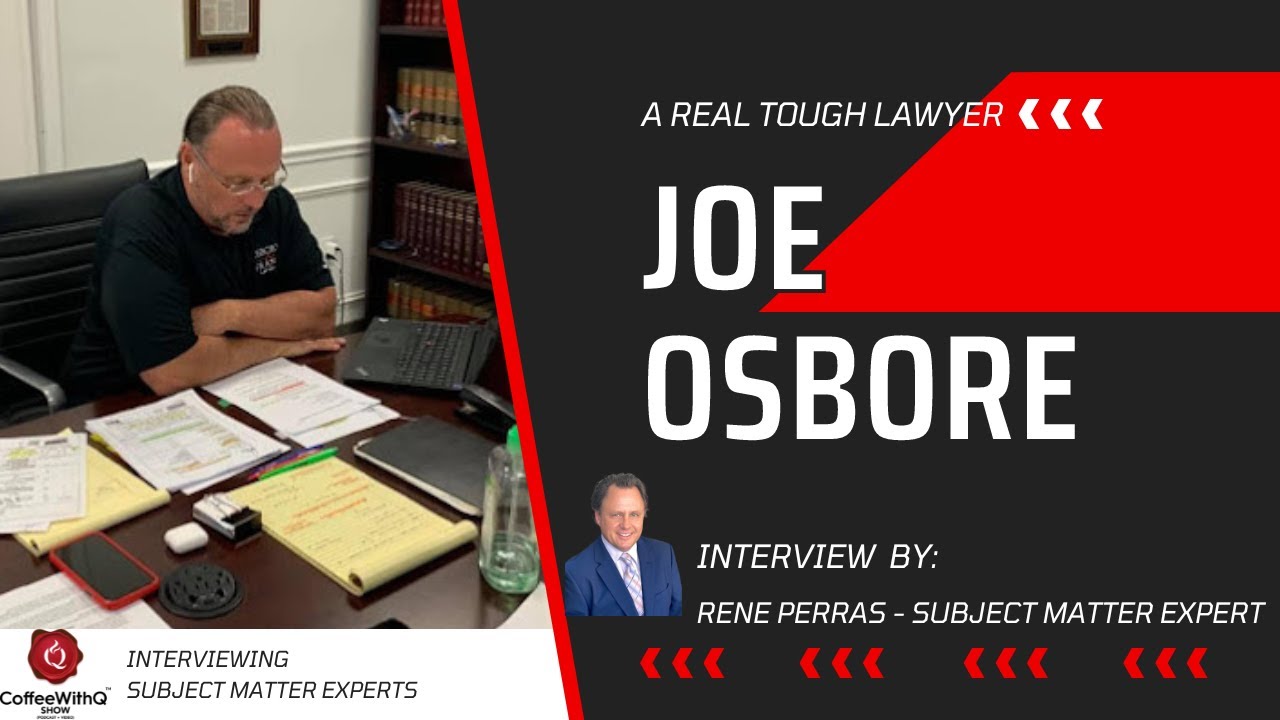
In this interview, host Rene Perel talks with veteran Florida trial attorney Joe Osborne about the American civil justice system, the constitutional right to a jury trial under the 7th Amendment, and how that system protects individuals from negligent corporations, businesses, and individuals. Osborne explains the contingency‑fee model that lets injured parties obtain legal representation at no upfront cost, and he emphasizes the lawyer’s role as a counselor who guides clients through medical, emotional, and procedural hurdles. He stresses the critical importance of early evidence preservation and adhering to statutes of limitation, describing how witnesses, product custody, and video recordings must be secured promptly. Osborne details his firm’s day‑one trial preparation process, from depositions and expert selection to meticulous evidence handling, and explains why experienced litigators achieve better outcomes through mastery of the rules of evidence, courtroom adaptability, and rapport with judges and juries. The conversation also covers the adversarial dynamics between plaintiffs and well‑funded insurance‑company defense teams, the strategic use of settlement threats versus trial, and why many law firms avoid trial altogether. Osborne shares a vivid medical‑malpractice case where a hidden EKG led to a multi‑million‑dollar verdict, illustrating the tangible impact of diligent investigation. He addresses public misconceptions that most lawsuits lack merit, arguing that the system serves as a watchdog that holds powerful actors accountable and ultimately improves safety. The interview concludes with a call to action for viewers to seek qualified counsel promptly, highlighting Osborne’s track record of recovering billions for clients and providing contact information for his firm.
Chapters
You know, we're counselors and we can help people navigate not only the legal hurdles and obstacles that maybe they may be experiencing as a result of bad things that have happened in the world, but we can also give direction in terms of how to get through that, how to seek assistance, what medical providers to see, what grief counselors to see, and really help navigate at a time when people don't want to be dealing with legal paperwork or dealing with claims or things of that nature. We really can take that burden away and counsel people both on the legal side but also on what to do next.
Welcome everyone, I'm Rene Perel, your host for today's show, a subject matter expert's interview with trial attorney Joe Osborne. Today we'll be discussing the importance of the 7th Amendment, the right to a jury trial for all Americans in certain civil cases, which is part of our Constitution and the Bill of Rights. Today we'll explore Joe's experience as a Florida trial lawyer representing regular folk who, by no fault of their own, have either been severely injured or a victim of a wrongful death. Joe, with the help of the American civil courts, has been able to achieve justice and compensation for families who suffered extreme loss. So I'd like to welcome Joe. Joe, welcome. Uh, I know this is a, uh, it's, it's not the, the funnest of topics to talk about, but I think it's extremely important.
Yeah, thank you, Renee, and I appreciate you having me here.
Okay, so let's tell the audience a little bit about Joe Osborne. Joe Osborne is a Florida trial lawyer and consumer justice attorney, graduate from Brown, an Ivy League school, received his Juris Doctorate, JD in law, from the University of Florida Law School. Joe has been practicing injury law for nearly 35 years, and with 18 years as managing partner of a nationally recognized personal injury firm. And in 2015, he started his own firm. 3 years later, partnered with Greg Francis, and today they are called Osborne and Francis, with 4 law offices in Boca, West Palm Beach, Orlando, and Lakeland, covering the state to help Floridians in need. Joe estimates to have recovered billions of dollars in financial awards for his clients, and what sets Joe apart from other attorneys is the amount of trial experience he's gathered as a licensed and practicing Florida trial injury lawyer. Joe's ability to overcome obstacles, navigate the legal minefield, bring a grievance from a Florida civil justice court, helping thousands of families achieve justice and recover compensation for a loved one severely injured or one who may have died. This has been his life's work, and amongst his greatest qualities is his determination and mental toughness to advocate and fight for regular folk who would otherwise suffer greatly without his help. But Joe will be the first to tell you that his greatest accomplishment is being a father of 3 children and a loving husband. So let's start with helping the audience understand the need for the civil justice court system and why it helps everyone injured and non-injured and the importance of the 7th Amendment. So looking forward to your answers today, Joe.
Sure. And again, thanks for, thanks for having me today, today, Renee. The civil justice system is something that's been part of our Constitution and our country, obviously, for hundreds of years. And the civil justice system in the United States, unlike other countries, is really designed to hold people accountable, not just people, but corporations and businesses and other entities that ultimately can do things that are wrong, do things that are careless, And ultimately lead to problems, both economic and pain and suffering and injury to individuals who ultimately become the victims of that carelessness. So the civil justice system is designed to be there as a deterrent. In other words, protect everyone, protect everyone from the carelessness and the negligence and perhaps even the willful conduct that, that can occur from corporations, businesses and individuals that can lead to problems for our citizens. So the civil justice system is a big part of the American way. Other countries, you'll see, you know, you'll see products that get onto the market that are very, very bad, that would never get onto the market in the United States. You'll see injury and damage to people in other countries where there is no accountability. And there is no ability for recourse for the people that are injured. But our system here makes it not only fair for people who are injured or who do suffer some non-economic or economic impact, but every day acts as the watchdog, acts as the watchdog, and makes people accountable and think before they do careless things. Because if they do, it's our civil justice system that will make them answer. For those actions or inactions.
It's there for everyone, and, uh, what sets us apart. Um, what do you tell people who are extremely apprehensive about talking with an attorney?
Well, a few things. If you've been hurt due to the negligence of someone else, whether it's a corporation, a business, or an individual, you can come see an experienced attorney like me At no cost. And we have a phenomenal system here in the United States called the contingency fee system, which means that if you've been injured by the negligence of someone else, or somebody has wronged you, or you've been in a car accident, or you've taken a bad product, um, you can seek my legal counsel. We can investigate your case, prosecute your case, and if we don't make a recovery, you owe us nothing. If we make a recovery and are successful in prosecuting your case, then our fee is paid out of the recovery. So at the end of the day, for the client and for the potential victim who may have suffered a problem, whether it's economic or non-economic, the system is really set up as a win-win situation. Meaning if you hire us, then you only pay us if we make a recovery on your behalf. And otherwise you'll never owe us a dime. So from the very beginning, there is no financial downfall to a client who comes and seeks our assistance. The other thing is we're attorneys, but we're also counselors. Uh, we, you know, that term counselor is often, often forgotten. So, you know, in my practice, I can tell you when someone comes in and they either can't work or they've suffered a loss or grieving because, um, you know, something terrible has happened to somebody in the hospital and the family or They've lost a loved one. You know, we're counselors, and we can help people navigate not only the legal hurdles and obstacles that maybe they may be experiencing as a result of bad things that have happened in the world, but we can also give direction in terms of how to get through that, how to seek assistance, what medical providers to see, what grief counselors to see, and really help navigate at a time when people don't want to be dealing with legal paperwork or dealing with claims or things of that nature. We really can take that burden away and counsel people both on the legal side but also on what to do next.
Having empathy is an important component to what you do.
I understand.
How do you reassure people who may be frightened of the idea of going into a courtroom?
Well, my response My response to that would simply be, don't be afraid. Given what I just said in terms of our role as both counselor and attorney, you know, for all my clients, we have gotten to the courthouse steps or gotten to trial. They are very, very, very comfortable and prepared for what is about to happen. We obviously pride ourselves, and I pride myself, in how prepared we are when we walk into the courtroom, when we're ready to try a case. And our clients are the same way. We spend hours and hours and hours with our clients preparing them for it so that they, when they walk in there, they know everything to expect. I can tell you that the system itself is extremely courteous and kind to potential victims, meaning the judge, the bailiff, the clerks, everyone in the courtroom setting will treat everybody with the utmost respect and kindness. And you can expect that not only from us as your counselor, but we'll make sure that that happens in the courtroom. Because at the end of the day, again, it's all about accountability. So even the other side who may be defending the case or will be defending the case, well, you'll be rest assured that they will treat you with the utmost respect and kindness and will let the process play out, play out as it will. But, um, but that's, that's something important for people to realize. There's going to be no Nothing but professional conduct, and you will be completely treated in a very, very nice manner.
Just a little follow-up to that one. In your years of experience, how often do you go to trial versus cases settling before trial?
It's a great question. It depends on the type of case. But I can tell you, over the course of 34 years, I have tried hundreds of cases. And they're not all— some of them may be 1-day trials, some of them may be 3, sometimes 6-week trials. It depends on the type of case it is. We do very much pride ourselves in preparing a case and handling a case at the discovery phase by taking depositions and handling the right experts, hiring the right experts. Prosecuting the case so it's positioned very well before trial to resolve. So once all the work is done on the front end between all the witness depositions, all the experts, securing all the evidence, we can get cases settled a lot of times right before we, you know, we actually have to go into the courtroom. But I can tell you, at Osborne Francis, between myself and the other lawyers we have here, I mean, we have tried so many cases. It's hard to put our arms around. It's got to be hundreds and hundreds and hundreds of cases.
Well, I think that's good to know for, for our audience. Another question: why it's important to consult with an attorney as quickly as possible?
That's a great question. And one of the things I think that really can ultimately impact, you know, how successful a case is, our initial investigation is of the utmost importance. importance in terms of making sure all the evidence that we need is secure. For example, if there have been witnesses to an accident, we want to talk to them right away before they disappear. If it's a products case and a medical device is removed at the time of surgery, we want to make sure that a hospital doesn't toss it or throw it in the trash because they have no need for it, and we want to make sure that it's secured. We live in a world where everything's videotaped now, video cameras and things of that nature, many times are on loops. And if the video is not secured in a timely fashion, that can be lost. So it's extremely important from our perspective to secure evidence, and that can exist in many different fashions, from medical records to some of the things I discussed. So getting us involved and getting me involved in your case as early as possible gives us the best chance of being successful.
Are there certain statutes of limitation that, you know, if you don't do it, you might not be able to bring a complaint?
Absolutely. Absolutely. So again, it depends upon the case, but every single type of case has a certain time restriction. Some may— it may be 2 years, it may be 1 year, it may be 4 years. It really is case dependent. But if a person waits too long or the family waits too long to come to us and it does happen where they are deciding whether to hire someone, they're not really sure whether a case exists, and they wait, you know, 2 years to come to us. We may have to say, sorry, we can't help you because at this point under the statute we only had 2 years to bring your case and now we're not able to do anything.
Well, I think that's important. Time is of the essence.
Absolutely.
Maybe you can tell us the importance of what it means to be prepared for trial or preparing for trial.
Yeah, nothing is more important. I can tell you that when we walk up the courthouse steps in order to start that case on a Monday morning, I am fully prepared. My team is fully prepared. Every lawyer in this firm is fully prepared where we know every possible angle of the evidence, the witnesses, what may be said, what may not be said, how we want to approach our case in terms of what witnesses we're going to call, how we're going to cross-examine their witnesses, how we're going to conduct jury selection. And we probably start that process one month before, where we are literally spending every waking moment prepping for that case. We get true tunnel vision, you know, in terms of handling that case to make sure that when we walk in that courtroom, we're ready to go. And that includes, you know, working on the weekends and all those things. And then ultimately, when you get into trial, that is your life. That trial becomes your life. And for 24 hours a day, that's what you focus on and concentrate until it's over. So without that type of preparation, it's very hard to be successful. So given our experience and how we do it, again, we pride ourselves in making sure we give our clients the best opportunity to be successful.
Just a, just a little follow-up to that one. Would it be fair to say that when someone comes to see you, And has a case that has merit, that you start from day one preparing for trial?
Yes, 100%. And that, that comes with securing the evidence like I talked about. So we're going to want to make sure that a witness we may need at trial, we're getting with, you know, within a week of that incident or accident. If the product needs to be— in a product liability case, oftentimes if you don't have the product, you don't have a case. So, you know, tracking down where the product is, how we're going to get it, where we're going to store it, making sure there's a, you know, a chain of possession so that we know it was the actual product that was involved in the case. Because in, as an example, in a products case, if we don't do that and don't have the product in question, then 2.5 years later when we're trying to prove a design defect claim and we don't have the product, it becomes a much harder challenge. So, do we begin— do we start getting ready for trial day one? Of course. And that is really in securing the evidence that's needed for a case, because without that, you run the risk of creating holes in your case that can be challenging to overcome.
Okay, well, that's good to know for our audience. Maybe you can share with our audience who the adversary is in most of the civil injury cases?
Sure. Uh, the adversary typically, uh, initially will be an adjuster assigned to your case, but ultimately, once a case is filed, it's the law firms that are retained by the insurance companies and the corporations. And we've laced them up against the biggest and most respected defense firms in the United States, uh, and they often send teams of lawyers at cases Because of typically unlimited resources and a strong desire to not only defend the reputation of the company or corporation, but to make sure that the client gets nothing. And I can tell you, we recently tried a case where one of the companies sent dozens of lawyers to the trial, literally dozens of lawyers. I kept seeing lawyers coming out of the woodwork in terms of the amount of lawyers that were involved in defending the case. There was 3 of us, and we're used to that. So you, you really need to make sure that you have an experienced, well-versed lawyer who's not only prepared but versed in trial because you're going up against a team on the other side. I can tell you, the 3 of us, we banged them over the head even though there was probably 30 on the other side, and we got a verdict for our client of millions of dollars.
Well, I think that, that should reassure people who are hearing you share about what happens in a trial.
Absolutely.
Why are people who have legitimate claims, you know, that, that basically it's evident, never offered fair cash settlements unless they hire an attorney?
That's pretty simple. Insurance companies and corporations Corporations take advantage of people, and they do it sometimes purposefully, and sometimes they do it in a way where they're just trying to save money. Their job is to save money when claims arise. So regardless of whether you're in a car accident or you're dealing with a big corporation, they just don't roll over and pay you, and they immediately go into how can we get out of this mess or case for as cheap as we possibly can and put pennies on the dollar to make sure that, uh, A, they're not spending too much money, and B, the headache goes away. So unless you hire a lawyer and you bring in somebody who, who, who knows what to do, knows how to secure the evidence, knows how to prosecute the case, knows what to look for and build the case under the elements of what the case is about, uh, big corporations especially and insurance companies are not going to pay you. Or pay you anything close to the value of what your claim is. As a recent example, we had a client that came to us where the insurance company— it was the insurance company for a corporation— had offered her $10,000 for her case. And she came very close to taking it because of some of the things we talked about today. She was kind of afraid of the process and didn't know what it would cost. And She was referred to me by a friend, uh, and 6 months later we turned that $10,000 into $650,000, and we were able to resolve the case for her for $650,000. But she came very close to taking the $10,000 because she was unrepresented and because the big corporation insurance company was trying to take advantage of her.
Well, she was fortunate to have met you and to have listened to her friend. What do you say to people who believe that most lawsuits are without merit?
That's, that's a great question. Um, I really think a lot of that has to do with people having no experience of being wronged, meaning that they don't understand that this, this process is about accountability and it's about being watchdogs. And even though obviously corporations and individuals make mistakes and screw up, that we're here to prevent that from happening to the best that we can. But that when it does happen, that without us, the United States and, and, and products that were being put onto the market and the way people drive and the way that you're taken care of in a hospital, it would be a lot less safe but for this system. And the lawsuits aren't necessarily about having no merit. The lawsuits are about helping people when things have been done to them that are, um, are negligent and result in catastrophic injury, in many cases to where their families are devastated. And, you know, we talk to obviously people all the time. We hear it in jury selection. We talk to people on the street. Many, many times, people who hold those opinions that lawsuits are without merit and the system— there's something wrong with the system, etc., it's only because they haven't been part of it. And as soon as something happens to them or one of their family members and they come meet us and sit down with us and they start to go through the process with us, us and understand what we do, then I think that people then start to understand and realize that no, this, this is a system that is incredible because but for this system and but for these lawsuits, people would be hurt all the time by the negligence of others and there would be no accountability. It's all about accountability. And once people look at it not just like, hey, someone's looking to get a buck, but it's about holding others accountable, I think that messaging makes a big difference in people's minds.
I think, and maybe you can shed a little bit of light on this, people don't necessarily go through this process regularly. It's maybe once or twice in their lifetime, if any. And then once they go through, they go, oh my God, I didn't know.
Absolutely. Absolutely. Even in jury selection, we'll hear it. You know, we have to interview jurors and pick jurors, and sometimes even jurors that are— have that kind of attitude, they end up on the jury. It's just because, you know, the number of jurors, the judge denies strikes, and they come into that jury selection process, you know, very jaded and/or think it's a waste of their time, etc. And then they sit through the process and they sit through a case and they listen to the evidence and they start to understand what's happening in the case. And win, lose, or draw, you know, we get to interview jurors many times after cases, and they'll come up to us and say, we had no idea the kind of work that went into this. We had no idea what this was all about. And many people who tried to evade being on a jury, you know, tried to get off because they didn't want to be bothered, will tell us, this is one of the greatest experiences of my life. I never knew that's what, you know, this was— that's what this was all about. And And understand the work and effort and the dynamic that goes into it. So to your point, I think it's a great one. Until you actually become part of the process, either through needing a lawyer, having been injured as a result of somebody else's fault, or even as a juror, I think people get a different appreciation for it once they're involved in it.
Well, that's, that's a nice thing to hear, that once you put it in front of them, They start believing what they're seeing.
So that's—
I think that bodes well. Another question comes to mind: what are some of the reasons why more experienced attorneys achieve better results?
I think there's a few reasons for that. I'll touch on a couple of them. I think the more you're— excuse me— the more you're in the courtroom, the more comfortable you are being in the courtroom. The courtroom can be an intimidating place. The courtroom can be a very intimidating place if you're not used to going there, which is why we spend so much time prepping our clients for that experience. And by the time they get there, they're very comfortable being there. But I think lawyers that spend time trying cases, number one, know the rules of evidence. The rules of evidence control how the courtroom and the trial is conducted. If you don't know the rules of evidence, then you're going to be really at a loss in terms of procedure— procedurally how to handle your case, how to handle your witnesses, how to get documents in front of the jury, how to make sure that they understand the evidence if you don't understand what's admissible and what's not. So an inexperienced lawyer is not going to have the ability to draw on his and understand the rules and how a judge may ultimately decide certain things when it comes to the evidence, which is so important to the case. I also think, you know, as a lawyer who's tried as many cases as I have, being— having the ability to think on your feet and adapt, meaning you may have a game plan for a certain witness, but depending upon how the case is going or what the last witness may have said, you really may need to adapt kind of what your approach and thinking is going to be. And many times that's on the fly to make sure you're dealing with issues and addressing the things that are happening live as opposed to following the script. You know, there are many times I've had a witness where I've prepared for hours for, and ultimately after that witness was, you know, had been on the stand and testified, I took my outline and threw it out the window and said, I'm coming at them this way. And was very successful at that. So you have to have that, that knack, that gut, that experience to say, you know what, during the course of the trial, I know what's important and I know how to get, you know, to get to someone and make sure that witness ultimately testifies favorable to my case. And then the last part of it is you have to be able to connect with the judge and jury. You can go up there and have the best case in the world. You can say all the right things and present the facts. But again, it's a relationship business. You have to be able to connect with the judge. You have to be able to connect with the jury. They have to like you. They have to be able to at least listen to you and be open to be persuaded by the evidence you're presenting. So I think unless you're comfortable in the courtroom and you understand the rules of evidence and you have the ability to connect both with the judge and jury, you're going to be at a real disadvantage as a trial lawyer.
I think as well that not everyone is built to go in front of a judge and jury. There's some, there's some law firms out there that never go to trial. They always focus on settling. I think maybe that's a distinction you could maybe say a few words on.
Sure. Yeah, no, and, and look, law firms are built differently, but, but many law firms are built in terms of focusing on the specialization of getting a case together and trying to settle it without having to try a case. They're either— they don't have litigators, they don't want to be in the courtroom, and although they advertise themselves as being, um, you know, kind of able to do that, they have no experience doing it. And oftentimes, without any question, the insurance companies know who they are. So they know that my law firm, Osborne Francis, they don't settle a case with us, they are going to be staring down the eyes of a jury one Monday morning, and we will be there and we'll be prosecuting our client's case. There are other law firms who they know without question, no matter what, what is offered, they'll never have to worry about staring down a jury on Monday morning. So ultimately, the insurance companies will end up settling cases with lawyers that don't try cases for less money because there's less risk. And they know that there is no threat. Where with my firm and with me, if they don't pay us what we think the case is worth, we'll go ask the jury what it's worth. And then ultimately, they run the risk of having to pay even more than I'm asking for. And there have been many cases where we were, we were trying to get cases settled for a certain amount, and ultimately, jurors, juries gave us even more than that. Well, that's good to know.
I have just one last question, Joe. Um, sure. You could tell us about an interesting trial you've argued before a judge and before a jury in court and, uh, what happened with that client.
Sure. Um, I was actually talking about this case the other day. It was an incredible case. It was a medical malpractice case where my client, who was in his 60s, had gone in on a Friday afternoon, uh, to get a stress test done as part of a physical. And they always say, don't get medical care and treatment on a Friday. Well, anyway, he had gone in on a Friday afternoon. That probably had nothing to do with it, but just one of those things. But he had gone in and they'd done the stress test. And after the stress test, they told him his heart looked great, everything was wonderful, and sent him home. Well, his son happened to be a paramedic, and he also had a wife. And that following day, which was a Saturday afternoon, my client, the decedent ultimately, was doing work in his yard and son came home from being out somewhere, paramedic, and found his dad, his dad in the backyard, uh, on the verge of death, uh, who had suffered a massive heart attack. Now picture this. My client, who's a paramedic, now is trying to save his father's life. In, in his own backyard in the house he grew up in. And unfortunately, it was too late. His father died in the backyard and had suffered a massive heart attack despite having a normal stress test the day before. So we got the case, the family hired us, we investigated the case, uh, and we got all the medical records. And of course, uh, they— The doctor was claiming that stress test had been normal and that there was no EKG printout for the stress test because it was normal and they only printed out EKGs when they were abnormal. So we fought the case and we fought the case and we kept digging, we kept digging, and right before trial we uncovered a printout of the EKG that actually had been printed out by a nurse and apparently had never been shown to a doctor. And when we— when you looked at the EKG, the man was a ticking time bomb. That it was— if someone had looked at the EKG from the stress test, it was clear that he needed to be admitted to the hospital right away where cardiac intervention would have saved his life. Instead, they sent him home. During that trial, when I put the son on the stand and had him testify about how he felt about the EKG never being read by the doctor and what he went through trying to save his own father's life on a Saturday afternoon in his own backyard. It was an incredible moment in the trial. And at the end of the day, jurors awarded the family millions of dollars, which they were clearly entitled to based upon not only the, the mix-up by the doctor's office and sending this man home with a Terrible, terrible EKG, but ultimately what the son and the wife had been through.
Well, you talked about it earlier about accountability and making people accountable for their negligence, and hopefully they, um, they change the way they do things so that these types of situations, these horrific, sad situations, don't happen to, uh, you know, a friend of ours.
Absolutely.
I have friends and I've— if I look back, I've been touched by some events that you're describing and it's just, you feel like there's nothing anybody could have done.
Sure. Yeah, no, and the family was devastated because this clearly was something that was preventable and just, it was one of those that had fallen through the cracks, but it cost the man his life.
Well, this has been a great show. Just a little bit more. Joe represents people as if they were his own family. He has done this successfully for nearly 35 years for thousands of families whose loved ones were wrongfully killed or severely injured due to some form of negligence by an individual, corporation, or by a large pharmaceutical company.
Pharmaceutical company.
The different forms of negligent acts by an individual or business can be many, like a medical injury sustained at the hands of a healthcare provider that Joe described, a company who manufactured a defective consumer product, or pharmaceutical giants badly developed drug medication. The fight for the most part is against rich insurance companies and their army of lawyers. The people he fights for were initially offered very little in the form of a cash settlement for their claims, and in some instances offered nothing at all. Joe's passion and past results, estimated well over $1 billion for his clients, is what makes today's clients receive the best possible settlement offers to recover compensation for their economic loss, medical expenses, and pain and suffering. To find more, find out more about Joe Osborne, Florida trial lawyer with Osborne and Francis, you can visit his website www.realtoughlawyers.com, or you can even call Joe directly at 561-301-3292. Thank you, Joe, for sharing your Thank you so much for sharing your insight and experience with us today. It was, for me, certainly helpful, and I'm sure for our audience as well.
Thank you, Renee. Again, I really appreciate you having me, and I really enjoyed it.
Come back and visit us. This is going to be one of many installments where Joe helps us understand how the legal system functions and And what we should, what we should be aware of. If we're better informed, I think we can make better decisions. So until next time, thank you.
Thank you.










