Osborne & Francis: Addressing Doctors' Negligence Part 3 on Coffee With Q
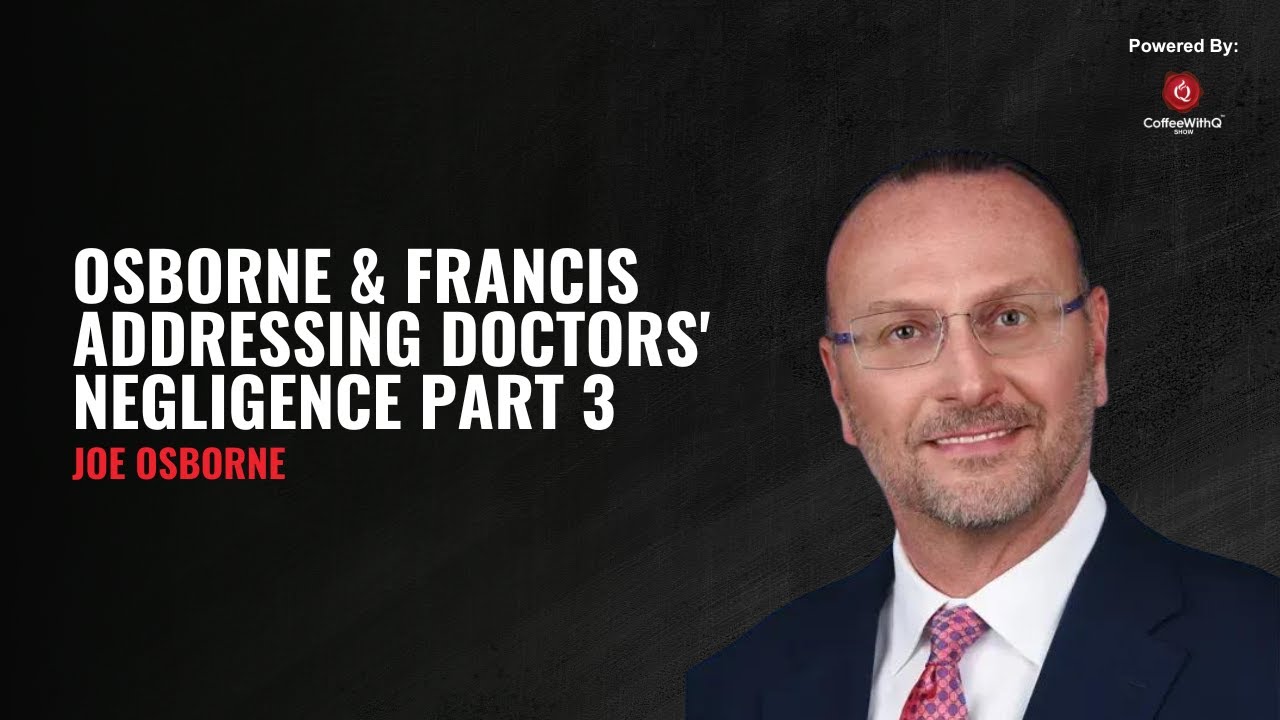
This content was created by Qamar (Q) Zaman. This content was uploaded by Qamar (Q) Zaman. This is a YouTube interview episode (Coffee with Q) titled "Osborne & Francis: Addressing Doctors' Negligence Part 3 on Coffee With Q" (created 2025-11-04T14:23:21Z). It is a conversational interview between host Qamar (Q) Zaman and guest Joe Osborne, a Florida medical-malpractice trial lawyer. The discussion focuses on medical negligence: the three elements of malpractice (deviation from the standard of care, causation, and significant damages), the critical role and qualifications of expert witnesses (including Florida's Chapter 766 affidavit/notice process), challenges in proving cases, an extreme obstetrics example, statute-of-limitations rules in Florida, litigation costs/contingency-fee practice, and legislative trends (caps and procedural hurdles). Contact information and the guest’s firm (Osborne & Francis / realtoughlawyers.com) are also mentioned for viewers seeking help.
Chapters
Hello and welcome everyone to another episode of Coffee with Q. Coffee with Q is dedicated to helping consumers find justice. Today we have the pleasure of speaking with Joe Osborne, a seasoned and accomplished medical malpractice trial lawyer with extensive experience in advocating for patients' rights. Today's show will focus on understanding medical errors, misdiagnosis when dealing with healthcare facilities and medical professionals. Joe, our guest, is an expert in this area of law. Welcome, Joe. Always good to see you.
Thanks for having me, Renee.
Okay, so how do we define medical negligence and what are its key components?
So there are really 3 factors that you need to have in order to have a medical negligence case. The first is what we call a deviation from the standard of care, which means that the error made by the physician, whether it's proactively doing something wrong or failing to do something that should have been done, is so egregious that other similar healthcare providers deem it to be negligence as opposed to making a mistake. And that is really the opinion of what we call similar healthcare providers who believe that Whether or not it's misinterpreting lab results, missing something on clinical exam, rises to the level of a deviation from the standard of care, because we're all entitled to the same level of care regardless of where we come from, the same level of care by our health system here in the United States. And then we have to be able to prove, assuming that there is a deviation from the standard of care, that that deviation or that negligent act caused— causation. Ultimately, the third thing we need, which is significant damages. So those are the 3 elements of a malpractice case. Um, a, a mistake, either by doing something wrong or failing to do something that rises from, uh, rises to the level of it deviates from the standard of care, number one. Number 2, causation, where we can show that that negligence caused Number 3, a significant impact on the patient's outcome, whether or not it actually caused them immediate harm or over time some other type of harm, like, uh, failing to timely diagnose and treat a condition or losing the opportunity to successfully diagnose and treat a problem successfully.
What are the challenges involved in proving medical negligence in court?
So there are some big challenges, and really it starts with what I'll call proving the severity of the error that's in play. And oftentimes that comes down to an analysis of, is this simply a poor outcome? Meaning, was there, you know, just something bad that happened to this patient? Or does it really rise to the level of a deviation of the standard of care? And we have to really rely on our experts and similar healthcare providers to help us kind of weed through those issues. If it's a urology case, I need a urologist to look at the case who's independent from everything that happened and give me an opinion about whether or not they think the urology care rose to that level of negligence and deviation. You know, oftentimes cases that we think really may have some teeth to them and merit, turns out that there were some underlying issues and this was really the result of of a progressive illness that oftentimes, regardless of maybe whether mistakes were made along the way, we were not going to be able to change the outcome of the patient's course. A lot of diseases in this world unfortunately are unpreventable. So sometimes when a disease is diagnosed or should have been diagnosed, really doesn't make a difference ultimately in the outcome. Pancreatic cancer is one of those horrific diseases that You know, regardless of the timing of diagnosis, unfortunately, the outcome often does not change. So if patients come to us and say, well, I had stomach problems and I had issues and I went to my doctor and then he blew me off, and then 2 months later I was diagnosed with pancreatic cancer, regardless of that delay, ultimately we know that even if the patient had been diagnosed 2 months sooner, the ultimate outcome would not have been any different because early detection has just not been shown to impact survival with a condition like pancreatic cancer and unfortunately many other diseases. And then ultimately, people die for lots of different causes. So we may have what we believe to be a great case in terms of either poor care provided or the absence of care. And then ultimately it leads to some issues, but then maybe a patient dies from something else. They may, maybe they had underlying diabetes or they had a brain tumor or an aneurysm and they may die from some other cause that's not— has nothing to do with the medical care and treatment provided. So oftentimes they can become very kind of sticky soups to get through, meaning that there's lots there that we have to weed through in terms of figuring out what are the other issues surrounding the potential claim and can we make it clear enough to where what we think happened is really why things turned out the way they did.
Interesting. Uh, you talked about witnesses, uh, expert witnesses. How important are expert witnesses in medical malpractice cases, and what role do they play?
So without a— without an expert in a malpractice case, you have no case. So for instance, in Florida, we have what's called Chapter 766 of the— 766 of the Florida Statutes, which means that if I have a medical malpractice case that I think has potential The only way I can bring that case— and let's say it's against a dermatologist— I have to go get a, a third-party independent objective dermatologist to look at the case and sign an affidavit for me that says after he or she has reviewed all the records and the information, they believe there's a good faith base for— basis for a medical malpractice case, meaning that the physician in question deviated from the standard of care. Without that affidavit, I cannot move forward with the case. It's one of the prerequisites and the initial prerequisite to bring a malpractice claim. And then what I have to do is I have to take that affidavit and send the potential defendant doctor what's called a notice of intent to initiate litigation, where I attach the affidavit. I send them a letter, I explain what we think they did wrong. They can see the corroborating affidavit. And then under the statutes, they get 90 days to do what I just did, evaluate the records, figure out if there's a case, and at the end of the 90 days, make a decision as to whether or not they think I have a case or not. Deny my claim, want to try to settle. 99% of the time, regardless of how strong we believe the case is, they say there's nothing, they did nothing wrong, they deny the claim, and then we can move forward and file our action. But if we went down to the courthouse and just filed a medical malpractice case, it would be dismissed on its ear because without the corroborating affidavit from the expert, um, you've not met the prerequisites to bring the case and you violate the statute. So without experts, there are no case or cases.
You bring in an expert, the other side has their own expert. How do we figure out Is there a standard for experts? You know, you can't just bring in anybody into these type of situations. So how does that work?
Good question. So, so in Florida, we do have some requirements for experts. They can't be retired. They have to be still practicing. They have to be engaged in the active practice of medicine. They have to register with the state as being qualified to give an opinion. You know, in a particular case. And oftentimes, and I'll use the— we can use the, you know, the example of, let's say, the lung cancer case. You know, even though that may seem like it's limited to one issue, was the film read the right way or not, that case can require multiple experts in multiple specialties. As an example, I'm going to need a board-certified radiologist to look at whether or not the film was missed. I'm going to need an oncology expert to look at the timing of diagnosis and the underlying type of tumor, um, and, and talk about whether or not, from an oncology perspective, did the 6 or 8-month delay make an ultimate difference in the outcome. And that would have to come— those opinions would have to come from, uh, an oncologist who clinically takes care of patients, you know, lung cancer patients, on a daily basis. I'm probably going to need a pathology expert because I'm going to have to get the tissue from the tumor that's removed and look at it from the standpoint of how aggressive was the tumor. Because they'll have a pathologist who will look at it and say, this was a deadly tumor. The timing of the diagnosis didn't matter. Even if you believe Dr. Jones missed, missed the film or missed the tumor on the film, the underlying pathology shows this was a very aggressive tumor. We may need to have experts in terms of ultimately what the impact is if the person has passed away. What are the economic impacts to that person's estate? We may need an economist. We may need other financial-type people to look at what the ultimate economic impact is on the family and the estate, especially if it was a young person who was still working. So that one case literally could turn into a 4 or 5 expert case. And oftentimes that is why medical malpractice cases are extremely expensive to bring. And, you know, the question is, how do you figure out who is— you know, they're going to have their people saying their stuff, and we're going to have our people saying, you know, the opposite. And ultimately, the jury decides. The jury listens to the experts, they hear the testimony, and they decide based upon credibility what they believe the medicine ultimately to be. And, you know, what experts they think make the most sense. Ultimately, it's their decision about what experts they think are right or wrong and whether or not we win the case or not.
Can you discuss a notable case of a doctor's negligence you've worked on and what its outcome was?
Well, this is pretty amazing. I hope not to scare people, but we see a lot of cases. I've handled a lot of labor mismanagement cases. where OB-GYNs, in the face of baby deliveries, especially first-time children who are being— first-time mothers, I should say, who are delivering children, often will have protracted labor courses. Once women have had a baby or they have their second or third child, typically labor is not as difficult over time than when it's delivering your first child. So I've handled many cases where things were not recognized during the course of labor and delivery. Hypoxia on the part of the child where the heart rates are going down, other issues seen on fetal monitor strips to where, you know, someone is trying to deliver a baby, you know, mom wants to deliver vaginally. They're trying to deliver vaginally, and it always comes down to the timing when a baby's in trouble of was a C-section called appropriately. Because a C-section allows an incision to be done in the belly. You open the belly, get the baby out, and it avoids all the trauma of labor. And in a, in a setting of a labor and delivery where you have fetal monitor strips and nurses and everyone's evaluating the status of the baby, the number one rule is make sure baby's okay, and if not, we need to get a C-section. Because that will eliminate the problem right away. I had a case where a labor and management situation was going very, very badly. The child was essentially stuck in the vagina. It was a breech delivery. And you're not going to believe this, but it happened. And instead of converting to a cesarean section, the OB— In attempts to continue to try to deliver the baby vaginally, and the force that was used in trying to deliver the child, in pulling on the child, decapitated the baby and literally pulled the baby's head off with the force that was being exercised, you know, basically implemented by him in terms of trying to get the child out. Didn't convert to a cesarean section, didn't recognize that that needed to be done as quickly as it needed to be done, that the labor, that the baby was breech and the baby wasn't coming out and the failure to convert to a cesarean section ultimately led to a catastrophic result. Obviously, mom was aware her baby had been decapitated and obviously was an incredibly traumatic and dire situation. And from time to time happens. It actually happens more— I shouldn't say more than you think, but when I first got this case, I'm like, how the heck could this have happened? There's No way this, this, this, this could be real. But in some of these situations with breech babies, given the tender nature of their tissues and structures and bones, that if the right force is exerted under the right circumstances, this can occur. So unfortunately, it was a terrible outcome for these parents. We brought a medical malpractice case against the hospital and doctor, and we were successful in that regard.
That's so sad. Um, and I can understand, you know, first-time mothers, um, their situations, uh, since, you know, I have 3 children of my own. So I know that the second and third, uh, were a lot easier than the first one.
Yep.
How do you see the field of medical malpractice law evolving in the coming years, especially concerning doctor's negligence?
I think it's going to become more and more and more difficult for patients to bring these cases. The protections from the legislature through laws and procedural hurdles and caps on damages are things that the legislature, and I'll use Florida as an example, they talk about all the time in terms of making it more difficult for patients and building in protections for hospitals and doctors. Caps on recoveries, meaning caps on non-economic damages, which means that if you're Loved one passes away and, you know, it was your father or your mother or your spouse, and the, uh, you're successful in your claim, there, there's going to be a law that says this is the most you can ever recover for, that you're basically capped on any award. We've had those in Florida before. They got overturned, but we now have a Supreme Court that is, uh, is talking about reinstating it. Uh, I told you about the procedural implications of 766 and what we have to do to even get a case to to the courthouse. And I think they're going to make it tougher and tougher to find experts and perhaps create, you know, other procedural hurdles that we have to get through in order to bring a successful case. So given the complexity of this and given the fact that these are not cheap cases, you know, there's not a lot of personal injury lawyers that do medical malpractice. This is a very kind of, you know, unique area That because of its complexities, you really need to make sure you have a very skilled, experienced malpractice lawyer. Cases are extremely expensive to bring. That, you know, if someone comes to me, we pay for that, meaning if we decide to take the case, we bring the case, we pay for the costs of the litigation. And if we lose the case, client owes us nothing. That's our burden to bear from the standpoint of us bringing a case, and that's how the contingency fee system works. We only get paid if we win, and we get our costs paid back if we win. So oftentimes for patients, you know, it's a win-win situation in the sense that they're only going to owe us if we're— if we make a great recovery on their behalf. But understanding those circumstances with the laws, the procedural issues, and perhaps caps coming, make sure that you reach out to an experienced medical malpractice lawyer. You know, if you have a question about a case, you know, as soon as possible.
It sounds like time is always of the essence with medical malpractice, and I guess it must be the same way. There must be a statute of limitation, or you can only bring it within a certain time.
Yes.
What is it like for medical malpractice law in the state of Florida?
It's different in every state, but in Florida for sure it's 2 years. So you have 2 years from the date the malpractice was committed or 2 years from when you were on notice of a potential claim, but in no event do you have greater than 4 years. So, um, you know, 4 years at the very, very, very end of time is your, your case is barred, um, even if you're not on notice of it, you know. Till, till maybe 3 years after. In a wrongful death case, there is no notice provision. So in a wrongful death case, you have 2 years, 2 years, 2 years. So there's 2 years from the date of death to bring a claim.
To find out more about Joe Osborne, Florida trial lawyer with Osborne and Francis, you can visit www.realtoughlawyers.com, or you can call Joe directly, and you can reach him at 561- Thank you, Joe, for coming on the show, and your experience with us is stellar as always. It was certainly helpful for me, and I'm sure for our audience as well.
Thank you, Renee.










