Podcast Episode: Navigating Federal Drug Crimes with Attorney John Helms (2)
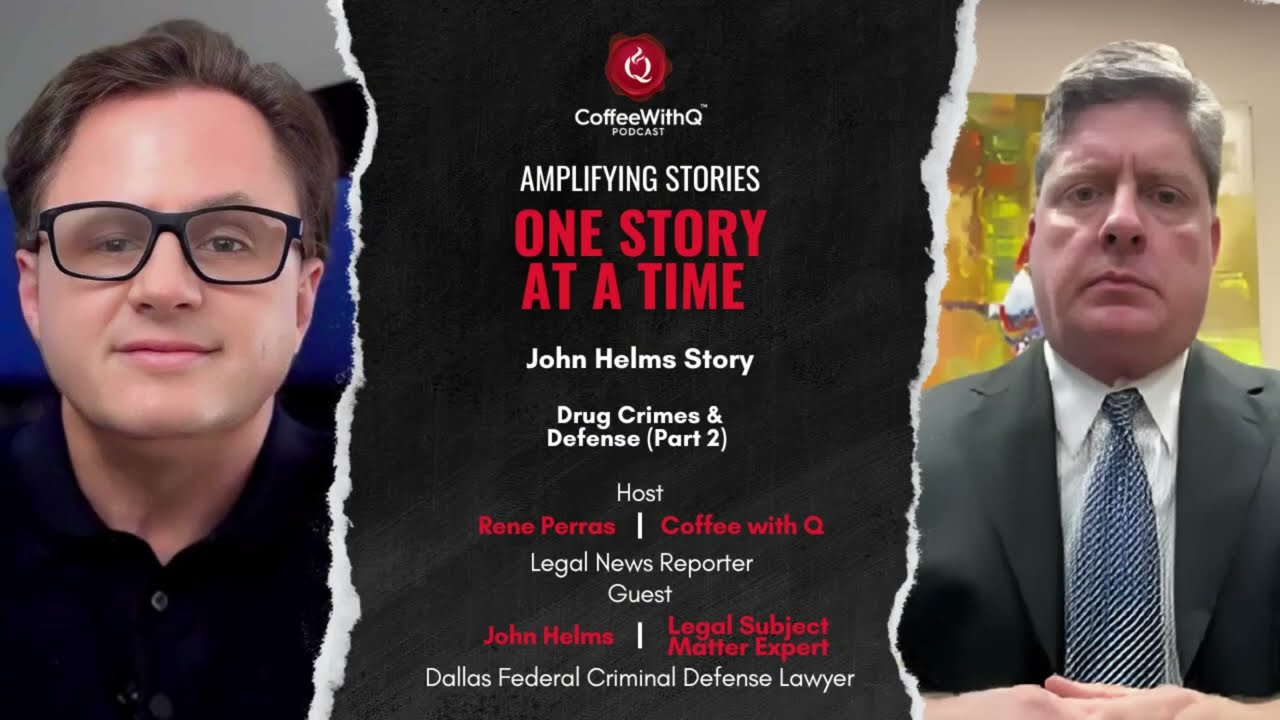
This content was created by Qamar (Q) Zaman. This content was uploaded by Qamar (Q) Zaman. This is a YouTube podcast episode titled "Podcast Episode: Navigating Federal Drug Crimes with Attorney John Helms (2)" (posted/created 2024-10-14) from the Coffee with Q News series. The episode is an interview-style legal news segment hosted by Renee Perrault (legal news reporter) with guest John Helms, a veteran attorney and former federal prosecutor with 30+ years' experience. They discuss federal drug enforcement in the Dallas–Fort Worth area and nationally, covering common federal drug cases (methamphetamine, rising fentanyl, heroin, cocaine, and large-scale marijuana operations), supply and manufacturing chains (Mexican cartels and Chinese precursor chemicals), trafficking/distribution trends, links between addiction and drug-related crime, pill mills/prescription opioid diversion, and a notable federal trial example defending a pharmacist that required extensive review and presentation of medical and prescription records. The episode also summarizes Helms' credentials and provides contact details and his website. Language: English; content type: YOUTUBE; context: legal news/interview (part two of a two-part series on navigating federal drug cases).
Chapters
Welcome back, everyone. I'm Renee Perrault, legal news reporter for Coffee with Q News, a platform dedicated to shedding light on crucial legal matters and discussions with subject matter experts who impact our society every day. Our aim is to educate and inform our audience through professional insights and analyses. Making complex legal questions or legal issues become straightforward and understandable. Today, we will be finishing our 2-part series on navigating the complexities of federal drug cases. And today I have John. John, it's great to have you back today. I'm sure that our audience will benefit again from your expertise as an attorney, and you've handled many federal criminal defense cases and federal appeals. especially those involving controlled substances, prescription drugs, and illicit drugs. So, hello, John.
Hi. Thanks for having me.
Wonderful to have you back. John's expertise and tenure consists of 30-plus years as an attorney, 25-plus practicing as a Dallas criminal defense attorney, 3 of which as a lawyer in the United States Attorney's Office as a federal prosecutor for the Northern District of Texas. Where when he was there, he never lost a trial or an appeal, a truly impressive record. Today, we're going to start off with what are the most common types of drug cases in the Dallas-Fort Worth area?
Well, as far as federal drug cases, I would say that the most common are methamphetamine and cocaine and heroin. You don't see a whole lot of marijuana cases at the federal level. Those can be handled at the state level, and that's just not something that the DEA, federal government are overly interested in unless it's a very large operation. I would say the most common of all is methamphetamine. Meth is All over the place. It comes almost always through the southern border from Mexico. And you just see a lot of drug cases involving meth. I would say fentanyl is, is growing. The amount of fentanyl that's coming into Texas is growing exponentially. So we're seeing a lot more fentanyl cases in the last few years. And then heroin and cocaine, you know, a fairly steady amount of cases.
Is the reason for a lot of meth cases, is it very cheap to manufacture? Is that one of the reasons?
That is one of the reasons. When I was a federal prosecutor back in those days, Most of the meth that we saw was made locally in, you know, what we would think of as mom-and-pop meth labs. And they would use different methods to get pseudoephedrine from grocery or drugstores, and they would cook it up. And it was very low quality. It was hard for them to get the chemicals that they needed. And so there wasn't a lot of supply and the quality was very low and the prices were fairly high. What happened over the next several years is the drug cartels in Mexico decided that this was a very lucrative potential market for them, and they created what we call these super labs where they would get large quantities of the chemicals they needed, and they would make the methamphetamine in large laboratory, almost factory-like conditions. So they were able to churn out meth that was a much higher purity level and for a low cost. So because of that, they were able to move out the mom-and-pop meth labs Almost like when Walmart comes to town and the mom-and-pop shops are pushed out because they can't compete with Walmart. Well, now the mom-and-pop meth cooks can't compete with the Mexican super labs. So because of that, they were able to make a lot of meth and make it cheaply. And they got it up here. And apparently a lot of people like it when they take it, become addicted to it. And so there's a very high demand for it. So that's why I would say there's such a supply of meth.
I think everyone in America has seen at least one episode of Breaking Bad, and I guess that's the reason they stopped producing that show, because of the super labs, maybe. Okay, let's go to our next question.
Go on, sorry. The mob meth cooks were not like the chemistry professor in Breaking Bad. They were people who'd go steal Sudafed from the drugstore to make their money. Um, we get it.
Well, everything is changing so quickly. Um, what are some of the most common federal drug crimes, uh, being charged in the Dallas-Fort Worth area?
Well, I would say, uh, methamphetamine, Heroin, fentanyl, cocaine. That is, those are the 4 drugs that we see the most of. I mean, you could say that marijuana is everywhere, and it is, but the federal government is not interested in user amounts or possession of marijuana or, you know, small marijuana operations. They're not interested in that. For marijuana cases, it needs to be a very large operation for the federal government to care. The other drugs, though, are typically imported from Mexico or South America, or in the case of heroin, possibly from Asia, although most of the heroin comes from Mexico. And so those drugs have international implications. They are dangerous. They cause a lot of societal harm. And so the federal government is focused on them.
What are some of the most common illegally used drugs in Dallas, Texas, and across America?
Well, I would say the most common illegal drug that is used is marijuana. It's not illegal in many states, but the federal government still has it classified as an illegal drug. So if you're in a state where marijuana is legal, you can still be charged with a federal crime. Although the federal government is not concerned about people using marijuana in states where it's legal, they are concerned about large marijuana operations where marijuana is being grown and sent around the country and sold illegally as opposed to being sold in legal dispensaries, for example. So we had a case, and we still have this case in this area involving people who are growing large amounts of marijuana in Oklahoma. Where medical marijuana is legal. And that marijuana, instead of just being used for legal dispensaries in Oklahoma, is being distributed all around the country, including in very large quantities into Texas. And so the federal government has cared about that because it's such a big operation and it's sending marijuana all over the country. So that's an example of marijuana getting on the federal radar. But other than that, I mean, methamphetamine is very— methamphetamine use is very common. I think cocaine use is probably not as common as it used to be. It was popular in the '80s and '90s. I don't think it's as popular now. Heroin has— I mean, it's still around. It just doesn't go away. And in part because it's so addictive. And then fentanyl is something new that we really didn't start seeing until a few years ago. Fentanyl use is growing. And I— my understanding, and from talking to some clients of mine, they're confirming this, even though you hear stories about, say, a high school kid trying fentanyl and dying, which of course is horrible, the most likely fentanyl user is probably a heroin addict. So fentanyl can be a substitute for heroin if for some reason the heroin addict can't get it. So we're starting to see fentanyl come in in larger quantities from Mexico where the chemicals are assembled. They get the chemicals from China. Put them together and mix them up in Mexico and then send them up here. So those are the common drugs of, of, uh, that I see being used where the drugs are illegal.
How about, um, we hear of Chinese fentanyl. Is it Chinese fentanyl produced by the Chinese, or is it the Mexican drug cartels? And maybe you can talk a little bit about the, uh, You know, the organization behind the manufacturing, the distribution, and even like the internet and how that's being used to sell and traffic?
I think there's a small amount of fentanyl that's coming directly from China. But most of the fentanyl is coming from Mexico. But the cartels in Mexico are getting the chemicals to make it from China. And so the United States government, in an effort to try to reduce the amount of fentanyl coming into the United States, has tried to work with the Chinese government to do whatever possible to keep either fentanyl itself or the chemicals from being exported in a way that they can be turned into fentanyl and sent into the U.S. So there is some fentanyl that I think is probably coming in. I think it's not in large quantities. I think the bulk of the fentanyl we see is because Chinese chemical companies send the chemicals to Mexico. There are few restrictions that the Chinese government imposes on that. The chemicals themselves may be legal in China. And so there's not a lot of oversight. They send it to Mexico. The cartels then take the chemicals from China. They make, make them into fentanyl, and then they smuggle them across into the United States.
How does drug-related crime and drug addiction go hand in hand?
Well, drugs, illegal drugs are a product. And they're sold because people think that they can make a profit selling them. In order to be able to make a profit selling them, you need demand for the product. So what that means is there have to be people who are willing and able to buy the illegal drugs. To a large extent, especially with certain types of drugs, Addiction is what is really fueling the demand. With marijuana, I don't think it's so much that people are addicted to it, that people just really like it and want to smoke it or use it in whatever way. And it's just a popular drug. But with certain other types of drugs, I think addiction really fuels, fuels that. So I want to give you 3 examples. One is methamphetamine. Meth is extremely addictive, and it's also extremely dangerous to your health. It can alter your lifestyle. It can change your physical appearance. Meth is a drug that most of the people who take it, I think, are addicted to it. You don't just go take meth, you know, at a party on a weekend here and there. Meth users are typically hardcore meth users who want to keep chasing that high. And so they're constantly looking for more meth. There are just not a lot of casual meth users. So what that means is that the demand is going to be high and fairly constant. for a supply of meth. And so that's why, because it's— there's so many people who use it, that's why it's profitable and why so much comes up and is distributed here. There's a lot of people who want to pay for it. So the next one I want to mention is fentanyl. Fentanyl is an extremely powerful opiate. It can be used and sometimes is used in hospital settings as a painkiller, but it is also an opiate like heroin. And when heroin addicts have a hard time finding a good supply of heroin or what they believe is good quality heroin, sometimes they may end up taking fentanyl as an alternative to heroin. And they may end up going back to heroin or taking more fentanyl. From what I understand, the experience that you get taking fentanyl is different from heroin. It doesn't— the fentanyl feeling doesn't last as long. It's more intense, but it's not a long-term feeling that the heroin addicts like. But still, If you're having trouble finding heroin, you might use fentanyl as an alternative, and then you might eventually decide that you like it and then start taking the fentanyl more instead of the heroin. So that's an example where an addiction to heroin can fuel the demand for another drug, in this case fentanyl. Fentanyl is now fairly easily available. It's cheap. Fentanyl is not a natural product like heroin. Heroin is based on poppies. So you have to grow the stuff. You have to grow it like a farmer. Fentanyl is just chemicals that are combined. So you don't have to worry if you're, if you're a producer, you don't have to worry about the weather and harvesting and things like that with fentanyl. So it's easier to make, easier to control, more consistent and cheaper. So that's— those are reasons why I think fentanyl to a large extent is piggybacking on top of heroin addiction. So that's another example. The third example I want to talk about is prescription opioids. Probably many, if not most people, have heard about someone who has had a terrible injury or very difficult surgery or something like that, and they've been prescribed opiates to try to deal with the pain, like hydrocodone, for example, and they eventually can't get off those pain medications. And so someone who had no intention of taking illegal drugs and was only taking something that they were prescribed by a doctor, they could end up addicted to it. Well, at that point, they're probably going to be taking more and for longer than a doctor is going to prescribe it. So they have to go to illegal means to acquire the opioids that they want because of their addiction. So there's a situation where a person started taking drugs legally, developed an addiction, and then they have to go to illegal sources to find them. And so that's why we see a lot of doctors, especially in pain clinics, for example, that are unscrupulous, being willing to overprescribe these types of medications because there's a demand for it for people who are addicted to those prescription drugs. And some doctors are willing to overprescribe Prescribe, and some pharmacies are willing to dispense them. So I've tried a couple of cases in the last few years about what are known as pill mills, where doctors and pharmacists and other people are working not necessarily in tandem, but they're they're doing things together that allow prescription drugs to get into the hands of people who are addicted. So that's a third type of example.
Well, you make a great point in explaining heroin and prescribed opioids where it becomes an easy gateway to substitute with fentanyl. I think that's, that's what seems to be happening in the US. Not an expert, but it appears to be that way. Lastly, John, can you give an example in a federal drug trial where you had to use skills as a trial lawyer that most people would not think you would need in a drug trial?
Sure. I tried a case in Fort Worth in federal court there where I was representing a pharmacist who was accused of Dispensing controlled substances, including opiates, outside of medical necessity. And it was a case where there was a doctor who had been accused of overprescribing pain medication, and the doctor would send the prescriptions to the pharmacist, and the pharmacist. Was filling prescriptions that had come from a licensed medical doctor, but he was accused of knowing, or that he should have known, that these prescriptions were not for legitimate medical purposes, and that instead, that the medicine that he was filling prescriptions for was then being sold on the street. And the skill that I had to use, among others, it was reviewing lots and lots of documents and compiling the information together and putting it together in a way that the jury could understand. And I'm specifically talking about medical records and prescription records. And I had to take these records and put them together to show that my client was not doing anything abusive by filling these prescriptions. But to do it, I had to go through a lot of records and summarize them and put them into charts so that the jury could understand them. That's something that's more associated with financial crimes. In drug cases, you normally think, well, you're dealing with informants, cross-examining informants. You're dealing with videotapes and audiotapes of people talking, and you're dealing with wiretaps, and you're trying to show that maybe they're not talking about what you think they're talking about. But all the, all the business records and business documents were more associated with financial crimes. I do financial crimes as well. And when I started my career as a lawyer, I was a civil lawyer, and I was dealing with business cases and complex business transactions all the time. So this was something that was not typical for a drug case, but I'm glad that I had a lot of experience in doing that so that I was able to, to take that information and convey it to the jury. in an effective way.
Well, that's interesting that a drug case could easily be connected to— or not easily, but in this particular instance was connected to a potential financial criminal structure. About John Helms and his law firm. John Helms has been an attorney for more than 30 years. Out of law school, John clerked for the federal chief judge of the Fifth Circuit Court of Appeals. That court is the 2nd highest court in the land, just below the Supreme Court of the United States. It covers cases for Texas, Louisiana, and Mississippi. He's a former federal prosecutor for the Northern District of Texas, where he never lost a trial or an appeal. And John is committed to providing the highest level of legal representation, and he specializes in a wide array of criminal defense cases. From federal and state drug crimes to tax and financial criminal defense cases. You can reach John at 214-666-8010, or you can visit his website at www.johnhelms.attorney. And it's not .com, it's .attorney. In summary, Dallas faces challenges from a range of drug-related offenses. with federal and state law enforcement agencies focusing on combating trafficking, distribution, and abuse of controlled substances. The most common drug cases involve marijuana, cocaine, heroin, opioids, fentanyl, and methamphetamines. It reflects broader national and regional trends in drug use and trafficking. John, thank you for sharing your insights today. Your expertise again sheds light on the critical issues surrounding federal drug cases and the broader implications for our community.
My pleasure. Thanks for having me.
This has been the final episode in Navigating Federal Drug Crimes, this week's legal news story for Coffee with Q News, where we shed light on important legal matters and discussions with our subject matter experts who impact our society every day. Tune in next week. When we will finish— we've already finished this, but we'll be talking about a new theme to discuss.
Thank you.










