How to book meetings on Linkedin? | How to use your personal brand to sell better
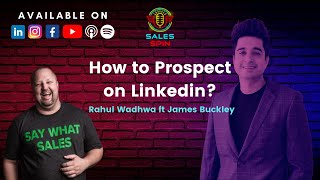
This is a YouTube video titled "How to book meetings on Linkedin? | How to use your personal brand to sell better" featuring an in-depth interview conducted by Rahul Wadhwa with James Buckley, a sales professional and personal branding expert. Recorded in August 2021, the conversation covers James's journey from a cook to a successful SaaS salesperson, his approach to building a personal brand on LinkedIn and other social media platforms, and actionable advice for sales development representatives (SDRs) on content creation, overcoming fears, and leveraging social media for sales success. Rahul Wadhwa leads the discussion, sharing his own experiences and engaging with James on topics related to sales, branding, and career growth.
Today's guest is someone who has his own LinkedIn brand, has been a guide, mentor, friend, and an amazing salesperson. This person did not shy away from helping me when I was in SDR myself, and even if I reach out to him today, he would not shy away from helping me out. I met him in 2018 in person in a conference and we immediately hit it off. He showed me some cool tech and I learned how important it is to adopt the latest tech when you're in sales. He made his own mark on LinkedIn and I was not surprised when he joined the John Barrows team. I've taken his personal branding course myself and I can tell you it is pure gold. So if you have not, please check it out. He's actually one of the few people who might follow on Instagram because of his content, which is totally refreshing and gold. I'm honored to have him on the show today. Welcome, James Buckley. So, James, I think what I want to cover today on the show is how you were able to build your LinkedIn brand. And I do have tons of questions. I'm pretty sure a lot of SDRs I speak to on a daily basis in India have, have those questions and I'm trying to, you know, use this platform to bring those questions and the same time understand your point of view. Plus great. I think you are someone whom I admire, you know, since the beginning, because I think. And I've taken your course as well. Right. So that's probably the biggest testimony. Right? I've taken your course. I think the course was incredible. I think your energy is insane and what you say and what you do kind of resonates with everything, who you are. I mean, so that goes definitely well with the identity you own. Right. So tell us everything. Like, I think like you said you got into SaaS like five years ago. Did you have like a sales role before? Because I'm pretty sure I got to know like you like 3, 4, 4, 5 years ago before I think we met at Dreamforce. So tell us how you were like, I think solution expert in one of the university. I'm not sure. I think I did some research. I do remember.
Yeah. So I think that it's worth noting that I come from a background of addiction. So I was a. I am a recovering cocaine addict and when I was in the kitchen for 15 years, I spent cooking. So kitchens all over the United States. Right. Mostly big chains, a few small mom and pop shops, but I was a cook for a long time and you know, in and out of the Kitchens. I would do sales jobs because I was good at it. I was. It was fun. It was exciting. I enjoyed it. I did well. So, you know, summer would come around and it would be 115 degrees in these kitchens. And I would say, you know, I just need a break from the cooking for a while. And I'd quit a job and. And then I'd go get a sales job for a year, and then I'd end up back in the kitchen. So I did in and out of the kitchens for 15 years. I did door to door, B, 2B, door to door, residential. I did some retail stuff for a while. I did a lot of upsells and cross sells as a server at some of these restaurants. I was mostly in the back of the house, but serving was always fun because I got to approach the table, build some rapport, make somebody laugh, right? Like, that was always a big focus for me, was the relationship between me and other people and how I impacted the way that they feel. So obviously, when I stepped into the software as a service space, which all happened by Facebook, by the way. Like, Alan Brady, who was a web designer for Cirrus Insight, posted on Facebook right after I graduated from college. And it said, my company's hiring salespeople. If you have sales experience, reach out to me and I'll connect you. So I reached out to him and I said, hey, I have a sales background. I'm happy to come in and do an interview. Maybe I'll be a great fit, right? So he connected me with Zach Meadows, who was the business development director at the time at Cirrus Insight. At the time, they were only a $4 million annual reoccurring revenue organization. I did an interview with Zach mostly in Spanish. Yos habla mucho a pero me gramatica as masomeno hermano soy de mayami. So because I'm from Miami, I was able to have this conversation with Zach across from the tables at lunch, right? And he was like, man, like, I just can't believe that you're not already gainfully employed as a seller, right? So him and I went back to the office, we played some ping pong, which was a big thing at Cirrus Insight. And then I came in the next day, and I came in the next day without him knowing. And I just wanted to sit and listen to the conversations so that I could get an idea of, like, what I would be doing. So I sat there and I listened. And again, we played some ping pong. I had some lunch with him, right? At the end of that day, he, he said to me, I think you should just go ahead and quit working in the kitchen and come, come to our team. I think you'd be a great fit. You seem to do really well with the team. Everybody likes your personality. What do we, what do you say? So I did, I put my two weeks in and I signed a contract and I came on, I interviewed with Zach, I interviewed with Jason Hubbard, who was the VP of marketing at the time, and Brandon Bruce, who was the COO and co founder. And all of them said, I think you have a great future here. Let's do it. So I was at that company for four years and in that process, around my second year, maybe even like well into my first year, I started to create content and I did.
Your book came out.
So the book was probably like later on, probably three, four months after I started creating content, I did the book. That book, Tip of the Spear, only took me six hours to write.
You gotta be kidding me.
I came into work one day early. It was like five, six in the morning. No one was in the office. And I thought to myself, you know, I should probably write a book about everything that I've learned in the last six months. This has all been really interesting. There's a lot of information people could learn from. I had done a bunch of events already, so I had this like knowledge of what was working for me in that moment as a new sales professional. And I wrote the book. I just started early in the morning and I thought to myself, well, I'll get into the job stuff later on. And I never stopped for the entire day for six hours. All I did was write. And at the end I had this rough draft which later got edited by one of our employees there on the marketing side. And then I self published it brought. Brandon was kind enough to say, this is amazing. Let's, let's release it and you can stick your name on it and sales reps everywhere will, will appreciate this. So we did. Tip of the Spear was a big hit. Hundreds, you know, probably 5, 600 sold.
In the first day I bought one.
A lot of people bought it. I, I had no idea. And of course, you know, like, lots of people reaching out to me. I love your book. I love your book. I'm going to this event. Thanks for writing this. Really going to help me. Big focus on events in the, in the book. A lot of, a lot about language and like what it is to be a sales professional and like learning the ropes as a newbie. But that was a huge step for me, was releasing this book. And that was when I thought to myself, like, this could be like my career. I could do this forever. It's so much fun. And that's how I fell in love with it, I think. I think sales development became my focus because I really do love meeting new people and making them feel good and getting them to trust me enough to try something different. And that's what sales development is at its core.
Interesting. How did you, like, become who you are on LinkedIn today? Because I think after you, like you said, you started creating content, a lot of people started coming to you, inviting you to these events. When did you realize, hey, today I have to go big on LinkedIn.
So in 2014 and 15, I was only on Facebook and I, I never wanted to be on social media. Like, that was not a focus for me. I never wanted to, like, have all these accounts and manage all this stuff. Like, I didn't want that at all. But on Facebook, it was mostly humor. I'm a funny guy. I like humor. I like making people laugh. I like to laugh. So I was always posting this humor on Facebook and man, it was just getting a lot of traction. People laughing, people engaging. Oh my God, you're so funny. Right? So I had all these things happening for about a year. And then at the end of 2015, my first year at Cirrus Insight, towards the end of the year, I said my new year's resolution is going to be that I want to use LinkedIn as much, if not more, than I use Facebook now. Best career decision I ever made because I took my focus off of social as a purpose of Facebook and I put it into content for the purpose of generating business and pipeline. And all I did was I started sharing one minute videos about things I was doing that were working and things that I tried that didn't work. So after a couple weeks of this and seeing amazing amounts of traction on the content, I thought I should probably give this a name. And I did. I came up with say What? Sales for two reasons. One, in the 80s when I grew up, say what was like a huge thing. Everybody was saying it. It was all over the place. And then one of the number one questions that I was getting at the time was, hey, what do I say when? What do I say when someone says this? What do I say when someone asks this question? What do I say? So say what? Sales was a natural thing that I landed on. What do you say? Say what? Like, no, you had no way. You don't Say that. Yes, I do. Right? Like, there was this element of, like, this is universal. Everybody understands this. It's like a giant macro that I'm attaching myself to. Wasn't long after that that somebody said, you know, So I had this friend, my friend Kenneth Herring, shout out, Kenneth Herring, Mr. I hate Mondays. Right? MRI hate Mondays. So Kenneth Haring was a brand unto himself that worked at Serious Insight. And he did this thing where he would get on for a minute and a half or so, and he would say, man, I hate Mondays. And he would say, let me tell you why I hate Mondays. I hate it. When. And then he would tell people why he hated Mondays, and everybody ate it up. He had a huge following. Lots of people liked it. So I thought. And then at the end of every. At the end of every video, he would say, hashtag, I Hate. Hashtag, Mr. I Hate Mondays. We'll see you next week, right? And next. And then he would go. So I thought, well, I got to say something at the end of these videos, but I want to say something that's meaningful for people like me, Salespeople. So I came up with, if you're a salesperson, we're the same person. And now people say it to me all the time, hey, man, we're the same person. Like, it just became this whole other animal that I didn't. I didn't even recognize at the time when I started saying it. But that catchphrase was a catalyst for so many different people to understand that they're not alone in the sales drama, if you will. They're not alone in saying getting no all the. All day, every day. Like, yo, we are the same person. I know your pain was what I was after. And I was very fortunate. Many, many salespeople understood that and gravitated towards my content as a result of that catchphrase. But I will say that it wasn't until later that I jumped into Instagram. 2017, I believe I jumped into Instagram. And now what I've learned is that I can jump on any platform and it all feeds each other. So I get people that reach out to me on Twitter and they go, I follow you on LinkedIn. I get people that reach out to me on LinkedIn and go, I follow you on Instagram. I get people that follow me on Instagram, and they say, I follow you on Twitter. It's like bananas how circular it all is. And people just choose which platform they want to talk to me on, and I talk to them on every platform that they'll Talk to me on. And that has been one of the number one drivers of conversation for me is meeting people where they spend their time. Great example. If you're looking at a prospect and you're trying to figure out what's the best way to reach out and you look at their LinkedIn and the last time they posted was yesterday. And then you look at Twitter and the last time they posted was 2010, I promise, you're not going to have any success reaching out on Twitter. You're going to have more success on LinkedIn, right?
Absolutely. Yeah. I mean, that's understandable.
You say that because you're an experienced salesperson. Most young sellers that are new to the game especially will just continue to fire off emails. They'll just continue to dial and smile. They'll just continue to reach out on this platform that this person hasn't logged into for six years. I'm blown away at the amount of people that don't even bother to go find someone on LinkedIn, on, on Twitter, on Instagram, and figure out what kind of person is this. They don't even bother because they're not interested in that person. They're interested in selling their product and that's the wrong thing to be interested in.
James, you have built this huge following, right? Like you said, in the next four or five years now you understand the game of every social media platform. So it's not just about LinkedIn, Instagram, Twitter. Like you said. If you were to, let's say, give somebody like, let's say three or four actionable tips. I'm not asking you to reveal.
I will, I will reveal what's in the.
Oh, awesome. So, yeah, I think a lot of folks, and I'll be very honest. Okay. I'm probably not a good teacher. I, I think I might have built, let's say, sort of small brand, you know, for myself, but I think I have been very unsuccessful in convincing somebody else. Okay. And I think I'm sure people, when they'll watch this show, right? They should be able to see, okay, you know what? I followed James and I was able to follow his footsteps and, you know, reach where I am. And so, yeah, over to you. Tell us like three or four actionable steps and something from the course. Nothing like it.
So I'll give you a couple that are from the course and I'll give you a couple that are not from the course. That's probably a good mix. The first thing is first open a notepad or whatever app you might use to take notes on your phone and become somebody that recognizes something that would make great content. And start a list. Keep that list with you all the time. Because every day you can wake up and you can look at that list and you can execute on something. Create a video, write an article, do a quick text post, right? But every day, go to your list and reference it so that you can pick something that's relevant to your target audience to think, talk about. If it's salespeople, great. If it's engineers, great. If it's human resources, great. Write those ideas down on that list and you'll find that you come up with 10, 20 a day, sometimes, depending on what you're doing and where. That's my next tip. Know how to develop the mentality of, hey, that would make great content. Because you've got to be able to recognize things that are going to resonate with your audience. Let me give you a good example. Sometimes I'm watching television and I see a commercial and I think to myself, how does this relate to sales all the time? Like, my brain defaults to, does this relate to sales? Can I create something out of this idea? Most of the time, the answer is yes. Not everything is going to hit, but I'll add that to my list and think about different ways to execute on it as I move through the day after day. So another tip. This is tip three, right? When you are posting, know that you can tag individuals that have large followings and your exposure is greater. So many people miss the mark because they don't know how to tag people that are relevant to the post. I'll tell you a quick story. That's a good example. I had somebody reach out to me that does communication, right? She does body language. She teaches people how to have the correct and appropriate body language on zoom calls. And she called me and said, james, I really want to post about this. What's your best advice? So I told her about our body language and the way that we come across in our videos. She posted about our conversation, but did not tag me. So she texted me and was like, yo. Like, it went well. I thought it was a great piece of content. I don't know why it didn't get the exposure that it did. And that's when I said, let me give you a piece of advice. If you're gonna tag somebody, if you're gonna ask somebody for their feedback, for advice for the purpose of using it in content, it would help if you tag them in the content so that they can engage and so that their audience can see it in their feed. But she had no idea that tagging me would have my. Her post showing up in my people's feed. So there's like a connection for my audience and her that is second degree that she was not aware of in that time. Some people say, oh, well, of course I'm going to tag people that have big followings. Don't do this if you don't have permission. This is a good way to rub people the wrong way. This is a good way for people to reach out and say, hey, don't tag me in that stuff anymore. Right? You don't want that kind of relationship with those people. You need to know that you're on a basis with these individuals that you can tag them and stuff and they're going to support it. They're going to be okay with it. I'm a different animal because anybody can tag me.
In fact, I was about to ask you. Thank you. You brought that up. I remember, you know, there was a time someone in my network had tagged one of the sales influencers or a leader, and that guy kind of got pissed. And I think it happened like a couple of times where he said, you know, on the comments, hey, stop tagging me. Even though this might be relevant, I don't appreciate unless you don't take my permission.
So you need permission from these people. Otherwise it loses its credibility. And I'll tell you how. Because people don't understand. If I tag Jeb Blunt in a post and Jeb does not like it, comment on it, engage with it, how does that look to my audience? It looks like I'm just trying to leverage Jeb Blunt's network in my content. And that is, like, underhanded, shady stuff. That's why salespeople have such a bad reputation, is because they do things like that. And they're slimy, they're sleazy, they're not effective because it makes us look bad as a professional. And again, that's back to branding, right? Like, so many steps that you can take so many steps. But the main thing is that you are consistent in your professionalism. I'll give you a formula that I use in everything that I do. Everything, no matter what it is. C +P cubed equals S for success. In all the things I do, I am courteous, I am patient, I am professional, I am persistent. And those things always lead me to a success eventually. Yeah, some take longer than others, but in the end, I will end up in the bucket of successful because I am courteous, professional, patient, and Persistent.
Awesome. Yeah. I think, I think we need to write this down and probably publish this.
It's a good formula.
Something, I mean, these are all incredible tips.
Yeah, it's a good formula.
These are all great tips. This. Did you, like, reveal everything from the course?
No. I mean, there's so much stuff in that course. That course is my, my, my claim to fame. Man, I love that course. And I think it does a lot for salespeople to realize their true worth. I don't think they do. I think many salespeople don't realize what they are. They are not engines for revenue. Even though that's what leaders will tell them that they are. They are first impressions, they are value bombs. They are paths for improvement. There are so many things that are not revenue engines. It just so happens that the steps salespeople take so often lead them down a path that ends in revenue. Successful salespeople. Right. Just so happens that that's true. But we can't consistently teach salespeople that their whole life is centered on money because then that's all they'll focus on. And they will say messed up things to people to achieve that goal. And that's why salespeople will close deals they shouldn't be closing. Sign up people they shouldn't sign up. Customer success will come to them and tell them they're not doing anything but giving them problems to deal with. Right. Churn is such a huge focus right now because so many people are selling to folks they should never be selling to. Right. There's so many nuances to what sales has become over the last decade. It's impossible to say that your only function is money. It's impossible. It's not, it's not healthy for the company.
Yeah. It's not healthy for anybody. I mean, it destroys the whole ecosystem. Think about it.
Yeah. And you can spot these people a mile away. It's so easy because they don't care about whether or not it's a fit for you. They don't care what your priorities are. They hop in, they show their screen, they run through 25 things, and then they go, what's my next step?
James, I always had this question, okay. And this something I'm not sure. I mean, I, I, I thought about this, but I never got the real answer. Like, I think you've established that it's important for salespeople to post the content. Create the content. Why do you think people do not create it?
Yep.
What's stopping them? I mean, there could be different reason, but I'm sure you have. Like there's a lot of reasons.
So first of all, I will say, I'll give you the top reasons. Number one reason, fear of judgment, fear of rejection. I think that salespeople specifically get so much rejection on the phones and emails during deals. You know, they get, I don't need another channel for negativity, right? I don't need another channel for trolls to jump on and tell me I suck at what I do, right? So they avoid creating content. So they can avoid that channel of negativity. But let's say for the sake of argument that they're able to overcome that. Another reason that might stand in the way is that they don't manage their time well enough to create content. Content takes time. Even these one minute videos that I do, I'll tell you that it takes one minute to do it. But over time I've gotten better at it. Starting out, I would do three or four different takes of these things and it would take 10, 15 minutes to get it right. And then I would post it. Now you've seen it work for me, so it was worth it. But some people don't have the consistency with which they need to build a brand to put out content consistently. So what you see is sales reps that go, oh, I can create content. And that's true. Every New Year's Eve you will see loads of salespeople out there creating content brand new. Hey guys, what's up? My New Year's resolution is that I'm going to create more content. So you're going to start seeing more of me. Hey guys, it's a new year, it's a new me, it's a new focus. I'm going to create content this year. That's my number one goal. Hey guys, what's up? It's 2022. You'll see it again this year, I guarantee it. Three months in, after the first quarter, you won't see 90% of those people again. They just vanish like farts in the wind gone. Right? And the reason for that is because they didn't think it through. They didn't think about all the ideas, all the things they wanted to convey to their audience before they started. So there's no plan for execution. It's not on their calendars, there's no reminders in their phone. They don't have a list of ideas to draw from, right? And this is why they fail. Which is the second, the probably the fourth reason why they don't do it. They're afraid to fail. Right. What if I put this content out and it does nothing for me? And because that fear is so real, they back away from it very quickly.
I agree. Agree. I. In fact, I'll add one more before that. I think I agree on the last part. You said one of my XSDR kind of posted about the same thing. And I told him the same thing. You know, just be consistent. Don't worry about the lights. Don't worry. And I told him, you know, how, exactly what I, how I started this. In fact, even today when I post something, I switch off the notification so that I don't even get to see the notification until the next day. And that is how, you know, I'm kind of disciplined myself. One of the other reason, I'll tell you is what I've realized when I've, when I talk to a lot of SDRs is they're afraid of the company.
Yeah. So this is actually a really strong point that a lot of sales reps come to me with and they say, I really want to create content, but I don't know how. And the company is not supportive. Right. So what I tell these people is, why do you feel like you have to talk about your company? Don't talk about.
No, it's not about that. It's about what the major reason, what I've heard from the reps is, hey, you know what? It's all good if I'm posting on LinkedIn and you know, my, my, my, I'm meeting my quota, but if I don't meet my quota, my company is going to come and, you know, tell me, hey, you're not meeting your quota because you're on LinkedIn all the time.
So first of all, do you remember MySpace? Yeah. So absolutely. The MySpace days were the days of leaders coming behind, standing over your shoulder and saying, hey, get off MySpace. We don't pay you to be on social media. Right. Can you imagine a sales leader right now coming behind you and saying, hey, get off LinkedIn. We don't pay you to be on social media. Right. It would never happen. It would never happen. The reason why the company is such a fearful thing is because I think sales reps think that it's only going to take one mistake for me to get fired. It's only going to take me stepping out of line one time and they're just going to let me go and replace me with somebody else. I'm here to tell every sales rep listening to this now, that's not true. They have invested so much money up front for you to onboard your technology, stack your onboarding, your best practices, your training, your software, everything that you've come on board and achieved, they pay for. Letting you go is not the smart answer. Here's the trick. Earn the right to talk about your company. Earn the right to talk about your product, your service, the things, the problems that you solve. Earn that with great consistency and content. Go to your marketers and say, I want to start creating content. Will you help me? Right? It's a collaborative effort to do these types of things. I had the misfortune of Cirrus Insight losing its original VP of sales and picking up a new VP of sales while I was building. Say what sales? Well, my original VP was real supportive. Hey, I want you to go on podcasts. I want you to be a guest. I want you to create these things. I want you to write these articles. I want you to do your videos. This is so great. It's all working out. And then he left and the new VP came in and she was like, I don't want any of this. I don't. I don't need you, nor do I want you to have any inbound leads coming from us, right? And it was like a big, like, slap in the face. But I stayed the course. I kept doing me, I kept doing videos, I kept creating content. And it ended up being that people knew me more than they knew the company. They would say, oh, James Buckley. And they go, oh, he works at Serious Insight. They would say, serious Insight. And they would go, who's that? Right? So there was this element of, like, not that. Not that Serious Insight wasn't anything without James Buckley. That's not what I'm saying. What I'm saying is I became so well known for a representation of that company that people would default to using my name when they discussed that company.
I totally relate to this. I think it happened to me, like, a few months ago where a few of the people told me, hey, I got to know about your company because you were there. And then so. And this is something which is becoming big because I remember, I think I was reading the stats the other day, probably a post by somebody where somebody said, hey, you know what? An individual brand has more interaction than the company's brand, where marketing has spent thousands and millions of dollars, 100%.
And individuals, so it's the whole content, individual economy, have a magnetism to them that companies struggle to obtain. I think once companies reach a certain point, you know, Amazon, Salesforce, Google, msn, cnn. Right. Some. Some of these are Media companies, some of them are products, but once they reach a certain point, they become household names. Orkin, pest control. Right. Big name, 40,000 plus employees. Cintas, the uniform company. Right. 45,000 employees. These are household names. Now individuals have the ability to impact other individuals. Usually the decision making kind of. Right. Companies struggle to achieve this when they don't have the branding that Orkin or Salesforce or Amazon has. Individual personal brands are just that. They're like magnets for individuals that are looking for value. And that's a starting point for any salesperson. I think that in the next 10 to 15 years we're going to start seeing salespeople have to have personal brands to be qualified to take jobs.
Yeah. In fact, that's my follow up question. Why are, or let me, let me actually rephrase that. What can companies do right now since we have established that personal brands are so important And I'm pretty sure there will be companies who would probably be scared, hey, if I help this person become a brand and tomorrow he leaves, well, you know what, that can happen with anybody. But let's just keep that aside. But let's assume that employee is going to remain loyal to you, going to be with you, and you're gonna eventually both benefit from it. How can companies, what can companies do right now to help these employees? You know, one thing you said is already reaching out to marketing.
So I think that leaders at companies need to be upfront with the expectations from sales reps when they hire them. Let me tell you what I mean. Sales leadership has a terrible habit of telling people what their next role will be before they start in the role that they're being hired for. You hear this in the interviews. You'll hear them say shit like, don't worry, this is just a stepping stone. Don't worry, this is just a foot in the door. Don't worry. Next you'll be an account executive and none of this will matter. None of that shit is true. None of it. Zero amount of that is true. It will always matter. It's not a, it's never a stepping stone. It's not a foot in the door. It's your career, man. So I think salespeople need to be upfront about what they want out of the job long term. And I think sales leaders need to start telling people, you're going to be in this role for two years, if not more. Are you good with that? It's going to take you a year just to learn the language, just to get comfortable with the product. Just to learn the icps, just to learn the Personas, just to learn about the customers and the industry that you work in. That's one year. Then it's going to take you another year to learn the conversation and the technology so that you can have the conversations effectively. That's two years. So if you're an sdr, this is what happens. And you know this is true because you've been a sales leader before. You've seen it. Sales reps come in. They've never had a sales job before. They're making $12 an hour at some restaurant in the kitchen, and then they come in to get this sales job, and that job starts at $40,000 a year plus commission. And they're like, oh, my God, I've never made this kind of money before. I am so thrilled to be a part of this team. This is my forever job. I will never leave. You're gonna have to fire me, right? And they're, like, so excited. Three months, six months later, you talk to that same person, and they're like, if I'm not an account executive by the end of the year, I'm gonna fucking quit. And you're like, what happened? Right? And this is because leadership puts them in a position where they're focused on the next thing, not the thing you pay them to do. So then they start getting this sense, like, how come I'm not being promoted? How come I haven't hit that next level? How come I haven't gotten a raise? I should look for another job. And that's why the average sales rep only stays at a company for 18 months. If leaders are smart, they'll start saying, listen, you're going to be an SDR for two years. And in that two years, I need you to build a brand. I need you to become somebody that's seen all over the web and that represents our company. Can you do that?
Wow. That is so.
Let me tell you now, any SDR that is worth their salt will see the bigger picture with that one sentence alone. Now, you don't have to worry about that SDR coming to you in six months and saying, hey, where's my promotion? Instead, what you'll hear them saying is, how do I create more content? What do we do? What about if we do, like, a show that we do every week? How about webinars? How do we promo better? Right? These are better questions for sales reps to be asking than, where's my money? Where's my promotion? Where's my upward mobility? If you don't promote me, I'm gonna quit. I have another opportunity, right? That's the kind of shit that people do, and it doesn't make any sense to me. Put some roots down. It took me four years at Cirrus Insight to really understand the value that I had as an individual contributor. Because of that, I landed at ringlead all through 2019 as a brand ambassador and business development manager, teaching other reps to do what I do. Now I'm at the company that I wanted to work for. I will never leave this job.
He.
He will have to let me go if he wants me to go. And I don't think that's going to happen. I'm hosting all the webinars. I've become a voice for the brand. I am 100% meaningful when I connect with people. I'm very authentic when I talk to them. That's why the man hired me.
In fact, that was one of my question, like, how did I got hired?
Because in 2016, when I met John Barrows, I knew that I wanted to work for him. I knew in 2016, at the very first Saster conference in San Francisco, when I saw him speak with Kyle Porter, I knew I wanted to work for him because he had all the right things in his brain. He was talking about being human in your process, building a brand that mattered to the space. You sold into creating content that was relevant and timely. All these things hitting me like a ton of bricks in the audience. And then I met him. I cornered him at the expo floor. You know, big giant me. I'm like, what's up, man? Like, you know, and I shook his hand and I said, man, everything that you said, John, it really resonated with me, and I want to thank you. And he was like, cool, man. Thanks a lot. I appreciate that. And off he went. And he did not even know that in my head, I had decided that I will work for this man one day. About a year later, he hired Morgan. And that was like a green light for me that said, holy cow, this can happen.
He's like a whole party for you. If I remember you, you were in Vegas.
That wasn't for me. That was for, like, the team. We were expanding like crazy. I got hired in December, and then we all flew out to Vegas to record all of this content. And that's where the course was recorded, the personal branding course, which is free, by the way. I'm happy to. To give it to everybody.
Awesome. I'm gonna put the link. I. I was actually. What.
What are you I was hired at JB Sales in Dec.4 months 19.
I was actually in Vegas 4 months October. I remember that. That's how I remember. Oh, sorry, sorry, sorry. I think I'm getting confused. Wait a minute. So 19? Yeah, I'm pretty sure that, yeah, it.
Was four months before COVID 19 hit. And then when Covid hit, everything changed. We became more zoom focused, more media focused, more remote focused, less travel. And I think John, I think John has said many times now, I don't know that we'll ever go back to in person because it's, it might, it just might not be economically worth it to go back to in person unless somebody really wanted it. And then of course, you know, we would jack our rate up to go in person. But honestly, this is what we've learned, is that it's the value that we bring to the perspective. It's the mental shift, the cerebral change that people truly need. The tactics, the techniques, the takeaways, that's what drives results. But the mentality shift, the perspective and the behavior change, that's what drives growth at the individual level.
This is some, some like, profound advice, man. Do appreciate it.
No problem, man. That's what you, that's what you had me come on the show for. It's good, right? Like, and that's what we're after. People don't understand that it's not about the result all the time. The result is monetary. The actions that you take leading up to the result, that's what gets the result. We're all so focused on the close, we forget all the steps that we have to take to get there. A great example is the education conversation. So many reps miss this, right? At some point early in your prospecting, you have to say to your decision maker, hey man, what is the process for you when you buy stuff like this? Can you tell me that process? I want to tell you how we sell stuff. If you can have that conversation. The expectations are managed on both sides, so it's no longer a guessing game. You don't go to that one on one and say, well, I sent them that contract last week. I really hope they sign it this week. Maybe. Fingers crossed, right? Like this is the. That people say in one on ones. Instead what you want is you want them to come into that one on one and say, here is my process. Here are the three ops that are right here at the end of my process. And based on this data, I know that these ops will close in the next 4, 14 days. That is a much more fruitful conversation for your leadership to hear because there's no guesswork in it. And that leader is being held accountable for your number and everyone else's number that's on that team. So they have to go back to their leaders and say, here's my process. These are the people that all of my team has at this stage in their process. And based on that, we expect these nine opportunities to close in the next 14 days. Instead, this is what they have to go back to. When you do it the way that it's done now, they go, well, we've got three or four people that might have some opportunities that are going to close. They sent some contracts. We have. We have contracts that are out. Yes, yes, we have contracts that are out. No, I don't know when they're going to get signed, but we do have contracts that are out. Right. So I feel like what we try to focus on is like, don't forget about all the things that matter up to that point. And education is one of those things that matter. I try to get to that part of the conversation early. And there's nothing wrong with saying, I've got a couple questions I need to ask you, and then we can have a real conversation. Is that okay? No one ever says no to that. Everybody's like, yeah, shoot, yeah. And you can say things like, how many sales reps do you have? Okay, that's good. Are you guys using Salesforce internally? I assume you use Salesforce, right, Man. Awesome. I'm just making up discovery questions here, but you know what I'm saying? You can ask your questions, and then physically, you can see them. You can watch. They can watch. You move it aside and you go, all right, cool. I could probably talk to you about a thousand things. What do you want to talk about? Let them drive that topic. Let them have that conversation the way they want to have it. It's not about you. It never was. You just thought it was.
This is. This is. This is pretty good, man. Okay. I. I do. So usually how I end my podcast is by asking, like, a rapid fire. I'm sure it should be easy peasy for you. I mean, you should be already a pro. Okay. Nothing personal. Okay. Don't take time. Just say whatever comes to your mind. You ready? Okay.
Whiskey.
Your favorite sales leader other than John Barrows. Ooh.
Chet Holmes.
Your best place to retire for me.
West Africa. Ghana.
What's your favorite sales book?
My favorite sales book is Never Split the Difference by Chris Voss.
Awesome. One final advice for people to build their brand like one advice which you can like which is like the top.
Most slow down does not happen overnight. It's not supposed to. To everything you've ever actually gave a about took time to achieve your brand is no different.
Awesome. Thank you so much, James, for coming in the show. It was really, truly an honor. And I can totally see, you know, this being the highest view.
My pleasure, man. I. This is fun. Let's do it again sometime. We'll do a follow up.
Absolutely. Yeah. And I, I hope you have a great track.
Yeah, we're gonna go run. I'm. I'm doing the running thing. So what we do is we, we go out to the smok and we pick a trail and we run about two and a half hours. Get the heart rate up, that's the, the calorie burn. So, you know, down 22 pounds. We're hope to. I hope to get below 270 this week, but we'll see if it happens.
Oh, you said you, you are so.
Right now I am at 272 as of last week. I don't weigh myself every day, but it's, it's. I, what I've been doing is I've been, you know, calorie counting and then burning with two and three workouts a day for about, you know, 30 minutes, 45 minutes. And then at the end of today, for example, I'm gonna do a hard push and we're gonna run for about two and a half miles. So it's a good, it's a good run. It's up and down. There's incline and decline and obstacles you got to overcome. But I really enjoy it. It's a lot of fun and I'm dropping the weight and I, you know, again, man, I gotta, I can't die at 55, so I gotta, I gotta make the change. I'll be 40 this year.
I thought you were.
I'll be 40 this year in October.
Oh, okay. Yeah, that's what I thought. I mean, I remember, I think I remember there was a time when you probably had posted your age.
Yeah. Well, so like I said, like, I can't die at 55. What I mean by that is if I don't change now.
Okay. No, no.
I would look great for 55. You know, I would be like. I would be like taking selfies every day if I look like, look at me.
Yeah. And I was like, surprised. I mean, if you're 55, you know, I mean, you don't need to exercise. Yeah. Do tell me tips as to how you started running. Because I think I suck at running.
For me, it's all about the breathing. I have learned that the idea is not to run fast. It's to run consistently so it doesn't have to be fast. Our tendency. My tendencies, like you probably is, like, I wanted to run really fast, right? It's not about speed. It's about getting your heart rate up and then being able to keep it up for 30 minutes or more. Right. So run slower is my tip to you. Run slower. It sounds crazy, but it works. I. I can run these two miles, no problem now. And I. When I first started, I couldn't do it. There was no way. I had to stop and walk and run a little bit again and stop and walk in a cramp, you know. But now, because I've been doing it, you know, last 10 weeks, twice a week, it's a little easier to keep it running. And God bless James Shand, my best friend. You know, he's always calling me, saying, let's run it out. Let's get in the kayak. Let's go hit the river. Like, let's go swim. Like, he's just that guy that's going to push me to do better, and I've got a lot of those in my life right now. So shout out to everybody that's been helping me do this. You know who you are.
Best of luck, teams. I'm pretty sure you're going to. You're gonna definitely. I'll see you at 200, like, in a month or so.
I mean, I hope so. Like I said, I. I think that the first 20, 22 pounds was probably just, you know, 15 years of neglect falling off of me. But I think that I'm finally starting to make real progress and change the way that I. That my body works. Diet. The diet change has been huge. I've changed everything about the way that I eat, what I eat, how much of it I eat, when I eat. It's all different now. And I, you know, I. I'm gonna kick the hell out of diabetes. One way or another, it's gonna happen, I'm sure.
Good luck. Yeah.
All right. Cool, man.
Thanks for watching this video. If you like the video a teeny tiny bit, Would you like the video? Subscribe to the channel and tell me what you like. Throw your best insult at me. If you did not like any part and you would want me to improve, I promise you will not offend me. Seems like too much work, right? Let's stop with subscribing and let me know in the comments what I should cover next. Thanks again.
Hey, come on.
More from Rahul

The SDR Role Is NOT a Stepping Stone | James Buckley on Cold Calling, AI & Career Growth




Trupeer Hired an Enterprise SDR in 1 Day. He Booked His First Meeting in Week 1



