How to build a career in Sales & Business Development?
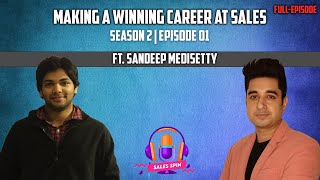
This is a YouTube video titled "How to build a career in Sales & Business Development?" recorded in July 2021. It features a detailed conversational interview between Rahul Wadhwa and Sandeep Mediceti discussing career paths in sales, especially for freshers. They cover topics such as the importance of curiosity, coachability, email writing skills, how to approach job applications in sales, and the differences between roles like SDR and account executive. The conversation is aimed at guiding newcomers on how to successfully enter and grow in sales and business development roles.
Today's guest is Sandeep Mediceti. Cool name, right? Last week we had Kalyan, the CEO of Alma Base. So Sandeep was the founding team member at the same company. And then he carved his path to success by stepping into roles like account executive to handling the whole sales function. I've known him for a while. Personally, he's traveled to 24 states in the U.S. i kind of envy him. I can vouch for the team he has built and the processes he has set up at Alma Base. Today he drops his knowledge from his experience and by interviewing countless candidates. If you're a fresher and toying with the idea of getting into sales, this episode is for you. Come on. All right. Welcome Sandeep, to the episode 18 and season two. First episode of season two of Salespin. Thank you so much for coming.
Awesome. Thanks for having me, Rahul. Very excited.
Absolutely.
Been a huge fan of all your content on LinkedIn. So pretty excited to be here.
Such a liar. All right, awesome. Let's get started. I think today's topic is pretty interesting and I know I said see this, say this all the time, but today's topic is actually interesting because this is focused. This is directed towards a lot of people who are struggling and they don't know where to go to. They don't know how to really tap into the sales. So that's exactly what we're going to discuss today. How. Let's. Before that, you know, I think it'll be interesting for everybody to know how you got into sales and why you love about what you love about it and why are you asking people to get into sales in the first place? It's. It's a high pressure job. So. Yeah.
Yeah, sure. So my entry into sales was an accident, right? So I was. I just wanted to become an entrepreneur. That's. That's my only idea. I rejected job and I rejected a. You know, like my admission in IIT Bombay. And then I also rejected a job in Reliance. I was a chemical engineer by education and I also rejected a job in Mu Sigma. Right. So after all of this, I just. I just wanted to be in Bangalore or in San Francisco. These are the only two places that I knew where a lot of startup scene is happening. So I wanted to be in one of these places. And two of my best friends are also going to Bangalore. So I just like, okay, let me go along with them to Bangalore. And I found a startup who ended up giving me a job. And the only. I mean, there were standard puzzle questions et Cetera as a part of the interview. But the. At the last round, the CEO asked me one question. Are you a left brain guy or a right brain guy? I said, I just have one brain. I don't know what. Right. So he said, all right, so let's figure it out. We like you, we'll give you a job. And I joined in a very, very generic role which was to. Which was to do marketing analytics, playing with Google AdWords, talking on phone with anyone who calls whenever there's no one to place an order for T shirts. So we were doing B2B E commerce. Unlike all the E commerce that's happening at the time. This is back in 2012, there are a thousand companies which all started as E commerce. Right? So that's, that's. I mean, I absolutely did not have a plan to get into sales. But one day there was this person who called, called us in the office. No one was there. I was the only one because I get free wi fi in office. I used to stay overtime and then just keep looking, watching different videos or doing courses on Coursera. And this, this person wants to place an order for 15 T shirts. I'm like, okay, I did not know. So I gave him my CEO's number and the CEO called me back and said, why did you even give my number to that person? You could have just taken the order. I'm like, okay, I don't know the details. So he gave me how to run a sales process, like in terms of taking a details, sending a payment link. I did all of that. That's my first sale.
Wow. That is.
I do not even know. Yeah, I don't even know that sales. But that's my first sale.
That is actually pretty nice. So how long has it been since you sold those first T shirts?
It's been seven and a half years now since I sold my first T shirts. So then once I sold it, what really pushed me to sales is I was following up with my customer support team whether the T shirts were delivered or not. So the CEO came back and said, you seem to be obsessed with the customer happiness and the customer satisfaction. And that is exactly probably what could help us do better at sales. Right at the beginning itself. Because you have that love for the customers. Right? Then he pushed me into sales.
That is actually pretty nice. I mean, I've never thought of it that way. That customer obsession customer like you did. Right. I'm pretty sure a lot of salespeople, including me, probably would not care a lot about. I mean, we do care I'm not denying that, you know, we don't care. I'm not saying because of the sake of camera, but at the same time, yeah, I mean, we probably tend to lose the sight of what happens after the sale is made. So. And that's something which I think.
Yeah, we move on. Yeah, yeah, we move on because we have quotas, we have targets, everything. Right.
We want to the next customer, next prospect. Yeah. So closing to next deals and deals and deals and so on. Yeah, I think that that actually makes sense. All right, so it's been seven and a half years since you made your first sale and I'm sure that's been an exciting journey. So what would you like, genuinely love about sales? Like, I can understand you have the customer obsession. So it's definitely coming from a deep, you know, deep love for the customers and I'm sure the processes. But what do you love about sales in general?
So I feel that sales is that first interaction in a way, like there would be marketing, but sales is where people will start talking to you as a business. Right. So. And if that first impression is broken and I think there will be a trickle down effect and it affects the whole business. It kind of. So, so for me, I wanted to become an entrepreneur, so I wanted to learn this because if this point things are breaking, then there's no business at all. We just shut shop and we just leave. Right. So that's what really excited me to stay in sales and learn everything. Because I felt that it is a centerpiece and everything else is the inputs and outputs are going from the centerpiece. Be it for product building, be it for processes, be it what customer wants. So that really excited me and for me that gave me an opportunity to learn more about the customers and understand, okay, what is it that we need to build for revenue growth and how can I now give these inputs to the product team? Of course, product team would have their own analytics and things like that. So I think for me it's all about building business. And I feel that sales is a microcosm of the map, the bigger business. Right. So that's, that's what excites me.
Interesting. So I can totally see why you love sales. So what? Why would you ask somebody else? Let's say that there's somebody, there's a youngster, you know, passed out of the college, irrespective of their background, if you were to convince them, hey, you should join sales and give them top three reasons, what would that be?
So over the last seven and a half years, What I learned is sales is also about not selling snake oil. It's all about solving problems. You know, like, like whatever we have seen in the movies and all the exaggeration, doing an awesome phone call, wearing awesome suits, all of that. Right. That's those. The days are gone. No more probably. There are, there are 5% of sales that are happening through that kind of a style these days. But now it's all about solving the problem. That's it. Right. So for anyone who's interested in solving problems right after their graduation or when they're looking for professional career option, they should definitely consider sales. Typically, even when I was graduating, people said, oh, there is software engineering, there's investment banking, there are consulting, everyone. There are multiple blogs, multiple resources and all talks around these three. Right. But no one's ever told me I couldn't find much resources on how to sell. I feel that it's all about problem solving at the end of the day. That's why I would recommend people that, hey, this is more of a cerebral job and less of lip service.
Fair enough. Fair enough. That's one. Okay. If you, if somebody likes problem solving, if they're ready to jump into sales, that should be. They should have a mindset where they understand, hey, you're not getting into a role, you know, which is probably inspired by Wolf of Wall street or all those movies. It's that there's actually much more to it. And like you said, you have to have that problem solving mindset. Okay, that's one. What's next?
Yeah. The other thing is, if you want to build business by yourself, like if you want to start something by yourself maybe 10 years down the line, this is the best opportunity. Like you're seeing everything right there. Think of this as you have, I play a lot of cricket. Or think of this as, you know, if you're a tennis fan, you are that, you know, person like a ball boy right there, where you would be looking at the action very closely. Right. So you would see the whole business building and the growth from, from a very, very firsthand experience which will help you to build your own business in the future. So if you're an aspirational entrepreneur, there's no other way. I think there's no other opportunity or career option for you to explore.
It's your sales that's actually pretty good. One of the things which I would probably add on to that is. And not onto that particular fact, but you're probably a separate point which will be. So think of it like, for example, I Used to work in customer service when I started my career. And I remember, you know, we used to not get paid a lot. And there was simple reason, right. Because you are solving a very small problem. Customer has, you know, deal has already been made. Now you're just taken care of after sales, right. At the same time, of course I had high aspiration and I and somebody I don't know who told me a simple principle. It's like, hey, you know what? Sales is what brings money to the table, right. Consider it like, you know, they're bringing a pizza to the table and there are eight pieces. Sales get the biggest piece because of course, you know, they are bringing the money to the table. So if you are aspirational, if you are like I would say competitive and if you want that you competitive spirit to be paid in a way, I would say that could be another reason for you to join sales.
Absolutely. So I would also add to that point, Rahul, let's say you also want to get involved in the product at any point in time. And you are this non tech person, like a chemical engineer like me who doesn't understand tech much these days. When I say tech, it's all software tech. And you want to get into product. Sales could also be that door for you to get into product. Because when you're selling a product, you need to understand it, right. When you're breaking it down for a customer, trying to help the customer solve their problem, you should have a deeper understanding. And then the advantage that you have is that you also are exposed to the customer and their problems. So you would be able to give better insights on how to build a product. So in case in the future if you want to become like a product manager or get into anything around building products, sales could be a great career option as well.
No, this is actually another interesting point because I'm pretty sure not everybody who gets into sales would want to probably stay in sales for their whole life. And I think sales is that probably a perfect junction where you know, they are connecting with customer service, sorry, customer success. They are dealing with product day in, day out and at the same time of course dealing directly with CEO understanding the business aspect. So I think yeah, the opportunities could simply be humongous. So yeah, fair point.
Yep.
So I think you and I both have been into sales for some time. I think you have been in sales for longer than I and I think we both have hired freshers, people with absolutely no experience in sales. And including me, like including you. Right. Who come from absolutely no background in sales whatsoever. You come from technical background, I come from hospitality background. And we both have been fairly successful. Like, I want to probably, you know, use the humble terms. Okay, now I think what. And we both have also hired a lot of pressures, right? And we have also made them successful in ways. But I think what we have not done so far is giving people a blueprint. Like, hey, if you follow this, you would be able to get into sales. So for a lot of people, first, they don't know, why should they get into sales? Which we have already clarified for everybody. Second, even if they now, and I get a lot of requests from people on LinkedIn every day, Hey, I want to get into sales, but I don't know how to. And they are probably, they're probably, you know, trying to approach the sales in a similar way where example, they're actually sending me like a long, lengthy email or a LinkedIn note with their resume, hoping for me to, you know, go to the profile, go to the resume. And again, given the time and given the other commitment, it's not possible. So I think I would love to know, what advice would you have for freshers? How can they crack their first sales job?
Yeah, just a disclaimer here. I have borrowed a lot of some of these ideas from your book as well. The one that you put last year where you were helping a lot of people during COVID who got laid off and who are looking to switch carriers from different segment to software industry. So for me, and you could also add to this. So when we start looking for people, especially freshers, right. The first thing we'll look at is do they have curiosity? Right. Because what's really important is if they don't have that curiosity to learn about something that they don't understand, and if they don't have the curiosity to go that extra mile and find out what the customer wants, I think that's a big deal breaker. Well, there are many skills that sales might require like email writing, et cetera. Those all would come secondary. But for us, when, at least at Alma base, when you're looking at VC for curiosity. Right. And the second is coachability. And what we, what we feel is if a person is coachable, who's receptive to feedback. Right. So we always give feedback during our interview rounds. I would, I could talk about the interview process as well, but we keep giving a lot of feedback during the interview and we see how they respond. If someone has a very closed mind saying that what this other person is talking about me is just bs, then we do not want that kind of people. To collaborate with people, you need a very open mind and one should be receptive to feedback. And that's how you could improve things. That's how you grow as a human being and also your company. Right. So that's the second thing. So first of all, these are the two things that we look at. And once we check these two boxes, then we go for the next things. What do you say? What do you look for?
I think these two points, I mean, of course we look for a lot of things, but I think you have already nailed the answer, which is by understanding how curious the person is, how coachable they are. I think I look for coachability, of course, like as a primary factor and then of course, curiosity. But again, there's no. There's no way that you can say, hey, this should be like more. Have more weightage. I think both of them are. What I also look for is. I am pretty sure this, what I'm going to say is probably like aligned to curiosity. Again, I look for hunger. I look for how far they want to go, but at the same time, that's not a factor on basis which I probably reject candidates. So, for example, and this is something which I believe I have learned from my experience in the past two years, someone who does not have the hunger right now could be a possibility. They're too young to even show that hunger that, hey, I want to reach there because they don't have the roadmap right now. That's something for us for leaders to provide them. So I still look for hunger in the sense, like, for example, how do they approach anything? For example, let's say if they want a video game from the parents, how hungry were they to get it? If the parents said, hey, get 80%, were they actually committed enough to actually study that hard that, hey, I'm going to get, score that 80% and actually get the video game. So if you're not, if you cannot do that, and this is how I probably judge those small aspects like how hungry you are. It could be like you had to appear for the interview. What all did you research? And most of the time, and a lot of times, you know, pressure, do not understand the importance of this aspect. So if they were not able to, let's say, research for the job, why would they do. Why would they work hard, like when they're actually on the job?
Yeah, right.
So this is the time to impress. And if they're not able to, you know, bank on, like, you know, clear these factors, I Think then there's a problem.
Yeah, I agree. Yeah, yeah. Hunger, kind of. In other words, drive. Right? Like what is it that they have? And you're right. Like we also asked some stories on, hey, what is it that you did beyond academics in your life in general, like any story, right? So want to understand what kind of a person they are. Which is, which is also very essential when you are getting this person into your team because they're going to work with other teammates. Right? So now, so these are, these are the baseline, right? Like you know, let's say hunger, curiosity and coachability. But now on skill wise, we know that these people are freshers, right? So imagine a person like me who's a chemical engineer or person like you who's from hospitality industry and there are no courses for sales. Usually there's no MBA kind of a program. Even in MBA they teach marketing, but no one ever teaches sales, right? So now what is it that they need to build on in terms of skills? So what we look at in skills is can they write a good email, right. And can they understand the product that we are selling and break it down in terms of, you know, helping the customer? Right. And then the last thing would be are they eloquent when they are starting a conversation? Do they have that clarity in communication? Right. It's less about the kind of English or the vocabulary that they have. It's more about the clarity of thought that they have. So these are the three things that, in terms of the skill that we look at now. What, what do you think? I can, I can break down these three, but I would love to hear what kind of skills you look.
No, no, no, absolutely. I think clarity in communication is something which I definitely pay a lot of focus at. At the same time I think one of the question even I published in the book was, and this is something which I do till today and you'll be surprised to hear a lot of people still do not, you know, prepare for these. This answer, which is where I simply ask them, hey, explain the product which you are, you know, my product, the company I'm working for, explain my product to a six year old kid. Do not use any jargon, do not use any technical language, get to the, you know, dumb it down, just dumb it down to the six year old kid. And if they're able to nail that, then I go even further. Then I say, hey, now you explain this to a 60 year old women or 60 year old man. Okay? Now what I want to see is how quickly they are able to Switch the context from a 6 year old to a 6. When I see, you know, the candidate has potential, I would also give them like a minute or two. Hey, you know what? I understand this is the question out of the blue. So take some time, even switch off the camera, have water, whatever you want. Think, think your thoughts. You know, make a, make a note, whatever you want. If you're able to answer that even within less than, you know, two minutes, I think you're able to nail it. Then of course, every, anybody can, you know, cram those. Anybody can just mug up the whole definition of what the product does. Right. The whole idea is, can you and because that's exactly what they would have to do when they will go on cold calls. Right. Explaining somebody, you know, what the product does. And that's what I think most of the sales leaders have also been teaching nowadays. Just dumb it down. If you can't dumb it down no matter how complex your product is. Yeah. You will have a hard time.
Yeah. Because I think we all have attention span, right. They light a long message and I don't even want to read. But imagine like it's bit down so that people can understand that 60 seconds that they give us and then we could take the conversation forward. That would be awesome. That's a very useful skill.
Fair enough. You talked about email writing and what I want to do is I want to be probably devil's advocate and then say, hey, you know what, this is my first time getting into the sales job. I have never written an email. I probably have written email to my colleagues, let's say who were students or from our professors or probably way back in school. I don't know if schools allow email or you know, we still stick to the letter thing anyways, so whatever I have learned and this, this is actually, this is actually a problem. Right. So I remember how we were kind of taught how to write an email or probably a letter when you were in school. Right. Those are all used to be lengthy. Those used to be like a certain format which was probably discovered in 80s or 90s. And I'm not sure if schools or colleges have kind of developed or probably have evolved from there. So if we are judging them, let's say on email writing skills where they have not been taught, like you said, there was no marketing, there was no mba. How do you, how do you judge them on email writing skills then?
Yeah, so I would, I would really look at three things in the email. First and foremost thing, the clarity of communication in terms of what is it that they're asking me to do in the email. Right. So are they just, you know, I receive different kinds of emails, so. And people write like 400 words, 500 words and I get lost in that. Right. So, so the first thing is make it very clear and crisp. Make it less than 150 words. If someone is writing an email to me in less than 150 words, I'm open to reading the full email even though it's garbage. Right. So that's the first thing that I look at in people. And the second thing is how they using fancy jargon. Right. If they're using fancy jargon, that means even they don't understand and even I won't understand it because I don't know what some of the words that they're using mean. So are they writing it just like what you said? Explain it like it's for six year old. Are they writing it the way they speak to a six year old? Very simple English, just like very common vocabulary, no fanciness. I would look at that.
Right.
Then the third aspect is are they writing something about a problem that I'm currently facing or something about that I relate to?
Relevance.
Right. Relevancy. That's the key. Right. So if, if they check all these three boxes. Yes. So that's a good email for me. And, and in school, as you mentioned, I think the best emails are the letters that we wrote is write a letter to the principal asking for leave in 400 words. Probably those are the kinds of letters that we have written in our English coaching. Right. In school.
Correct? Yeah. I think you already nail everything. I think one thing I probably want to add to the email writing aspect is make it about me. Right. Most of the emails, most of the messages which we get are, hey, I have done so and so. I have no experience or so and so experience. And one thing probably annoys me is when people say I have 3.2 or 4.8 years of experience anyways. So yeah, it's so I think most of the emails or most of the messages I get on LinkedIn are all about them. It's not about how they're going to solve a problem for me. And I'm also, and I'm only talking about emails or messages which I get from freshers, people who have no idea about the job. Of course, people who have been doing this role for some time, they also, they already understand. So I don't face the problem with them. Yeah, I think make it about me. I'm not saying that, you know, write Fancy things. Write why you like about me. Just be relevant like Sandeep said. Tell me, hey, I see that your company is hiring for sdr. I noticed that one of the requirement for this role is perseverance. One of the role, one of the requirement is XYZ and this is how I excel. And maybe give an example how you were able to, you know, showcase that similar particular, you know, trade in the past. I think that would probably make things more interesting.
Totally. Yeah. Relevancy is extremely critical. If not, I'd be like, oh, this is not for me. Well, it's a good email, but not for me. I just ignore it. That's it.
So these are things which we look for again, if you want to get into details, I think you can probably download the ebook which I will put the link in the comments. Let's move on to the next phase which will be now you have already chosen a company. Let's assume that you've chosen a company and let's actually go take a step back, Sandeep, and maybe when you can probably talk about how can people go about choosing a company now There are tons of companies. If I'm a pressure and I'm thinking from like a pressure right now I'm coming to Sandeep and I'm asking, hey Sandeep, I know I want to get into sales because I'm inspired by you or let's say 10 of the people I know in sales, how do I choose a company what to look for? And then we can probably ask more questions. Sure.
So the fundamental thing that I would do if I were like about to graduate and looking for a job. Right. First and foremost thing I would go and read or just look at what are all the companies out there. Angelist is a great database for that. Right. And I would say like, okay, what are these CDC startups? That's how I would approach it. Or some of the or other filter that I would put it. Startups that are older than three years old because these startups have crossed a certain kind of threshold in terms of either profitability, bootstrapping, things like that. Right. And then I would also look at any verticals if at all I'm interested. Let's say I'm someone who's interested in say customer support software. But, but these are very hard at a very early stage for you to even say that, oh, I'm interested in this particular vertical. So I would keep that open. But if someone has a clarity, put that as well. Like I want to do only education software. Right. Or I want to do only e commerce software or logistics software. There are different ways that you could filter and then look at all those companies and go to their website, spend like around 30 minutes, try to see what does the team team page says, which talks about culture and values typically. Then try to see, you know, what does the product do? Right. Were you able to understand the product? If you're not able to understand the product, that's a big red flag. That means the startup is. They don't know what they're doing yet. Right. Or they might be just in the process of figuring it out. Right. And then third thing that I would say is, what are the customers saying about the startup? There is no better validation. Yeah, there's no better validation than a customer testimonial out there. And there are platforms like G2, Crowd Captor or generally Trustpilot and review websites like this. You could go and read what the customer says. Say now based on these three factors and the filters that you've already put, you can go and shortlist short. I would say shortlist 10 companies. Don't do more than that because 10 is also a lot. Probably I would even bring it down to five companies. Now go, go to LinkedIn and look at who are the sales leaders or who are the leaders. It could be CEO as well, or the CEO or any other co founder and see what they're doing, what they're saying in general. Right. And follow them, you know, and keep observing what, what is it that they're talking about, the company as a whole. Get a better understanding. Once you get that and you feel comfortable, hey, this is a company that I really love. Right. Over the past one month I have been researching understanding, learning about it, and really now want a job in this company. So now reach out to the sales leader. If you see a hiring section there, don't ever go and apply directly. I have never, ever got an interview call from any HR ever. If you're a software engineer, you're in the best place you might get. But not in sales, right?
Absolutely. I think I would want to probably elaborate on that.
Yeah.
I myself, if a company I'm working for, you would see that my company has put a job out there. If you are applying through that portal, trust me, you're never getting a call. And I don't mind, you know, saying this on a, you know, podcast, but I can be. I'm also speaking the truth. You will never get a call because when you do that, you actually go into a pool of 200 candidates candidates and as brutal as it sounds there and then I don't have a filters, I don't have filters to find out, you know that hey, out of 200, how do I go to 10 or 20 or let's say from there. So yeah, do not apply from the portals unless you are applying for other roles. Sales big. No, no, go ahead.
Exactly. Let me give you this amazing numbers that you know we had in our own jobs code, right? For one SDR role, we got 400 applications right now. Now the whole idea is how do you cut to the noise, right? How do you stand out like everyone that 400 has an equal chance when if you're going through the, you know, the hr, everything, right? But you need to do something beyond to grab eyeballs. So that's why I'm saying that go to LinkedIn, look at these leaders, what is it that they're saying? Now use the same email writing technique, right? Where you make something relevant for them, keep it short and speak to them about what is a problem that you could solve. Right? And the way I would say is, I would also go to, I would also recommend people to take one step and say you build a five email follow up process. You know, write the first email to see if you can grab like a 15 minute conversation with that sales leader to understand about their product better. If not, then the second email follow up with a 1 minute video pitch of their product to them like saying that hey, you know what, I've done some research and this is what I understand about the product. And if you give an opportunity, this is how I pitch the product to the potential customers, right? And then the third email probably I would say, hey, here's a small deck that I prepared on how I would present the product to prospects in the future, right. And in the fourth and fifth email I would emphasize on, hey, here is what you know the customers are saying and here are probably what you could, we could do better in terms of the product and here are some ideas. So what does all of these emails essentially say? So one, it's showing your curiosity, it's showing your research of going above and beyond to learn the product. And it's also showing that you have some ideas to collaborate and make things better when you join the team. So that's how I would approach writing to a leader like that.
That is actually a great approach. I think I'll probably add on to that. I mean like we already discovered, we already agreed that do not apply on these portals. Best way is reach out to a leader but there might be a bottleneck. You know, let's say leader does not accept your connection request, okay? What you can do is use lot of free tools out there, find the email address, write them an email. Like Sandeep said, if email does not get your reply, I mean, of course what you have to do is not just send an email. You have to track the emails. If you see email has been open, take an action accordingly. Do not shy away from saying, hey, I know that you opened my email 15 times because I've been tracking what is holding you. To get back to me, send them a video, okay? Give them another reason. Show them a variety of things which you can do. For example, when you do the video, you're actually basically telling them, hey, I'm not afraid of being on camera. Video is the next big thing after email. People would want that personalized experience. So yeah, I'm actually ready. So I think that could actually be the game changer.
See the key factor here, if you think of it from people who are hiring, right, like both of us, what we would look, okay, is this person. How quickly can this person start selling so that we, as leaders, we hit our quota as well, right? Because every company has a certain revenue goal and you're hiring the salespeople to accomplish those revenue goals. So let's say there's a candidate who take three months to get trained and get their feet wet and get ready to sell versus a candidate who has done all this legwork way before, who's sending your video, sending your presentation and gives you an impression. Oh, I mean, I just need to train a couple of weeks for this person and he or she is ready, right? So suddenly, you know you're saving or as a company you're getting 2.5 months in your bag and you could probably have a better chance of hitting your quota as a leader, right? So that will give the advantage to these candidates if they look at this approach and if they take this approach.
That is actually bang on. I think one more thing I would probably want to add on is follow a variety of sales leaders in your country, respective country, whether in India or us, just to get a hang of what these leaders are talking about. Because that will give you a sense of what they are concerned about. For example, let's say there's a sales leader who's talking about how he hired, let's say, last person who turned out to be a failure because of XYZ reason. Just. Just an example. Now what you can do is you can use that as a reference point and say, hey, you know what? I am reaching out because I noticed that you hired somebody who did not meet your expectation because of X, Y, Z. This is how I can excel in that particular spare. So that, that is how it can give you an edge which you know, which nobody else is will be able to. So I think Sandeep, that's a great point. Could you maybe. So let's say if again you'll be talking to freshers and a lot of people who are trying to get into sales, who should all they follow on LinkedIn.
You know, like typically freshers are getting hired for SDR role, the sales development role. Right. So first they should follow you on LinkedIn. It's not because you're hosting this podcast. I'm saying that there are very less SDR leaders out there who really care about SDRs, who speak about how SDRS need to function efficiently, who also speaks about how companies need to treat SDS better and pay them a fair compensation.
Right.
The very less seas leaders like you, especially in the Indian SaaS ecosystem. And who has that exposure of working with some of the giants now like Charge B, what fix like all of these unicorns. Right. So first it's you. Then the second person that I would that would come to my mind is Prakar, who's that early salesperson who was accidentally again pushed into sales. He was joined as a marketeer in what fix and now the leader in sales. He has got a lot of things to share as well. And then there would be other Lakshman from Outplay. He is built. He's building a tool for just SDRs. Right. So he has a lot of insights and he typically speaks a lot of stuff around how SDRS can do prospecting and succeed. These are the three people in Indian SaaS ecosystem that comes to my mind. And I would also suggest people to just broaden this whole following on LinkedIn. Because LinkedIn is free, right. There's no paid thing that you need to do to follow people and learn. I would say Morgan Ingram is one person who does a pretty good job of how to prospect. He's always coming up with a lot of innovative ideas. So that, that's one other person that I would say. And there is another person. John Barrows is one more. While it could be very, you know, at the beginning, it could be overwhelming, but he also has some good content out there where people could just follow all of. All these five people and that should be great.
Yeah, I think the list is pretty big. I would try to Put like a list together and for everybody so that they can simply download and you know, click the link and start following those people. And do not be afraid, do not be scared of, you know, following these people. You're just following them. You don't have to connect with them because they might already be above the threshold, the 30,000 limit. But yeah, just follow them, read the content, interact with the content. If you think you actually have, you're actually feeling confident about it, feel free to show your curiosity here. If you don't understand something, feel free to say, hey, I'm a fresher, I'm trying to get into sales. Could you maybe elaborate on this something, something what they might have posted which you don't understand?
Absolutely. Just comment on them and all these people would be more than happy to just reply right when someone is asking them a question. One more person, the Lemlist founder who kind of built like a company from nothing to now. I think it's in double figures ARR. So they do an amazing SDR work and cold email cold prospecting in their blog as well. So I would also recommend. His name is G, just G. Founder of Lemlist. So I would also recommend that person.
Absolutely. Yeah. The list is totally endless. I think there have been tons of people who have been actually trying to get into at the same time. Yeah, I think I'm reading a book, I actually downloaded a book, tech Powered Sales. And this is all about sales development. But this will be totally overwhelming for you right now. So once you've spent like a year or so, that's when you can probably go into this. The space is absolutely amazing. I do have a follow up question Sandeep. So there are a few companies who would also hire a lot of threshers as account executives directly. While we know that, you know, the path which we have kind of shown to other SDRs in the past is hey, why don't you start as an sdr, work for a few months and then you can probably see where you probably want to head and eventually become account executive. Do you think that's the right approach or do you think what we have been doing so far is become an SDR and then go to AU is what works best.
Yeah, so it's, it's a very tricky thing when you hire someone just as an account executive directly. The reason being one, they might not understand the market, they might not understand the context of the customer problems and they might not, you know, just so any product, like almost all the products are awesome out there. Let me tell you this, right? Like, if you ask me, hey, what's the difference between an X product and Y product who are competitors in the same space? In features wise, it's almost the same, but it's the salesperson's job or the role there is to present that particular feature in the context of the customer problem. So if they don't understand, and as an ae, that's what you would be doing day in and day out, you're setting your team for failure and that's like a very bad experience, customer experience. And that would, that means you're losing this customer for another three years. Because in SaaS specifically as a, contracts are signed for two to three years or sometimes in five years as well. So you're losing an opportunity. So I would say, hey, start with small steps. Probably like give someone a role for SDR for six months and then graduate them to an account executive.
Fair enough. I mean, I would say that will still be too early because they would spend some few months just learning that the job. But yeah, I think that's, that's a fair assumption. Let's say there could be a few people I think I've known who were pretty sharp. I mean, they were, they probably had some sort of own entrepreneur or, you know, business background. So they would come crack the SDR job like in three or four months and then they're ready to become like an account executive. So there would be exceptions. I would not deny it, but I think what you said, Exception.
Yeah, exceptions are always there. But I would also add another point to that. So let's say if you are hiring someone for an AE role, then make that person do their own prospecting. Don't give them leads. So when they're prospecting, they would understand things from ground zero. Right. But if you're feeding them leads, that means they just don't understand what's going behind the scenes in terms of how persistent someone needs to be to get a lead.
Totally. Yeah. Thanks, Sandeep, for coming on the show. We are, we are moving towards the most exciting part of the show. That's what like viewers have told me, which is the rapid fire. Let me know when you're ready. Okay. And I'm going to ask you just my question. And the way it works is it becomes harder and harder eventually. Okay.
Okay. All right, let's go.
All right. One company you would bet in India and us.
Right now?
Yeah, right now.
I would probably bet on. There's so many companies, but I would say stripe is my go to company that's in US.
What about India?
Yeah, that's in the US In India I would probably bet on.
I know it's a tough one.
Yeah, it is. There are many companies. Okay, hold on. Charge me.
They're already unicorn. Let's, let's, let's move to somebody who's not a unicorn yet.
Somebody who's, who's not a unicorn yet. Okay. I mean I think charge, we could grow much bigger. So that's why. Yeah.
So.
Okay. I would bet on this security startup cloudl which currently I'm collaborating with them because they, the reason why I'm helping them as well as security. Cloud security is a massive thing and they have, they have a lot of tailwinds going towards with them.
Okay. All right. Do you read books?
Yeah.
Okay. One book that changed your life.
Never split the difference.
Interesting. If you were not in sales doing.
I would become a squash player or a cricket player.
Awesome. That is actually getting interesting. Right. One piece of advice for your younger self.
Should have quit engineering way before and just picked up a sport as a full time career.
That is actually good. Okay, last and the most interesting one thing which you hate about sales.
The number driven approach and you get judged by only numbers. Unfortunately I hate that.
Yeah. I mean that, that's part which we, which we chose. Right?
Yeah. No, I mean see you, you might be an awesome salesperson but unfortunately if the company is not doing well and, and you bet on that company just like you know many people who join startups.
Right, Right.
And for whatever reasons the company did not grow as much as you thought. And so suddenly you don't have anything to say, oh, I hit 125% of my quota or 150% of my quota. 100% of my quota on your LinkedIn. Then, then that, that, that makes your life very tough. Right. So that, yeah, well it's, it's a great thing to measure on numbers but that, that's the part that I hate even I don't know how would I judge a person if I don't know the numbers.
True, true. Absolutely. I think unless we come with a better solution.
Yeah.
All right. Thank you so much Sandeep once again for coming on the show. Really appreciate it and we will stay in touch.
Yep. Thanks Rahul. Thanks for having me.
Thanks for watching this video. If you liked the video a teeny tiny bit, would you like the video? Subscribe to the channel and tell me what you like. Throw your best insult at me if you do not like any part and you would want me to improve. I promise you will not offend me. Seems like too much work, right? Let's start with subscribing and let me know in the comments what I should cover next. Thanks again.
More from Rahul

The SDR Role Is NOT a Stepping Stone | James Buckley on Cold Calling, AI & Career Growth




Trupeer Hired an Enterprise SDR in 1 Day. He Booked His First Meeting in Week 1



