How to Stay Motivated as a rep and beat all the odds? | Ft. Srinivas Birasal || Episode 09||
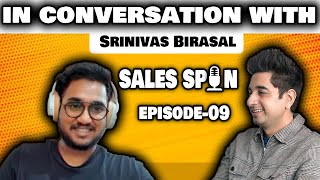
Srinivas Birasal talks about his journey as a Sales Development Representative, the challenges he faced, and how he stayed motivated. He shares strategies for SDRs to support account executives and build a successful sales career.
Today's guest is an sdr. And not just any sdr. Sdr. So nice. I had to hire him twice. Yet the Grimes. I have worked closely with him for around, near, and hands down, one of the hardest and the most sincere workers I know. He has proven himself over and again that he has what it takes and he will do what it takes. When I went to the campus to hire from his college, he was nowhere on the list and luckily appeared at the last moment only to surprise us. The first time I met him, I was worried that he was too honest and would have a hard time adjusting to the corporate culture. But boy, did he prove me wrong. I welcome Srinivas Virazal on Tailspin. Welcome to episode nine of Sales Fin. And today it's just me and I have a very special guest, Srinivas Birazal. We popularly call him Veera, which is a popular Indian beer. Srinivas and I have worked closely for about a year. If I might write. I have hired him. Not once have I hired him. Twice. I'm sorry, you were saying?
Yeah, we are close to worked over.
Here over a year. Right. So I've hired him. Not once. I've hired him twice because I had hired him in the previous organization I was with and then I kind of rehired him in a different organization. He had to go through the interview process again, by the way, and that was not. That was not an easy one. He recently got married. I think we go way back with Srinivas. We went on a Bangkok trip last year. I think that was the last time he traveled. That was the last time. That was not the last time I traveled, though. And he recently got married, like I said. And he's looking depressed, as you can see. Is the marriage.
No, no, not at all. The marriage. It's not getting depressed. I think it's. It's a good thing to. To have. It's a new phase. Not. Not. I would say it's like we both are really understanding. So it doesn't feel like, you know, someone telling you in a jail or something. It's. It's a good experience. Till now.
Even though you don't look as happy as you were earlier, I'm sure something has changed. For sure.
Nothing. I would say probably, you know, if. If not, I. I wouldn't say work stress, but not sure about why I'm looking like that or why people are feeling that I look like that. But I think an extra responsibility has been added and then you need to take care of that as well. Sometimes it does get overwhelming with respect to a lot of stuff, but it's not that bad. I'm really liking the space.
Nice. Nice. Yeah, a lot of people can't say that for marriage, except me, of course. I have a better. I have more experience than you. So, yeah. All right. So, Srinivas, I think you've had an exciting journey. You work with Reliance, I'm guessing before you joined chargebee and before that you had fraggled tons of interviews. What I want to do is if you could maybe walk us through your journey from college till Charge B. And now you're at Habilo. Now you're a senior SDR at Habilo. So we'd like to talk more about that in a little bit. But, yeah, first, quickly walk us through your journey from Reliance to chargebee.
So I'll make it really quick with respect to my journey from Reliance. So the reason why Reliance then charged me then below has an exciting story in itself. So just so if people didn't know I'm a horticulturist, by. By my undergraduation or graduation, what you can call I am not a tech guy. So I was one among the people who knew com skills better. So that's the reason I got through Chafee. So let's come back to Reliance in itself. So I was a procurement head for Tamil Nadu and Chennai region in 2016, 2017, before I got through my master. So Reliance was pretty much a. Pretty much a job which I took up because I didn't get my master's degree there. So I couldn't. I couldn't get. I couldn't crack, you know, the government exam because of all the other things which I don't want to discuss on this conversation. But, yeah, I couldn't get that. Reliance happened. And then I realized that people have done masters, PhDs, didn't actually. I mean, they were not worth it if they didn't get a government job, which was, again, a lot of. Lot of hassle and the other stuff. So I realized that, you know, Masters in Business Management is the way to go. So that's when I joined. Christ, and those were the most beautiful years. So at the end of it, every management will give you a placement. So that's when I met you. I think that was the first time you hired me. So that's when the journey started with charity. You know, it was. It was a. It was a. It was a crazy journey. I. I feel it was one of those places where I didn't have all the comfort for the first time in my life, I didn't know a lot of stuff about what should I be doing here because sales development was a very, very new role for me. We'll discuss this in later. How I fell in love with sales, how intuit happened in between how Charge P happened. So that's how I came into sales development role. And then I fell in love with that. So close to 1, 1 year, 2 months in the inbound was the time that I felt, you know, my life changed. I learned a lot of stuff, probably so much so that I believe that, you know, past 14, 15 years of my life, my learnings were very less. And then it was time I moved on because I had goals. I had goals to not move into a mainstream role of, you know, probably SDRA and the other stuff. I had different goals. So I moved to Hublot and now I am working as a senior sales development representative. So basically, as of now, I'm individually contributing before taking up the roles where I'll be probably mentoring a few people and those. That's a quick introduction of what I do.
That's exciting. That's exciting. Thank you so much for sharing that. I want to bring up something which I'm not sure you would want. You actually wanted to. So I remember the first two months when you were at Charge B and there is a, there's a rigorous training which is involved to, you know, train any SDR xrs, because product is so vast and, you know, there's so many things to learn along with the process, along with the product. And, and that, that, that was the time, you know, before Pandemic. Of course I remember a lot of leaders were not in the favor of, you know, pushing you to the floor because not everybody felt confident that, you know, you would be able to strike the conversation, you would, you would be able to understand the product. Like everybody, There were other SDRs who joined alongside you and they were able to hit the floor before you. And then there was a time when you had to retrain yourself for a month. Right. I want to understand how you were able to cope up with all the pressure that I have to perform now. Because there are a lot of things at stake. And I want to mention this, I thought I would probably mention this after you share your story. Not only you were able to hit the floor, not only able, you were able to hit the coda. Month on month, you were actually, you actually were awarded the Transformer, like the best SDR for that year. So I want to understand, I want to know all about it because I'm sure that could be like an inspiration story for everybody.
So, yeah, I was not expecting this topic to be spoken about. But some, some things, you know, even though they were. But those things, you know, give you confidence at every point of time. So quickly talking about what happened or how I, you know, how I, how I was able to probably bring in my best. So one of the reasons I personally feel I failed or I couldn't cope up with the other STLs when we started was I was, I was having that mindset where, you know, a tech guy or a person who knew tech would probably cope better and people who were around me, they were necessarily not, you know, tech people. You know, if I can take names with Sid Beatsura, none of them were tech people. Right. So once I understood that people who were non tech as well were ramping up and all the pressure was always there on me. So one of the prime things that I believe I didn't do well to start off with was, you know, I was not able to differentiate between those hard skills and soft skills that an SDR should have. And I personally felt that I lacked in the first month. And I went all out on the product. I just understood what the product is and the other stuff, but I, but I forgot to concentrate on my soft skill development. That's where I failed. And when the leaders didn't trust me to go on board, I was shattered. And like every other guy, every other person who wouldn't get that would be shattered in itself. So what happened in that one month of me getting back to training was, you know, I started thinking, I started thinking of three or four options. So why don't I go back to the core of, you know, a retail job where it's, it's a very, very similar job day in, day out. I know it. It's a procurement. I can directly be the head of procurement for whatever it is. Right. But then it struck me that, you know, you, I wouldn't learn something new every day. It was, it was an absolutely new learning for me and I understood that it's time I start proving to the people that I can do it. And a guy who is from a small town who had ambitions, who can actually make it big. And that's when I started believing in myself. And for once, I didn't even think about moving to a different SaaS company and starting as an SDR. So I never thought about it. I wanted to altogether go back to my retail world where it was easy. It was, it was no hard Work, no learnings. So that's when I felt I should prove it. And yeah, I think you were there. You helped me. We brainstormed a lot of stuff. I remember you telling me, this is the lead. These are the 40 set of leads that you have. Give me an approach before I send you live on the floor. Give me the confidence that you'll have this kind of an approach as an sdr. And I think it was two or three weeks after I had my training, we had brainstormed, and at a point of time I came to you and said, I think I'm ready. I think you should put me on the floor. And I think there was no looking back. I believe it was in the month of August when I started hitting the numbers, and there was not even a single month, which I did. So it was an inspiration for myself on how I came out of it. If someone is struggling out there as an SDR when they started, I believe this is just a phase. Everyone is going to get through it and they need to be strong enough to not switch jobs. That is one of the things that we.
I like that. I like that. I'm gonna, I'm gonna, you know, use that as a clip and, you know, put that as a motivational quote or something. Yeah, that was definitely nice because I'm sure a lot of SDRs are struggling and that's, that's a no brainer. I'm sure not everybody could actually succeed all the months, so. And this could actually get demotivating. In your case, it was at the beginning of your career, so I'm guessing it would be more devastating. But in other, in cases of other SDRs, it could happen just at any point of time. So I think it's a very timely topic. So thanks for bringing that up. I think today's topic is something which you have chosen and we have not given it to you. Okay. I want to say this for the record, so I want you to announce the topic this time and then I do have tons of questions. I'm sure we're going to brainstorm on that a lot.
Sure. So the topic that I chose is pretty pretty, you know, something pretty much not a topic that an SDR would want to take up, especially if you, he or she is in the early part of their career. Right. So it's, it's. So the topic is, it's important we as SDS understand that, you know, our work should impact AES the most. This is my topic and I'll have my reasons. I don't want to state it now, but it's, it's important in a very simplistic sense. If I have to say our job should impact the immediate person whom we are passing on our leads to. And that's the account executives and not, not holistically to the SDR managers. I know a lot of people, probably my manager would see this and probably going to question me, but I personally feel that and I have my reasons. Correct me, you're very well versed here. So yeah, that's the topic.
Okay, interesting. It's. You kind of touched a nerve for a lot of people, I'm guessing and I'll tell you why I'm saying so. So to clarify what he said, Srinivas. So what he's saying is, and this is kind of contrary to what a lot of SDRs would believe, especially the ones who are actually kind of entering the career right now and I'm talking about 22 year old young kids who are just out of college and they were told that hey, SDR is an exciting space. You book meetings, you have a quota, you hit the quota. Don't worry about what happens to that meetings eventually because even if they don't close, USD still get the quota, you still make the money, even if your account exactly doesn't. Whatever you said, whatever. The topic for today is exactly the opposite. What you're stating, Srinivas, is that SDR should worry about the end goal. Like, you know, for example, let's say my quota Is to hit 10 opportunities a month, right? If I am able to get 10 opportunities, while I understand that there would be qualification criteria in place to ensure that those are not like you know, opportunities which will never amount to anything. But in an SDR head, if you get into an SDR head, he is more concerned about meeting his quota. He's meeting concern about hitting those 10 opportunities rather than hitting four opportunities which let's say out of which one might lose 25% closure or 25% closure, right? How do you make the shift? Or let's say if you were to train an SDR today, how would you make him understand that hey, this is important.
So, so these things I again want to give credit to charge where I come from, right? So I did both my inbound roles and an outbound role and we've had this conversation long time that an outbound role is way more challenging. How do you do that? So, so I personally don't want to touch base upon an outbound role because for an outbound lead, the lead cycle, the closure cycle is way more different. And the skill set that, as an outbound STR should exhibit, they're different. They're way too, you know, complex. They. They need to understand, develop those skills. So from their perspective, it will be difficult for them to understand when the lead is going to close, right? But it's for them to show their skill sets, which is a completely different grounds on what an inbound SDR does. So how do you, how do you train an inbound SDR for such kind of a challenge or such kind of thing is something that I want to talk about. And the reason I say this to you is wherever you go, there's a lot of value for person who does an outcome. The reason being you would have developed a skill set. What does an inbound rep do? You're shown, you're told that, okay, there's a lead that comes in. You just need to qualify that. That's where I believe inbound reps needs to step up and say, no, this is not just the role that we are going to do. Right? Inbound is not where you get the lead. You. You qualify them. And what do you qualify upon few basic questions which have historically been there since my grandpa's age. Right? Everyone does that. What value add do you bring in? Right? How many times do you actually sit with your account executive and ask them, hey, dude, do you have any feedback? Right? How many of the SDRs do that? None of them. I have personally seen myself where, you know, I've had peers where their job was to hit the quota, their job was to hit. If the X number of opportunities, say 30, 40. Their job was to do that. Right? But at the end of the day, you need to understand as an inbound sdr, where your value add would come into play. And if we can take the names of different people, you know, Archie, how he used to qualify a lot of stuff. And that's where I learned a little bit about it. I learned the stuff where probably, you know, it's important we give something more to the, to the A's. And I want to define that, right? When you, when you say more to the A, what do you give? You have the timeline, right? You ask the timeline. That's. That's the part of qualification everyone asks, right? But how does an AE make sure that, you know, this is something that's the critical information and SDR gives. You need to understand the emotion. You know, I was talking to one of the marketing heads without naming, you know, the funny question is, he told me, have you ever asked a Question to the prospect, what will make you come back to us again and again? Has any of the STRs, I mean, how many of them have attempted the standard question with their prospect? Do you think any, any of them might have attended attempted like that or do you have anyone in your mind? Rahul, if someone did that, I don't think so.
I myself haven't done it. So I would not say that, you know. Yeah.
So we have completely forgotten that we as inbound STRs have completely forgotten the importance and value we actually can bring to the table in expediting the process of an opportunity to a deal closure. And I think that's where it's important we bring that element. And in the world where account based marketing are taking over, in the world where the outbound SDRs are getting assistance, where does an inbound SDR who is itching to go to an outbound team and perform that has its value? Right. That's where I come from and that's where I believe I don't need my quota to impact an SDR manager's comp, right. And I want to say it out loud because it's just the compensation that he or I am getting by booking the opportunities. But what is the company getting? Right? That's the concept of an SDR in itself. So I think that's where we need to probably have a dialogue with people who are there out there in the inbound segment.
I think you brought up an interesting point because if you think about it in a way like you said, so let's say, even if, let's say you're an SDR and you just started in this company in the last, let's say one month or so, that's it, six months, you're meeting your quota 150% month on month, but the company is not able to close a single deal. In that case, the company would anyways go back to the roots and find out, hey, how were those meetings booked in the first place? How did they become an opportunity if none of them actually closes either? There could be a problem with the way the meetings were booked or maybe the way opportunity qualification criteria was set up. Or they might, to the last resort, we can always say that, you know what account executives were, let's say not able to close any of the deals while everything was in place. It was account executive fault where they were not able to close a deal. But I think you did bring an interesting point. So I think as a business, if you think about it, and since let's say I'm Leading like this whole function, right? And I'm thinking from my perspective as well, if my team is able to, let's say hit 100% of the quota, I'm able to hit 100% of the quota. You know, it would not amount to anything. Nobody would amount to anything. I mean I would probably not have a job, right. If the company is not producing any revenue from that meetings at the same time, as you grow, and I'm talking from let's say an SDR manager or a director of the development perspective. So I was saying as a leader of a function and as you grow in an organization, it is important for let's say also the leaders to understand that they will always never be compensated or just on the team's performance. So I'll give you an example. Let's say right now my team performs and I none of those meetings are producing. None of the opportunities we are producing are turning into any sort of revenue. That means there is a problem with the way we are setting up meeting. There's a problem with the way we are qualifying an opportunity, right? So that is something which an SDR would have to understand as well because someday they will never be, they will never remain an SDR throughout their life. So they will have to grow into AE roles, into SDM management role. And this is one of the thing, I think an interesting thing I can bring up. So let's say today you're an SDR and you want to become SDR manager. Let's say tomorrow if you are, if you're, if your thought process is, hey, I wanted to set up meeting, I don't care about whether it loses the revenue or not. Remember two things. One, karma, tomorrow you will become an AE or an SDR manager. And when you do that, you will actually be in a tough position to teach other SDRs or coach other SDR. Say, you know what, this meeting is not worth it because now you, then you'll be on the other side and you'll have to face the Bronx.
That's, that's the end goal, right? Even though I, I have outrightly told a lot of people I'm going to announce that I might not, I might never want to become an account executive. And my, my goals are different. But it's important I as an SDR understand what an account executive requires. What kind of, what kind of leads are you passing on? It's not that I haven't passed on leads with a short on budget which had the requirements, you know, some things matched, some things didn't but, you know, but the highest compliment I've ever gotten was not from my SDR manager, not from the directors. It was from, you know, not one, two. It was all the, all the AES whom I've worked with historically. You know, they, they used to tell me that, you know, your notes were very crisp. We loved the way you put it up. And the highest praise I felt came in when I, when I moved to Outbound on charsb. And after two or three months, one of the account executives told me, dude, I miss you in Inbound, man. Actually, even though you're doing really well in Outbound, the very few people who used to give me accurate notes in terms of what we wanted. So even being an inbound, you can make a difference is my entire agenda. And how do you make that difference? Not by qualifying. I can book. I can book hundred opportunities, I can book hundred demos. How does that matter if 10 of them don't close, right? And that's still just a 10% conversion. You're filtering your MQL to SQL and then again SQLs filter out. And if you're giving directly MQLs to, you know, your current executive, then why, why is your role even important? So that's my thought process.
Fair enough. I think that's, I think it makes sense. Because let's, let's go back to the inbound rep, right? Being an inbound rep, where company has spent a lot of money, you know, in bringing those leads, sometimes it costs up to 150, $200 to bring one lead, right? Source, one lead. And let's say if you're not able to do justice to each single lead, then of course the process is broken somehow. But let's say as an sdr, if you have the capability, if you can, let's say at times, stretch and, you know, do a better job than you're supposed to do, than you're expected to do, I think you're already finding ways to stand out in the crowd. Like, for example, you said, right, from someone who is not trusted to hit the floor. And I remember the same amount of people who did not trust at one point in time were the one who actually were the first one to clap for you, right? So that goes without saying. Srinivas. I think that there is something more an SDR should be doing, like thinking of these tangents, for example, what you said. So I think I'm convinced I actually had complete plans to probably throw, throw some admonition on you that, hey, you know what, whatever you're Saying does not make sense, but I think I'm fairly convinced. And then SDR should probably start thinking on those tangent at least, you know, once they have spent six or seven months into the role. Because that is when companies also start kind of thinking about the transitioning plan. So yeah, I think that is, that is fair, I think. Okay, so now we have about five minutes left. What we want to do is. I want to ask you one final question. TikTok question. Okay, give me one. So let's say if you were to give one pro tip for all the SDRS irrespective of inbound and SDR inbound or outbound. Right. Whatever the role might be, what would that be?
One pro tip for an sdm.
Just one. Okay. It has to be the T top one.
Be on top of your cr.
Are you trying to impress me or are you trying to impress your boss?
I am not trying to impress anyone. Where do you get all the information? And the reason I say this to you is people, people tell us. You need to be very accurate. You need to have your hawkeyes on your emails. You need to make sure what a prospect is putting up on the LinkedIn. Just, just tell me if there's a one stop shop. Where do you get it? You have your sales engagement tools like salesloft, right? You have sales navigator Incorporated. You have your emails incorporated. You know who is clicking, who is opening, you know what someone is posting. Salesloft gives you everything, right? You have owler integration, you have competitor, you know, kind of it. So where do you go first when you wake up? Don't go to all the probably your tweets or go to LinkedIn. Go to your sales. You have your Twitter connected over there. You have your LinkedIn sales navigator connected over there. You have your email connected over there and you have your competitions out there. So probably you're not just doing yourself a favor, be it inbound or outbound on what these people are posting. What do you need to do as a part of your messaging? You'll also know which are the 10 other companies that probably you as an SDR can target next week, next month, next week, whatever you want. So be on top of your sales engagement tools or your CRM.
Interesting. Yeah, I like that. Right on to the last part of the show which is the rapid fire. Okay. And of course you don't know the question. So let me know when you're ready. And you have literally two seconds to think about the questions and you know, give me the answer. Ready?
I'm ready.
One Two, three. Who will or Charge B?
Charge B.
Best boss ever. Me.
I. I had only you as my boss. I never had an HDR manager till I got.
Okay, so unfair question. Unfair question. Let's try that dog or a cat.
Person dog any day.
Okay. Windows or Mac?
Mac. That's not a question.
I'll tell below that how much you're talking about it. Okay. One feedback for salespin.
Salespeople. So I think it's a great initiative and the only feedback that I have is I think you need to invest a little more time on this. And the reason I say this to you is it's interesting. And when I say it's interesting, I don't want to wait for two or three weeks for some episode to come up. So probably say just like a YouTube channel which comes up with a video every other week. Mkathd Pocket. Now like I want to see your episodes, say daily, which is of a lot of ask from you. But if there's. If there's a video that probably pops up every week or every couple of weeks, it'll be better.
Sure. Okay. So I think. Thank you so much. I think that really helps everything. I think we really enjoyed it. I really enjoyed it. I'm not sure about you. I. I think this is going to be very interesting conversation given that a lot of SDRs might be in your shoes right now, who might be struggling with their targets, who might be struggling with. In their first role. And I think you are someone as I know and as everybody, as the world knows, someone who's like a very hard worker who will not shy away from doing that hard work, going that extra mile. So last thing I want to ask you is where does that come from? Because let's be honest, okay? Human. Humans are innate, you know, this does not honestly come from within. Right. So nobody wants to work 14, 15 hours a day and without an end in sight, especially in the SDR role when you're not able to see those results instantly. Right? So if you start a sequence today, you start prospecting today, you'll probably start seeing the results seven days or sometimes even later. Right. How do you. Where does that come from within? I'm just trying to understand from a philosophical point of view, maybe.
So where does that hardworking instinct comes from? Is, I would say for some people, fear of failure is something that they take it very differently. For me, the fear of failure is the motivating factor. And the reason I say this to you is so I don't have anything behind my back or something out at my place where I can go back and say, chill around. So, for me, the fear of failure is a motivator. And I don't fear that I'll fail. That fear of failure gives me a motivation that I shouldn't fail. Right. And that's what kicked me in 2019 when I was struggling, when people were not trusting me with my process, people trusting me going on floor. Right. So people can take it in a very negative way. There has to be a motivating factor. Few people will have money. Few people will have, you know, probably to travel, a lot of stuff. For me, the fear of failure is. Is motivating every day to do well, to work hard, and. And I'm doing that.
Nice. Interesting. Thank you so much. Again. Come on.
More from Rahul

The SDR Role Is NOT a Stepping Stone | James Buckley on Cold Calling, AI & Career Growth




Trupeer Hired an Enterprise SDR in 1 Day. He Booked His First Meeting in Week 1



