How to succeed as an sales development rep everyday and get promoted? | Episode 03|
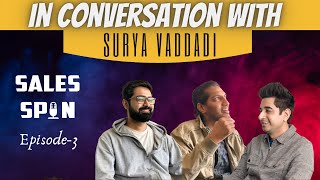
This is a YouTube video titled "How to succeed as an sales development rep everyday and get promoted? | Episode 03|" created on March 23, 2021. The content is a conversational podcast-style discussion featuring Rahul Wadhwa, Kaushal, and Surya, focusing on the journey and challenges of sales development representatives (SDRs) in the SaaS industry. They discuss topics such as career growth, product knowledge, sales techniques, automation impact on sales roles, and personal anecdotes related to sales leadership and team dynamics.
Better got about my way this is start of a new day Feel fresher than toothpaste Singing out this be the new thing New swing set Imma go for the.
Hey everyone. Welcome to episode three of Salespin. Yes, we made it to another afternoon. He's looking sleepy. I'm not. I actually had a shower and yeah, we are looking. We're looking better today than previously. That's what we've been told at least. All right, so today we have a guest whom I hired about one and a half two years ago as an sdr. And today he's a team leader. He handles a small team of sales development representative. So interesting journey it's got. And so he used to work with me. With me a few years ago. Now he works with him.
I report to him now.
Oh, okay. So welcome Surya. This is the chance. Surya, when you enter. So we'll make it run. Don't worry. Welcome Surya.
Oh man. I thought that he'd be walking in with his glasses on.
Yeah, that's what we told him to do. Right?
Just like those semicircle ones and he's like, oh, I need to remove this.
Or probably those one. I don't know what that's called.
Where you actually just open that. Yeah.
Surya actually works in night shift us hours and he hasn't slept so he probably started working 24 hours ago or maybe, maybe more. So he's. He has not slept for 24 hours. So great job already. We are very thankful that you're here. And I know again, you, you charge like a bomb for to be in the show, but yeah, either way it's worth it.
Thank you guys. I expected some coffee but like you just. Guys gave me like some water. I think you guys should get.
That's warm water.
So that's warm water. Yeah.
Think of it as espresso.
Yeah, right. It's good for your hair. Right? So since you're growing that. What, what's. What's behind the hair, by the way?
Yolo, you know, you just do something different.
Right?
So that's not. And you should do this also like every time he says yolo and just I feel that today's. Today's episode is pretty. I was really looking forward to it since last night because I've now I work with Surya and he actually helped me transition into the SDR role in the SaaS industry. He gave me that guidance in terms of the understanding the product before you actually sell that something which a lot of companies kind of miss out on is Something about what Surya did for me. So thank you, Surya. Thanks for.
Why are you lying so much? Just because we're in camera right now. Last time he spoke, you said, you know, Surya made my life a living hell.
I didn't say that.
You said that probably. I'm actually super quoting right now. I'm super quoting right now. But what you said was bay worse that my mock calls for them were like, you know, that I went through hell and came back. Something like that. I don't know. I'm voting.
I survived.
You said, yeah, yeah, now you're so.
I came out as a rock star. That's. I think that's an understated skill.
You never said that. You never said that.
Doesn't kill you.
Makes you stronger.
Makes you stronger.
Absolutely.
I totally agree to that. And who gets killed every day in sdr?
Absolutely.
Well, okay, I think it's an interesting topic. So I want a very funny answer for this. Why did you become an sdr?
Because I wanted my life to be miserable.
I would say, okay, nice.
And I got rejected in every other job that I applied for and this was the only one that I got selected.
So Rahul, you're saying so basically before this video started said that he hired him two years back. And so is it safe to say that because nobody was hiring Surya.
I would not comment on that. No comments, no press now, no paparazzi, please. So I remember, you know, would that be one of your strengths? For example, you said that, you know, you got rejected so much and when I probably asked you in the interview, what's your strength? You might have probably talked about, hey, you know what, I got rejected so much that that's probably my strength now.
Absolutely.
And I remember a funny story. Okay, so not many people know that but I don't leave a single chance to narrate this story. So before, you know, Surya came for the interview, he had actually taken a break for about one or two, one or two years to travel. And when I'm in the interview, I'm thinking, hey, you know what? This is a hippie. Okay, I'm going to hire a hippie. This is going to be an interesting addition in my team. Whether he performs or not, at least we'll have some fun. And I'm being very honest and I've told this like so many times before. So yeah, that calls for an interesting story. We're going to talk about that. There's so many interesting things to talk about, Surya. You know, we're going to dive into that very soon. But before that, let's jump onto the topic of today's discussion, which is you're a team leader. Right. And Most of the SDRs I have trained or hired, and I've hired, like, more than about 20, 25. I've interviewed over 150 so far. And if I ask anybody the growth plan, which you tend to normally do in the interview. Right. Everybody talks about, hey, you know, what solved my time to resident SDR for 18 months or whatever. And. And what do you see? What do you want to do? Like, in six months or eight months or year from now? Everybody says, I want to become an A. Why did you choose to not take that path? You know, road less taken. And you are a team leader.
Good question. And I respect that because not a lot of people actually ask that question, why a deal? And why not an A? But for me, it felt like when I was working with people, one. I learned it from you, of course. Thank you for that one. Give away stuff for free. Right. So I was giving away knowledge to people, and people felt empowered about that. And that's the feedback, just word of mouth across the whole team. You know, people felt that, you know what, you should talk to this guy. You should talk to this guy. And that's what kind of helped me be visible. And the leadership also saw that in a lot of ways that, okay, this guy, you know, should kind of train or this guy should, you know, coach, things like that. And that just kind of escalated in such a way that, you know, people actually started approaching, hey, I've heard this. I want you to coach me. I want you to train me. And that kind of felt probably, this is my calling.
Yeah.
And I was like, just taken. Like, yeah, cool, let's do that.
All right, that's. That's pretty interesting. Now, from where I come from or from where, you know, most players come from, it seemed like a lot of work, if you ask me. Yeah. You know what? So I have to give for, like, two years before I can probably achieve that, or probably I can achieve the same status or probably I can think about it. So let's say I'm sure you also, for example, have trained him. You work with him. And I'm pretty sure he also want to become an accountant executive, just like everyone, right?
No, no, no.
So you don't want to become an account executive?
I want to, but my reasons are different either way.
Like, so you know what?
I actually, I should. I should highlight this point. It feels really good to see something you know come out of this. So back when he said, when Surya said that thanks to Rahul for this, for the giveaway part that he started back in September when I was actually starting to hunt for jobs and Raul here actually helped me refer in a few companies and get me like land me some interviews. When I wanted to thank him, he just said pass it on. Right? So that's one. Give, give. Giving is something that I've learned from him but like I couldn't really implement it till actually got to come to charge me and work with Surya where he actually gave away that knowledge so much and just for like so little, probably for nothing that I actually felt that, you know what, this is how you actually make a difference. Right. And today when I sit here with these two guys, it's a privilege for me and I'm not even being sarcastic. Usually I am, but really, I mean.
It is, it is a privilege for you. So I'm not sure if anybody actually knows Surya. If you know him well, you realize that he's someone who really, it comes very natural to him that you know, when he wants to give, it's not that, it's not force. Right. So you have to. For few people it'll be like, you know, for example, if I tell, when I told him, I'm not saying that it doesn't come naturally to him but when I told him, it's forced.
Right?
Yeah. I should stop sugar coding things. So for example, if I tell Coach Kaushal, you know, straightforward, he'll be like, okay, what the hell is some. This is a new gun he's probably, you know, throwing at me. But for example, if I tell him, I don't have to tell him. First of all, I know he will do it like without even asking. And there are tons of people to whom this might come naturally if it doesn't. I would say even if you think you want to do this forcibly, it's okay, do it for some time and then after that you'll probably get the hang of it. It's just like going to the gym for the first time. So yeah, that's pretty interesting.
Absolutely. Burn your fingers once, you burn it like twice and you get to know, do you really want to touch that?
We would probably want to put a warning. I don't know if our kids are mature enough to understand this was a joke. People. Some people might burn the finger.
You're planning kids?
No, not at all.
Okay.
Yeah, that's, that's done. Yeah.
So what I wanted to actually.
Know.
From Surya, like, and this is, this is, I mean, I, I feel that it's, it's important we discuss that right now because we usually don't get time in this work environment that we have. If you work from home, actually talk in person. And I think if we talk about that today, that's gonna really help me and the people who are viewing this.
Right?
So a lot of companies, and I'm just more talking about SaaS companies, software as a service. You really need to, I mean, okay, that's. How do I frame this? A lot of people sell their products, they're good at it, they're hitting their numbers, right? But I can say that now that most of them don't know the product that well. And that's okay, that's fair. I'm not a software guy, I'm not an engineer. So I may not understand a lot of modules, how APIs work. So all these terms I started to understand when I joined the SaaS industry.
Right.
But I still sell that I'm meeting my numbers, whatever you call that.
Right.
But I believe that you, what you are selling, you should know what you're selling, basically, right? What's your take on that?
I totally agree with that. Because if you call, if you ask me what is an API, I still don't know what is API, but I am surviving, right? That's the secret to my survival, not knowing stuff. But also sometimes what Rahul says, like, you know, fake it till you make it. But yeah, if you make it, no one can, you know, pull you down. If they pull you down again, try to climb up the ladder, right? So that, that's one way, but the other aspect to that is obviously trying to understand the industry rather than the product itself. So you need to know who you are selling to, what they need basically. And through that, the product, you can basically tell, okay, you know what, you're in this industry. I've spoken to 10 other people who are facing the same problems as you. I'm sure you also have this problem, like, yeah, how did you know that? And that's how you're like, yeah, dude, I'm the expert. Like, yeah, you are the expert. Like, I want to buy it from you. That's the perception that kind of builds around that. And you know, knowing the product or not knowing the product, that comes secondary, knowing the industry where you're selling. I think that comes as a priority. Totally agreed with that.
And yes. So basically to extend to, basically add on to that question, now that you've spoken about that, that when you actually solve someone's challenges, you also get to know your product parts of it, right?
Absolutely.
And this happened with me yesterday. This is actually a true story. I was, I was talking to a prospect who brought up a competitor and started asking about the competitor's features and then asked me how does your product stand out as compared to the features that your competitor is selling? And hand on heart, I have actually gone through a lot of Surya's videos, the mock calls, mock calls where he has actually spoken about the competitors products and the client. And there was this. Okay, this is, this is one great video that I saw where Surya explained the competitors features and then you know, even our products features as compared to the competitors features. And the CFO of the company, I saw that on camera, clapped, did this.
Yeah.
Wow. So were you in like a zoom call?
Yeah, because there were like multiple people joining the call and it was like the first SDR call.
Wow.
So instead of 15 minutes, I took the call for like about 25 minutes. But at the same time I knew that I could like he's against sugar coding.
I'll give you an example. So when he was in SDR and I was managing him. And so as an sdr you're of course supposed to make certain number of calls in a day. Right. And you have to finish those activity, make sure all the tasks are done. So I remember there was a time on the very first call, what is the maximum time SDR should spend? Like five or 10 minutes. I distinctly remember 15 minutes. I just remember he spent 40 minutes on an introductory call. That's how passionate he is about helping people. That's how it's, it's a good and a bad thing, both.
I just want to know how do you do that? Like how do you do that?
That's a question should be, you should be asked.
Not the timing, not the timing. I'm just saying how do you compare your competitors products to your product and sell your product not defaming or not demeaning the competitors product. I've seen you do that.
Absolutely. One thing is how many people over here like you know, actually spend a lot of time on what the competitors are doing rather than just focusing on how we sell better. And that's one of the things a lot of people miss. And now if you ask me, I can actually tell the specific like competitor A, competitor B and C, what are their specific niche industries that they sell to and you know, what industries they are good at or they are bad at. And compared to like, you know, the company that I work for and how we are better at that. And this again, a lot of people miss out on understanding what's the value add? Why do I need that? It's not a part of my payroll or like, you know, it's not part of my job to understand. But this is the crux of not just becoming an sdr, a good one, or a team leader who can coach, but also as an E, when you close the deal, like you don't want to just address the features, but also the value proposition, what are you missing out? Is the product that you're buying today cut for the industry that you're selling to? It might solve the problem today, but what about six months later? Like one year ago, probably Zoom was not at the share market rate that it is today. But if you were to understand probably this is what would happen and you were able to catch on that, then cool. Nothing like it, right? You probably would have been a billionaire by now.
So I think I have a follow up question and this could be very important for a lot of people. So while I appreciate, and I always appreciated what you did, for example, but at the same time, and now I'm sure you would probably relate to this more. Let's. So you understand that, you know, you were playing a velocity game. You have thousands of leads coming in, equally distributed to all the SDRs. And if an SDR, because he wants to become an A at one point of time and he has accumulated so much knowledge that now he's looking for a chance to, you know, let that out. And if every sdr, for example, tries to, let's say, explain the product in the same similar fashion as you do. And I'm not sure first of all if every SDR is even trained or probably it's a passionate about doing this. And if the SDR, let's just start spending 40 minutes, don't you think that's a loss of the productivity?
It can be, yeah.
He hasn't pulled up a lot for that, I think.
Right? No. So the question I'm trying to ask is, so maybe he was able to pull it off. Well, yeah. You know, while for example, he might have stretched maybe during the shift, like.
You know, as he said that probably like the 40 minutes call that I took instead of that 40 minutes, I could have taken like three calls and passed on three qualified leads to instead of just one. I totally get that now. It also kind of goes in that way where you can think about like a sniper approach. Sorry, where you can Spray a machine gun anywhere. But what about becoming like, you know, the sharpshooter that you know you're aiming that specific target and you know that you will bring him down.
For a meeting with an account executive? Don't you think that for one, that account executive is actually trained to do a certain job? And that's how the, that's how the important the process is, right? So if you understand how a cycle, how a factory works, right? For example, let's take a biscuit factory, right? There's a team who's responsible just to take care of the dough. Second team is probably responsible to make sure all the ingredients are actually in place. Third team is making sure making is on point, the temperature is okay. Fourth team is making sure the quality is in check. That's the reason they have processes, and that's the reason you see everything is working seamlessly. If the dough guy starts to think, you know what, let me start baking, you know, because I want to get into baking someday. I want to take up the baking. You know what, I'm going to take this dough and, you know, take it somewhere else. I'm going to start a new factory, I mean, within the company. And while he's doing a great job, he will also produce it. But what you are, what you're doing is probably in that case is actually messing up the whole process, don't you think?
I would not completely agree to that because I would think about in such a way that example, if you were to go to a sweet shop, okay, and you just look at it, probably you might not be liking the sweets that are there in the shop and you might just turn away and go back. But if you get a person who knows probably what you like, even though you could be diabetic, you could have one piece and you could die, but still be able to sell you a kilo of that sweets, that's what is what probably can be done in terms of understanding that sniper approach, right? Because I'm not trying to sell you that one kilo because that's what the cashier would do. What I'm trying to do is just get to the next counter where you're able to actually see those different suites that might catch not your eyes, but what your wife needs, maybe you would still buy that.
Okay, follow up question again. Another example, since you're throwing examples. You go to a doctor's office, there's a receptionist there, and this person has been there for a while. She of course knows what kind of diseases doctor diagnoses and eventually gives medicine. Doctor has spent good enough time, he's been trained well, spent five years in studying, then the practice and all that stuff. Now just because we, you, let's say as a, as a receptionist, you know, you know something about. Okay, you know what, stomachache, it must be this way. You don't have to go to the doctor. Why don't you take this medicine? Right? You know.
This is an example, but this is a funny example, but it's actually true. Like I have known people to take medical advice from a chemist. So there's this aunt.
Do people do that right now?
No, not me.
No, I'm saying I used to. I mean my parents used to do this earlier because nobody wants to go to doctor. But I'm sure people probably stop that now.
No, no, there's this aunt like of mine. There's this lot of pain. Can you suggest something like. Yeah, so do take out this one. And then he gives the medicine. She's like, so she trusts his confidence.
Confidence, yes.
See, I know that word.
That's probably Surya has the confidence.
Okay, good point. So I think I'll take that, you know, as a valid point. But do you think everybody can wing it or probably everybody. So okay, let's take the same example what you had earlier. You go to a doctor and you know, you speak to the receptionist. Receptionist like, you know what, you don't have to probably spend thousand bucks on the doctor. Why don't you just take this medicine now you are actually messing up the whole ecosystem. Right? Agreed. And you probably could be like a great SDR who knows about the product and you can explain the product just like the way it's supposed to be done. Even though you've never been trained on this. Right. What if the other SDR imitates you and now messes up the whole system? He's talking about me.
He's talking about me.
I told you.
I told you one time I shared my screen. Screen to show the prospect of product.
Just to like explain what I was.
To explain what I was actually trying to.
So you probably.
I shouldn't do that. I shouldn't like put that on video.
Right now without realizing it.
Okay.
People might take that, you know, and so imagine, imagine now you have three SDRs and everybody's handling 400 incoming leads and everybody start dumbing the product. You know what Fuas, they're going to take it from here.
Yeah, you just give that job. And then A's would be like, we can close it.
And then AIDS would be like, you Know what? We don't have enough damage.
Thanks for putting me in the spot right now, guys. Like, yeah, seriously, my employees are looking at this.
The A's and not are already not happy with me.
Just imagine you paused it such a manner. They're like they're already not happy with you. It's me. The way you pause.
I'm learning, guys. I'm learning.
It's okay, you know, so keep doing thing. Obviously once you, you know, going back to that example, only once you touch it, you know it's hot or cold. Right?
So diplomatic answer. Let's not touch it.
Three things left now. Yes. First thing we want to know is why are you growing your hair despite the hot afternoon in Bangalore? It's very hot. You already said it's too much work. We would want to know if you're trying to inspire.
You know, I respect that. Actually I don't like, I don't want to question that. I think it takes a lot of discipline.
Yes, yes.
Bombay has got soft water.
Maybe my hair is just too nice. I don't know.
I know what you do before videos to your hair.
Whatever.
You work a lot on them.
That's okay.
The video can be 20 minutes but the head 40 minutes. So you know the, the reasoning, right?
Okay, I have a question for both of you.
Yeah.
And this, this happened. I mean when Rahul had asked me in the previous video that we were, we were actually talking about this in our first video where you wanted to know what SDRs are thinking, right?
Yeah.
And last night I had a good, like good 15 minute conversation with an SDR where we came, like we both are really passionate about the product. Okay, I'm not gonna name him, but people are really passionate about the product. And when I, when I told him that I'm doing this video today with Surya, he was like asking this question, asking this question.
Okay.
So like I can't ask him all the questions because of the crunch of the in time. But I would like. We both were really curious about this one thing.
You're scaring me. Literally, you're scaring me right now.
He's building the premise, right? You know, the tenant, sort of.
You'll be pretty chill answering this.
So it's okay.
Okay.
It's not about the product or anything technical. It's. It's. It's like. So in my previous sales job, I had to manually do a lot of things before I came here and realized, oh, these are the tools that are automatically synced, integrated and doing that for me, one Example being sending out proposals. Second example being following up with prospects. Right. So this was most mostly manual. And I'm adding the manual. And I'm adding the word manual. After coming to this job earlier, I thought, except it's how it's. That's how it's done. Right, gotcha. So yesterday, this SDR and I were discussing as an sdr, sometimes it gets a little monotonous, like in sales, because we are doing probably following the questionnaire, sending the email templates and doing this day in and day out gets a little monotonous. What if tomorrow there's a tool that comes in nice and replaces us? And that's when we thought, Surya. Because if we have that kind of knowledge, or probably, if not knowledge, if you have the curiosity to learn every day, we are not replaceable. Like, we cannot be replaced, at least for the next five years. Can tech sales replace SDRs? Is my question to you?
Good question. Actually, really good question. The answer can be yes and no. Because at the end of the day, people feel, at least today, and I would say even for the next five years, I would feel comfortable personally talking to someone before I invest like 100k, you know, a contract before I buy a tool for my company. And I'm sure you would as well. You wouldn't want a robot selling you, right? What the next thing, like Will Smith, like, you know, selling you, like through iRobot or something. I don't know. Right? You, you would feel insecure or you would feel like, what's kind of happening? So again, to answer the question, in short, you still would need humans to sell you stuff. You would feel more human, only then you would feel connected. Otherwise, I don't think it probably would replace humans as totally, completely. Yeah.
So you're saying that it has to be personalized and that cannot be done through any automated tool.
What if a person can be done? Because I was having a conversation with Rahul about this and I know he was about to jump over here because you're trying to.
Hold on.
I know there are tools literally that can, you know, pick up resources from like LinkedIn or, you know, your Instagram or whatever, and then customize an email based on that and then throw that email out. That can be done, but that's just a step in the door. But what about actually closing the deal? You need someone to talk to before you get that question. Answers like, okay, fine, yes, now I got the confidence, let's put that signature on that paper. I think for that you still need a human I would defer not agree.
I got it. At the same time I have a mixed opinion. I'll tell you why, I'll tell you where I'm coming from. So I'm not sure if you've read this book Art of thinking clearly, okay. Which has, I don't know, it talks about a bias or something where it talks about a wonderful thing which, which is where it says if something has not been replaced in the last 20 years, chances are it will not be replaced in the next 20 years. So let's say for example email. Email was born in 1980s or I don't know, 60s probably email still exist. Email is still the most vital thing we have today, right? As an sdr, most of your job is done on email, right? Similar is also true for human beings, I would say. And I think to really, if you want to really deep dive into this topic, there's a book called Bots, it's on Amazon. I'll probably send you guys the link. I'll also put the link here. It's a wonderful book. I have just read the premise, it's on my to do read list this year. That how you can probably future proof your career sales tech career from let's say, let's say automation or technology basically. So as long as, like, like, like rightly he put, you know, as long as there is a, there's a human touch to it, I'm sure people would want it. But at the same time I have been listening to these podcasts recently where these people, of course, especially in us where they talked about, in fact this was in John Barrow's podcast recently where he talked about that they flipped or they actually bought two million dollar houses without talking to a single human being. Wow. It was just on chat. And I'll give you another example. Okay, so let's say I like some property, I'm looking to invest, of course I want to see the property, no doubt about it. But do I really need a human to actually walk me through, think about, right? For example, there's a property I want to buy, there's a flat, right? I, as long as I can say somebody can. Let me imagine there's an electronic door, no person so far, no security guard, nothing, right? I make an appointment on a bot, I go to the secure, I go to security, I enter the key details or key number, whatever. I get into the room, I see the hotel, I see the. Sorry, I said it's a flat. I come back home, I speak to a bot, I speak to chat to chat with somebody, this could be a bot, this could be a human being at the back.
But then you need to.
I want to make a space. Of course, I want to ask questions.
While you're seeing the space, you need to ask questions regarding the wiring, the water.
Yes, I was about to just say that because now, say example, you tell me, how long has the SAS industry been into existence and how long has the real estate industry been in existence?
Probably a bad example. But at the same time, what I'm trying to say is I have a mixed opinion, so I am not really concrete on whether this will survive. Of course human beings will always be there. Like I said, if something hasn't been destroyed for the next in the last 20 years, chances are it will still survive. And I think this could be true for like a lot of the things. But at the same time, you also have to understand how a lot of things have changed now. For example, let's talk about food ordering apps, right? Five years ago I would have to call a restaurant and tell him that, you know, do this, you know, put, put less spicy or you know, put more salt or something like that. Today I don't have to speak to a human being at all. So let's say, and this, this would probably be true for a lot of my relatives, for example, who stay in village or probably a small town. But for me, I have not spoken to a restaurant person for the last four years or five years. I've not spoken to a delivery guy for the last four, five years. Because now let's say food app actually allows me to put directions. Okay, you know what? Don't ring the bell. Don't call me. Simply put, simply give the food to security. I don't have to even deal with this guy. So there's no human intervention at all. What if robots are actually delivering it as well? I don't even need human beings.
That's actually happening. Amazon is doing that drone deliveries.
So yeah, I think I'm probably at the mixtape right now. I don't know.
Actually, you just gave me a good idea probably for a startup that I can think about.
Yes.
Okay.
Speaking of that, there's a funny story, okay, Surya is an idea man, okay? He can literally be called an idea man because he has tons of ideas. If you really want to build a startup, spend an hour with him. He don't. We don't even charge. Take some ideas, do something on your own and build a startup. I'm telling you to be successful because he has great ideas. I'm not Saying he can't execute. He doesn't want to. He just. He actually. His idea of a startup was that he would tie up with the companies where he would give them 50 to 60 ideas in a quarter or a month and charge them a subscription. That was his idea and he narrated that idea to one of a big official in one of the company. I would not want to name that person. This is a funny story.
I wish he watches this.
We were actually, you know, during our sales kickoff, he shared this idea with the higher official in the company and the person said, you know what? My security guard actually has more ideas than you do. So do you think I should invest in him? It was actually more funny when I said the first time. Yeah, but it was a very awkward situation. Yeah, yeah.
Thanks. Is the second time the awkward situation just repeated like thanks.
That was way awkward because we were drunk. Yes.
Anyway, before we end the video, let's do the rapid fire.
Yeah, I think that's a kind of norm now. So it's fun.
It's fun.
Okay, I'm gonna. I'm gonna bring some skeletons.
Yeah.
Okay.
Ready? I don't know if you are ready.
I'm ready. I'm ready.
I'll go for it.
I just had some really hot water, so I'm ready. That's a shot.
Okay. How do you pronounce your name?
My first name is Surya. My last name is Wadadi. Sounds like Bacardi or Ferrari.
If you were given a funding right now, what would you do with it?
I would invest in other companies to let them grow and you know, build the company out of that.
What is one idea which you have been thinking about? I know you have tons of ideas which is one idea you would act on right today if you have all the money in the world.
It would be more about enabling salespeople. I know there are tons of tools that are like barracks and others as well that I cannot compete. But it would be more about geographical education or geographical enablement. In terms of the training that happens in the western world is completely different than what's required for say the Indian market. It's probably invest a lot of time and effort on that.
Pink shirt or white pants?
Pink shirt or white pants? Why not both?
Yeah, that's good.
Rahul can pull that off?
Yeah, I can pull up. I can pulled off yellow. Any like weird thing anyways, it's all about. Okay, one advice would you think, you know, for all the SDRs out there probably who are like getting into the role.
Just be yourself do whatever you can. If you feel it's okay, don't get disheartened. Like you will have your day. Everyone has their tough days. I had mine. And there was a point where I thought like, probably I'm not built for SaaS. And I know today I'm a TL but a team lead. But I felt that probably I'm not cut for sales.
Petition for beer in offices or delivered to homes.
If you're working from home, yes, we can. Definitely. I think that's an interesting. Home is a sensitive area. Living with parents.
Don't we already have that? Like where in Bangalore? We get that delivered, right? Yes.
If you're living with the parents and parents are not cool, then like surprise packages.
Oh, okay. Okay. Yeah. Companies sponsored beers. Yeah, that'll be interesting.
It's an interesting one. Definitely up for it.
Books and packages that are delivered by companies or food.
Of course. Who want books, man? Come on.
Yeah.
No, yeah.
You can order food anytime you like. But books you need to think about.
Especially somebody when. Okay. There's something which I've realized. I have given books to like endless people, endless times and some. And lately I've started to realize, you know what? People don't read it. Then they want to read it. They'll simply buy and read it. Why would they read it just because you gave it to them? Now I have. No, no.
If somebody gives me a book, I would definitely read it.
You are a different reader.
If I purchase it for myself, I may not read it. But if somebody has gifted it to me saying that you should read this.
Book, I will never do that again. We are different people, different generations.
I know one again. It can be set up as a.
It does. So I'll tell you what. I have a book. I have a book. So it was. So we had a secret Santa in my previous company and we were asked to pick a book. I could have picked a great book, right? You know, somebody's giving. Giving me a book. You know, I'll probably keep it as a memorabilia like you said. No, I picked up a Harry Potter book.
Okay.
And I'll tell you why. Because when you look at the book from here, it has the Gryffindor flag, you know, all over and what it does. Right now I have my set top box written on, you know, kept on top of it. It looks nice.
Nice.
Last question before we end the rapid fire. Would you prefer my hairstyle or Rahul's hairstyle? Right now if you are to dare.
You not say hairs, dare you not say his it's not a hairstyle, dude. It's like a. Yeah.
The answer is like you know given. Right. Like it is given.
Don't you have to maintain that like think about. I don't like I don't have a comb. It it's default.
It's not hair. It's like is it hair by the way.
I'm getting some minor thoughts but I don't want to answer that.
But yeah, end on that. I hope you enjoyed the video if you really loved our video do do go hit subscribe on the YouTube channel of sales spin we have a page on Instagram as well and LinkedIn so.
And if you want Instagram too yeah instead I just mentioned that before and.
If you have if you have any suggestions for topics that we should cover in our next video do hit comment and we'll be happy to take it up.
Thank you guys.
Thank you. Thanks for coming.
You do need tomb babies better know that you perfect nobody could tell you one thing.
More from Rahul

The SDR Role Is NOT a Stepping Stone | James Buckley on Cold Calling, AI & Career Growth




Trupeer Hired an Enterprise SDR in 1 Day. He Booked His First Meeting in Week 1



