How to win at Sales Negotiations? | Ft. Sayantan Mukherjee || Episode 02 ||
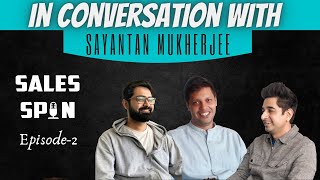
Sayantan Mukherjee from LinkedIn breaks down sales negotiation strategies, sharing personal stories and practical tactics. The discussion covers how negotiation styles differ across cultures, with focus on the Indian and global markets.
Hey guys. Welcome to the second episode of Salespeople. Yes, we now have a name and this is the second episode because last week we gave so much love to our first episode that we now have a page on Instagram and LinkedIn. What is it called? YouTube too? Oh yeah, even YouTube. Yes, go for Apple, talk about it. Alright, so Instagram, handle YouTube, handle LinkedIn, handle everything you will find in the comment box. So feel free to subscribe and show us the love just like we did last time. Yeah, we got about 3,000 views. About 400. He has a T shirt by the way which says don't follow me. So why should people follow? That's because this was. I bought this before we were famous but at the same time he's wearing a T shirt with heart seats. Yeah, mine is fine as very cool. Show a lot of love and hearts to these people as well. Yeah, yeah. So currently, yeah, it's a hugseat. Any friends lover please subscribe. So without further ado we have Santan Mukherjee here from LinkedIn. I think I know Samthan. It's a funny story. I was one of Samthan's clients. I was at Chaudhry and he was trying to sell us and he actually sold us so pretty good to put up there. And he's been a friend. I think we've hanged out. We've had multiple instances where we hang out after the work as well. So pretty interesting stories out there. Yeah. So yeah, Sayanthen is from LinkedIn and we've had a studio for LinkedIn so that's I think LinkedIn bit because you push it for us. Yeah. If this video is not successful because of him. Not because. No, that's because of LinkedIn. Great. So Shankar here is as we just mentioned he is from LinkedIn and therefore we have a great topic today. We're going this. This episode is going to talk about. Specifically talk about negotiations. Yeah. Yes, LinkedIn. I mean Shankar here has negotiated with companies that both Rahul and I have worked with in the past and I think that's. I think he's the best person to talk about negotiations. Shandhu, can you tell us the most interesting negotiation that you have had with any of our companies or probably any other company that if you want to name them it's great because that's going to spark. Yeah, we are tag company. So before I get into the example, right. Let me just take a step back and talk about negotiation for a second. That's okay. If at this point I've been in sales for 10 years. And right now I'm an account executive. So obviously negotiation is a big part of my role. But if you were to open up my IDP at this point and for everyone out there, IDP is my individual development program. So things that I want to get into my brand, the first skill set which is noted there is negotiations. I identified negotiation as my weak link about five years back. And it's still, I would say, the thing that I need to get better at. And I'll tell you why. I think of all the skill sets that you would go through as an AE or an rm, negotiation is something which is most dependent on your personality and on your client's personality and the culture of where you're selling. So in India, where people love to negotiate, right, you go to the bazaars, you go to shops, you go anywhere. You just have that mindset of negotiating for 1 rupee, 5 rupees, 10 rupees. You can imagine that. Yeah. Because you sell it in the US market. Rather welcome to the world of India. So in India, even if you're selling to CXOs with big organizations, you actually end up hacking 400 books. And that's something which shocked me. And I'm selling the product for even grows. So as someone who's always struggled with negotiations, because personally, I hate negotiating, right? So I end up. I know if I want to buy something, I go there, I buy something. Either I have the money to take it or I don't have the money to take it. I won't feed to the shopkeeper. Can you, like, give me a discount of 50 rupees or 100 rupees? But my wife, even if she can afford it and she knows she wants to take it, she will just end up spending another 10 minutes on, I think it. I don't know what it is, but I haggled and I got that 15 discount, probably at the back. That's a big, small. Yeah. And for this reason, you know, negotiations always used to make me very, very uncomfortable. So with a lot of simulations and practice and role plays and, you know, educating myself, I've reached at a point now where I'm not uncomfortable sitting in front of a CFO or a head of procurement. But it's definitely not my favorite part of the sales cycle. Right. But something that when you reach to that point, you're also excited because you know that all the work that you have put into the value bit has substantiated and now they're sort of looking to buy it from you. Right. So there's a certain amount of excitement as well. It's actually interesting to hear when you said that for negotiations it depends a lot on a person's personality. And then you said that over role played, over the time, you actually kind of developed that personality or was it like inbuilt the beginning and you still say it's not your favorite part. Yeah, so I've not developed my personality. As I said, I still hate negotiations. But what I've realized is it's part of a job. Right. So if I have to sign enterprise deals, I can't sort of shy away from the fact that I need to get better at it. Right. So in my personal space, I will still not go and negotiate with people. This gentleman, is that me too? Yeah, yeah. But for my job is something that it's. I look at it as a skill set that I have to build, but it doesn't necessarily have to be something that gets ingrained in my personality. Like for example, doing a deep discovery and being generally curious about clients is something that I've taken from and learned from and tried to inculcate that in my personality as well. So now if I go and meet a random person, I would show genuine empathy, curiosity and that's something that I like. Right. But I don't think that negotiations or for getting better at happy with people is something that I would want to ingrate. Right. You were talking of examples. Right. So I'll give you a good couple of two examples. Yeah. We want to hear the weirdest conversation story probably where like maybe something like where you said one of the clients tag you for 100 bucks. I'll be candid. Hundred bucks. The reason why you're saying that. Right. Because that has to sell. Yeah. Because I think people want to hear that, which makes them feel like, oh my God, this happens. Yeah, yeah. So I actually have a story in mind. I can't take the name of the organization. They still partner with us, but it's quite a large organization. India headquartered company. Right. And their turnover would be somewhere in the range of 800 mils. Right. He's talking about my ex company. There are 800 mil companies in India and they are in the captive digitization space. Right. So they do a lot of BPMs and they're big on the healthcare sector. So we were working on a deal. They wanted to enable their sales team with Sales Navigator, which was a product I was dealing with, a product that I ended up selling to you as well. And everything was done. Right. So all the functional leaders, they found Value with it. The dm, they loved the product and everything. And then the ball went with the procurement score and it was stable to be 100k deal. Right. Now the good thing here is I knew that the procurement had very little leeway to negotiate with me because my champions had told me that we are going to buy this for sure. So they also knew that I also knew that. Right? They knew that. They knew. Yeah, obviously they knew that I have like very strong connections that know that this won't go away just because of the pricing. And you knew that they knew that, you know. Yeah, yeah, yeah. So that's why I said, made it very interesting. Right. So when I went into the negotiating room, the head of procurement, after the peasantries and everything, he told me, shantan, I know you know a lot of people in our organization, you've done a very good job, but now we have to start afresh. Right. So that's where typically the alumn started. Because what he's telling you is, boss, I know you've done a good job, you know a lot of people in my organization, but comes to signing up the contract, you have to sort of start the whole process again. You have to give me something. Right? I, I don't care what value the sales people are going to get from the product and what's going to happen and all that. What are you giving me in terms of financials? Right. So imagine. And that was like a six months sales cycle. Is he talking about crying or just now? No, no, no, no, no crying. I've had unfortunately that experience as well. But that was, is that unfortunate really? Like were you offered a bright. No, no. He was asked to make a bride. Yeah. You think that. Were you sort of asked to give a bride? No. And honestly I never come across, to be fair, I've never come across that scenario while selling to corporates or enterprise. Right. The only time I faced that situation was in the formative years of my career while I was sitting in government. Okay, right. That was a separate. We love each other. We love everything. Yeah, that's. Yeah. And we were not in power at that point. I respect, I think, you know, I have to ask this and actually to you both because you have been into sales for a long period of time and it's, it's, it's actually. So it's a coincidence because this morning. So I, I share my flat with a, with a sales guy, he's been in sales for five years now and he told me a hack about negotiation. Right. I'm sorry. Man, like he told me not to leak that, but I think this will sell and tell me this is true. What he does and what I used to do also was I used to go to a client which with whom we had to go and it was a day and he told me that whatever be your price, you have to blur it out. You have to just so he said, after you have spoken, given the commercials, don't speak. Whoever is the first person to speak loses. Yeah, I've actually heard this. I don't know if you're different people. I don't know. Probably said it first. Maybe it was Jordan Pepper or somebody. I don't know. I probably some Instagram program could be. I don't know. I've never been to like thought. I've thought about it as well. I'll tell you the hack that it's not even a hack. Right. It's a very simple philosophy and something that I've improved thankfully over a couple of years now. Earlier when I would walk into a negotiation table, I would be so excited to close the deal, I would lay all my cards out at one go. Right? That's not right. That's not. Especially in India. I think probably yeah, you're right. Probably. I'm not seeing the same situation in us not seeing people in us like probably hanging or you know, negotiating so much. They would probably give a price, give it a take it. I mean it's not like the way in India, you know what, they're probably fighting more 5%. There'll be like four to and fro. Yeah, yeah, yeah. So two months too much. I think even as Indian, I think I tend to do that to be honest. But maybe, maybe not to that extent. For example, you're leaving in dollars round, for example. Let's say if I'm trying to book a travel, you know, book a travel agent and he's reporting me a price, I would want to get him at the price. I would try to, you know, somehow pressurize him. Hey, you know what, I can always go to your competitor, he's offering you a better deal. And even though I don't, I think even proofs or not, I'm sure there is at the back of the mind he has to make a sale and I can take a panel with that. So I would. Why would I not? And actually the interesting point is all the procurement T2 is mid sized or large organizations today are actually trained on that. So how do you make the life of salespeople more difficult? Right. And similarly, we are also Trained on how do you make the life of procurement people more difficult. But I really think that it's because of this that we Indians are better in sales as compared to people who are selling abroad. Line. Because even before sales happening, even before me learning sales. Yeah. In organizations I think we are taught that at home the mentality. Right, right. Like our moms are the best sales teaching us. If you have to talk about today's topic, I'd probably refer that my parents did not give me sales at all and I get nothing against them. Yeah, that's what it was. So my mom never had into the subsequent never. So And I think I learned that for my. My mother would probably not engage in a lot of money matters. My mom would. And my mom would. I was asking double the price. She would not even care to ask why was it so expensive? He would just give that money. And I think I probably the life of that sales people in bed. We're so uncomfortable. I want a better price. Of course. So when I started spending money that was my parents money. When I started earning money on my own, that's when I liked the both of the money. That's when you lied. You know, money is important. Do you? Do you? Yeah. That's how I learned the hard way. Right. So probably it's like I said, maybe all the grape. Hi guys. That you guys had as a kid, I did not have it. I wouldn't call it grape. I also didn't have Greek money. So I'm not great. So it's not about having money or not. It's about like for example, in my mom and thin she had to let's say buy 20 kg worth of the, you know, vegetable. 20 kg vegetable. She would probably get whatever 50 at 50 rupees for daily bag. Your mom would probably get the same for 22kgs. Right. You get the logic. So you got more. Got to understand that I learned that the hard way. I had to read books, I had to, you know, talk to people. I had to do all that stuff. Oh yeah. And I don't think I've learned that lesson yet because I couldn't negotiate. Right. But let me just sort of close the loop on what we started off with. Right. And that story that I've been showing. So the biggest lesson that I've learned around negotiation is from my manager, one of my managers. He told me that we have to approach negotiations. The outcome has to be that you have to walk away with a win where you don't drop the balls and where the customer feels that they have also gotten value this conversation. So what we ended up doing in that deal that I was talking about, it was a 100k deal, right. And initially we were talking about 12 months. Now I actually in the product that I was selling, LinkedIn has a very transparent pricing policy. So all these things that a lot of sales people would do, you know, they would give like one cost and then they know that they are 40% to play with or 20% to play with and all that. LinkedIn doesn't do that. Right. So it is like one standard cost across customers. You have certain leverages around the service component. So what we did was we spoke to them that you know what you are talking about a 12 months contract. And in a 12 months contract, which is what the best that we can do. But you know that this is a product that you are going to, your sales people are going to use for the next three, four, five years. Now if you talk of doing a 24 months contract with us, I have a multi year discount which I can give to you that gives you a price benefit. But more than that, what it does is it gives you your visibility into your budgets. Right. So as a cfo, you know, walking into next year, what your spend on LinkedIn is going to look like. Also because we are expanding the duration of the contract, I can up the service entitlements for you. So there are various service entitlements. Right. So from, we start from, from a basic goals and whatever. So whatever they were entitled for the moment they went into the multi year frame, their service entitlements would be after. So we actually didn't negotiate on the price. Okay, you gave additional services. Yeah. So we ended up signing a multi year contract. So it was a win win for me. Right. So Instead of a 12 months contract, we ended up writing a 24 months contract. Right. So overall I ended up with a bigger deal from the client's side. They thinking okay, my annual spend still reduced by maybe 10%. But which is true. True. It is true. And I now he'll go back and to his CEO that boss, I have better service entitlements. Right. We have visibility into our budgets and I think this makes a lot of sense and we signed that deal. So I think the biggest hack that I've learned around negotiation is you have to think just not about yourself. You have to think about the client and what is it that you can. It has to be a middle path and this will only happen when the client has to buy a solution. If you are still at that iffy point when the client is not sure if they buy a solution or not. You can't have these conversations. But if the value bit is 100% crystal clear, it's a sign off from the functional end, then this is the sort of conversation that you would have. It has to be a win win and once it is, the deal would follow. So great, I think if you thought this was over. We still have 1/20 seconds and what we're going to do is bring something very interesting. We have nine rapid fire questions for you and you have five seconds to answer each question. Okay, awesome. All right. And if you choose to pass, you can however, yeah, you probably get to go home and yeah, you probably get too daring smart if you want. All right, are you ready? Y. Okay, five seconds. I'm going to. I don't have a timer, but yeah, we probably keep on imaginary. What color is your toothbrush? Orange. If you were not working with LinkedIn, where would you be? Gartner, who is your online favorite set reader? Naveen Rama. Okay. Are you holding the night? Perfect Night. Night. Describe yourself in three words. Lazy, crazy, happy. On a scale of 1 to 10, how cool are you and why? 3. Because I don't think I'm cool as hot. Oh, okay. Nice one. Most underrated feature about LinkedIn culture. If you got a million dollars right now, what would be your first thought to do with it? Resign and distract. Okay. One thing you hate about sex. Nothing. Okay, awesome. Great. You don't get a hamper. I'm not carrying over, so. And we don't have the money either. Yeah, but if you want to donate, I'll probably put my GPA link and feel free to do that. Next guest we have. We can probably have like a copy or something. The mic is mine. All right, great having you shanken. Thank you so much for being our first ever, you know, honest. Thank you. Despite the COVID I can thank you guys.
More from Rahul

The SDR Role Is NOT a Stepping Stone | James Buckley on Cold Calling, AI & Career Growth




Trupeer Hired an Enterprise SDR in 1 Day. He Booked His First Meeting in Week 1



