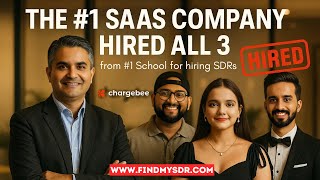
This is a YouTube video titled "Success Story 2- The Real Reason Chargebee Hired 4 SDRs from School of SDR" containing a detailed English conversation recorded in 2025 between Rahul Wadhwa and CJ. The discussion focuses on the hiring experience and feedback regarding candidates from the School of SDR, highlighting their preparedness, quality, onboarding speed, and retention at Chargebee. CJ shares insights on Chargebee's hiring process, talent density, career progression, and the advantages of recruiting from a structured SDR training program. Rahul leads the interview, exploring the impact and value these candidates bring to the company.
Hey cj, welcome. Thank you so much for being here.
Hi Rahul. Nice to connect.
My goal is to really understand what has been the overall feedback while hiring candidates from School of sdr.
Sure, Rahul. Firstly, I think I remember from a few years ago when we were chatting about hey, someone needs to build a school of SDR because this, this, you know, sort of the SaaS revolution was taking up. There were a lot of companies hiring and building teams in India and I think there was a need to build sort of high quality SDRs, PDRs as a cohort which can sort of work across GEOs. So I'm glad you're, you're building that and great to see some early signs of success there. Fun fact, I did not know while hiring these people that they were from School of sdr. So they went through the same rigorous process that we have for any other candidate. But because I think because of the quality that they had, they made it through to the final rounds and then finally accepted offers and joined us. There were a couple of candidates who have joined us in the marketing team. So that's, that's a whole different team and whole different process. And then a couple of candidates who we have hired within the sort of the BDR outbound team and I've personally also been involved in interviewing some of those candidates. So great to find out after the fact that hey, these good candidates that we hired did come from School of sdr. So kudos to you and the team.
Thank you. And the fact that, you know, all of them are still with chargeby, that I'm assuming gives you the confidence. I want to ask you one question, cj, which is what do you think chargebee is doing differently to retain and attract some of the good candidates? Because all the candidates when they're interviewing with chargebee and any other company, they're like, I want to join chargebee. I don't know why. I mean, while I know why because I work with chargebee and I understand why, but I want to understand what do you think they're feeling during the whole process? What are you doing differently?
So I think we've been running, building these teams over the last few years. So it's taken a series of iterations for us to continuously improve our playbooks, our process, both in terms of hiring and as well as when we actually have these teams executing on various mandates in different GEOs across different segments. So there's a bit of an experience involved, there's a bit of iterations that have gone into improving the quality of both Our hiring process, onboarding, as well as the journey that a new SDR or a PDR takes through chargep. There's also been a very conscious sort of career mapping that we have done over a period of time. So there have been a lot of, say, people who have gone on from. We used to have LDR teams back in the day, so LDR to an SDR to an AE to, you know, a team manager. They have been BDRs. So our current BDR manager joined us as an individual IC, SDR working first on inbound and moved into a BDR role, then, you know, sort of over a period of time became a BDR manager. So we've always been conscious of creating these internal career paths. So there is, there's growth, there is progress. So that's probably one of the reasons why we are able to attract good candidates because they see these success stories and want to emulate them. One final thing I'll touch upon is one thing that we are very conscious of is just the talent density, right? Each new hire that we make, currently every company wants to run with more optimized, leaner teams. And talent density becomes increasingly important in such scenarios. So every new hire that we make has to level up as compared to the current team average or where the current team is and be value add to the mix or not bring tabs down. So what happens is, even if, when we hire somebody who we think is really good, when they come and join the team, they still feel challenged, they still feel positively challenged to, you know, sort of continuously learn, perform and be amongst a peer group which is again, talent dense. So this keeps the team on its toes. There is a lot of positive reflection on how do we continue doing better. So that element of talent density, I think plays out well and helps the broader team just level up over a period of time.
And would you happen to know by any chance, based on what you just said about team members leveling up and of course there is an environment which kind of nurtures this kind of whole relation where everybody has to look up to and everybody has to kind of level up from school of sdr, did they? They displayed that level of commitment.
I think the couple of SDRs that are hired in the marketing team, from early feedback, I think they're doing well. They continue to well since they were hired. One rep that we hired for our team, there are a couple of things that I really liked about that candidate. So one, even during the interview process, she was one of the most prepared candidates that I've come across And I probably would have hired 100 people at such. We probably interviewed a large volume of people over the number of years. I remember two particular people, including the one that I'm talking of, with whom I've seen them just being the best prepared candidates over the years. There was one, one candidate a few years ago who came to the office with five pages of handwritten notes about chartreuse context. And that was for an early LDR role. And I was massively impressed with the sort of. Just the.
I remember we talked about that. I remember.
Yeah, we spoke about that. And then just recently when we hired this candidate for the BDR role, where she surprised me was I'd given her a bit of a sort of scenario or task to work on before my round and which was just to plan and approach one of the newest segments in the markets market that we were targeting. She came prepared with a presentation which was like a fairly matured one in terms of just the content and approach. It felt like somebody who's, who's actually been thinking about this for the last few weeks in terms of building it out. And I was fairly, fairly impressed by what she was able to deliver in terms of just putting up that presentation, her approach, the content, the context in couple of days. I'm sure she used a combination of modern tools to get that. But that also shows that you need context, you need those mods to, you know, sort of use the modern tools and get, get your format, get your content together. So that was very impressive. Even after when we've hired her, one of the things that we were doing certain mock calls and it felt that she was like again, she's been doing this for a few months, not just in general but, you know, very, very quickly adapting to ChargeBees context. So I think both those things have been fairly impressive. Still early days, but I would say posted sign.
Thank you. Yeah, I think I reached out to Srinivas. I believe she's working with her him and I think he had a similar feedback in terms of the kind of effort she had been able to put in, especially from the fact that she's very young in the career and the kind of effort she was able to put. I'll definitely reach out to her to see what she prepared. Probably we missed the presentation and. All right, thank you. Now, in your own words, cj, please tell us, what do you think is the best advantage charge the got by hiring from school of sdr and especially the fact you only got to know this later.
Yeah, so I think the thing was These were candidates that we thought of as any other candidates, but they felt better prepared. They were of a high, you know, sort of degree of quality. When they entered our rounds, they went through a rigorous process and ended up getting selected to the team. And it was great to find out afterwards that, yes, they, they had gone through a program with you and the team with the school of sdr. I think what I liked about these candidates was just, I think a couple of things, degree of readiness that they had. So it definitely felt that, you know, we hired this person and they could start contributing to the team two weeks, three weeks from now, versus, you know, you sometimes hire somebody on potential and you sort of, of course, work with them, onboard them, train them, get them context oriented, get them sort of going into a certain state of momentum and it takes a few weeks to a few months. Right. So I think just the time to onboard and be ready. That's been quite good. And it probably shows that they've gone through a more structured sort of training program to get there. And I think in addition, we've also felt their sense of eagerness to learn. That's been fairly promising. So still early days, but I think these are demonstrable signals that they will do well with us over the period.
Thank you. And final question. Let's say if a founder or leader reaches out to you asking you, hey, should I hire from school of sdr, what would your answer be? And while you have already demonstrated, you know, you're confident about it, what do you think? What would be that one liner response you would give them?
Yeah, so I think it goes back to a few years back, if you remember our conversation of, hey, somebody should be building this school of SDR in a, in a lot more structured way. Because it stemmed from the fact that back in the day, back like four or five years ago, when we were trying to hire from a pool of candidates in India, we had to really work hard to get the right quality, train them over a period of time, get them to a state where they are actively, positively contributing. I would say all of those steps can be skipped if somebody comes to, you know, sort of, you potentially looks at those set of candidates, of course they go through your neutral hiring process. But I would say there is an element of readiness, there is an element of quality that they would find. So, yeah, I'm glad you're doing this. Our ecosystem needs a lot more sort of high quality, skilled, you know, XDRs. That's the, that's not only for the role that companies are hiring them, but as we always look at them as an internal funnel for future roles and future growth within the org for people who can come in, perform with high agency and do well over a period of time. So yeah, I would recommend that if somebody is taking care of setting up the foundation for such strong candidates, definitely try it out.