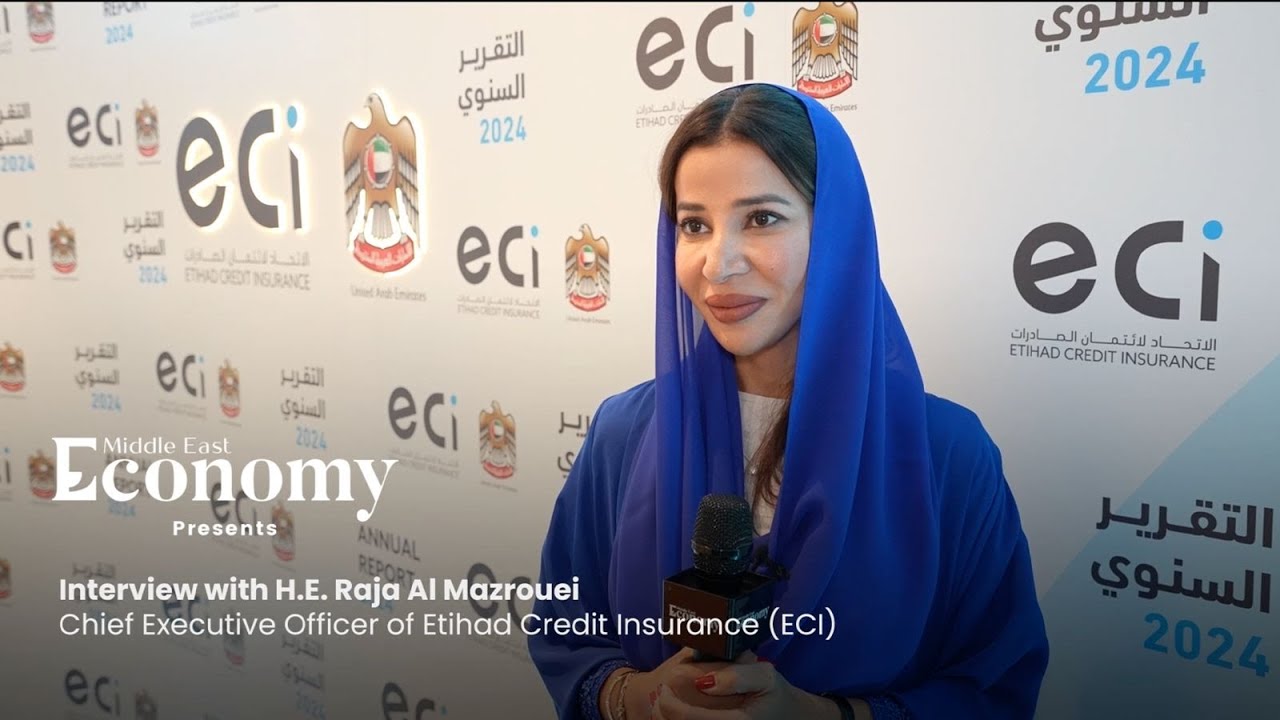
How AI & Digital Trade Are Transforming The UAE’s Economy | Raja Al Mazrouei
In this NextGen interview, Raja Al Mazrouei, CEO of Itihad Credit Insurance (ECI), discusses the UAE’s strategic shift from oil to a diversified, digital economy. He explains ECI’s role in enabling non‑oil exports by covering buyer non‑payment risk, and highlights the importance of Comprehensive Economic Partnership Agreements (CEPA) for global market access. Inspired by Sheikh Mohammed bin Zayed’s 2051 vision of exporting the last barrel of oil, he stresses upskilling talent and embracing technology. Raja outlines the UAE’s digital transformation, citing the appointment of a Minister of AI, 22 chief AI officers, and the potential of AI tools such as email‑responding avatars. He champions gender inclusion, noting that women hold 40% of cabinet posts and are increasingly present in finance, and emphasizes mentorship and role‑modeling. The conversation turns to leadership, where Raja advocates authenticity over authority, self‑awareness, embracing failure, and continuous feedback. He shares a personal story of launching the DIFC FinTech Hive in 2017, overcoming skepticism to build a thriving fintech ecosystem. Finally, he makes a case for investing in the UAE, citing safety, strategic location, robust legal frameworks, and high quality of life.
Chapters
TranscriptAuto-generated · 19 min
Hello and welcome to NextGen, your exclusive look into the future through UAE's industry leaders. Today's guest is Raja Al Mazrouei, the CEO of Itihad Credit Insurance. Excellency Raja Al Mazrouei, thanks so much for joining us today.
Thank you for having me.
So ultimately, you're helping UAE companies go global.
That is the main role of ECI. And the second one is our role is really to diversify the economy away from oil. And here comes our mandate to ensure non-oil exports of UAE companies. So with the CEPA agreements, the Comprehensive Economic Partnership agreements that the Ministry of Foreign Trade is really taking forward and progressing for the UAE, they enable us to connect with those countries and understand their credit the risks around those countries.
What would you say is the most common challenge or the biggest challenge for companies who are looking to export?
Not receiving the payment. And that's what stops them from exporting, because for a company to export, they need a letter of credit. So with ECI covering that non-payment risk of a buyer who does not have a letter of credit is the biggest advantage for any exporter. quarter from the UAE.
What would you say was the single most pivotal moment or decision that helped move the economy ahead?
For me personally, I was very inspired by His Highness Sheikh Mohammed bin Zayed Al Nahyan, the President of the UAE. A few years back, I think it was 5 years ago, right before the pandemic, we had the Government Summit. And he spoke at the government summit and he said, in 2051, we will export the last barrel of oil. What do you think we should be doing at that time? We need to think about it from now. We need to upskill our talent to be able to do that now, and we need to identify the opportunities and the tools and the means that will take us where we want to be. And for me, that was, as you say, a wake-up call. We need to diversify. We need to upskill. We need to understand the dynamics around us that affect the economy to remain competitive and leading in our region.
So if we take the conversation back to the non-oil economic growth that the UAE is projected to have, what would you say is the next game changer or the next sector that will really make waves in the UAE and globally?
Digital economy. Digital economy is definitely creating an opportunity for all countries to grow. As we all witness right now, technology has affected all sectors. If you go back to 2017 and you look at the top capital markets, it was dominated by oil and gas, financial services, some tech companies. But if you look at the top capital markets today, you will see it's dominated by tech companies. And why is that? Because we're moving towards efficiency and intelligence that is generated by machines that we train and nurture. Artificial intelligence is not only going to affect the way we do business, it's not going to make us irrelevant or redundant. On the contrary, it will give us a lot of help, a lot of efficiencies, and a lot of tools for us to enjoy working without having to do all the— I don't know which word to use, but the you know, basic—
Redundant.
Checking your email. Like, I would love to have an avatar in my office that responds to my emails based on my way of answering emails and my judgment. And, you know, I look at the feedback every day and say, oh, that was okay. Or I say, no, next time when you find a question that's really So I see us there in a few years where our, for example, emails understand how we would answer.
It's really interesting to see how the UAE is a pioneer in pushing to understand and use and implement AI.
So the Minister of AI was appointed back in 2017, and when that announcement came out, I am sure a lot of people were like, Minister for AI? Why? I think today we understand why. The UAE government has just appointed 22 chief AI officers in different government entities to showcase the importance of AI and how it's going to shape not only the private sector, but the government sector, which is the public service. And then when you look at AI in particular, you need to understand more than one thing. As a leader, you need to understand what is this technology, how is it going to disrupt the economy, am I going to be protected or disrupted, and if I am going to be disrupted, how, and what should I do now to avoid being disrupted or obsolete in a few years?
Let's talk about your personal journey and your leadership journey as the chairperson of the Harvard Business School Umm Al Meena Advisory Board. You're also serving on the boards of Zan Digital Bank, Al Ansari Financial Services. I'm curious to know, when will women in finance be a norm and not someone seen as having broken barriers?
For us in the UAE, we see this as a norm. I am in a country where close to 40% of the cabinet are Women. Women ambassadors, women CEOs, women are everywhere. And we have the mandate of inspiring the next generation. And that's why we go and we speak about our journey and how we navigated all of the career angles to reach where we are today. So I personally think it's a norm. And by the way, for the first time in my career, When I started to go to trade credit insurance events, I noticed there is a lot of women in trade credit insurance.
And you're very outspoken, you have a very public position. How are you leveraging your voice to promote the UAE's standing internationally?
So I go to events and I speak whenever I am invited, although this speech will take probably some of my time that I would rather put in generating a transaction, but I feel it's equally important to go there and speak. And if you touch one person by that inspiration, then that makes the movement. So I'm very outspoken. I participate in events. I share a lot on my digital channels, specifically on LinkedIn, about all the initiatives And all the activities that I am personally involved in because it really opens up hope, it opens up minds, it opens up something for someone somewhere. For me personally, I used to be inspired by Her Highness Sheikha Lubna Al Qasimi, the first woman minister. I was like, wow, she did it. So You always need that role model, that anchor that will give you, you know, that it's normal. She did it, I did it, you can do it. So we have to continue to tell the story and we have to invest in mentorship programs. And it is very important for women to be mentored during periods of their career because they're overwhelmed with responsibilities. graduating from school, getting the dream job, then the dream family, then the family responsibilities, and then still wanting to be on top of everything. It's okay to balance the responsibilities during that time, but then you'll pick up again and you will get where you want to go. There is no deadline. That's what I say. There is no deadline to achieve. You can achieve when you're 20, you can achieve when you're 50, whatever makes you happy. There is no deadline and there's no criteria. As long as you're happy, then you've answered the question.
When you look globally, what lesson do you think other economies can learn from the UAE and the way it operates?
You know, having an open mind is very, very, very important. When, you know, I started working with innovation in financial services, the conversation with financial institutions were very harsh. there was compliance and regulation, and they will use every excuse not to open their labs. But then there were those institutions who were open to the conversation, who created an environment for testing and for collaboration and for co-creation and for failure and for whatever it is. And we were able to launch some products. So really having an open mind towards anything will give you a new perspective. So I believe that the UAE has this open mindset that enables it to assess every situation as it evolves or as it emerges, or assess any opportunity or any technology or any trend as it comes, gives it enough view and analysis, and then decides whether this is good. Okay, let's try it. Let's create something where we can test and play with it. And if it works, we launch it, we scale it. And if it doesn't, that's okay, we tried, we look at something else. So I would say progressive enablement of whatever reform or technology or
whatever. I want to touch on one of the points where you say if it doesn't work or if you fail, it's okay. And sometimes I feel like within certain cultures, failure is something that people are scared of, so they won't try. How do you overcome that?
By experience. I have failed a few times and it was okay. I was mentored and I was given another opportunity. And I think it is important because how would you learn if you don't fail? Because you learn from your experiences and failure gives you a lot of experiences to reflect on and to learn from and to adjust and change.
If you had to give one piece of unfiltered advice to young professionals who are looking to become leaders and get into leadership roles, what would it be?
If they want to get into leadership roles, they need to be serious about it. So they need to understand their personalities very well and understand how they would be contributing in a leadership role. It's very important to understand that leadership is not about authority. It's about authenticity. Because to be a leader, you have to lead from the inside, from your heart. It's not because I am the CEO or I have the charter that appoints me that people will listen to me. I have to connect with them. I have to understand what they're doing. I have to convince them that I understand what they're doing or what I am doing. I have to inspire them. Otherwise, I will not succeed. So it's really, really important to be authentic no matter what. Whatever you learned about leadership and I've done, you can guess how many courses or books, I really realized that it's your authentic self that will help you connect with your team and with your peers and lead them towards a common objective.
And I love how you say it's first of all understanding yourself. First of all, understanding what it is within you. So it's not just about, oh, that's my dream. It's looking within and seeing what are my strengths and building on that, which is something that not many say.
And also, what are my weaknesses? So I have been in very difficult situations within my career where I thought I can't do it and I was almost giving up. But then I came to think, so what? Let me try. You know, I became fearless, but I became fearless not in a bold way. I became fearless of Can you
give an example maybe from your early days of a really challenging moment?
This is an example I always share, is when I took on the role at the DIFC of the FinTech Hive. That was in 2017, and in 2017 in the UAE, nobody, very few people heard about FinTech, including me. But then at that time, we had the opportunity to, you know, look at the financial center and its strategy of growth, and we realized that technology is affecting all sectors, including financial services. What do we need to do as DIFC to remain competitive and make sure that our clients are also competitive and benefiting from this technology? So we realized that fintech is really changing the sector, and then we started to look at fintech, and I fell in love with it because I come from a technology background and I have been working in financial services for a long time. So I thought that was the— I was the ideal person to lead this initiative. However, during that time, I didn't get any support from my friends or my colleagues. They thought that I'm doing something crazy because most probably it will fail and then I wouldn't know what to do. I mean, many years later, thank God, it is one of the most successful initiatives We started with zero companies. Today, the IFC is celebrating, I think, close to 1,500 startups in the center. It's a great challenge that has helped me understand my powers and also understand that being agile and being authentic and saying you don't know something when you really don't know is okay. I learned a lot from the startups. I learned a lot about fintech from the startups. So when I was recruiting them for the program, I would ask them about the technology and they will explain and tell. And then when I had those conversations with my peers, they say, oh, but what do you know about fintech? I was like, as much as nobody. There's not much that I'm missing out on right now. But right now is the opportunity for me to tap into fintech, understand fintech, understand the technology, be the first in the UAE to lead this initiative. So I looked at it as an opportunity, not as a challenge, although it was very difficult at that time because I was trying to figure out what was going on. But I am grateful for that experience because it really shaped me into who I am today.
So if, final question, we take another look at leadership as a topic, what would you say are the biggest misconceptions when it comes to leadership and something that might be holding people back?
Misconceptions about leadership are many. I would go back to my point of authenticity versus authority. Uh, an authentic leader is a person that his team will believe in, his team will trust his vision, and his team will invest in that vision and enable him to achieve there. Authoritative leader will not get anywhere. He could use, you know, his appointment and title and everything, but leadership is really, I would like to say, an inner connection. If I don't believe in you, no matter how much I show you that I'm here to support you and I respond to your emails, I will never give you that energy that you require for us to achieve this. So it is really important to understand one's strengths, weaknesses, acknowledge the weaknesses, the areas of development. I always ask for feedback. And, you know, something—
Do you think you get real feedback or are people scared?
I do, I do, I do, because I ask very frankly. So I do receive that feedback. And it's more important for me to understand the areas of development than the areas where I am great.
Has your leadership style changed over time?
Oh, so much. I am more patient now and I am more expressive. So I give feedback most of the time, good or bad. I always give feedback. And what you see is what you get. And now everybody knows this because I like delivering, I like creating impact, I like outputs, I like results. So I'm really focused on what is it that is going to generate those results rather than, you know, getting busy with other things. So my team knows me, my colleagues understand how I operate. And yeah.
I know I said final question, but last thoughts I promise. Why should people invest in the UAE?
Why not invest in the UAE? Because it's safe, it's secure, great location, international law if required, legal and regulatory frameworks, multinational, has the most beautiful, you know, places to go to. Amazing schools, amazing healthcare system. It's open, and we have proven ourselves over the last 53 years. And I think if you don't invest in the UAE now, then it's too late.
Excellency Raja Al-Mazrouei, thank you so much for your time today and for this very candid conversation.
Thank you for having me.