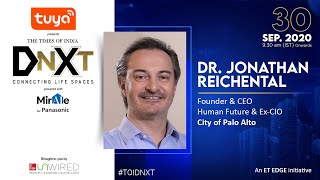
In this expert talk, Jonathan Reichental, founder and CEO of Human Future and former CIO of Palo Alto, outlines three major trends reshaping connected living. He begins by highlighting rapid urbanization—3 million people move to cities each week and infrastructure is expanding at a Manhattan‑size rate monthly—while noting the resulting challenges of congestion, poor air quality, carbon emissions, and sea‑level threats. The first trend he describes is the hyper‑digitalization of cities: deploying dense sensor networks, smart signage (e.g., LinkNYC), and connected infrastructure that can monitor parking, traffic, air quality, energy and water use, thereby improving quality of life. The second trend is the ACES transformation of automobiles—Autonomous, Connected, Electric, Shared—illustrating how self‑driving, networked, electric, on‑demand vehicles will alter mobility and enable redesign of urban layouts away from car‑centric grids. The third trend is the rise of drones, both aerial and terrestrial, for delivery, inspection, and emergency services, supported by recent regulatory approvals for commercial use (Amazon, Walmart) and pilot projects like the Starship robot. Reichental concludes by emphasizing the need for inclusive, sustainable smart cities and promotes his newly released book, Smart Cities for Dummies, as a resource for the broader public.
Chapters
Foreign.
Welcome to our segment on the Expert Talk where we bring to you three trends that will transform the future of connected living. And our first expert. Joining us Right here is Dr. Jonathan Rackendel, founder and CEO of Human Future and ex CIO City of Palo Alto. So we're looking forward to learning from you on the global perspective and the various trends that are transforming the future of connected living.
It's lovely to see you, Eisha. Thank you very much for that lovely introduction. Yeah, I'm thrilled to be here at this event. I've done a few of the Times of India events and so very happy to be part of this. Yeah, there's a lot I could share with you, but I got some short amount of time and so I'll jump right in and tell you about the three trends that I've chosen today. And I'll start with something that I think we can all relate to very, very quickly, and that is our home. Our home now belongs to cities. We see about 3 million people moving into cities every single week, and we're building infrastructure at about the size of Manhattan in New York every month. And by the way, we'll do that for the next 40 years. And as we cities grow, by the middle of the century, we'll be up at about 70% of all humans will be living in cities. So our future really does belong to cities. And whilst they've been incredible for bringing so many people out of extreme poverty and making a better education, more available to more people and more job opportunities and just better economics overall, they certainly have their fair share of challenges. And it's not hard to see what those challenges are every day with our own eyes. One of the greatest challenges that we see in almost every city in the world is the problem of congestion. Right. Of traffic. And this picture here is not unlike what my commute used to look like before the pandemic. And we'll probably we'll get back to there again when the pandemic begins to subside in a while. But in every major city, if you travel from the airport to a hotel in the downtown area, you will confront this kind of traffic. So we have a big problem to solve in finding new ways for humans to move people and goods that's either very clean and efficient cars or alternatives that should include things like walkable cities and cities where you can cycle. So our cities are producing an awful lot of byproduct through, you know, providing this abundant way of life that we all have. And it's coming at a price. It's the price of air quality. And the World Health Organization maintains that up to 2 million people die each year as a consequence of very, very bad health, air health quality. Our cities are also the place where we are creating a lot of the carbon emissions that the scientific consensus says it's heating up the planet. And so if we're going to solve climate change, we're going to have to do it inside our cities too. 1.5 billion humans live on coastlines in about 600 cities. And so as the sea level rises, those cities will flood if we don't begin to address this big challenge. But moving down sort of to the local level, to the activities we see every day, we have old systems that are supporting our city function. This probably looks very familiar to those of you who've ever dealt with a city issue. And the reality is this is how our cities function In a world that really wants to function like this. We want to be able to provide a digital experience because this is what you expect and experience in the private sector. And we want to see it also in how we interact with our cities. And what that all boils down to is we want more digitalization and more connectivity, because after all, they both go together. You've got to have really good connectivity. And so the first big issue or the big trend that we'll see is how we digitalize our communities and cities and how we connect them in a much more rapid and fast and dense way in terms of how we communicate. So major cities around the world are already deploying infrastructure to support, you know, connecting our cities, connecting our people to our cities, connecting objects like cars and sensors and, you know, things like waste baskets, trash cans, so that we know when there is trash to be collected. So we need a digital infrastructure to support solving and providing a better quality of life for people and our future in cities. And so the major shift is going to be how we interact and connect with our city, not only the services, but the infrastructure. In the future, not too long from now and already exists in some cities, we'll be able to do things like tell the air quality in all aspects of our city. If you are suffering from a lung illness, it'll tell you whether you should avoid a certain area because of high levels of air pollution. We'll be able to use our smartphones for finding parking spaces, that is before self driving cars take over. Of course, we'll be able to do things like manage our energy and manage water better. So a major transformation that's going to take place in the next few years Is the digital transformation of our cities to support a better quality of life. And we'll see some of it. We'll have to connect things like sensors. And those sensors will show up on lampposts, right? So here you see one. This is actually a project that I did with my team in Palo Alto when I worked there. And this set of sensors here does things like detects available parking spaces. It also counts traffic. It also detects, for example, the speed of cars, the type of vehicle, the direction they're headed in. And we could add more and more sensors to this to enable us to capture more data that helps decision makers, helps inform our communities so our cities again function better through better connectivity. In New York City, for example, there were over 22,000 phone booths. And of course, as we entered the 21st century, more and more people had cell phones and finally smartphones. Nobody was using these cell, these telephone booths anymore. But the telephone booths were compelling because they had power and telecommunications going to them. So the city came up with the idea of replacing them all with these new devices, the digital signs called Link New York City or Link NYC that would provide free WI fi, free high speed WI fi, but also connect and allow people to make free telephone calls anywhere in the world. Digital sign would allow enable people to get information about the community. So not only can people connect to this thing, but they can be connected to each other through this digital signage. Now the next big phenomenon that's related to our cities is the future of cars. And it's been said that one of the biggest game changing technologies of the first 50 years of the 21st century will be the emergence of the autonomous vehicle. Cars will drive themselves. I have no doubt. The reason, I can say this with confidence because I have been in many of them and there are many self driving vehicles already here in Silicon Valley. But that's not all. There is a quick acronym that I'm going to share with you called ACEs a c e s ACEs. It's an easy one to remember and it describes a more connected automobile future. The A stands for autonomous. As you can probably imagine, the future will be about autonomous vehicles. And that will include things like drones and trucks and buses and even even motorcycles and bicycles which return themselves when left at any location. And so the C then stands for connected. Every car, every car pretty much coming off the production line today is a connected car. Whether it's connected to a satellite system for information on weather or roadworks, or it actually now is connecting with the infrastructure, collecting data about congestion and other infrastructure alerts that a car should be aware of. Cars will connect with each other and when they're autonomous, they will negotiate around each other. And then the E of the ACES is for electric. And we just had an announcement here in California that by 2035, 15 years away, we will no longer be able to buy or sell gas powered cars in California. And I know there in India too, you have some pretty aggressive goals in the 2000s for a similar target. And then the final letter of ACES is S stands for shared. We won't own cars, we will be just having them on demand. There will be fleets of cars managed by organizations that we will just call up on our cell phones or smartwatches or probably the next connected device that we can't even think of right now. And so that will totally transform the automobile industry. But it'll go much further than that. When cars can drive themselves and they're connected to the infrastructure, we can design our cities differently. We don't need traffic signals or stop signs or we don't even need lanes. We certainly don't need the grid system, which has been such a significant architecture of American cities and other more recent recently built cities. We have built our cities around cars, not around people in the last 100 years, which is terribly unfortunate. What connected cars might enable us to do is to start to build the cities around people again. And that's really a good news story. Now, the third and final connected technology I want to share with you is the emergence of drones. Today. They're quite rare and they're sort of a hobby. There's sports with drones and we see drones definitely in things like building inspections, in emergency management, for making movies and documentaries where you have to have a flexible camera. So they've become extremely popular and valuable over the last decade or so, but they're going to be a lot more present and a lot more connected in our society soon Here in the United States, just in the last two weeks, the Federal Aviation Authority, which has, you know, responsibility for the airspace over the United States, they approved both Amazon and a major other retailer called Walmart, which many of you know to be able to use drones for transportation and delivery of goods. So we used to think overnight was fast. We used to think that same day was fast Here in Silicon Valley. There's a lot of things we can do same hour, we can do within one hour. Drones will even compress that time even further. So the drones will have to be connected to each other. They'll be connected back to base, they'll be connected with us, and they will become a very visible part of the urban environment. Now, we often think of drones just as flying mechanisms, but, or what we call aerial drones. But there is also the emergence of terrestrial drones, these vehicles that drive around communities and increasingly will be driving around communities, delivering things and picking up objects. When I was at the city of Palo Alto, we experimented with this very robot right here, this very specific terrestrial drone right here called Starship. And you know, it can navigate its way around a city. It doesn't go very, very fast and it doesn't go very, very far in terms of distance, but it's very effective for delivering food and potentially delivering medicine to people who are maybe homebound. So these, again, these devices have to be connected to the infrastructure over various wireless networks. They will be embedded with artificial intelligence so they can operate. But we can anticipate that a whole variety of drones are going to be a very visible part of our urban world. So in summary, you have three major connected phenomena. Our cities will become hyper connected as we deploy more digital infrastructure. Our cars and automobiles will become a lot more connected and out of necessity as we go to a world of autonomous vehicles. And finally, we are going to see drones emerge in our urban environment in a very big way over the next few years that not only will be visibly different, but will offer capabilities that we don't have today. So as I wrap up my comments here, in the short time I had, I wanted to just share with you some information and education on this topic, if you like. The topic of the future of cities and everything about them in terms of how we can improve them, how we can improve quality of life, more inclusion, more equality, how we can have more cleaner energy. I've written a book on it and the book came out two months ago. It's a huge bestseller. I couldn't be happier. It's called Smart Cities for Dummies. But it's not for dummies, it's for everybody, for everybody who's interested in, in our future, in our future of cities. And you can buy it all over the world. You should find a link in smartcitybook.com and I would be so privileged and honored if you wanted to learn from my book. And with that, in the time I had, I wanted to say thank you very much. It's been a real pleasure to be able to spend this very short amount of time with you. I understand you're having a great day and hopefully you'll have a continued great day. I'm not sure if I'm going to take questions or not, but I'll pass you back to Isha. Thank you very much.
Thank you so very much, sir. And I can't wait to pick up the book Smart Series for Dummies. And I'm sure our audience here is also looking forward to learning now that we know that the three trends that you shared, you know, focusing on cities, getting the automobiles connected and drones. So we have a lot to look forward to in the books. I'm sure you'll have a lot of readers from our audience members joining in. Thank you so very much for your thoughts there.
My pleasure. Thank you.
It's been an absolute delight listening to those fantastic trends. And our next segment is also going to take those trends forward by our keynote speaker and future of Connected Living Mirai by Panasonic. But before we introduce to you our next speaker, I'd like to request all of you to please be a part of our opinion poll. Share what you feel and let's see see what maximum of you think. On the other side, our keynote address on future of Connected Living Miraya by Panasonic. So stay tuned.