#67 Urban Innovation Leadership Programme: Navigating Change and AI in Cities
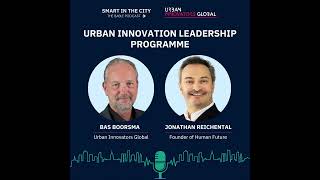
Baz Bourzma and Jonathan Reichental discuss the Urban Innovation Leadership Programme and how AI and decentralisation are reshaping cities. They argue that lifelong education is essential to thrive in the Fourth Industrial Revolution, and that public sectors need to shed risk-aversion to keep pace with rapid change.
Chapters
Foreign.
The City the Bible Podcast where we bring together top actors in the smart city arena, sparking dialogues and interactions around the stakeholders and themes most prevalent for today's citizens and tomorrow's generations. I am your host Tamlin Shimizu and I hope you will enjoy this episode and gain knowledge and connections to accelerate the change for a better urban life. Smart in the City is brought to you by Babel Smart Cities. We enable processes from research and strategy development to co creation and implementation. To learn more about us, please visit the Babel platform at Babel SmartCities EU so you might have noticed a bit of a theme in some of our episodes lately, and that is that we're talking a lot about leadership in urban spaces and urban innovation and also how fundamental education is when we're talking about smart cities. So that is because at baba, we have recently launched a new academic program, the Urban Innovation Leadership Program together with Urban Innovators Global. So here with me today is someone you might remember from his episode while he was still CDO of Rotterdam on the podcast, and he is none other than Baz Bourzma. He's the founder and partner of Urban Innovators Global, professor of Practice at Thunderbird School of Management, author of a new digital deal, and as I mentioned, the former CDO of Rotterdam, which is welcome Baz.
Good day Tamlin, and thanks for having me.
Always a pleasure Baz. And accompanying him is also another great guest with a very long titles, lots of things going on in his life. So none other than Jonathan Reichental. He is a respected professor of the University of San Francisco, founder of Human Future, author of Smart Cities for Dummies, and I've also learned many other books including really great books also for kids. And he's also the former CIO of Palo Alto in California. Welcome Jonathan.
Great to be here.
Great to have you. Thanks for also joining us very early on your side. So before we get into digging into all of your expertise and so many interesting topics here, I want to get us to know you a bit more. So we always start off with a bit of a teaser. So between the two of you, I actually saw a lot of parallels between the experience that you have in common. You're both professors, you've held similar positions in local government, wrote books, founded companies. But what do you think is one thing that you do not have in common?
Baz, it's all yours.
Well, first of all, we both love Star wars and we've been together nerdy enough to try and break into Skywalker range of George Lucas in California. Right. So we do this type of things, but there is a big difference. I also love Star Trek and I don't think Jonathan likes Star Trek. So there's the differentiator.
Yeah, I don't know Star Trek. Well, I wouldn't say I don't like it, I just don't know it. Yeah. But definitely we have a lot more in common than we have differences, which I hadn't thought about until I saw this question. So that's really. Maybe that's why we like each other. I think Baz is one of the, my best friends, one of the greatest guys. So we have a lot in common.
Yeah, a ton. I actually, when I was looking at all your credentials, I was like, they are going to say the same thing over and over again. Right. But I'm really interested to also dig into your different perspectives. So, Jonathan, I listed your credentials, but please tell me more about you as the person. How did you get into all of this and tell me where you are today?
Yeah, yeah, thanks for that. I'll just be brief. I'm a technology guy. That's my background. I was programming when I was 10 years old and I've had various technology roles. But the surprise that happened in my life just a few years ago was I was invited to be a leader in a city moving from the private sector. And, you know, I was curious and I was intrigued by the opportunity. So I, you know, big in long conversations with the city manager prior to saying yes, you know, he tried to convince me and I tried to really understand it. And finally I said, yes, let's do this. You know, I'll make a bet on you, you make a bet on me, and we'll see what happens. And the idea was that I would go to the city and I would work with the team and partners in the community. You know, being Palo Alto to the center of Silicon Valley, I thought, here's a great opportunity to use tech to move the, to create a model and move the city forward. And we would together change the city. But the remarkable thing is while we did some of that and I got a lot of stories to tell about that and they've been well written about and talked about. The city ended up changing me, and that was the big surprise. So I just sort of fell in love with this space and realized that cities were the grand challenge of the 21st century. I hadn't realized that until I was deep in, in the work and I'm hooked. I've been hooked ever since. And so I think That's a big defining quality of who I became. But who I am today in addition to that is I'm an educator. That's really what I am. You know, I think about writing books and creating a video series, running workshops, being a professor, doing work with, with Babel and, and Urban Innovators Global. For me it's all about spreading the knowledge of innovators and helping people realize their full potential. So that's, that's probably who I am today.
Really, really well, well spoken and really interesting background on how cities are shaping people as well. So Baz, we heard from you last time but for, you know, give us, give us also some intro into who you are, how you got to your role today, what, what shaped you.
Well, it's actually I only came to think of it now that this is another thing where Jonathan, I differ. I did not start out as a technological guy. I studied history and my professors warned me at the time if you do that, you take the longest road to unemployment. And I was never unemployed, luckily. But what got my digital career started, my career in digital and cities is really, I was running a different company in the late 90s and I had lots of customers that were travel oriented, transport oriented, mobility oriented, and you know what? Then 911 happened and I lost like 2 3rd of my customers like in two weeks and I had to rethink what I'm going to do next. And all that was there with me was customers on tech digital. People hadn't invented the term smart city yet, but it was kind of emerging. All the broadband, you know, what we're going to do with all fiber broadband and what will that mean for education and healthcare and citizen services? And then I got a call from Dutch government and said, Baz, you're working with some of those cities around the world and we would like to create a network so that those cities can work together and start learning from each other. And I actually as, as a commission job, I ended up building this foundation which was actually one of the first smart cities networks in the world. Again, that word still didn't really exist at the time. And so I'll cut the story short, but that's that 22, 23 years of work in this space at this particular point I always hint at, but that's where it started. A number of years later I got a call from Cisco because that was in the year 2006, 2007, An Inconvenient Truth from Al Gore had just come out and everyone was thinking green at the time. And the then Cisco CEO John Chambers was on stage with former President Bill Clinton under the banner of the Clinton Foundation. And John Chambers, in his mid American accent, was saying, oh, Mr. President, I'm going to demonstrate to you how we can help green cities through network technologies, and I'm going to put my own good money into it. And like, 60,000 people at Cisco were going like, oh, no, John, what did you commit to now? But that was the start of a massive smart city program called Connected Urban Development. And it connected cities like San Francisco, Amsterdam, Seoul, Korea, to collaborate. And we actually pushed lots of thought leadership. We created proof of concepts. That was my start at that level, really getting smart community thinking to the next level. And it evolved from there. Cisco is a great employer, and I worked in. It worked for them for 11 years. It's a little bit like Hotel California. You can check in anytime you like, but you can never leave. But at the end, I did leave about six years ago, and the journey continued. I became professor of Practice at Vandenberg School of Global Management. Later on became Chief Digital Officer at City of Rotterdam. And now we're on again with Urban Invaders Global. It's been a great journey and I've never been bored for just one second.
See, I learned stuff, too. That was cool.
Yeah, yeah, absolutely. I was reminded of stuff, too, that you talked about the first time we had the podcast, but also we'll make sure to link back there too, for all the listeners. You have some great stuff in that episode that's still really applicable today. Speaking of that, to remind ourselves, last time I asked you to share an inspiring quote with us or like something that you like to live by. I don't know if you remember what it was, but I'll tell you in case your memory doesn't serve you well, if you are living in times of radical change, if you're living in a design shift, learn to be comfortable with being uncomfortable. Can you speak any more to that? Has your perspective changed at all since you. What do we think it was like 15 months ago or something that you recorded that?
That's correct, Tamlin, and I still absolutely live by it. It's to learn to be comfortable at being uncomfortable when living a design shift is fundamentally true. But I think the design shift has become larger in those past 15 months for circumstantial, contextual reasons. Anything from conflict in the world to politics, you know, that actually aggregates the sense of change for the better or worse. But at the same time, if you purely look at digitalization and also digital as a Force for the other, let's say transformative changes. You pump cities like, you know, energy transition, circular economy. It is aggregated and one of the main aggregators over the past 15 months has been AI. AI has left us even further in times of a shift that a lot of people experience rather personally, and it's accelerating even further. So if you're not that good at being comfortable, at being uncomfortable, I propose that you try and learn, because it's going to be even more important than I was thinking of, let's say, 50 months ago.
It's crazy, right? 15 months ago, we weren't even using ChatGPT.
Correct. It came out in that month.
I used to make podcast episodes without ChatGPT, you know, so, yeah, there we go. So I want to ask you both, what does it really mean to be in a system or design shift? What does that actually mean, though, when we say that? Jonathan, you want to go first or.
Sure, I'm happy to. Well, I'll talk about system shift specifically. You know, if you think about the modern world, it's not that old. About 270 years approximately, starting in the 1700s and what defined the modern world initially, and historians will probably argue this, but I think the first industrial revolution really shapes the world. And 100 years later, we get the second industrial revolution and. And then in the mid-1900s, 1955, 1957 and beyond, we get the third, which gives us the information age and all the digital stuff and electronics and all the stuff that's enabling this to happen for the four of us to be here on this digital platform in different countries in the world. It feels like now we are and have the evidence for a new yet a fourth Industrial Revolution, a convergence of the digital world and the physical world, what we call cyber physical or digital, sometimes referred to. And just like the previous ones, you know, the world, the world is changing. Life is going to change. The nature of being a human and existing on the planet is changing. And what makes it different is, first of all, it's happened sooner than the last in terms of cadence. And the actual leaps that are being made during this 4th will be greater. As Baz alluded to, artificial intelligence is not a, for example, a sort of a small change that affects one or two industries. It is a big change that affects every industry. And it's happening fast and it's disruptive. And whilst in previous centuries we had more time to prepare and adjust and evolve, this is happening a little bit faster than perhaps most of us realize. And so the preparation has to Happen faster. The acquiring the right skills, being able to move into different areas and in what you can provide, the value you can bring to the world is going to happen more greatly. But being open to that I think is really key. So our time together here, 2024 is a moment that is we should look at in the context of a fourth industrial revolution, A significant shift in which the world will look and behave differently as we progress through and get to the other side of it.
Really, really thorough and well thought out answer Boz do you have a different perspective on that or anything you can add to what Jonathan already said there?
There are a few things that I would love to add. So first of all, I thoroughly agree with all the things that Jonathan just said and I think it's a great way of describing exactly what, what where this journey got started and where we find ourselves. I mean it's a system shift that we're living, but also a. I would say that the previous industrial revolutions have been several industrial revolutions, each of them incubating a system shift. But together they were one design shift that is going from what it was to something highly centralized. Centralized production, centralized time zones, centralized retirement schemes, centralized education systems, everything centralized. This is what a series of industrial revolutions essentially did. Where this is not only a new industrial revolution but also a design shift is that we're letting go of some of that centralized organization to being decentralized, highly networked. Just think of how we befriend it's network. Look at how we learn. The teacher is no longer the centralized holder of monopoly of knowledge, the determining what children will learn or will not learn. They are a coach because Learning is happening 24,7 in this highly networked society. This is so distributed. And this is a design shift that is not just something that touches on technology. This is what some people think if they hear the word digitalization or digitization. They think oh, it's all about technology. No, digitization, yeah, digitization is the process of going from analog to digital. Digitalization is a design shift and a system shift where we actually completely let go of centralized organization. Or not completely, but large kind of to make place for a way more networked world. And what is typical for a design shift and a system shift is that it also comes with new values, new dreams, new ideas, new jobs, new. It's not just about technology, it's the entire world around you that is Chang and this is exactly where we find ourselves. And this is accelerating because it's not just one technology like the steam engine or electricity, powering this, it all started with digital technologies, but those have now created new children like AI, which themselves represent a design shift and a system shift that lands on top of one that started just a few decades ago, which we are only starting to understand. So this leaves us even more disruptive, disrupted. And while this comes with plenty of opportunities, massive opportunities that we could be very positive about, it obviously leaves us challenged because us, the way we're wired as human beings, we are very able to deal with cultural shifts, you know, shifts in values, expectations, outlook on life over a generation, like 20, 25 years. But all of this is happening in a matter of just a few years. Damien, you were just saying like you did not have ChatGPT just 15 months ago and now you do and your world has already changed and this is even accelerating more. So this is tough for anyone.
Absolutely exciting, but also nerve wracking times, right, that we're living in. You guys both describe yourselves as educators at heart. And I think also why I'm so excited about our joint program and what we're working on with the Urban Innovation Leadership Program is that one of the ways that we kind of conquer a bit of these challenges that are coming about because of this rapid change is through education. So with this, I want you to put your educator hat on. I want to look at a few different things through a couple different perspectives because you guys have it all. You have all the varying perspectives from both of you on your side. So if you put your educator hat on, what is really the core, what is the importance of education when we're talking about this design shift and system shift and about smart cities and urban innovation.
Happy to take that. A few years ago I was, I had a call it a one man show. I did this performance and it was called Winners and Losers in the Fourth Industrial Revolution or something to that effect. And it was an optimistic, it was a positive story, but through the lens of some risks that every one of us could be exposed to. When you look at these industrial revolutions over the last 270 years or so, as each progressed, not everybody succeeded, that's the truth. But some people really thrived. And so what I like to do is learn from the past. It informs us in the current and helps us think about the future. And I think about the fourth Industrial revolution now we're all part of it. We're much more informed, we have much more access to information. Nobody can say, I didn't know, you can't say that today because we're so connected. So we kind of know that we're going through this system shift and so there's a choice to be made. And obviously I'm simplifying here for the time we have together, but you know, are you going to choose to be a winner or ignore the signs and what's happening and not maybe be as successful as you could be? So for me, you know, education means that you're choosing first of all to be a winner. You're choosing to acquire perhaps new skills and new insights that set you up for success in the future. The changes that are happening right now and will happen in the months and years ahead will be highly disruptive and people will be displaced and people will lose their jobs and they will be less relevant. But if you are learning and retooling and are enlightened about, you know, what's happening, you can be well positioned. For me, that's the tie in is, you know, I do believe in lifelong learning always and it's more important than ever. It's not just sort of a cliche, you know, it actually is the difference between a life fully fulfilled and one where there's more struggle and to the degree you have the opportunity, and more of us have the opportunity than ever to learn right through all the channels, position yourself with the tools and the skills to be successful in the fourth industrial revolution rather than not see it, the writing on the wall, excuse me, and not be the fulfill your full potential.
Absolutely. Bas, how do you see that from the lens of maybe these leaders in urban innovation do what? What is education? Why is education so, so vital for these people when we relate it specifically to leadership?
Yeah, that's a super good question. Here's the thing. First of all, I think that as we let go of say, some of the more centralized organization structures, the old tendencies of being a good old boss, centralized control, top down management, we're letting go of a lot of that. If you look at the younger generations, they're much better versed at collaborative structures and broader governance. Which leaves the successful leader of tomorrow much more effective if she or he will apply, let's say, leverage, a circle of influence rather than a circle of control. And that requires talent, it requires a different way of bonding with people. And then the other component that I can highlight is obviously what does it take to be a good innovation leader? Because that's the question that you ask, what does that mean? And we are living in this time of radical change, which means that you've got to out innovate yourself and your organization faster than you can say the Word innovate. And the problem with innovation is that you never know what you're going to get. It's like the box of chocolate it right. And that is troublesome for leaders that want to get reelected because they make this promise and then they can't keep that promise because they are going to deliver on innovation. But then the typical innovation journey looks like, I think I start out in A, that may be an assumption that might be wrong. But let's say I start out in A, I'm going to try to achieve B, but suddenly I achieve C or D or E or F. And then you know that your original idea has exploded in your face. And that is really troublesome for people that want to get reelected or organizations that are risk averse. Now 80% of public sector is like that. It's risk averse and it will typically do something if other civil servants have done it also or other public sector leaders have done it also. So as a leader you've got to prepare the minds for that. You yourself got to be learning to be comfortable with being uncomfortable because you don't know what type of outcomes you're going to get. You need to also understand that yes, your project manager, your PMO office is all powerful and can do a lot of things. But if you're going to try to confine everything to KPIs, you may forget or be blinded to the harvest that might be left and right to you, but it's just not fitting in that KPI. That too is innovation leadership. And this is something that you can educate yourself for. This is something you can prepare yourself for. You can learn the lessons from other leaders that have gone on that journey and have succeeded. There are ways and methodologies that you can motivate your teams, your staff. You can strike build design structures of collaboration that will get you to innovate successfully. That is something that can be learned, but it's not something that is optional. It's actually mandatory. We need it today.
Let me add something to that actually, if I could. That's great points that Baz is making there. I've had the title, I've had the word innovation in my job title in my life. I was the head of technology innovation at a big firm quite some time ago. I've been thinking about why is it so hard? Because innovation is really hard, really hard. And look, if we were all good at it, you know, it would be a different world. I don't know actually what it would look like, but we're not. Some people succeed and or some organizations succeed, some don't. And what I've concluded, or at least my current place, where my thinking is, is that innovation is hard because typically you're building for a world that doesn't yet exist. Right? Innovation is all about building for tomorrow, next week, next year, whatever. And that's very different from reacting to the past. You know, you can kind of respond to what's happened in the past, you can respond to what's happening right now. But when we think about, like just a new product or service, you've got to build it for the marketplace of tomorrow and not the marketplace of yesterday. And that makes it particularly hard. So the question is, well, what do you do about that? Well, that's why you have to experiment more. Because. Because you're inventing for a world that doesn't yet exist, or innovating for a world you're. You're going to make mistakes. You're going to. Actually, it's not going to work, but some things might. So I think that experimentation comes into the center of the topic now in a. In a much greater way than ever before. And while this has been recognized by the private sector, you know, I think about the businesses I've worked for in the past and the companies I work with today. The private sector businesses, they get experts, experimentation. But if your question later on is, you know, what can cities do? I'm going to answer it right now and say they need to experiment more. And we've been saying this for a while, but it seems like that's the way in which you build for a world that doesn't yet exist. You make some bets and something's going to pay off. It's not how you do everything, but a part of your world has to be experimentation in the 21st century.
Can I add, can I add on to that a little bit? Because there are so many people in public sector and people that are not in public sector that will judge on public sector that they are not the ones to do that, that they should just live on. They should just serve society, keep it free and fair and deliver on citizen services and regulate. That's it. But the great book from Mariana Masucato, Moonshot Economy. For anyone that has not read it, definitely recommended reading. She makes the point that governments have often done this. Actually, it's sometimes markets that fail or markets simply don't exist. The typical example that Mariana Mazzucato always provides is the Apollo moon landing program, right when President Kennedy said, look, we're going to go to the moon and we're going to do that before this decade is out. He actually established a mission that didn't just galvanize America, but it galvanized public sector because it had to do something for which the markets didn't exist and the technologies hadn't been invented. There was no market to address that. So it became a public sector program. And that particular pattern has happened again. Without public sector in America, the Internet would not have emerged and evolved in the way that it did. Think of all the predecessors to the Internet, you know, had a military and academic background. And it's an important thing to remind ourselves that public sector can do this and often should do it if markets are not doing it.
Really great discussion here. I don't want to break it up, but I do want to now ask you a bit more, more from your experience, you touched on it obviously just now, but from your experience with public sector. So if you can take off the educator hat, of course it can stay in the room. But put on the public sector hat a bit from your work with public sector. What do you think is really, really missing to make public sector more agile, better prepared? These things that you were just discussing, Buzz, what is the driver behind this?
Well, first of all, I want to say something super, super positive. I had never been in a public sector job after decades of work and working in private sector and working in technology companies and what have you, not what surprised me. I probably had that kind of not so positive appraisal of much of public sector when I came in and role cdo. And what actually surprised me is how hard people work, how driven many people are. And I think first of all what's missing is sufficient respect for that aspect for all of those people, that government, that think that government is kind of something evil that must be kept very small. I couldn't disagree more. I mean public sector is a great good and there's wonderful people working there. Now I think what is missing is that much of public sector is still organized in very old fashioned, old paradigm centralized ways. Much of it is top down and there isn't really a collaborative culture and people are not encouraged, back to the previous point, to innovate, to take a risk. If anything is missing, it's that particular component. And I think it's also something that does start out at the top where you're going to have a proper mandate, where you're going to create that, you're going to allow people to be mandated, back them up in full and allow them, give them a license to fail. Because this Is another thing. If you're working in an organization that's truly risk averse, and again, most public sector organizations are, then risk is not that failure is not an option. But if you innovate, failure is an option. Actually, the opposite is true. It is a good thing because through failure you learn how many rockets did Elon Musk blow up before he got them to fly? And he's still blowing them up, you know, but he's learning now in public sector somehow that's not a thing that you're allowed to do, but you should. And obviously, yes, there is a thing of taxpayers money. You're not going to blow up rockets, you know, all on taxpayers money. Well, NASA has done its fair share, but you know, in principle that's not the idea. But there needs to be an understanding that you cannot make progress that society needs, especially in this time of massive change, without that type of risk taking, without that type of mandated innovation, and therefore also with the acceptance that failure will be part of your journey. Don't fire people because they fail once or twice. Applaud them and explain. Allow them to tell what they have learned. That type of culture needs to be, needs to be nurtured and it's going to take time and not everyone is going to feel comfortable in it, but that's part of where public sector needs to go to.
Yeah, not blowing up rockets, but really like housing.
Borg.
I had on here Lisa Olson the other day and she was talking of course about how they have an award for the biggest failure in their council. Right. And not to applaud the failure, but they're applauding the lessons learned from that. And I think that is a really strong cultural message to stand behind as well in, in, in public sector. Jonathan, how do you see it from your perspective?
Yeah, sure, great points there bas made and I would echo many of those. I also want to recognize the great work that's been done. Like let's, let's be real clear about that. The cities are better positioned today than ever before for success. You know, they have chief digital officers, you know, they have chief data officers. So they recognize digital and data more than ever before and they are experimenting and they are innovating. It's not, it's not pervasive. You know, the future is here, but it's not evenly distributed as they say. So you know, a lot more cities, cities have to come on board and recognize that. And I think that's the sort of what's ahead of us is getting those smaller and medium sized cities which are the bulk of the cities in the world to understand these qualities that can further the agendas. I think the one thing that I would just add to this conversation in terms of what's missing or what can. What can change is incentives. Incentives. This is what I saw working deeply in and continue to see in cities and other types of governments around the world. They get the opportunity to work with so many different types is a consistent issue or challenge with, with incentives that is very different from the. The private sector, where, you know, if you are tasked with a certain major objective, you know, the, the higher you perform, the better you're rewarded and the better, you know, all the outcomes are. Whereas in many agencies, and I'll be quite coarse about this, I'll just say often if you're, if you don't do as well or you do really well, it doesn't make any difference. So we lack that sort of extra impetus. And I'm not even suggesting what the incentive is right now, whether it's monetary or recognition or something else. I'm saying we just need to think about incentives that encourage the kind of outcomes we want. We know this from behavioral economics, something that's been studied for decades. We know this works. Humans need this. And if we want to make and see progress in our communities in a way that we haven't seen before, I think we need to focus on the incentive structure.
So incentives and this cultural shift in the way that we're thinking, really powerful messages there. So last hat private sector. We can't forget the private sector. Hat why do you think private sector also needs more education? And what are, do you think are the key challenges that they're really encountering right now?
Who wants to go first?
Yeah, sure.
So a lot of people, to my previous point, feel that public sector is the less sexy place to be in a private sector is where all the dynamism happens and where people are supposedly, you know, more faster and they are sitting on a better set of innovative ideas. And that very often is not necessarily true. And so what is really needed is for a lot of enterprise to really be aware of what the world is that they live in. If we think of the urban space, and that's the topic here in this podcast, we think of urban innovation. You actually have to understand what it is that's happening there. And I've seen way too often presentations that are so off the mark, which tells me that people aren't simply unaware of what the circumstances are that they need to sell under and that somehow they believe they can help their customers
with
yet another vendor that is providing a digital platform for all of the urban services promising their audiences. That is going to be one platform to keep the entire city operating. And I always say, well, you know, to use that paraphrase of, of Lord of the Rings, one platform to unite all of them into darkness. It's not going to happen because cities by their very nature are a mess. And there's always going to be a thousand platforms that are somewhat loosely connected under the most ideal circumstances deal with that reality. That's what it looks like. But then there is this mindset within the company that is not dealing with it. So given the speed of urban innovation, given the speed of digital, I think it's very important that practitioners, leaders within those companies get to that next level of informedness. Skills also important to up your skills in a sense that, let's say the single skill job is on its way out. And that doesn't just apply to private sector, by the way, but if you are working in a technology firm, for instance, it was just simply good enough to be a fantastic engineer and just watch over the product that you see evolve no longer.
True.
Very often you need to be able to also be a great communicator and have people understand what a product will do. And more than that, the ability to empathize actually, you know, great service, great solution. Hello. Who are what is being left out of your design? Have you actually considered that question? These are the type of design think skills, emphatic skills that are uniquely important to the era and place that we are acting in. So this is the type of, of skill sets that are so much needed. And this is why it's so important that as we are building the academic leadership program, Tamlin Urban Innovations Global and Babel Smart Cities, collaborating and building the academic program that we are not just focusing on facts, focusing on technologies, focusing on the hard skills of the past, but really looking at that array of larger skills, soft skills, empathic skills, collaboration and drill down deep so people start to feel, understand, appreciate the level of detail, the level of how deep the challenges run and then be prepared for it. That's what our program is all about and how we should be taking it further. And this is definitely what is needed in private sector.
Yeah, a lot to digest there. But I'm wondering Jonathan, what do you think with Your private sector Dr. Hat, what are, what are they? What are they missing? Why do they need more education?
Yeah, I, I love so much of what Baz said it was. He made such, such Incredible points. I, you know, the point about communication skills and soft skills can't be said enough. And as a professor myself, you know, I'm teaching often hard skills, you know, quite, quite technical skills. And, and, and yet with those classes, I'm emphasizing why it's so important to make presentations and have your presentations be critiqued and to work in teams and to really strengthen your collaboration skills. You know, some students are working a group and they have issues, they have tension and you know, they, one person does a lot of work, another student does less work and they complain. And what they're actually learning is what it's like to, to live in the real world, that these are the realities of, of humans working together. And you have to figure out how to overcome those and turn a bad situation into a good situation. I'll share with you a quick story that I've been sharing quite a lot and people, it's been resonating, which is, you know, it's in, it's in the government arena, but it applies absolutely to the private sector. And that is. There was one of my staff members many years ago, you know, he was, I came in as a, as a leader and he just was part of my team. I didn't hire him. He was just part of the team and he was a project manager and he kept doing projects and you know, I would review projects with, and the success of the, and the ongoing progress of projects with my, with the team members. And he over and over was having a lot of issues. So one day I sort of had to sit down and really try to understand this. And I said, have you ever had formal project management training? And that the answer was a surprise. He said no. His project management skills just evolved over time. He just sort of grew into it as so many people do in their work, right. They're promoted into positions because they show potential or demonstrate certain skills. This is the same with the private sector and the public sector. So I said to this individual, we're not going to give you any more projects. In fact, stop everything you're doing and we're going to spend, we're going to invest in you over the next few weeks to go to school, learn project management skills and even get your certification, your PMP certification. And then we'll give you a project and see how you do. Well, long story short, he came back, he started doing projects and he was one of the highest performing project managers on my team. What's the lesson there? There's a couple lessons. One is you got to understand the strengths and weaknesses in your team members and understand if there's gaps, that's where you have to educate. You have to educate in those areas. And number two is if you're going to ask people to do things, make sure you've given them the skills to do the work you're asking them to do. If we want people to innovate more, we want people to use data in more creative ways in public agencies or in the private sector, we got to give them data skills. You know, just asking for it isn't going to happen. We actually have to invest to make it happen. So I think that's what I would say for both industries, and you asked specifically about the private sector is let's make sure people have the skills for the work that needs to be done tomorrow and not skills that are now obsolete because of the past. Things you don't need. Right.
That's a really powerful story of leadership. And I think that puts us all into the mindset of how we're really building teams and building successful teams that can innovate quickly and can do the jobs that we want them to do. So really powerful there. I have one more question, because we touched on AI a lot and already we flirted with AI, But I want to dig a little bit deeper into it because I know you guys are both dabbling with it quite a bit. And it's so prominent now that there's so many different benefits, challenges that are coming out. What do you think, Jonathan? What do you believe the integration of AI into city infrastructures and services presents more benefits or challenges? And what impact do you think it will have in the overall scheme of urban development?
Yeah, sure. First of all, recognize that AI isn't new in the public sector. It's just been kind of more behind the scenes. What really is new in the last since November of 2022 is generative AI, a specific type of AI. It's a subset of the bigger topic and the ability to create new content based on some simple prompts. And that is offering the public sector a lot of advantages. And clearly with the introduction of any new tech, we're asking some questions about any of the risks. So, you know, probably more than city leaders recognize. Staff are already using it quite a lot for generating content. You know, I'm working with one company right now. They're called Legislate, in fact, and it's in its early stages, but basically with a few prompts, it can create things like proclamations, declarations, and eventually it'll actually generate the first draft of legislation. So really seeing some optimization opportunities there. So I think there is a huge upside to content generation within the right set of rules that are appropriate for your agency. I think staff need to be educated and this is where I get a lot of demand, actually significant demand over probably any of the topics I've been teaching over the last three to five years. Agencies want guidance like how can we use it in a positive way to serve our communities but also manage the risk? Right. That's the sort of the, how I would characterize generative AI. But what we're going to see clearly over the next six to 12 months, like really in the near term and beyond is going to be this generative AI capability baked into everything, baked into our productivity tools, our traffic management tools, you know, more and more into our cyber cybersecurity tools, you know, the day to day products. The financial system that we use to run a city AI is just going to start to show up in all sorts of ways, prompting us and assisting us all along the way. And I have to say that's probably a very positive thing. Right. And I'm very supportive. I think, you know, in AI I'm okay swapping out a, the artificial for augmented right now. So thinking about this is augmented intelligence. How can these new tools help city staff and leaders do what they do, but do it better? I suppose maybe create some efficiency, some automation along the way. The question of whether there is higher risk in the future for jobs for creating maybe problematic content or output, I think we have to face that and that might be a little bit further in the future. The existential questions of automation and AI are still a ways away, at least as far as I can tell. Although we might get surprised. Right. So what we've seen over the last few years is yes, the public sector did embrace cloud computing and I think the same thing we're going to see with AI. We might be initially a little reluctant, but I think we're going to embrace it and it's a real bonus to public agencies.
Absolutely. Buz any final word on that?
I'll try to be quick. I think what is very important about AI in a city is that it helps to deliver on things that we've been promising ourselves for a considerable amount of time. Give you an example. Many city innovation programs, many chief digital officers have been preparing for open data programs, bringing together as much data as humanly possible and then, you know, fingers crossed that something innovative will come out of it. Problem with that has been that it lacked purpose, generic storage of data and then having some wild, you know, goose chase and some, a few, few, few hackathons to, to, to hope that something come out of it and then obviously very, very little happens. Obviously. There's also been the statement that data is new oil and the data is the big new currency. And, and that's also been, been a bit of an underwhelming reality on the ground. Data. There was no scarcity and not every piece of data was as valuable as the other. But here's the one thing we have a limit to look at the relationship between particular pieces of data and its impact on whatever is happening around us. AI is changing that AI is actually allowing to see relationships between data that we human beings would not and that allows for those open data initiatives, for instance, to finally become relevant. Very simple example, it may very well be that if there is a major car accident at the east side of the major archery ring road around your city, that at 3pm for reasons that we don't understand, the parking lot at the east part of town is full. It's like the famous butterfly that claps its wing in China. And therefore a, you know, huge storm is brewing over Florida. And that's, that's, that's the level of complexity that human minds cannot really penetrate or get or embrace. AI can and it will. And it's already impacting the massive complexity of city dynamics, the way cities get managed, the way traffic is happening in it. And this is going to be very impactful. One final comment. On a negative side. A lot of people have been saying a lot about Armageddon happening and Terminators coming. My biggest worry is much more mundane. That is about jobs. And it's not just about the loss of jobs. What will soon happen is that most of us are going to have a job where we're going to monitor as to whether AI has been doing the right job. And that's pretty boring. And I think there is a challenge. How do we keep ourselves inventive, creative, doing stuff that human beings do best and not just be in a job that we need to monitor AI?
Yeah, really, really interesting perspective on that. So that's all for the main interview part. Now I just have a little fun segment for you and we're touching back on a segment we haven't done in a while and it's a bit of a fun one. It's called Freaky Friday and I thought you were perfect candidates for it. Freaky Friday. Switch places with your co interviewee and answer a few questions in their shoes. So now baz you are Jonathan and Jonathan you are Baz. And I will now see how good your communication and marketing skills are because you and some of your soft skills because now I want you to try and promote each other's book. So who would like to start?
So I'll be happy to promote Smart C's for Dummies.
There you go.
God.
I am Professor Dr. Jonathan Reichental and I'm very proud to actually again put spotlight on my fantastic book Smart Cities for Dummies. And the interesting thing is that yes, it is for dummies in the sense that it's for everyone. Everyone gets this book. This is a book. This is not for the techno. Well, it is also for the technical people but for everyone Whether you are 18 year old, fresh out of college and you are going to study psychology to anyone that actually wants to manage innovations in a city. But this is for everyone. This is about our urban futurist. This is about your aspirations as to what you want your city to be and how you can contribute to that. And in that sense, this is not a book for dummies. This is a book for the brightest and most colorful of minds. I hope you will enjoy.
Read mine.
Well, thank you for that.
How did you.
That was impressive. That was really impressive. I am Professor Borisma and I wrote a book called A New Digital Deal. I was thinking about some of the things we're confronting today, many years ago already. So in many ways I'm happy that I was able to anticipate the great digital transformation that's happening to society and how we can prepare. So it was a little prophetic and it's more relevant today than ever before in helping organizations and individuals understand our time of digital change and why it really matters in everything we do. And it's a very popular book because it was written initially in English, but now it's available in Arabic and perhaps one other language which I just can't remember right now. Maybe Jonathan, you can help me.
Well, Bas, I remember having seen Danish and Italian editions also.
Oh yes, it's also Danish and Italian. So yes, I'm very. I think it's more accessible because it's in different languages. So I hope you'll enjoy it and I'm pleased that it's a lot of the thoughts I had have come to fruition. It's more relevant than ever.
Wonderful. All right, that was a good exercise and really funny to hear. So thank you both Jonathan and Boz. You may switch back now into your respective bodies. So now I get to now I get to ask you the question that I ask every single guest. It's a recurring question. And actually, Boz, you answered it last time, so I want to kind of refresh your memory a bit on how you answered it also. So the question is to you, what is a smart city? And bas answer last time was to me, a smart city is a city which leverages the best of its citizens, the creativity of its citizens, the best of all stakeholders, the best of technology, the best of new designs and old designs to arrive at a community or city as a series of communities that is resilient, that is happy, and that is getting ready for the future and looks at the future with a sense of comfort and a sense of trust and confidence. That was your definition 15 months ago. You did, you did pretty good, I think. Do you want to adapt anything to the context of today from your definition back then?
No, I think this is pretty comprehensive. It doesn't focus on a singular technology or something and it's not technology heavy. And I think that's an important part of why this definition to me works.
Absolutely. Jonathan, to you, what is a smart city?
Well, I have my well articulated definition in my book and in my writing, but I want to even simplify it further because I get asked this question a lot and I want to start by saying the word smart cities is not nearly as important as what we're trying to achieve. So you can call it many different things. I'm not. None of us are really hung up on that anymore. And it's sort of evolving, actually, over the last decade. And I'll just say it like this, you know, first of all, every, every city's challenges and priorities are local. Right? So what's important to Rotterdam may be different from Palo Alto. What's important in London may be different from Sydney, Australia. And those cities should focus on those things. But ultimately what this is about is how can we bring innovation and particularly technology to bear on improving the quality of life of our communities. That's it.
Really, really well put. And thanks also for simplifying as you've also put everything super eloquently. What a dynamic duo to have both of you guys on. So thank you so much for coming on. That's all I have for you today and I'm really, really happy to have dug out so many of your interesting insights. So thank you so much.
Thank you, Tamlu.
Thank you.
And to all of our listeners, don't forget, you can always create a free account on Baba-SmartCities EU. You can find out more about Smart City products, solutions and implementations. Thank you all very much. Thank you all for listening. I'll see you at the next stop on the journey to a better urban life.
More from Professor

Technology Ethics and Responsible Innovation Coursera Specialization Launch Teaser




Technoethics: An Essential Leadership Skill for the 21st Century | Dr. Jonathan Reichental
Technoethics: An Essential Leadership Skill for the 21st Century | Dr. Jonathan Reichental


FOF 154 | Jonathan Reichental. On Cities and Governments Using Technology To Serve People Better.

Miasto to emocje, relacje i codzienne historie – rozmowa Waldemara Olbryka z Jonathanem Reichentalem

MS01┃Jonathan Reichental, PhD - Perfection, Creativity, and Who’s Actually Having Fun?