Accelerating Urban Innovation in the Age of Covid-19 | SmartCitiesNY Webinar October 29, 2020
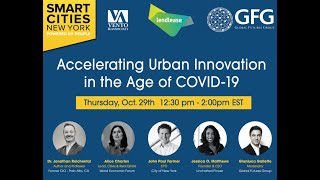
The SmartCitiesNY webinar, moderated by Gerry Halton and Gianluca Galletto, gathered a global panel of experts—Jonathan Reichental, John Paul Farmer, Jessica Matthews, Alice Charles, and Susan Constantine—to discuss how smart‑city concepts are evolving under the pressure of the Covid‑19 pandemic. Halton framed smart‑city evolution as three generations, with the current “Generation 3” focusing on resilience, wellness, and people‑centric technology. The discussion covered a wide range of initiatives: New York City’s Internet Master Plan to close the digital divide; Dubai’s aggressive paper‑less strategy that re‑imagines service delivery; IoT pilots such as CityScanner that collect granular environmental data from city fleets; Lend Lease’s PODIUM digital‑twin platform supporting the Milan Innovation District; Uncharted Power’s integrated infrastructure platform that turns street‑level assets into revenue‑generating edge‑cloud nodes; and the broader economic challenges of commercial‑real‑estate vacancies and municipal revenue shortfalls. Panelists emphasized human‑centric metrics—gross‑national‑happiness, 15‑minute neighborhoods, and time‑saving programs—as essential complements to GDP. They also highlighted participatory governance tools like New York’s participatory budgeting and NYCX Collabs, and debated the role of leadership, culture, and institutional flexibility in scaling urban innovation. The webinar concluded with a call for continued global collaboration among cities, NGOs, and the private sector to accelerate resilient, inclusive, and sustainable urban recovery.
Chapters
I'm Gerry Halton, one of the founders of Smart Cities New York. And I welcome people from around the world to this webinar on the future of cities. Smart cities, especially in the era of
COVID
I'm part of Global Futures Group, a firm made up of government officials, educators and business leaders who work in the area of technology and cities, especially powered by people. And our goal is to improve the quality of life for people around the world and to increase economic growth. We believe cities are the source of vitality and functionality that can be augmented by technology, especially in an era of pandemics and other threats to urban life. If you think about smart cities, we're in what I call the third generation. The first was Gen 1 was the sort of data centered in the 1910s and then in the 15's Barcelona. And we in New York began featuring the power of people as part of cities. And now we're into what I call Generation 3 as we work on how smart cities can create resilience and wellness. Of course, it's not the first time science and technology had the power to rescue cities. If you recall, London and big cities across Europe were failing because of cholera until the science discovered the source of the problem, technology solved the problem and cities went on a growth spurt that's really lasted nearly 200 years. So what are we seeing around the world right now? We're seeing cities like Singapore double down on their investment in smart uae, Europe, the US are all got examples. I think you'll hear more and more about them today. So in many ways what the onset of COVID has done is it's led to new approaches to cities where science and technology can provide the solutions. Not only does it reduce Covid, but it can increase economic growth and jobs. So that's why we've asked this panel, a delightful panel of experts, people with real hands on experience in what's going on in cities, to join us and to talk to you about what they're seeing and what they are building to make cities better. Of course, the heart of this is Jonathan with his new book Smart Cities for Dummies. Which really gets to the heart of what does it take to make a city smart? Which is a question I've been asked around the world and I think people continue to look for answers. So with that let me introduce my colleague John Luca Galletto. He's an expert in foreign direct investment, in innovation, how to make smart cities grow economically. He's worked extensively in Europe, but also around the world, including in Vietnam and of Course, the United States and New York City. So with that Gianluca stage is yours.
I left myself muted. I'm sorry. Thank you, Jerry, and welcome to everyone. We are really delighted to have you all here. And as Jerry said, there are people connected from I believe five continents today, which is truly remarkable because also we're living in an age in which we notice how globalization can have also some adverse effects, including the COVID crisis. I second Jerry, everything he said about smart cities, about us. We provide advisory to government and the cities, local government, national governments, but also private sector companies to try to put them together to provide the solutions for the future in an urban setting. Why the urban setting is still relevant because people are leaving cities. We don't know what's happening really what the end result is going to be. But still more than half of the people in the world live in cities. About 3/4 or more of the GDP of the world is produced in cities. And also a lot of problems like emissions, for example, producing cities. And talking about crisis with COVID is coming in a time in which there's other things that already happening. One of them for sure is climate change. And I know my friend Jonathan has seen this firsthand with all the fires and everything else. So what we want to do today is the idea is to provide you with some practical solutions, examples that we have seen around the world from people who have done things not just like seen or looked, you know, these are people who do. And finally, why we want to also make sure that smart cities for us it means not just a fancy tech, not just connected devices, not just algorithm, but it's really about how a cities prospers for its people. Because you can have the best algorithms in the world. But if some people cannot afford a house, there are 60,000 homeless people in New York. So affordability of housing, equity are all important questions. And what's important is that we try to democratize this concept because it's not just for insiders. If people people from doing anything in the world, businesses, but just a common person understands more of these concepts that are, these are solutions taken sometimes behind the scenes that affect us all the time. Look at energy, water, data, data, who wants the data or not? But by doing, by understanding, you can make better decision. You can influence your policymakers. The policymakers also can make better decisions. So without further ado, I will introduce the panel and then we go straight into the questions. You can see the bios actually in the link that we provided. So it's. We don't have to spend much time on that. But I'll go in alphabetical order and we will start. So introducing everyone, first of all, we have Alice Charles, a friend of ours from the World Economic Forum. She is a. She's an expert in real estate. She leads cities and real estate for the World Economic Forum. And basically it's a very global view. Secondly, we have Susan Collins from Susan Constantine, I'm sorry, from Lend Lease, which I want to thank. Actually, I want to thank Lend Lease. We are a partner of Lend Lease. We work in the Milan Innovation District. And I want to thank them for helping us in this. And sorry, I want to thank also Vento and Associates, It's a communication pr, strategic communications firm in Milan that's also helping on this. So sorry, Susan, going back to you. So she will. Everyone will tell us also more about themselves. She leads Europe. She's head of Business Europe for digital and for Lend Lease. And then we have John Paul Farmer, CTO of Chief Technology Officer, New York, formerly with Microsoft and formerly with White House. Finally, and not finally more, we have Jessica Matthews, a remarkable entrepreneur who started a startup that actually provides an actual solution. And she will tell you more. Very interesting. And last but not least, we have Jonathan Reichental my personal friend who has written the book Smart Cities for Dummies with actual purpose of democratizing anything and talking about him. I would just like ask him the first question and if you want to say a few things by yourself about the book and then you've written this book and can you tell us about what it says, what is the topic today? And please everyone, if you can give us examples, we need people to come out of this inspired but also feeling that they heard something useful.
Thank you. Thanks very much, Gianluca. So glad that you are doing this. And congratulations to you and Jerry for Smart Cities New York and for getting it going again. We've had a little hiatus, of course, but now we're in the virtual world. So here we go with Smart Cities New York again. So congratulations on your great work. I'm thrilled to be here with such incredible panelists. And I couldn't be more thrilled with our attendees that are coming in from Brazil and Saudi Arabia and Italy and so many different places around the world. So you're all very welcome. You know, I was thrilled. I worked for almost 10 years as the CIO and CTO of the city of Palo Alto, often called the birthplace of Silicon Valley. And it gave me a really fascinating sort of entree into how cities work and particularly how cities could run while utilizing new and contemporary technology. And I fell in love with cities. I really did. And I had the opportunity to work with leaders around the world, almost in every major city and country in the world, to help them think about how can we make our cities better places for people to live. Fundamentally, this is a topic about people, and it's a topic about quality of life. Sometimes we get distracted and we think, hey, we're going to talk about tech all day. Well, if we're talking about tech, we're talking about the wrong thing. We have to talk about issues and human issues. So last year, I had this opportunity to write a book on the topic. And I was so humbled to be able to bring together all the experiences that I had had around the world, lots of examples from the Middle east to South America to Australia, United States and beyond, and put it into one comprehensive book. So I, you know, it's a great honor to be the guy who wrote it, and it's received very well. And I wrote it, you know, not to make money. I wrote it actually to evangelize the important things we have to do to build better communities. Really, at the end of the day, if a city or a mayor or a city manager adopts any of my recommendations, I'm the happiest guy in the world, and it's a benefit for everyone. You know, cities are really important today. There will be an argument that perhaps during a time of COVID cities aren't as important, but I'm going to make the argument they're more important. You know, as you quite rightly pointed out, Gianluca, we're moving into cities in vast numbers. About 3 million people every week are moving into cities, and we're building infrastructure the size of New York City every month, and we'll do that for the next 40 years. So they really matter now with COVID there's less revenue, right? We see this. This is a real crisis right now. And so because there's less revenue, we don't know how long this is going to go on for. We need to innovate more. We need more urban innovation because we need more digitalization, which brings down the cost of services, hopefully, if you do it right. And so we see an acceleration, in my view. I wanted to give one great example. In Dubai, in the United Arab Emirates, only about two years ago, they initiated what's called a paperless strategy. The paperless strategy, and as you can imagine, it is about digitalization. It's about going from sort of analog city services to completely digital services. And Their target is around 2022. So it's quite aggressive and they're doing really well. There should be no paperwork, which should reduce bureaucracy and errors. But the amazing thing about this process that I want to share is not only are services going digital, which is a win, win all round, but it's creating the opportunity to reinvent how you deliver services. So as you inventorize everything from permitting to birth certificates to education stuff and buildings and transportation, all the incredible bureaucracy of government, as you digitize and inventorize each one of these, you say, should we continue to do it that way? Here's a chance to reinvent it. So I think, in conclusion, I think this is one of the hottest topics right now. It's only getting bigger and it's a multi trillion dollar opportunity for cities, for entrepreneurs and all sorts of industries.
Thank you, Jonathan. So let me go and. Sorry, I have troubles with the phone here now with the computer. Hold on a second. All right, doesn't open. So let me ask a question then too. Let me go to John, John Paul Farmer. And so they can start telling us something that basically what has happened in New York, I mean, New York, we talk about a lot of things about New York, including I've heard the mention ghost town. If anybody was with me on the Brooklyn Bridge yesterday, it couldn't be anything, anything farther from the truth. So packed and actually bump in the bumper. So what have you, what kind of technology strategy have you implemented here? What are you preparing for the future? What kind of initiatives? And also to both of you, as you already spoke, and I want everyone else to say something, is it relevant to. Again, I want to hear from you to speak still about smart cities and is it important. So give us some examples and
well,
thanks for that, Gianluca, and thanks for everyone for joining us here today. I just want to build on top of what Jonathan shared, we are seeing the acceleration of the digitalization of society. So I don't know if it's maybe we've seen seven years of progress in the last seven months, but it's happening and it's here to stay in New York City government. We've got a lot of important pieces to focus on and work on this digitalization of society. We've got the Mayor's office of the cto, which I lead. We also have an Office of Data Analytics, Office of Information Privacy, NYC Cyber Command, really important components. But then we've also got all these agencies that serve people, that interact with people and they don't always have the capacity that we know they need today and in the future. So we work on helping build that capacity. We, we've been connecting these agencies, especially in light of the pandemic, and we've been incorporating data in new and beneficial ways. I can attest that New York City is not a ghost town. New York City is New York City and will remain New York City. The things that we do, the things that my office focuses on even prior to this pandemic and this crisis, are four things. One, universal broadband, two, digital services. Three, inclusive innovation, and finally, fourth, emerging technology and society with a real focus there on digital rights. And so these were the things that we had in place. This was our strategy back in January. The mayor had already announced the Internet Master Plan, which he released to much fanfare. That is the roadmap for how we close the digital divide, how we ensure that digital redlining doesn't take place, how we help the. The two out of every five New Yorkers. It's really incredible. Two out of every five New Yorkers who are disconnected or under connected. We often talk about the digital divide as though that's a rural challenge, very much an urban challenge too. And the Internet Master Plan gives us a roadmap for really the first time ever, a portfolio approach by which city and industry can collaborate. Citi can maximize the impact of its real estate assets, buildings, poles, rooms, bus shelters, fire department call boxes, you name it. And we can really be creative about how collectively we solve this problem, how we provide lower cost options, because at the end of the day, this is an affordability problem. And the Internet Master Plan, when you look at it, it's a 4G and 5G technology plan, but it's also an equity plan. This is about how we close these divides, how we bring everybody on board, how we ensure that every child has opportunity, no matter what zip code they're born into. And it's also an economic development plan, which is so important now as we are all facing the challenge of rebuilding after the crisis. I bring up the Internet Master Plan because it came out before the crisis hit, but it's only become more important now. Everybody sees that these are not luxuries, these are necessities. This is not only the morally right thing to do, it's also the smart thing to do. This is the smart thing to do from an economic development standpoint, the smart thing to do from a public health standpoint. So a few things that we did, having the Internet Master Plan ready to go as Covid hit, we know we needed to make more connections internally within government so we stood up a Covid data task force right off the bat. Hilary Mason, a fantastic data scientist, volunteered her time to come in and do that work and lead that work for us, my colleagues. Kelly Gin, the Chief Analytics Officer, has created, in collaboration with the Mayor's Office of Policy and Planning, the COVID Data Recovery Partnership to help create pathways for private sector organizations to provide their data to New York City government for benefit. During this time, we're fighting Covid, we also had to do things like create a PPE dashboard so that we could have real time data from a lot of different sources about personal protective equipment. The gowns, the gloves, the masks that were being made here in New York, that were being bought and procured from elsewhere, that were being donated and being able to make sure those were directed to the right places. So data was really critical and core in the response. And it has shown to New York City government just how critical a good data strategy is for a government in any time of crisis. I do want to note some smart cities work. Traditional smart cities work not just thinking about the data layer, but really thinking about connected devices. Out in our communities, we've been really focused on ensuring that we're building trust in the way we deploy devices to make sure that communities understand the benefit that they're receiving. And it's not just a bunch of metal and plastic going off on poles in their neighborhoods, but we actually label what goes up so that people can see it and understand the benefit. One of the things that we've done earlier this year and we're actually running again, is a pilot with MIT called CityScanner putting an array of environmental sensors on city fleet vehicles. And what you see by doing this is that we're able to collect over 50,000 data points per week. Over 50,000 data points per week. Compare that to the old way of doing things where we might collect 9, 10, 12 data points from fixed devices that were averaged over the course of a number of days. And instead we can get minute by minute data block by block, and what that means for the efficiency of city operations. But also when you think about the social determinants of health, being able to really respond in a granular way to the needs of a particular block, where you might have kids who are suffering from asthma unnecessarily, where we've got the ability, if we have that granular data, street level data, block level data, we can respond and do the right things for New Yorkers. And it's important to note that this is all part of and will be a part of the Internet of things strategy that the mayor has announced we will be releasing and we're on track to release in the coming months. So those are just a few things that are happening. When you talk about the technology strategy, it's important to recognize that there is so much going on and there's so much that any government needs to provide that we really need to focus on Internet of Things, on broadband connectivity, on data partnerships, and make sure that these are developed in a way that they're complementary and we recognize the places where they can connect to one another. But ultimately, we got to be able to chew gum and walk at the same time. There's so much to do during the pandemic, but even after the pandemic, that we've got to be able to do a whole lot. And I'm fortunate to have great partners inside government, but also outside of government, in the private sector, in academia, in the nonprofit community that are helping us do just that.
Thank you very much, John. I'd like to ask a question to Jessica, because I want to see if we can. Jessica, can you tell us what uncharted power is about? What's your mission? What are you doing? Because I think it's just the first example of a real solution that you offer, and we'd like to hear that.
No, of course. Thank you so much, Gianluca. Thank you guys for inviting me to be in this virtual room during a time when I think we're having. We've all known this stuff was important, but it's fun when things. In a kind of twisted way, it's fun when. When things are important and urgent because then other people care about what we care about, right? So, like, let's just, you know, we've all been focused on this for some time, and now everyone's like, oh, my gosh, what's. What's going on? I also want to say thank you to everyone who's signed up for this from all around the world. I think a lot about who I am and the way I see.
Yeah, tell us. Tell us also about your story, because
it's a very interesting based off of, like, all the places that I've called home, Right. And the fact that I have to kind of find a common ground, be very aware of the differences, but find a common ground. And so I was born in Poughkeepsie, New York, upstate New York. However, I'm 100% Nigerian. I'm from a Doe state. My father lives in Nigeria. I spent a lot of time in Nigeria My father, before coming to the US where he actually met my mother, who. And they're both part of the same tribe. They met in Brooklyn. He spent a lot of time in Milan. He went to Milan Polytechnic. And so I always laugh because my father is.
I didn't know that.
Yeah, my father.
We have a great connection.
My father's a mix of Tony Soprano, the father from Coming to America, and Samuel Jackson. And so, like. And I am the daughter of that.
I need to meet him.
Good luck to everybody who has to interact with me and my fiance and whatever the. That always turns into. And then on top of that, right now, I live in Harlem, right? And so I have seen the big city, the small city, the European city, the sub Saharan African city. And there are a lot of things that make them different, but there are some things that are so the same that I have always had this kind of true north around, trying to address the issues that I think are very much universal, right? And there are a few universal things. Things. And so for me, I've dedicated now about 13, 14 years of my life, which doesn't seem like a long time to Everybody, but I'm 32, so it's a really fucking long time to me. I'm fucking tired. I'm gonna be honest with you guys. I've been doing this shit for a long time. For me, really thinking about, like, access to sustainable infrastructure, the biggest impetus came from the time I spent in Nigeria, because that was when it was very clear that it wasn't actually a socioeconomic issue, it was an infrastructural issue. And over time, I had to kind of learn and evolve. And my understanding of what the infrastructural issues really started to evolve. I started to see them more in different ways, even in Poughkeepsie, in Harlem, in Europe. And I think, for me, what's really exciting about what Uncharted power is really focused on right now as a sustainable infrastructure company that started thinking through power, but really now is focused on the streamlined integration of not only power infrastructure, but civil infrastructure and smart city infrastructure. You know, I think that the big thing is we all know that the world's in crisis right now, right? I'm 100% speaking to not even the choir, to the pastor right now when I say this, but for the few people who aren't, you know, as aware, you know, we're talking about natural disaster that are wreaking havoc at an exponential rate on our planet. My partner's from the South. His sister lives in Louisiana 5th. Not only did she just get Covid, by the way, just get Covid hitting the fifth like tropical storm, like, it's insane. That's what's happening in Louisiana. We have millions of students that lack basic access to connectivity today, in 2020, when they're in a George Jetson hovercraft world where Kylie Jenner could be a billionaire. We have people who don't have Internet, right? We have cities that are facing unprecedented budget deficits, marginalized communities that feel even more left behind. And what's been almost insanely frustrating, but almost exciting for me in my work at Uncharted Power and for our team was the realization that the problem isn't actually necessarily technological, right? Almost all of the technologies we need to have a world where people have the security and opportunity that they require in their communities. From 5G to AI to machine learning, all of these different things, autonomous vehicles, they exist. They exist, and if appropriately deployed, would address a lot of the problems that we need to have the data and understanding to improve the way people live in their communities. So then the question really became for us, so why then don't we have that? And unfortunately, the reality is, and I hate to say this, and this is going to be probably a little bit controversial, we've been building smart cities that actually aren't that smart. Guys, I'm just going to be honest, right? I'm just going to be honest, because a truly smart city should be a smart city that's scaled everywhere. And if every single community does not have access to smart, sustainable infrastructure, then there's something about the way we're doing it that's not that smart. And so what we then looked at that, well, what's actually the problem? And it kind of basically, it looks like we've been. We've been deploying smart products, but not really fully integrated cities. The analogy that I've been using for people not in the spaces, it's like going to a food buffet, like a really good Vegas food buffet. Like, you have the prime rib and the lobster and all that good stuff. And then you're like, this is amazing. I want to eat all of this stuff. And then you're like, where's the tray? And they're like, what do you mean, where's the tray? Where's the plate? Where's the cup, where's the fork? There's nothing. Cities right now have been kind of been said, look, we have all these amazing things you can do, but there's no streamlined way to integrate, integrate, deploy, and operate this smart city infrastructure in communities. And the result is siloed expensive solutions that really can't scale, right? That's why you end up having cool stories about how there were five smart streetlights, but then four years later, there's only five smart streetlights, right? And so what we've done in uncharted power is say, well, why don't we go ahead and create the tray and the plate and the fork? Why don't we create Basically an industrial IoT platform that streamlines the way that you can actually deploy and manage integrated critical infrastructure from power cables to, to broadband, to sidewalks, to water pipes? And so what we've created with our uncharted system that we're now actually going to be using to build a sustainable smart community in the city of Poughkeepsie is this solution that hopefully will become like a building block for everyone who's trying to really accelerate the pace of smart infrastructure development and communities. We're thinking about how costs need to be lowered, right? We're thinking about the platform methodology, of how we make sure that the burden doesn't just fall on the cities and its citizens, right? So looking at how we can have additional revenue streams from derived data insights, looking at how each paver actually doubles as a nano data center so that we can actually generate revenue from edge cloud services that further subsidizes the actual cost of the system and the infrastructure. That's what we're doing on our end. And we, we're not going to quit until every single place that I call home, from Poughkeepsie to Harlem to Nigeria to Milan, can truly say that the default is a smart and sustainable city. So, Gianluca, did I answer the question?
I believe so, but we have time to come back and also people will have. The attendees will have the opportunity to also ask questions a little later. That's why we make it a little longer today because of that. Let me ask a question to Alice. So, Alice, you've seen, you traveled with Ed at the end a lot because now we're all very difficult, but you know the world, basically, I think probably more than anyone else in this panel. And also you deal with the real estate, which is the built environment, which is critical in cities. What, what, what have you seen around the world that you can tell us? Also, we had a chat the other day. You said a couple of very interesting things that I also agree with on what smart cities, urban innovation means. So give us your take on the topic on your view, a global view.
First of all, thank you very much. Yeah. If you can hear. I'm just saying, first of all, thank you very much for having me, and it's a pleasure to be with all the panelists. And how do you follow Jessica? Literally, everything she said I completely agreed with. And it reminded me of work that we did a couple of years ago in India, which was part of their 100 Smart Cities mission, which was making a lot of those points that she just made. And I guess one of the things I do want to highlight, where we were with smart cities before COVID and what has been happening in cities because of COVID and where we likely will go. So before COVID we had seen a lot of the large corporates who had been investing in smart cities for many years had actually started to significantly reduce their teams. And actually, smart cities teams were disappearing, and they were calling them government teams. So that was because their businesses were not making money, and so they were not able to sell the kit they were developing to cities around the world. And why was that? You know, it was often because they were developing solutions that actually weren't what citizens needed and weren't what cities needed. And they didn't recognize what Jessica just said, that, yes, cities are similar, but there's different contexts. So, you know, a solution that you design for tropical. A tropical city in India is very different to a solution you develop for Las Vegas example. So in that context, we had seen a lot of. A lot of failures. What we had seen was a huge amount of pilot projects. And remember, Cisco did an analysis of this around the world, and they were saying 75% of projects were failing at the pilot stage. So we were not getting to scale for a variety of reasons. And I guess then Covid hit. So what's happened in Citi? So we've seen many things happen. We've seen a move towards sustainable mobility, particularly walking and cycling. We've seen mass transit being abandoned in many cities around the world, albeit I'm going to qualify it, that in Asia, it's came back and technology has been used as an enabler to bring it back. We've also seen huge issues with people's mental health. People have been isolated. We've seen huge rise in domestic violence. Just today, I got correspondence from the city of Melbourne, which was pointing that, you know, they had an increase of 59% in domestic violence against women since COVID 19 started. So, and that is something that many cities around the world are saying they've experienced. But at the same time, we're seeing a growth in innovation and Technology. And so, you know, you're seeing hackathons coming out of cities, you're seeing an interest in leveraging that opportunity in cities. Then there's the other side, which is real estate. So we are seeing huge vacancy levels, particularly in relation to retail, for example. And sorry, my 2 year old has come running into the room which is a real COVID 19 sign. He will be three tomorrow. But we are seeing huge issues with vacancy of real estate as well, particularly in retail and restaurants. And that may well continue for the next number of years because there has been a shift to online retail, to omnichannel retail. But at the same time, in relation to smart cities and innovation and tech, what we are seeing is a move towards solutions that are very much about buildings. So you know, how can we create healthy buildings? How can we create buildings that are net zero carbon? How can we bring people back into buildings in a safe and sustainable way? So we are seeing development of proptech. The other thing that we are seeing is huge losses of revenue in cities. And you know, John, in the city of New York, of course will be able to tell us about that. But whether it's New York or whether it's Helsinki, that's traditionally a city that's brought in a budget surplus of around 300 million Euro. Cities have lost significant revenue, and that's from mass transit, from sales taxes, from property taxes, etc. And their returns on their investments are down and their expenses are up. So you know, that's in terms of health, sanitation, et cetera. So in New York's case that deficit is plus 8 billion. In Helsinki's case that deficit is plus 500 billion. So that's significant. And as cities think about future investments, they're obviously going to have to think about investments where there's an opportunity to generate revenue as well from smart city solutions. So for example, if that's somebody commits an offence, which we're seeing in many Middle Eastern cities at the moment, and the police authorities are using smart city solutions to detect people committing an offence and they're able to share that revenue. So that is another area that we're seeing developing. So very much what I'm seeing is solutions around health and well being, solutions around revenue sharing. But as we move into the future, citizens are demanding a green and just recovery. And it has to be acknowledged that technology is an enabler of that green and just recovery. And whether that's in terms of the way we operate our buildings or whether we use digital twin technology to decarbonize our grid Systems, we will need to leverage technology. And I know Lend Lease is coming up. They've actually done an amazing job with their Podium platform recently, which is, again, cities are going to have to develop their digital twin technology to be able to interact with systems like Podium in the future. So I certainly see the need for innovation and tech, but I think the direction of travel has certainly changed in the short term, and really innovative approaches need to be brought to bear to find the revenue and the capital funding to invest in that technology in the future.
That's. Well, I'm just thinking that we, to everyone, we haven't scripted this. It's been, of course, we have planned the questions, we have some plan, but it's the flow. Honestly, it's just coming out incredibly, incredibly great way. Because now basically everything, everyone opened the door for the next one, the next panelist. So I want to go to Susan. Susan, sorry if you had to wait and sorry, before I was butchering your name, I just know someone, Susan Collins, and I was talking on email with her before. But let me first of all tell us a little more about what you do with lendlease. But also we want to know what kind of cities, what kind of neighborhoods Land Lease is being committed to building. You have an enormous pipeline. You're building. Also, you engage in regeneration, urban regeneration projects. You are building the Milan Innovation District. We are a partner there. We've been working on making, creating partnerships for you guys. So since real estate is critical and since the space, it's been empty, Alice mentioned Proptech. So the floor is yours. Tell us.
Great. Thank you very much. Okay. I really appreciate being here and thank you, Gianluca, for having me. This opportunity to be here. And I couldn't agree more. It wasn't scripted, but that was a great segue from Alice and also Jessica, I think all the points that she brought up before that are exactly the type of things that we're trying to address on multiple levels. So let me just give you a little bit of an overview of where we are exactly that lendlease is in the position of urban regeneration. And so we're looking at urban innovation in a variety of different ways. But what we do as Lend Lease, we have the opportunity to address that holistically. And so I am part of the Lend Lease Digital team and we're a business unit that we recently launched a podium called Podcast Podium, which Alice was referring to. And it's a property lifecycle platform. And so that does fit in the space of PropTech. And we do see there's a big push into looking into what we can do in the prop tech space. So we currently are implementing our PODIUM product and services globally. We have key projects in the US in Singapore, Australia and in Europe. So in Europe we're concentrated in two main areas right now in the UK and Italy. And I am currently based in in Milan focusing on implementing PODIUM for the MIND project. So that's the Milan innovation district. So our approach is to connect in the integrated business model that we have and to provide new technology across the way we design, build and operate. And that's also in coordination with the federated innovation we have at mind. So the idea is to really push new technology not only with what's out on the market, but how do we work together and why we're even in that design phase of building and creating and thinking of the future city, what that's going to look like. We are able to adapt. And especially when we see things like Covid, it's changed the way our society works, the way we live, the way we build, the way we design. And so I think what we're seeing is how our industry needs to be resilient to that change and how are we able to readapt to the way people use spaces and to how what the definition is between a residential space or a commercial space and how can the new cities of the future start to change that? Some of the key areas that we're looking at is we also see, you know, I think there were some comments also around affordable housing. So how do we start to address affordable housing from our market? And then that also starts to look into but we want to also make sure we're building better buildings, even if they are affordable housing. So how do we answer the questions of dealing with sustainable design but also changing using technology to our advantage so that we are doing more sustainable buildings, but also from down the way we create those buildings and create cities, we're making them safer not only for when you live there, but how do we build them, the people who are going to be on site to create them for moving more of that fabrication off site. So using DFMA properties. And so that's what, that's what we're seeing, what we're doing. Our technology on the PODIUM platform is also focusing in and another way I see that we're able helping cities is how do they bounce back in situations post Covid can we find solutions to help them design faster and be able to connect with city officials much quicker and faster and to realize a vision more accurately so we're starting to take and look at that from different perspectives, utilizing different technology of digital twin. But also I think what Jessica related to, and I think she's in a similar space is seeing that the fact that, you know, I like her analogy of, you know, bringing the plate to the table when there is so many fancy things out there. So what is that plate? How do you, how do you become the glue? How do you connect all these fancy tools that are out there and not just have new tools for new tools sake, but actually use them to make better places? I think one of the biggest pieces we're trying to do as well is because we have that holistic loop, we can start to analyze the data. So once we move. And a lot of the work that I'm more focused on is on the design side and the construction side, but working very closely with how do we start looking at that on the operations side, how do we look into autonomous buildings? And, and how does, if a building knows how to respond, if it knows how people want to improve their air quality again in this situation of COVID how many people are allowed in a space at a given time? Because even though we might be addressing Covid today, it's going to be a different situation in the future, maybe not very different. So the same problems are going to come up again and again. And so how do we look at that data, how do we analyze the data and bring that back into being able to implement them across the life cycle of the urban regeneration project that we have and be able to learn from that data and make sure that our designs of the future are not rebuilding what we've already done, but we're learning from that and making them better for the people who use them.
Thank you. Thank you very much. It's very, very extremely interesting. I will come back because I want to hear something more specific maybe on exactly what's happening in Milan. But I think just before I go back to other questions, I think just try to identify some themes. One is that looks like cities are not particularly smart. I guess the second thing is that technology is an enabler and so we have to look at the well being of people. Then it's critically important now the fact that commercial real estate is empty or partially empty and then loss of revenue and so we need revenue generating partnership. So on that I have a couple of questions for, I guess for everyone and I will start, I'll start from John again and want to hear on. Actually no, let me start from Alice and I want to ask about the commercial real estate. And then I want everyone chime in what's happening in New York and places you've seen commercial real estate. Okay, so there's a. New York is particularly affected, I think, by it, but not only. So I give you a number that I read the other day. Out of the portfolios of all the mortgages or commercial mortgages that are out in the United States, those that belong to the banks, about 80% had been in some form or another restructured. So the bank has said, okay to the landlord, you're not making any revenue, nobody's renting, but I will give you some slack and leeway. The opposite is true for all the mortgages that instead have been securitized. And actually they are the best, they're majority because everyone. You get a loan and then it's sold outside. Just for people who maybe are not familiar, it's basically your loan. The bank sells it into packages and other. And there's a million of investors that's very difficult to restructure. So you have only 20% of those. So the question is, how can. What you have seen, what can we do with this to mitigate this? What's the. What do you think? What do you have seen to mitigate this issue, which. Which again, sorry, it also, it brings also less revenue for the cities.
So yes, you're absolutely right. If we have vacancy in our real estate, then that of course means less revenue for cities, but it also means less vitality, less footfall in our cities. And that has a significant impact as well. For the last 10 years, I've actually sat on the board of an asset management agency, which was a country's asset management agency tasked with dealing with distressed assets from the great financial crisis. So in this particular situation, we ended up with 74 billion worth of land and property assets in cities all around the world, New York included. And you know, that was basically where you had. The sector was really over leveraged in the great financial crisis. And so you had to work through those assets, right? Each and every asset, you had to decide, is that a viable asset? Has it got a viable business plan? And then you had to decide, okay, do you pull the plug and go to receivership, or do you actually try to work with that developer to develop that asset? So, you know, there was a lot of those decisions had to be made over the last 10 years. And I think that we're actually convening a meeting of the CEOs of real estate Banking and Investment just next week to actually talk about distress assets and talk about what we're seeing to try and make sure that there's a better relationship between cities, real estate developers, banking institutions and investors than during the great financial crisis. Because unfortunately, because we didn't have that positive relationship, there was very negative consequences for many people, particularly who, for example, were living in social and affordable housing, who were often evicted when large amounts of residential stock were bought by so called vulture funds. And then, you know, they were, they ultimately had to leave their premises. But what are we seeing right now in relation to real estate? First of all, if I turn to offices, the jury is still out in relation to offices. I personally believe that they will come back. I know that MIT is doing some research at the moment, which I think will be published quite soon, which was actually looking at interactions across department departments within MIT before COVID and then interactions post Covid within mit. So before COVID you had the architecture department talking to the food department, you know, and finding those sort of informal connections. But post Covid the architecture department is talking to the architecture department. So and that's happening in our, in our corporations as well. And it means we're just going back into our silos and we know that that does not drive innovation. So I do believe that if we are to get the most out of our staff and the most out of our organizations, we do need to bring people back to the office. So I think that the office will come back. In relation to retail, we had a huge move in cities in China already to omnichannel retail, so online retail. So as a result, what we had in terms of retail in China was experiential retail. So if you wanted to go and experience a product, you went to a mall and you experienced that product, but the retail unit itself was smaller. And we've already made this huge shift through Covid to online retail. So I think that we're going to see a lot more of that. So that means that we need to rethink a lot of that retail space in the center of our cities. In relation to restaurants, I think unfortunately many of them will fail because, you know, they're small and medium sized businesses and some of them are being helped in Middle Eastern cities and in Asian cities by the real estate owners actually taking on the burden of the deliveries. So, you know, the Uber Eats and so on of this world are commanding that little bit of profit that they would be reliant upon to survive, for the restaurant to survive. So I guess some of the real estate developers are helping out, helping their tenants and taking some of that burden away to help those restaurants to survive and thrive. But unfortunately, I think a lot of restaurants will go under in relation to hotels. I think that hotels are an asset that's fairly resilient and they are capable of being converted to alternative uses. In relation to housing, I'm just going to very briefly finish on that. In relation to housing, we know that when you have a recession, people lose their jobs and they often lose their homes as a result. So there will be much greater need to provide social and affordable housing in our cities around the world over the next number of years.
Thank you. So, Joe Farman and Jonathan, right after, it's just John, what have you been seeing in New York that on this? What is the city doing to mitigate this? Because it's pretty, pretty harsh here in some areas of the city. Anything that you can tell us about it or initiatives of the city.
So perfect timing. My Internet connection got a little bit wonky right there. So I heard part of the question. I think what I can do is I can comment on what's happening here in New York City and build upon what we've heard so far because so much of what's been said is really, really good. The focus on infrastructure, the fact that society has under invested in infrastructure for a long, long time, and that means both physical infrastructure and digital infrastructure, and that underinvestment has not affected everybody equally. It's been inequitable, it's had disparate impact. It's been something where the people who need the infrastructure the most are the least likely to have it. The other place that I think we need to keep this conversation going is around space, physical space, both public and private, and how we are going to ensure that space is used productively and well. And as Alice was just pointing out, there are these challenges. And Gianloka, you pointed out as well some of these challenges. There are these challenges that we face in terms of agreements that made sense when they were signed no longer make sense for our viewers here today who are from outside the United States. It's really important to take into account that we've got local government. We also have state government and we have federal government. So thinking about that government stack and the responsibilities that each have, there are certain things that we can do locally, but other things, we need other levels of government, in many cases the federal government to step in. And if we want to resolve some of these issues with agreements, whether those agreements be those of commercial tenants, securitized loans and mortgages, or whether we're simply talking about people who are behind on the rent because they lost their job. There are clear best outcomes for society that are not possible without the appropriate intervention at the federal level. So we really hope that will occur. But we're focused on what we can do locally and what we can do locally, say, on the infrastructure front. Looking at the digital divide, recognizing that we've seen digital redlining that the people who need affordable broadband are frankly the least able to get it because the costs are highest for the companies to provide it in those particular neighborhoods. Well, the city. This summer, the mayor announced the acceleration of the implementation of the Internet Master plan. He announced $157 million in capital funding to go toward creating infrastructure or opening up infrastructure at low prices to players in the parts of the city where it's needed most. And that number is the largest ever municipal investment in broadband in a US City, by a US City. And so it's an example of what we can do locally, and we are doing locally. We're also focused on school kids, both schools and shelters that families live in, and the learning bridges, which are these third party sites where kids can learn if their parents need to go to work, but they don't want their kid to go to school right now, given the crisis, or maybe that school is closed at a given time. So making sure that we actually have the public spaces that are connected, that have the appropriate infrastructure, can receive the services that are needed, is a really important part of that. But I also just want to build on top of what's been said about private spaces are important too. And we need to make sure that we get the right kind of intervention to ensure that those private spaces are used productively. They don't sit fallow and empty simply because some agreement was signed five or 10 years ago and folks would really love to redo it, but it's been securitized and they just, you know, the rules don't allow it. That's where we need folks to chime in, change the rules and make sure that we can, we can move things forward and move this recovery forward.
Thank you. Very, very enlightened. Quick question to Jessica to understand. We talked about the. We need revenue sharing, public private partnership, basically. How can you do that at scale? I know you're doing a pilot and Poughkeepsie now.
I'm so glad you, you can be
brief because I want to also.
No, of course I'm glad you asked about that, Gianluca, because I think again, from the private sector view, there is, it seems really, really difficult to conceptually understand how we will get to a world where everyone gets the infrastructure they need if the burden of the cost continuously falls on the city. I personally think it's impossible. The numbers don't make sense. And so to me, it goes beyond, I think, revenue sharing as much as like, we need to start thinking about technology not as kind of just something cool to add on, but really as something that should be accelerating, kind of like convenience. Right. And so this is not a perfect parallel, but for us, when we thought about our platform, we thought about Google, right? And Google has a lot of things that are very imperfect about it. But the reality of the situation is with incredible, at incredible scale, Google has been able to provide a vast array of digital infrastructure at almost no cost because they've created a platform that allows them to generate revenue in different ways. There's an ethical question there, but I do believe that there's ways that you can build an ethics into that kind of system. And so for us, the first thing we had to look at was how do you first and foremost lower the cost of, of actually deploying, integrating and operating this infrastructure and then how do you generate additional revenues? So for us, there's really three core parts of our system, right. First, we knew there was a problem with one dig and fear of obsolescence. So we knew we had to create a structurally sound, modular, serviceable paver that when it was installed, you would be able to, with the appropriate tools, open it up and upgrade whatever you put in the ground. That in and of itself is massive to have something that can be installed in highways and anywhere the ground. But it's something that you wouldn't have to be worried about obsolescence if you put it in the ground, worried about how would you open up the ground if you wanted to change it. So that streamlines the physical integration and gives city planners that kind of. We've actually talked to some this week where they're like, we don't even know what to do. In a world where we can upgrade what we put in the ground, then we had to think about the digital infrastructure. So, so we have a digital twin, real time data, obviously that serves the interoperability. And then we had the edge cloud services, not only from a revenue perspective, but in particular when you're integrating the power grid, they need better power consumption data at the edge and they need better ways to manage that data. Overall, we expect that to lower the costs anywhere from 30 to 40% based on the way that we're already looking at how this has been done before. And so when you have that now and you have that streamlined platform for the cities, it also streamlines the way that these smart city technologies can be integrated. And that's when you get some interesting revenues because you're able to take what is normally the most underutilized asset a city has, the ground itself, and really turn on ways that it can generate revenue. Right. So each paver essentially becomes a real estate platform for renting colocation space, for thinking about this again, what you. Your assets as a way to generate revenue, as a way to create. This is the city's data. We don't own the data. Right. So how can you generate revenue from the insights from that data when real estate.
It's very clear.
Yeah. So that's what we're really thinking about.
Thank you. So I think the last question before opening up, I'm going to ask John to say this and then if anyone wants to chime in quickly. So, last question is what kind of metrics we can use for urban innovation? They're often elusive. How can we measure progress? Really simple, in English, as somebody said, term. Jonathan, please. And then we'll open. And thank you.
Yeah, thanks, Gianluca. And by the way, thanks for assembling such a brilliant panel. Wow. I'm blown away. I just want to sit back and listen, to be honest with you.
Me too. It's hard to take notes. Here it is.
Thank you. It's an essential question. Essential question. How do we measure all this? Look, first of all, let me state some basic facts. If we don't measure it, we're fooling ourselves. You've got to have strategy and you've got to have supporting metrics. Are you making progress? Right. And part of the answer is, sure, the metrics should reflect the plan. So, you know, the metrics for Helsinki are going to be different from New York, which are going to be different from Melbourne, probably. Right. Are you measuring, you know, the time it takes to issue a permit. Right. Are you measuring, you know, the accidents that happen to kids when they're cycling to school in the morning, you know, and is that progressing in a positive direction as you start to apply new ideas and new innovation? So we could list a lot and, you know, my book talks a lot about metrics, and it's an important topic, but I wanted to throw out just a slightly different answer to make it more interesting. You know, the metric we use for society around the world, unfortunately, for many decades, is the gross domestic product. We measure economic value, we measure productivity, and that's how we base so much on that? We base so much on that. Is it the right metric is simply super focusing on economic progress, the right characteristic? And it's an important one. I would argue potentially that we need to measure quality of life and specifically happiness. I think we need to measure the happiness of people in our cities. I mean a smart and sustainable community has to be a community where its residents wake up every day relatively pleased with where they are and their services and life in general. And so maybe we need this thing. It's called a Gross National Happiness, not a gdp, but a gdh, you know, sorry, a GNH Gross National Happiness Index. The country of Bhutan has fully implemented this. Many of you have heard about it, right? And I was curious, are any cities measuring happiness as part of their progressive strategies? And the answer is they're beginning to. Let's look at Sao Paulo in Brazil. So Paulo in Brazil now has happiness and a set of variables underneath it as a measure of their smart city work. Even in the United States, the city of Seattle, the city council approved further evaluation of the use of some happiness goals. And the country of Philippines is also exploring, rather than measuring just gdp, gross national happiness. So I wanted to get that out there. I don't mean it to be hokey or trivial. I actually think at some level it's the most important thing. And by the way, cities and communities that are happier are more successful and healthier. That's what the data says.
Thank you, Jay. So actually you pointed out something happiness. I know that Jeffrey Sachs, one of our also speakers and friends frequently is working exactly on this topic and I think someone, another Professor Simon Hanault and at Oxford. So that's a very, very interesting. How do you translate it on something practical. So I will open the floor to the questions that we have had, we received through Q and A and forgive me, I may maybe elaborate them. So I see that there's a few questions that come up about data which is I believe it's the how. First of all, how do you make sure that those data. This comes from Richard Dunks says how can you make sure that data are used good way usefully, not just like you collect them and they're stored. And then there was another question says like how do you who owns the data? That's important. And I know I've witnessed that New York City has actually signed a digital rights agreement with a bunch of other cities around the world. So I would ask, I think first John Paul Farmer on this. How do you, you know this data question?
Data is critical. It's the core of what we're doing now in 2020, and it's going to be critically important going forward. We've got to make sure that we are respecting digital rights as we use data. That that means not just privacy, which is always at the core, but also cybersecurity. NYC Cyber Command is a fantastic addition to what New York City can do. It's only three years old, but it's a powerhouse behind the scenes. It's behind the scenes because they're doing their job so well. That's why you don't know about them. So NYC Cyber Command doing cybersecurity, but also transparency and accountability. We need to make sure that the tools that are being used and the data that's being collected and the data that's being used is transparent and that people trust in that usage. So I think we got to think broadly about digital rights internally in terms of how we use data. It's got to be built on trust. People have to see the benefit to themselves of the data that they're providing. I think Covid and the Pandemic is a great example of that. People are willing to share data either with a government or in many cases, with nonprofit or academia in ways that they wouldn't otherwise, because they understand that there is a benefit either to their friends and neighbors and family, or potentially to all of us, including themselves. And so we're seeing people willing to share data, but they've got to have the control. It's got to be that the person has the authority, they have the choice. Not something they're being forced to do, because we'll see a lot of people making really conscientious decisions, but also making the right decision for themselves. And so I think that's a lot of people jump to, well, we need all the data. Let's just. It's an emergency. Let's go get all the data. And we do need to move quickly. But I think it's important that as we move quickly, we respect people's digital rights and we ensure that we are not breaking down the trust that we're trying to build up.
Thank you. That was actually asked by several people. There's another question here, actually. Ali, I think I made a mistake, and I've been. I took your place. You were supposed to ask the questions. Ali, are you there?
Yes, I'm here.
You want to read? I just said, yeah, I just see that there are many questions. Sometimes they were similar. So I just solo group them. And so we make sure that everybody Answers them.
So one of the questions. Yeah, one person was asking about how do you ensure that the data that you're collecting is actually used meaningfully and to its full potential?
Yeah, yeah, we just. Daniel, I just went with that. And John answered that and also answered about privacy, because there were many. There were a lot of questions about that.
And then. Yeah, go ahead. I'll let you go ahead.
There's a question from Darren McKelvey. I don't understand what you were. Darren is very. Is this possible in the. In the current climate? And what do you mean by that? I'm curious just because I don't understand what Darren is saying. But Darren, can you please resend it later? So I have another question. I'm just looking. That's. Tell me you got go in. It's a lot of question.
So one of the other ones was, what about the public realm? How does smart city planning create more human centered versus car centered streets? And how do we operationalize Jane Jacobs vision of a livable city?
Who wants to take that?
I mean, I'll just give a quick 2 cents on that. Others might have more substance as well. Clearly one of the things that's happening is in order to accommodate environmental changes, we're having people eat outside, we're having to pedestrianize more streets. And what's happening is people are discovering how nice that is now in Europe and in many countries in the world, you know, this sort of eating out and having areas that are just dedicated to people is actually a lot more common than it is in many US cities. So we're getting a taste for it. It's been sort of forced upon us, but I think we like it. And what a lot of city councils are doing in the US and now in other places is saying, you know, can we make that permanent? Not, not to steal John Farmer's thunder, but I use always the example of Times Square where, you know, a few years ago there was the experiment to pedestrianize that really important, you know, urban intersection. And the idea was just to do it for, you know, a few months as part of a, you know, just sort of a festival slash urban experiment. And it ended up being permanent because it added such a tremendous change to that area. And unintuitively, the traffic actually improved as it was rerouted around that area. So I think we have the potential with COVID now being forced into more place making. And it goes back to my theme a lot, which is we have to bring city design back to humans and not so much about automobiles, you know, because so Much of the last 50, 60 years has been about building cities around cars.
John Luke, if I could pick up a bit on Jonathan's comment. There's two places in the world that I've been following which I think are pretty interesting. You know, Helsinki has a program called saving one hour a day of wasted time in which you're trying to figure out what really troubles people and uses their time, unfortunately. And there's a lot of ways that smart cities can help in that, but there's other ways too. So I think one way to think about happiness is giving people back time they can use to be with their kids or to take a course, get a new skill. The second one that we're beginning to see rise is out of Paris and the C40 teaming up on this so called 15 minute neighborhood or the 15 minute city. It says get everything within walking distance, get everything within bicycling distance so that you almost by definition have a comfortable, happy place to work and live. You're not an hour on the subway, you're not caught in congestion. So I put those two on the table as where the future is moving. And they're very practical and they're very human centered and they require people to say what they want and then you design the city to match that.
I was actually just about to jump in and talk about the 15 Minute City from Paris and I guess you, you know, to speak to C40. First of all, the mayor of Paris put forward the 15 minute city concept before COVID 19. It was part of her re election campaign and she worked with a professor called Carlos Moreno in the University of Sorbonne who worked with her to develop that concept. But what I would say is yes, it's getting a lot of attention from mayors. The Mayor of Milan has committed to it and many other mayors because yes, the mayor of Paris is part of C40, which is a major mayoral network focused on addressing climate. And they have been focusing on a green and just recovery and they've identified core principles with mayors of what would encompass a green and just recovery. But what I wanted to actually highlight is that Melbourne has been working on that for a very long time. It's basically Melbourne's to 20 minute neighborhood, which has been called the Paris 15 minute city. And so I think that we should acknowledge that they've actually been doing it and we have seen results there. You know, they measure success in digging up asphalt and replacing it with, you know, parks, replacing it with cycleways, walkways, and that's something they've worked on. So we have seen success there. And I guess in terms of what they call their 20 minute neighborhood, that's a place where you live, where there's housing diversity, where you can age in place, where there's affordable housing, there's safe streets, but you've also got access to green spaces in terms of sports and recreation, community gardens, green streets and as my 2 year old made a cameo earlier, local playgrounds and parks for people like him. But also that there's lifelong learning in place, that there's local retail facilities, that there's local employment opportun and of course you've got public transit and you can walk and cycle. So I think that we can see results from Melbourne, which is regarded as one of the most livable cities in the world.
I like the appearance of your child because just extremely short anecdote. I was at a conference in Barranquilla, which is a big port in Colombia, and for the first time was about usual things, either economic developments, Mercedes, etc. But they had an entire program with all the cities, sorry, all the children on the stage. And it made me realize, you know, we never talk about children, how important it is for them to be in a nice place to live. So I think, and it's, you know, I've learned that you can learn so many things going anywhere, everywhere you go, there's something to learn. So there's.
There's a coalition which UNICEF has established and it's the Real Play Coalition. So it's unicef, ARUP and a bunch of others, LEGO foundation, the Inka foundation, which owns Ikea, have set it up. So check it out.
Great. So just before, because we have very little time left, I just want to ask. I'd like to, Susan, tell us just extremely briefly what's happening in mind. But also before for everyone else there's a question that says do you have any examples around the world of participatory data? See, because I can't read it here, the way you shoot. Anyway, I think it's about how the community can participate in the digitalization of services. If you have any examples of that. So for everyone else to very quickly, please Susan, if you can on mine. And then we can answer on that too. And for everyone else.
Well, just first I just wanted to finish off on the last question. I think how it related to also to mind and exactly what we're trying to do because we are focused on the project at mind. It is about bringing together all the different research. So how do you. We have an element of education research. There's the hospital. There's the human technical human Technopol, which is one of the advanced industries in genetic research bioresearch, if I said that correctly.
But when we're in the work we're
also trying to do in the city of the future, I think one of the things we need to also realize is that there is this element of trying to say okay, how do we get rid of the car? Which that is one element of what we're doing at mind. But we also have the Decumano, which is going to be one of the longest parks linear parks in Europe. But we're also using transportation and mobility as one of our research areas. So how do you start and not isolate what the world is doing as far as how do you bring new technologies and transportation and mobility into your city? And I think that's one of the things that we're responding to. So rather than isolate them and look at cities and look at parks all as in isolated situations, what we're trying to do is looking at them holistically in that design.
So any examples of participatory digitization of municipal services that any one of you have seen? And I can say that New York's actually from, I think last year or two years ago passed a law about participatory budgeting. So that's one thing. So I don't know if anyone wants to take that quickly.
I'm happy to come in with a specific example. So in addition to participatory budgeting, we have a program that my office runs called NYCX Collabs. And Collabs is about working with communities that are historically under resourced and too often overlooked and letting them set the priority, asking them what do you want to work on? And hearing back things like safety at night, cleanliness, housing rights, making sure that we don't end up with an eviction crisis coming after this year. Things like mental health for youth. Those are the types of things that we've heard from communities. And the role we play in is to work with them on the role technology can play to help them achieve their goals. Working with members of the community, working with community based organizations and working with government agencies.
Okay, so before I go, I have just one last question that comes I think other people and also from we had it before. I just want a quick clarification. Just the people don't know mine. Milan Innovation District just happen to be working there. So I know it a little better. It's a used to be the site of the Expo 2015. So it's a large site. It's being reutilized and regenerated to host an innovation district where people working, people live, produce innovation and also compile projects. And it's a collaboration between government companies and startups and academia. So last questions that we have for everyone. Please chime in. Is that what happened? We started with COVID we got to finish, I think with COVID in a sense that how has this changed? Really does the urban innovation the path. Some of yours have already answered that. But the issue is really, have you seen any. Why does some cities and countries do better? Especially cities and others don't. Anything that you can tell us about this that you think, what's that? Anybody who can start? Who wants to start?
I was thinking about Jessica or Alex.
Okay, Jessica. Jessica doesn't talk. So Jessica, where's Jessica? Why do you think so? Why do you think it happens? I mean, also a little shout out on New York. New York, the state and the city is doing really, really well. Considering the density and the amount of people.
I think New York City is doing brilliantly well. I think it's, you know, again, I just spent some time in Mississippi and Atlanta and I'm here in New York and I think Cuomo's doing a brilliant job. I think the city's doing a brilliant job. And this is a very unique city with the number of people. People keep talking about, oh, 1 million people left. Okay, well, there's still like 7 million left just here. So it's still very crowded. What do I think though?
It's only 400,000 people left in the past. But it's exaggerated. But I want to hear if you would think why?
You know, I actually think that. I think someone, an attendee said something that I thought was really interesting in the chat. This person's name is Dana Chermesh. And I think this is actually when I was doing this, I was like, I really agree with this. And so I'd like to call, you know, give this person a bit of a shout out here that we're finding that the success is where really understanding that the, the resiliency is rooted in family oriented neighborhoods. Not like the sexy Sohos or meatpacking, but that is the families. And whether or not a family feels safe in a place, that's what kind of gives it perhaps the overall community, the resiliency to kind of overcome what's going on. I will say this. There's an African proverb, I believe it's Sudanese that says we wish to bequeath two things to our Children, security and opportunity. And to me, a smart city or a sensible city I love that is a city that is most efficiently designed to do that, to give people security and opportunity. And so Covid is simply a challenge. There will be few more challenges. There have been challenges before. But the cities that are honestly thinking about and have been thinking about consistent efforts around sustained security and opportunity for people, for people with families, for people thinking about their legacy and how their kids will move forward, those are the ones that are able to overcome things like this.
Jerry, John, do you think it's a problem of leadership or of behavior? Of what do you think? Jerry and Jonathan, I want to hear from you. Been discussing this yesterday. So I think it's.
Well, from my point of view, I think it's a combination. Obviously, culture plays a part. The United States is different than Europe is different from China. And we've seen that show up.
But of course, Asia is doing very well, right as doing well.
But of course leadership's a part of this. What your leaders help you do, what your leaders emulate goes a long ways to changing behavior and ensuring good results. So I think you need to emphasize both. People are really important and listening to people and involving people is critical, as we said, for smart cities and for Covid too. The other hand, leadership often has to be there to break open barriers, to set the model. So I point to both.
John, do you want to have any add anything before we close?
You know, just, you know, just hear
here, just go buy the book. Is that what no advertising here, please. Well, by the way, actually you were kind enough to offer 15% to the, to the people who attended here. So you can sign the book too, if you guys want to buy. I think there's a, there's a link there.
I just wanted to flag that there's a culture of planning for resilience in Asia that we don't necessarily have in Europe or North America. And we're very much in the midst of an extreme second wave. Even in the country I'm in, Switzerland, which has a tendency to obey all the rules and now isn't because people have fatigue, but also the other thing in Asia is there's a tendency to plan for the collective, whereas in Europe and the United States we plan for the individual.
Very good, thank you.
Very, very, very, very good. And Ola, Jen, look, I just have a couple of comments before I have you, before you go ahead and wrap up and Jerry too. First of all, breaking news. I'm going to announce the 14 minute city in San Francisco. I kid. I kid. No, no, no, no, no. It's just funny.
Going to be Paris.
Yes, exactly. There's a dialogue going on about the 20, 20 minute city, the 15 minutes. So I'm announcing the 14 minute.
I'm going for 10.
Yeah, we should start providing people again, afford the city. I think before, honestly, I mean, that's my own take, you know, because. And then we talk about this stuff.
But anyway, no, I just want to say well done, Gianluca. Wonderful, masterful work in pulling this together. I just want to say a big thank you to you and the panelists.
I pay them, I pay them for saying this. So I want to thank everyone again for being here. I think it was extremely interesting. Jerry, will just say the last words. I think a lot of themes came up and I don't want to just summarize. You don't need this. But I want to leave everyone with a question for our next panel, which is we always. One of the areas where there's very little innovation is institutional settings. Let's say the way city, countries, states are organized, the way they. It's very hard. Of course, constitutions are rigid for a reason, but, you know, I've seen attempts. Italy has changed its electoral law so many times, but because it can't change the constitution. However, that's important because as we see today, in places where it's highly decentralized, coping with a pandemic, for example, when health care and public health policy is highly decentralized, is much harder to implement, especially when you have the center that doesn't want to engage or whatever reason. So can we next time talk about, can you try to involve thinkers about this that are not just constitutional professors? That's for the next, but thank you again. And Jerry, just last word to you and see you all again soon.
Thank you, John Luca, and thank you all to the panelists too, for a great discussion and around the world discussion. I appreciate it very much. So, again, I don't think you as a listener are making your own conclusions about what the big themes are. But you can see that smart cities, technology and engaging people still are constant themes in this. But there's sort of a new urgency and a new opportunity as we see city life changed by Covid, city life changed by climate change. All these are going to force and offer an opportunity for new solutions. And I appreciate the fact many of you are generating those solutions right now. What we hope to do, Gianluca and I, Global Futures Group, Smart Cities New York, and the whole team is keep this dialogue, going around the world to team up with World Economic Forum, to team up with C40 and others to be sure that a better world is where we end up, even though we go through this rather tough time right now. So again, thanks for great questions from the audience. Thanks for great participation by the panelists. And don't fail to take your vitamins and stay energized. We need you.
Thank you very much. And we'll be on time. Unbelievable. 1:59. Bye bye, everyone.
Thank you.
Bye bye.
Thank you again as well.
More from Professor

Technology Ethics and Responsible Innovation Coursera Specialization Launch Teaser




Technoethics: An Essential Leadership Skill for the 21st Century | Dr. Jonathan Reichental
Technoethics: An Essential Leadership Skill for the 21st Century | Dr. Jonathan Reichental


FOF 154 | Jonathan Reichental. On Cities and Governments Using Technology To Serve People Better.

Miasto to emocje, relacje i codzienne historie – rozmowa Waldemara Olbryka z Jonathanem Reichentalem

MS01┃Jonathan Reichental, PhD - Perfection, Creativity, and Who’s Actually Having Fun?