Artificial Intelligence (AI) Ethics for Leaders - Dr. Jonathan Reichental
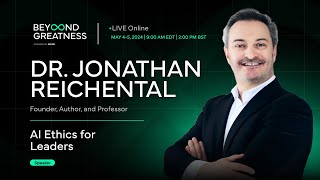
In this concise presentation Dr. Jonathan Reichental introduces leaders to the emerging field of AI ethics, which he frames as a subset of "techno‑ethics." He begins by defining ethics as the everyday behavior that reflects a person’s belief system, values, and morals, emphasizing that ethics is about what we do when no one is watching. He then clarifies what AI means, distinguishing artificial narrow intelligence (ANI) – systems that excel at specific tasks – from the still‑hypothetical artificial general intelligence (AGI). Using real‑world incidents such as Microsoft’s Tay bot, he raises the question of who is responsible for AI behavior, arguing that leaders ultimately bear accountability. He surveys key practical challenges: bias arising from historical or unrepresentative training data (e.g., Amazon’s gender‑biased resume screener, facial‑recognition errors, and voice‑to‑text disparities); privacy and surveillance concerns when AI ingests camera or personal data; the alignment problem where an AI’s literal interpretation of a goal can cause harmful outcomes; hallucinations in generative models that produce fabricated facts, illustrated with a Claude query about his own biography; and the lack of explainability (XAI) that undermines trust. Reichental then outlines a responsible‑AI mindset, listing core principles such as bias mitigation, privacy protection, safety, and compliance with regulations like GDPR. Finally, he offers a simple "PLUS" decision framework for evaluating AI choices—checking for existing policies, legal constraints, business alignment, and personal values. He closes by directing listeners to his website for further resources.
Chapters
Hi, everyone. I'm Dr. Jonathan Reichental. I'm delighted to be part of the Beyond Greatness Summit today. I'm going to be presenting, just for a short while, an introduction to AI ethics for leaders. I am a professor at the University of San Francisco and Menlo College. I also do master classes at universities around the world. I. I own a small tech company called Human Future here in Silicon Valley, and I'm also an author. You can see some of my books here. Now, what I'm going to talk about over the next few minutes just should not be construed as any particular legal, tax or investment advice or beyond. This is purely for informational and educational purposes. My lawyer tells me I have to do this. So the topic today is ethics, but actually the ethics of technology has its own name. This name is surfacing now as the way that we talk about this topic. The term is techno ethics. It's been an academic area of study for a few decades, but is only now becoming apparent in the world of tech and particularly now in the world of leadership, as the topics of the ethics of technology become more and more pressing and are a priority for. For more and more of us in the world of AI. The question of AI. AI ethics, of course, is certainly a much hotter topic than it was even two years ago. So before I kind of jump into the specifics, it's important to establish some definitions here. And the most important definition is what is ethics particularly, what am I talking about when I talk about ethics? So one of the ways that we can think about what the word means and in fact what it means in action is to sort of imagine the genesis of it and how it manifests in our lives, at home, in our work and in society. Well, it starts off with our belief system, right? Every one of us has a version of the truth. And where that comes from is where you're born. It comes from your parents, it comes from your religion, your spiritual system, your friends. It comes from very different, all sorts of places. And they form, you know, your version of the truth. Our belief systems then inform our values and our values about our what, you know, we believe to be right and wrong. And when, when you apply your version of the truth to what you believe to be right or wrong, that's your. That's your moral right. So it's assigning your values to your belief system. And then fundamentally, what we're interested in is when we know this and based on our morals, values and beliefs, how would we conduct ourselves? What would we do? So ethics is really about the behavior. Right. It's what we do every single day. I sometimes like to think of ethics as what we do when nobody is watching. Right. When you are in a business, in your office or online conducting business, what is it that you're doing even when you don't have someone looking over your shoulder when you're not being supervised? Right. So if we apply these four areas in terms of an actual example. So I'm going to use the example of privacy. It's a very topical item, of course, too. Your belief system. You formed your belief system and you believe a person deserves privacy. Now, not saying this is right or wrong. I'm simply saying this as an example. So that's your belief system, however that was formed. Do you think that a person deserves privacy? Then you are now applying a value to that, whether it's, you know, right or wrong, and you believe it's important to you. It's a right. So that's your value. Now, when you apply it in terms of your belief system and your value, you get this question of your morality, which is how that you would say that intruding on privacy is wrong. That's your moral right. And then, well, what's the action? That's the ethics. Right. The action is you wouldn't read a person's journal or diary, whatever, where, depending on where you're coming from. In the US we say journal. That's your ethics. You would not read a person's journal. So the most important takeaway here is I'm talking about behaviors, and that's what ethics is really about. But why do we even have ethics? Oh, sure, it's a simple question and maybe a lowball question, but let's establish why do we care about ethics when we have laws and we have policies and we have regulations? Well, not everything fits neatly into those categories. There's a lot of behaviors that in the context of culture or an organization, may be considered inappropriate or wrong, but don't meet the requirements of a regulation or a law. In fact, there's a lot more ethics often than there are the associated or the appropriate laws and regulations that, that exist in a bigger context. Right. So we need to be covering those areas somehow where it makes sense that guide us around behavior that doesn't fall into something that's more rigorous, like laws, regulations, and policies. Okay, so I just wanted to spend a bit of time establishing some definitions up front before I jump into the actual topic here, which is ethics in AI and it gets us actually to the next definition. I just want to Again, sort of give you my perspective on this, given that you're probably listening to a lot of lectures or talks on AI Is what do I mean by AI in the context of this talk that you're attending right now? Well, I don't want to make it up. I take it from Merriam Webster, a very popular dictionary here in the United States. And an AI is really the capability of a machine to imitate intelligent human behavior. So the key thing there, by the way, is the word imitate. Right, imitate. Because it isn't intelligent human behavior. And that's worth mentioning more about just in a moment. In fact, when we talk about AI today, or when I talk about it, I'm actually talking about something called artificial narrow intelligence, or ani, sometimes abbreviated to narrow AI, which means that the AI is very good at one or two things. The code that's being written is very good at solving a specific problem. This is in contrast to artificial broad intelligence, or what we're referring to now as artificial general intelligence, which is AI that, by the way, doesn't yet exist, but we're making progress towards that end. That can solve a lot of different problems and is much more sophisticated than the narrow specific AI that we have today. But we must recognize that artificial intelligence, first of all, it's imitation and it's artificial, isn't human intelligence. It is a simulation. It is sort of a kind of a trick. Right. One of the reasons why we can't say yet that we're building AI to be like the human brain or how a human behaves is because we don't really know yet how the human brain works. We don't understand consciousness, you know, or, you know, we don't have a very good understanding of reasoning. And our brains are very good at things like planning and problem solving in a way that is hard for us to quantify in order that we can build code around it. So we still have this leap to make. It doesn't make AI. I'm not trying to lower its importance or significance. I just want to separate it from the topic of whether we are in a place today that AI is comparable or is emulating human intelligence. It's. It's not. I. I mean, it's fair to say today AI is some really good mathematics, a lot of data, and some code that weaves it all together. Right? So it is ultimately about mathematics, data, and code. There isn't any consciousness sentience or reasoning or planning yet. Yet is the key word. We. It seems like we may get there, but we're really focusing on what we have today now as we get, as we begin to use AI in our businesses. Of course, what makes AI distinctive from other technologies over the years, and I've been doing this for over 30 years, is the degree to which it has a role in every single industry and almost in every function in every industry. It is a technology that is going to be and is already seen to be quite disruptive in its pervasiveness and its ability to be, ability to be applied in, in so many different contexts as we begin to use it. We have the first question is, well, who is responsible for the behavior of AI? Right. Well, the ethics of AI. Let me show you a quick example. This was a very popular case that came up just a few years ago. Microsoft was testing an AI bot, some software that was running on Twitter. It's called Tay AI. It's been subsequently shut down, of course, and it didn't take long before the AI through its coding started to emulate some bad behavior that people were inputting into the, into Twitter. And it started to become very, it was just very inappropriate. And quickly Microsoft shut the thing down. And so this raised a few questions. Well, first of all, why did it do that? Put that aside. Who is responsible? Do we blame the code, the AI itself, the developers, Microsoft, Twitter leaders? We've got to be real clear now as we think through this, where responsibility lies. And we don't necessarily have the questions answered yet. We don't know that definitively. But as leaders, certainly in the short term we have accountability. The, the, the problems that occur as a, as a consequence of the things we do as organizations are going to come back to leaders. And, and so there, there's going to be a lot of blame to go around when we deploy systems. This happens already today in non AI contexts. But AI has the potential to have behavior that could be much greater and more impactful than things we've seen in the past. Let's look at some of the different ways in which AI creates some challenges for us already. Right. And these are just some entry level issues. Nonetheless, they're very important. Let's talk about bias. You hear about bias in AI. And so why do we see this? Well, think about where the data comes from to, to power AI. It's coming from data, you know, across the Internet. And you know, if you think about the data, information and data on the Internet, it can be old, it can be stuff from the 1920s, 1940s, 1960s that has been, you know, captured and, and codified in websites and and then that's harvested. So what we thought was appropriate in the 1920s may certainly seem inappropriate in the third decade of the 21st century here in 2024. And we could see a lot of that. Some examples are not just from the older data, but just how data and the coding originates. We saw the example of the AI recruiter that was used to look through resumes for Amazon, which you can imagine it's reviewing tens of thousands all the time. It, it had a propensity towards favoring males in those resumes. We know there was the example of facial recognition that became less accurate with people of darker skin, which is very problematic. And in a related matter, some transcription services from voice to Text that were less good at interpreting African American voices, thus creating in of itself bias. Now, all of these are just examples of both the problems with using data, but also the people who write the code and how the code works. Right. What, what are the solutions to this? Well, you have to have this as top of mind as you build AI into your, into your world, into your organizations. Let's talk about privacy the second time. I'm talking about it today in my, in my presentation. It's a very big topic, of course, and, and privacy shows up in areas like surveillance. So more and more cameras are, are being deployed often for security purposes. And, and then the question is it's captured and that becomes an input for AI. How is it being used? Is it, are there guard rails to ensure that that surveillance is not being used for nefarious purposes or can, can be captured by those that would put it to nefarious uses? You know, are we okay, are we comfortable with our, with face recognition no matter where we are when we're outside the home? Right. And so this concerns AI and our decisions because that is data that will be captured and used by all sorts of AI solutions. And that, you know, this is going to mean that we have to be clear about our intentions and clear about protecting that data. Should we use it? Should we need to capture private information for the purposes of our solution, it's going to force us to be more, even more paying more attention to cybersecurity and the aspects of securing data overall, just as a little fun exercise, maybe I would suggest try this. What does Chat GPT say about you? Have you tried putting that in who, who is and then put your name in. Now, for a lot of people, nothing will show up. But if you are notable leader already or you know, you are, you are a notable person within your industry, it's possible it comes up, are you okay with what it shows up? Where do they get that information from? So give that a shot. And if ChatGPT doesn't say anything, excuse me, ChatGPT, try Google, Gemini or Claude or another AI tool and see if it comes up with information about you. Now, within the realm of thinking about the impacts of our AI decisions and the consequences, there is this question of something called the alignment problem. As we build out solutions, we'll AI be aligned with our values. Right. And, and so let me give you an example. If, if we are building and we have good intentions to build an AI robot and we ask that robot to, you know, this is, this is just made up as a fantasy case to go as fast as it can to the store and back, right, to purchase something. And, and you think that's a reasonable thing to ask a human? If you ask the person, can you go as quick as you can to the store and get me medicine and come back? Well, a person would get in their car or get on a motorcycle or a bicycle, would go as fast as they could. They would come back with the product from the store. But if you ask an AI robot to go as fast as it could, it may not be aligned with our values and it could destroy everything in its path. You know, hurting people or killing people, destroying, you know, public items in the, in the, in the, around the streets that, just pushing into things, crashing over things, crashing into other vehicles, even smashing through the store window, grabbing the item it needs, and doing the same thing on the way back. Okay, it's a bit of fun, but I'm trying to communicate a bigger point, which is we have to be real careful in how we code and constrain our AI solutions so that they behave in a way they have ethics that are aligned with what we intend them to do and what would be, of course, what a human might do under reasonable circumstances. Right now I want to just talk about interpreting information from AI something called a problem called hallucinations. And for the purposes of this example, I actually put in my own question. Who is Dr. Jonathan Reichental? I used Claude Claude IO, one of the competitors in this space. And it came up with some nice information on me. I was pretty pleased that it called me the mayor of the Internet of things, which I thought was actually quite funny. I don't know where it got that from, but. But it says a lot of correct things. It says, I'm an American technology leader, I'm a former cio, and it goes on to say a lot of nice correct things. But as I read more and more into this, I'll highlight them to you here. It says, I teach at the University of San Francisco. That's correct. But then it says that the McLaren School of Business in their healthcare information technology graduate program. Well, I don't believe there's a McLaren School of Business and I certainly don't teach in the healthcare information technology graduate program. The next one is even more interesting. It says, I host a podcast called Dr. Reality where I interview thought leaders about how technology is changing society. I do not have a podcast currently and I certainly don't have a podcast called Dr. Reality. Then finally it says, I serve on a number of boards including the United nations center for Regional Development, the China Green Tech Council, and the Commonwealth center for Connected Health. I don't serve on any of those things. I don't know anything about them. So just in this small use of generative AI, you can see that there are fake bits of information. AI generates fake information. We call it hallucinations. And so the question is, what do we do about that? And does that create ethical risks, behavioral risks, from what people can do using that information? This is sort of at a, sort of a superficial level, but a very important one. What does it look like when this kind of logic is embedded within systems? And the consequences then can be very far reaching. And to reduce these risks, we need to make sure that our AI models are trained on diverse, balanced and really good data. But that's probably not going to be enough because hallucinations are very complex to overcome and just highlights again our need to be aware of the consequences of this AI journey that we're all on. Another concept is what we call explainability, and you see the definition there on the screen. Explainable AI or xai is a way for humans to comprehend and trust the results and output created by AI. Well, you can see in the last example under hallucinations, I have a lot of difficulty now trusting with 100% certainty the output of generative AI. And that's a problem. If we don't trust it, is it going to be that valuable in a business context? Or if we overly trust it, does it create then consequences that are too risky for our, for our organizations? We need to understand how the answer was derived. Perhaps we need to understand the, have some references. Where did it get the data from? How did it come to that conclusion? And when it's more complicated, when AI, for example, is embedded in robots and machines, understanding exactly what's happening in order to reduce risk, to reduce harm, Potentially and, you know, be able to correct issues, to understand if there are problems with the data and understand the consequences. So today that, that can be a little bit hard. Some of the things we're doing with the most advanced AI is a bit of a black box. We, we kind of are impressed ourselves with the output that AI is generating, and we're not entirely clear how, how it's coming to those conclusions. We need to get on top of that because if we can't explain it, the ethical ramifications can be quite, quite enormous. Perhaps one of the ways to think about all of what I've talked about today is through this lens of just being responsible with AI, something we call, hey, responsible AI. And what do we mean by this? It means that if we're going to be involved, which we. There's no doubt all of us will be at some level. The percentage of organizations incorporating AI today is in the 80 percentile. And probably within a year or two, it'll be. Every organization will have some AI initiatives underway or in place. So what is our responsibility? What is our ethical sort of obligations to ensure that AI is safe to humans? We can trust it and we're doing the right thing, the right thing for our employees, our organization, our society. This is something that we have to take on as leaders and ensure that we have the right training, the right frameworks to deliver on responsible AI. No doubt problems will happen. What I could imagine happening here is that we will look back and when companies have created trouble, they will be asked about their responsible AI practices. And if they didn't have them, well, that could create some real issues, I guess, for that business. You can see here with this slide some of the areas, just some of the areas that are within the scope of responsible AI. These are some of the principles, things like what I've talked about today, things. What did we do to reduce, and to the extent we could eliminate bias in our data sets and our outputs, did we protect, you know, people's privacy and adhere to laws like GDPR and others around the world? How safe was our AI? You can take a look at the other areas here, and none of them are particularly surprising, I would say. I think you look at them and like me, they seem like the appropriate areas. And there's probably more relative to our own organizations. But these are a good starting point. And if you want to take a picture of this screen or just pause the video if you're watching this on record, you can do that. What we need to know as we move forward with artificial Intelligence. And we commit to ourselves an ethical approach, responsible AI. We do need to understand, you know, the consequences of all our decisions and to be thoughtful around that. And in doing that, fully understanding what all the risks might be, or to the extent you can do that, how might we reduce those risks? By taking AI decisions that are measured and thoughtful and responsible. Right. So we need to think about these consequences. Cause unlike a lot of technologies, they can be far reaching and could be problematic for your business if not done correctly. Now, one way to approach it, I wanted to leave you guys with something called a plus approach. A very simple sort of first step in evaluating the ethics of AI. And you could think of this maybe from a personal perspective, and then, of course, think of it for your team and then more broadly for your organization. So each of the letters plus stand for different activity here. The first thing is, as you think about an AI ethical decision, all right, what behavior are you going to take relative to this AI decision? Is there a policy that guides you? Right. Is there something documented? Has the organization already established a policy around it? So that's the first thing you want to check is if there's a policy which guides you, then you're in pretty good shape. So you want to think about that. The next one, of course, is if there's, if there's a policy or if there isn't, either way, is there a legal framework in which you can think about the thing you're about to do, the decision you're about to make? Right. Is there some law that's in place? And I think we can agree there will be regulatory, excuse me, there will be laws and regulations regarding AI in the United States and countries around the world in time. So you should be looking at that. Next one is to look through the lens of your business. Is the decision aligned with the best interests of your business? And so that's what we mean by the U for universal here in plus. And then finally, a very important check here is, is the ethical decision you make aligned with your own values, what you believe to be right and wrong? Test yourself. If it doesn't feel right, put your hand up. Right. If it doesn't feel right, pause, maybe consult with others. If the decisions that are being made around AI are not aligning with you at all, you might be in the wrong business or you might be leading the wrong business. So always make that a check. Okay, so we only had a few minutes together here. And if you, if you liked anything I shared with you, you like my style of teaching, or you want to know more, I encourage you to Visit my website, rikentile.com learn. You can see it there on the screen, where I have a lot of free material, plus some premium material and a way for you to get in touch with me if I can be helpful to you. And so with that, I would like to thank you very, very much for this time and I wish you the very best for the rest of the conference or if you're watching this on playback on a video. Thank you for joining me today and all the very best to all of you.
More from Professor

Technology Ethics and Responsible Innovation Coursera Specialization Launch Teaser




Technoethics: An Essential Leadership Skill for the 21st Century | Dr. Jonathan Reichental
Technoethics: An Essential Leadership Skill for the 21st Century | Dr. Jonathan Reichental


FOF 154 | Jonathan Reichental. On Cities and Governments Using Technology To Serve People Better.

Miasto to emocje, relacje i codzienne historie – rozmowa Waldemara Olbryka z Jonathanem Reichentalem

MS01┃Jonathan Reichental, PhD - Perfection, Creativity, and Who’s Actually Having Fun?