Building a more efficient, privacy-focused future with smart cities
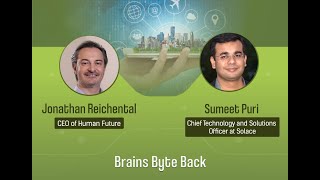
Jonathan Reichental and Sameet Puri discuss how cities will need smart technologies to handle 68% urbanization by 2050. They cover real-time traffic optimization through 5G sensor networks, autonomous vehicles, and drones for delivery. Privacy and data misuse remain the core tension: cities generate vast amounts of data but lack safeguards to prevent surveillance.
Chapters
According to data from the UN, in 2018, 55% of the world's population lived in urban areas, and that is expected to increase to 68% by 2050. With an increasing number of people living in densely populated urban areas, our cities will be forced to adapt from transportation to sustainability. Cities will need to harness technology to tackle these challenges that come with a larger population. Hi, my name is Sam Brakegear and welcome to Brains Bike Back,
your podcast
for everything related to psychology, technology and our society. In this episode of Brains Bite Back, we explore what these smart cities might look like, how they will function, and how they stand to change our quality of life. To discuss this, we are joined by the former Chief Information Officer for the city of Palo Alto and the author of Smart Cities for Dummies. In addition to this, he is also the CEO of Human Future, a global business business and technology education advisory and investment firm, Jonathan Reichental. Alongside Jonathan, we are also joined by the Chief Technology and Solutions Officer for Solis, a company that specialises in the smart movement of data, Sameet Puri. We discuss what transportation looks like in an ideal smart city, how smart cities will be better equipped to deal with accidents and emergencies, and how smart cities will be better equipped to handle and monitor crime. In addition to this, we will also look at how drones will facilitate deliveries, how cities can be redesigned based on AI observations, and what increased number of sensors and cameras means for our privacy. Now, if you like this episode and
you want to hear more just like
it, then subscribe wherever you get your podcast. You can also follow us on YouTube and subscribe there where we publish all these episodes.
You can also follow us on Twitter
at the Sociable and we love to hear what you think. So reach out to us on Twitter or leave us a review on itunes. Thank you.
And now let's get on with it.
Disclosure this episode contains a client of an Espacio portfolio company. Sam if Bill Gates was down to his last dollar, what would he spend it on? Good question Sam. Well, if you haven't seen or heard it already, one of the most popular quotes in PR is from Bill Gates, who stated that if he was down to his last dollar, he would spend it on pr. And with good reason.
Why?
Because quality PR turns unknown businesses into established industry leaders. If you're looking to build industry credibility, reach new markets or grow your business, our sponsor Publicize is a digital communication agency that has helped businesses like yours gain exposure to in major online publications for the past decade and for a limited time only, exclusive to brainspike Back listeners, you can receive an SEO assessment as part of your package for any tier of service at no extra charge with this special promotion. To find out more, Visit publicize COBB.
Gentlemen, could you please share with our listeners who you are and a little bit about your background in technology relating to smart cities. Jonathan, if you would like to go first and then Samit.
Sure. Hey, thank you, Samuel. I'm really delighted to be with you today and I'm always thrilled to speak about the future of our cities and communities. I'm a technology guy. I've been doing this kind of work for 30 years. Spent a lot of that time in the private sector. And then about 10 years ago, I had the incredible opportunity to be the CIO and CTO for a city here in Northern California in Silicon Valley. And you know, I was going into that role to lead tech, you know, to help optimize solutions and bring new solutions out. And yes, we did a lot of that. But I also fell in love with cities and I fell in love with this notion of building better communities. And I got the chance to bring our best practices to the attention of lots of communities around the world and eventually sort of carved out a space as a thought leader and a person of action, you know, a change agent. I'm not just a talking head. I actually do this work and today, you know, after I left the city, I decided to go and do this full time. So that's a bit about my background and I think it's such an important topic. I'm delighted to support about it.
Awesome.
And Sumit, would you be able to do the same please?
Yeah, thanks. Thanks a lot Simon for having me here again. A pleasure to be here. I'm Sumit and I've been a technologist as well. Not for as long as I'm younger. He gave his age away. Yeah. But yeah, I've been at it for about 20 plus years as well and working in all kinds of spheres. Started as a programmer back in the dot com era and ever since I've worked with more and more complicated problems, work for banks, banking problems, telco problems, defense as well, procurement systems, so. And over the years grew up to be an architect, a chief architect and I'm currently the chief technology and solutions officer at Solace. And Solace is a Canadian company and a rationale business where we work a lot with IoT, we work a lot with smart cities. I live in Singapore, so I've had my share of influencing and working with multiple smart city projects and initiatives here from land Transport to connected government to port authority and whatnot. So as we as we discuss, happy to share some of those experiences, take learnings from Jonathan as well as we go. But yeah, that's me.
Yeah, definitely we're going to get into it and I'm super happy to have you both on. I think you're both the perfect matches to discuss this. And I have to say this is a topic which is really special for me because I love cities. I do love the countryside as well but without a doubt I have that urge to always live in an urban environment. But I would love to kick off our first topic really which is transportation because it impacts everyone in modern cities and I'd love to know what will public transportation look like in an ideal
smart city and will we see more
or less kind of car centric transportation designs across smart cities? Sumit, would you like to start off and then Jonathan, if you want to add your thoughts.
Yeah. So see I live in Singapore and the public transport is extremely good, reliable, efficient and if we see how it would look like in the future or how the evolution is. Right. It's a living lab we call it here. So in my interactions with people who are responsible for the design and advancements of this, the core notion is like when will public transport be popular, really popular as a means of transport of choice. Not, not that I take public transport because I don't have a car. Right. So Singapore regulates cars in all very interesting way. The number of vehicles in the city is constant. So for a new vehicle to come in, an old vehicle has to go out and we have the certificate of entitlement for owning a vehicle which is a bidding system so it's managed that way. But the agencies, the goal that they measure themselves against. One of the goals, at least based on my conversations is that the time it takes from you for you to get from A to B on a private your own vehicle versus taking public transport. So typically in Singapore and it's pretty efficient, it varies from like 1 is to 1.2, 1.3 times to double.
Right.
So there will be areas that you can go like in P car traffic. If I go from my home to the office, whether I drive or if I take the public transport, it'll take the same time. In fact public transport will be more predictable because it's not going to get into jams and all. But then there are like it's not fully connected. There are parts of the city where taking public transport could take twice the time because of the changes and all I have to take, to reach the destination. So the goal is to make it more predictable across the board from anywhere to anywhere, and then to narrow this gap that it should never take double the time because that is an any like an instant decision for a busy person that, okay, let's, let's drive or let's take an alternative means. So from a smart city perspective, the core underlying infrastructure of transport, the buses, the trains, have to be put in place and in future, autonomous vehicles like how do you take care of the last mile? So can the last mile be improved further? But then also the confidence, the trust comes with the visibility that if I can predict that I'll get from A to B in this time and I'll make the meeting, then I'm more likely to do that. So that's the digital aspect of the smart city solution as well. And then the efficiency aspect that if multiple means of communication, your buses, your trains, your taxis, your vehicles, if they are all talking to them, and we can get into this as we go in a V2X kind of an experience that you know that your changes will not take an additional time or the overall predictability of getting to your destination is accurate based on the various inputs that you're getting, getting triangulated. I think that's the business goal. And technologies such as IoT Connected Government Census feeding information, information being exchanged with the various participants who need it, whether it's government, whether it's private owners of these public transport providers. I think that's how we get there gradually.
Excellent. Nice. Yeah, that sounds really promising. I know obviously when you open up Google Maps and you plan to go to a destination, it tells you more or less how much time it might take you to get there. But to have that on public transport, to have like, oh, we're going to arrive at this stop or this sort of time and have a granular kind of magnifying glass to these details.
That'd be awesome.
Jonathan, do you want to share your thoughts on this topic as well?
I'd be delighted to. Yeah. I'm glad I'll be speaking for the next two hours about this topic for you. It's huge. You know, I have had up until March when before things shut down because of the, because of the virus, I was traveling quite extensively around the world and advising cities and, and you know, one of the things I recognize and everyone else should sort of know is that there isn't a lot of consistency between smart cities. You know, smart cities are very much the reflection on a particular city and culture. But I did notice four commonalities that were no matter what city I went to, pretty much these were challenges, and they are transportation, energy, sustainability, digitalization. And so transportation is a big one there, as you can tell. It's the one that, you know, is so visceral. Everybody takes some form of transportation in their city. So you know about it, you feel it, you have an emotional connection with it, if it's good or bad. And it's multidimensional. I mean, when you talk about transportation, we could have a great conversation just about walking. Can you walk to work? Can you walk to a park? Can you walk to the store? How walkable is your community? And you might think, and your listeners might say, I thought this was about smart. Cities isn't about tech. It's not technology. Well, the first sentence in my book about smart cities is, this is a book about people. This is not a topic necessarily about tech, although that plays a big part. And so it's about making better communities. And so, yes, we got to make our cities and our neighborhoods and our communities much more walkable. It's great for health, it's great for the environment. We noticed that cities all over the world are embracing the bicycle in a way we never thought possible in the 21st century. Right. I guess, you know, 20 years ago, we might have thought something like the bicycle was going away, right? No, it's coming back in a really, really big way, and it's entering cities that were traditionally not cycling communities. So the bicycle is another layer right now. Not to be to copy anything that Sumit said. I wanted to kind of say a few original things. We're going to see much more use of drones, and we're going to see terrestrial drones, the ones that go on the ground, and airborne drones, and they're going to be involved in delivery. Right. So you probably noticed, and I'm guessing it's the same case in Singapore and in Colombia, deliveries exploded. I mean, we're ordering everything now. And here in the United States, you know, I live in a. In a condominium community, and, you know, you go to anywhere where there's post boxes, there are piles and piles of boxes. It's out of control. You know, we've sort of embraced this. And not only are, you know, trucks and motorcycles and other forms of transport going to be used to deliver, well, drones are going to play a very big part. Two, the last point I just wanted to make on this is cars are going to drive themselves. Sumit did allude to autonomous vehicles. I just want to go A little bit further and say, I believe that cars are going to drive themselves in the future. Humans don't have a role in that. And although it's a little controversial, if you go out a couple of decades, we will not be allowed drive cars. It'll be illegal the same way as it is to ride a horse down a highway here in California. You won't be able to drive a car.
Yeah, I had a previous episode on that and it's going to be crazy when we go to transition. I was saying that in my lifetime, like perhaps when I'm an old man, people are going to say like, wow, when Sam was born, when you were born, people were allowed to drive cars. Like exactly the accident rates and do not know how like accident prone humans are at driving. And right at the moment, I think we're still kind of at a stage where I don't want to speak for everyone, but it's the premise of an automated like lorry or something barreling down the highway is scary, but to us in the future, the idea of someone driving that is even scarier. But you also touched on some points which I think we could spiral off in too. Like you mentioned, like energy and sustainability. Those are questions which I haven't even got loaded up or even thought about for this podcast. But those are also significant points. And you at your point on walking as well as someone from the uk, I mean, our whole society is based around walking because it's very old. And then I go to the US especially in the south, and you can see it's all based around the car. So that's, that's a huge disparity I've definitely noticed, which makes a big difference to where you live. But kind of following on from like transportation, I'd really be interested to know how will smart cities be better equipped
to deal with accidents and other emergency situations.
I'm sure drones might play a role in that, but I'd love to hear what you have about to think again. Sameet, if you want to start off and then Jonathan, if you want to contribute.
Sure.
Yeah. See dealing with the accidents and emergencies. So there is the infrastructure, technology aspect of it, that autonomous vehicles, as they get better and better will be less accidental because computers are always more predictable than humans and so that fundamental doesn't change. And I was reading this interview sometime back from somebody from NASA and they were saying that we were successfully driving the rovers and Mars and Moon and all of that. And why is Earth so special? Right. So we could. This is still charted water so as the technology then the technology exists to a good extent, but it has to be owned further. And all the variables that exist in our cities and beyond need to be factored in. So I think artificial intelligence and accentuated with machine learning is going to play big part. We work with certain companies who solve exactly that problem. So if you get information from vehicles, from pedestrians, from cyclists to John's point, and then if that can be correlated, so signals could be given to drivers and in future directly to vehicles of an upcoming risk. But the fundamental from a technology perspective that we've seen, again I've seen Singapore do it, I've seen a couple of Canadian cities and government do this, is to connect various aspects of the infrastructure, right? So the train system, the train stations, the buses, the cars, the taxis, all of them are generating information all the time, whether it's location information, whether this is how they run, all of that information. If you were able to correlate that and you can Google this, in Singapore we have a program called Faster. So F A S T E R, it's an acronym. But that is all about getting analytics, getting information from multiple sources of public transport information. And again, this could be train station data, could be information coming from trains themselves, buses, et cetera, correlating that and preventing incidents. And these incidents could be accidents, these could be outages, these could be security incidents. And then you take decisions such that, let's say if a train station is compromised, do you put the buses to take care of the commuters there on the east west road or the north south roads? Simulation systems in happy times, that, okay, a Wednesday morning usually looks like this, but today I'm seeing an anomaly what is going on and then preventing that and taking emergency responses ahead of the game, right? So that's already happening and it's going to get better and better with all of these autonomous vehicles coming in. Again, as a part of a connected car program, we've discussed use cases such that while we still have drivers or passengers there as well, if erratic driving behavior is detected, somebody is falling asleep, somebody having a heart attack, does the car go and put itself on the shoulder, deploy the airbags, cause the emergency response services, all of these things are happening. But it's about, I think to me as a technologist, lots of data being generated. This data needs to be captured, moved in real time, pushed into systems. Whether they are at the edge or in the cloud, they need to be pushed into systems who can make sense of this data for like artificial intelligence, machine learning, and in a correlated way. And I mean, I get to do this because I work for a company who provides that infrastructure, call it the event mesh. So if all of these events are being generated and they float over that mesh, where you can make meaning out of it, whether it's improving efficiencies or preventing accidents and emergencies, or handling them, I think that's where we are headed.
Excellent. So if I've got this right, and I'm not sure how, but like this kind of mesh, it's almost kind of like reoccurring theme of connectivity, like having this overall connectivity across everything. The way I see it, and I'm now seeing it on this call, is like a smart city. Almost seems like it's going to be an organism where it's. Everything's connected and everything speaking to one another. Almost like I'm guessing, and I'm not a doctor, but like the human body or something like that, Is that, is that a fair, like, kind of analogy, would you say?
It's like the nervous system. So the event mesh in this particular way, you have the underlying network and 5G is going to revolutionize this whole thing and then the application to application connectivity over on top of it. So again today, if your finger touches something hot, the nervous system carries that, that signal. There's a sensor in the finger that goes to the brain which could tell the finger that hey, pull your finger off. Right. It's the same mechanism to your analogy. There's the nervous system that needs to be put in place. There is intelligence, real intelligence or artificial, which has to decide what to do with it in a fast enough manner. And then there are sensors all around.
Awesome. And Jonathan, what would you like to add on this?
Yeah, not a lot. I mean, sumit was quite comprehensive in describing the possibilities there. I'll just add a couple of things. One is, yes, as we deploy things like 5G and other wireless technologies, we're going to connect everything. You know, the question is, if it's low cost and it's ubiquitous, why wouldn't we? Right. And so the question becomes, what can you do with that when everything talks to everything else? And that's going to be one of the mysteries that will unfold over the next few years as this all happens. The angle I would just take to add additional value here is we often overlook data in cities. You know, when I joined a city back in 2011, which is almost 10 years ago, all I saw was a world of constraints. You know, too many projects, not enough money, not enough talent, not enough time. You know, all the typical things. But I saw an abundance of data, and I've been sort of on a mission ever since to say, you know, hey, city manager, or hey, Mrs. Mayor, you know, you're sitting on an incredible resource that you already have, and you're not using it. You're not using it for decision making and for developing solutions and for connecting better with your community and engaging people in a deeper dialogue. So data is something that cities are discovering quickly. They're laggards relative to the private sector. But let's think about data in the. In the context of reducing accidents, which is the heart of your question. You know, one of the things we have to do in cities, and to a listener who is not familiar with this space, some of this just sounds really mundane. But it's so important. You have to count traffic. You know, it's a funny thing. Like why? Well, there's so many reasons. You need to know the number of vehicles, the type of vehicles, the direction vehicles are going and the speed they're going. In order to do things like redesign roads or implement new roads or when you're introducing a new building, you need to know the impact on traffic flow. So if we can start to deploy. We are in many cities, in Silicon Valley here and all over the world, sensors at intersections which count and monitor traffic. Suddenly, rather than having sort of a point in time where there's a. There's a person standing out there with a clipboard, you know, counting cars, you know, one time every quarter, you've got real time data coming in on traffic. You can start to really. And you. And applying machine learning, understand patterns and behavior. And once you see, for example, hey, you know what, there's collisions when these conditions are met. We have the data now to support that. Let's do the redesign. Let's redesign that intersection. Let's redesign or reprogram the traffic signals because apparently at rush hour, when they are spending too much time on red, that's causing one of the roads to create a hazard for cyclists. Right. So smarter cities tap into that data and they're getting better at it because we have more ways to capture it and use it.
Awesome. Well, one of my favorite quotes I once heard, and it's absolutely true, is you can't manage what you don't measure. So this idea that we're going to be able to measure so much, I suppose that means that we will be able to more effectively manage so much more within our cities. So that's really exciting.
Once again, thank you to our sponsor, publicize, Visit Their website. If you want to find out more about their PR for growth packages, their free resources, or even schedule a call. And for a limited time only, exclusive to Brainspike backed listeners. You can receive an SEO assessment as part of your package for any tier of service at no extra charge with this special promotion. To find out more, visit Publicize Co BBB
On a similar topic with regards to emergency services, I'd love to know how you think crime will be impacted by smart cities. Like how we will respond and monitor crime. So, I mean, like, real quick, I'm from the UK and I think we're one of the top countries in the world for CCTV cameras. So I have quite a negative, like, view. I'm coming into this thinking, like, is it literally gonna be Big Brother? Are we gonna be in smart cities where there's cameras everywhere and like, you even like drop some litter and suddenly you're like publicly shamed? I know they do that in China. They have that in China, where if you drop something that's like all the TVs around just like turn to this person and say like, pick that up or something like that. So I'm kind of bit worried in that sense. But at the same time, hopefully you folks have got the answers. You can reassure me. Jonathan, again, maybe if you want to start this time and then samit afterwards.
Yeah, yeah, I'll try to keep it brief. I mean, a great, great introduction to the topic there. The statistics on London, for example. The amount of times that you're captured on video in London is astronomical. I think you're more likely to be on video than not on video. If you walk to the corner store to get a newspaper and a Mars bar or something. So there's a lot of temptation, right? When you have cameras everywhere and you have sensors, there is a temptation to begin to leverage that data in ways that it wasn't intended. Let me take this angle, which is the train has left the station. On this topic, we're going to be putting up all sorts of sensors. We already are. We're going to be putting up cameras. And the question is often sort of after the fact, what does that mean to cybersecurity risk and privacy? And that's not the right time to be having that conversation. The right time is when you're designing it, when you're actually putting it together. And so we do need more safeguards. We do need a deeper conversation. And dare I say it, at some level, we need regulation and probably some supporting legislation because, you know, unmanaged, there Will and there. And there are areas of the world where this is going to backfire in a really negative way. Again in my book Smart Cities for Dummies, you know, I really talk a lot about this topic and the one thing I want to make clear at the very beginning is in the book is that smart cities are not about surveillance cities. And the reason I say that is because so many people already believe that and that's a terrible starting point. You know, if the entry is this is a way of using technology to monitor humans and our behavior and to create social credit that you referred to there with China, it's not going to work. We have to focus on quality of life, we have to respect privacy and culture. So I just wanted to take the angle, this is a very large topic and I'll leave Sumit to sort of maybe take us in a different direction perhaps and maybe talk about solutions.
Yeah, again taking a huge on similar things. See if you're on camera and if on the other side somebody has access to that information, that's the reality. Right. So can that be misused? But it's no different from you using, let's say Internet banking where you type in your password and there is somebody on the other side who could misuse it. Right. But again this is privacy, that is money. Depends on what you value more changes from person to person. But I just think that how did we solve it for payment system, Internet banking, etc. We did it by putting enough safeguards, enough encryption into those transactions that, that most people, if not anybody on the other side, on the bank side can't see your information. That's how you get the best of both worlds. And are there compromises? There will be compromises. I mean some people will find loopholes and that's how humanity has always been. But generally speaking we've got a lot of CCTVs in Singapore as well. And from a crime prevention perspective, think of it this way, that you have the land transport authority and they have their CCTVs. You have the environment authority and they have their CCTV. And if an incident happens outside of a train station, does the police get called in? They go investigate to find out that oh this is bigger, this is more than an incident and thankfully it doesn't happen much here. But if, let's say it is a riot, do we have to then wait for the police to go and investigate? Or can those CCTVs who are watching that incident, if that information was being fed government wide across agencies, all encrypted that AI engines Could say that there's no need to investigate. I see fire, I see a mob, I see all kinds of things. This is a riot. Mobilize riot police immediately. Your first responders are different and that is how you control the situation. So making sure that with all of your draft, like not just CCTVs but social media reports, people reporting it from the citizen to government app to open a police report, etc. As you correlate all of that information. So then I keep on going to the point that the security aspect has to be handled, the humans have to be reduced if not removed from the decision making so that they can't compromise the system and signals have to come out. You get this by having that the whole mesh that we talked about, event mesh in which video also is shared across agencies.
Awesome.
I mean that sounds ideal really. And I think this would be a really good transition into the last point I want to make. Because you talked about how, or we both talked about, or we've all talked about really about how this kind of data will be used and what kind of security guards we need or security we need in place. Because there's also the perspective of not it just being like stolen or you having someone having a constant eye on you. There's also the fact that this could be a gold mine for marketeers or people that want to conduct advertising because if they know like all your behavior and all your movements, then they're going to be able to advertise to you with incredible accuracy. I mean, already online I get like ads for things which I'm like, how do you know I want that? How did you know that I was going to go for that? So I can only imagine that like being able to track every physical movement will. Will change that so dramatically. Because obviously like we have certain implications now with gdpr. I suppose my question is to what extent will advertisers be able to use this information and what will advertising look like? For example, if I walk into a store and it says like, this is the product for you. I think I even saw that in a movie where it's like good day. Like someone walks into a store and they're like, hi, this is your recent purchases. You can like buy this sort of thing. Like will we see that? Where, like just from like facial recognition or something. They'll recognize you. As soon as you go in, you have an account ready, you'll have whatever they'll have.
Recommendations.
Yeah, I'd be really interested to know how this will work.
Yeah, yeah. And I think a Minority Report is a movie that I think that might be it. Yeah. Pushes that idea a lot. It's kind of neat. You know, to some degree that does exist today. You know, there are solutions that using, you know, Bluetooth and beacon technology, it will show up on your phone when you, when you pass the retail store that's in place. Not everywhere. So we're kind of in Minority Report to some degree already. One thing I would say is I wouldn't mix as I think about the future of cities and the work I do. We don't necessarily think about the role of retail. For example, that's like out of the realm of public service. We might support economic growth and we might issue permits and things, but what a store does to generate customers and stuff is not really the purview ultimately of government. I'll just kind of answer the question from the government perspective. And it's an area that I actually worked in quite a lot over the years when I was in a city. The answer is very cultural. Like Palo Alto was the city I was the CIO and CTO for. They didn't want to ever really engage in advertising. It just wasn't consistent with the culture of the community. You know, there are so many opportunities to sell data or to maybe use advertising to be able to fund a new bus shelter or some digital signage would bring in, you know, additional revenue to the city. It just wasn't something that they felt they wanted to explore. And so nothing to do with technology. You know, really much more to do with philosophy. Now that's not the case in other places. So you look at Link nyc, which is the digital signage in New York, and it's replacing all the phone booths. It's a big success. Everybody can get access to free high speed Internet, make international calls. And then of course, there is the digital sign itself where you can make reservations for theaters and find out what cool things are happening. But advertisers can put stuff in there that shows, buy this pair of jeans or buy this watch, and that revenue basically pays for it. In fact, it's profitable. The city gets to pull in additional revenue. And in the case of New York, which is so large and there's so many of these, it's not trivial. This is actually real money. Many communities will try to use the advertising model to fund, you know, discretionary projects and sort of to improve their parks and things. Not an alien concept at all. I think just the broader and final comment on this would be there's a special relationship between community and cities relative to Data, you have to collect, store and use data to function as city. It's just part of how it works. Right. And that's why my earlier point is that cities are sitting on so much data and if you take advantage of that or you know, you don't treat it right, there's already enough tension between, you know, community and city hall that needs to be calibrated really carefully. And some communities will go all the way and say, yeah, we're gonna, you know, monetize this as much as possible. Others are gonna be the other side of the that spectrum and say like Palo Alto, it's just not for us.
And Sumit.
Yeah, I mean I couldn't agree more. And I can give you a couple of specific examples and scenarios quickly. Right. So see, solace is being used and leverage that experience to connect all vehicles in Singapore. So we've got about 1.2 million vehicles for electronic poles, for traffic management, for everything. Right. And so we connect all vehicles for a bunch of other car manufacturers as well. So millions of devices getting connected. Then we are also used as a backbone to connect various agencies for the government. Right. So land transport to environment to police to. All of these agencies are like sharing information on a government wide backbone. And the whole mesh I was talking about earlier now as the information is flowing through all of this system, it's all published, subscribe, write once, read many, many times. You can have like, you can fill buckets with this data and do interesting things with it. So you could be improving your road infrastructure. That's a good use of data. So you can anonymize that data. Or if you're connecting all the vehicles, guess what, you can issue speeding tickets. But the moment you go down that path. And I'll get to advertising, the moment you go to that path, nobody wants to have their car connected. So in Singapore, what we had to do, we. So that the government was very, very clear, the legislation was put in place that none of us did. None of this data will be used for individual monitoring. So even though the vehicles are connected, the agencies are responsible for speeding and all of that. They can't do anything with it. They don't have access to that data because that's the whole intention. You want to have that trust relationship, doesn't mean that you should be speeding. There are other checks and balances will take care of you. But privacy is extremely, extremely important in a smart city. I think Jonathan was also saying that. And then there is the ethical issue. So how do you fund innovation? You can either fund Innovation through taxpayers money. Or you can fund innovation through advertising. Like who funds Google or historically it was advertising. So otherwise we would have been paying a lot of for that. So. But where is the ethical line? What should be allowed to be shared with advertisers? The technology is there and probably certain kinds of advertisement, certain kinds of anonymous usage of data in real time will be allowed at some point in time. And it's good because it funds a few things. But it's a balancing act and I think most cities will err on the side of being conserv. Because trust is paramount. Right. You're already connecting people already worried as we were talking about with smart cities becoming or not becoming surveillance. It is Jonathan. Smart. Really like that thought. But the trust element has to be balanced with the advertising capabilities.
Yeah. In order for it to work for everyone. Definitely trust is going to be a key component here for sure. Yeah. So thank you so much, gentlemen. I really enjoyed this. It's been a lot of fun. And if people do want to keep up with what you're doing and follow you or yeah. Go to your websites, what is the best way for them to do that? Sumit, do you want to share that with our listeners? And then Jonathan.
Yeah. So you can connect with me on LinkedIn. I think the links can be posted. You can search me up on solace.com so you can check me out. I am on the leadership page there. So be in touch or drop me a note at Sumeet Puri. Spelling will be there in the link, I believe.
Awesome.
Great. And so yeah, thanks Samuel for this. It's been a fascinating conversation. I learned a lot from Sumit as well. So I wrote a book on this and you can find my book at www.smartcitybook.com pretty simple, right? Smartcitybook.com or go to Amazon or whoever it is that you typically buy books from. It's Smart Cities for Dummies. It's a best seller and it goes deep on all these topics, you know, deep and wide. I mean the thing I love about it is smart cities and the future cities. It's huge. It's huge. If you love energy, this is for you. If you like public safety, this is for you. If you like buildings and cars, you know, it's just vast. But anyway, that's a way to learn more about what I'm doing and what I've been writing about. I'm active on Twitter, so Reichental R E I C H E N T A L You'll find that, I guess in the show notes and like Sumit, I'm very active on LinkedIn as well and you know I will issue an invitation. Come, come, let's chat. Let's talk about these challenges and how we might solve them together. And I'll always respond. I'm not one of those people who, you know, you send me an email or something. It's a black box. I actually want to hear from you and look forward to it.
Awesome.
Well I've really enjoyed this and yeah, again thank you so much for joining me. That was today's episode.
Thank you so much for listening. Go check out other articles and podcasts just like this at the Sociable Co you can also find us on YouTube under the Sociable or tweet us at the Sociable and you can subscribe and follow all of our podcasts on any of your favorite podcasting platforms. Just search brains, byte back. We hope you join us again soon and take care. Sam.
More from Professor

Technology Ethics and Responsible Innovation Coursera Specialization Launch Teaser




Technoethics: An Essential Leadership Skill for the 21st Century | Dr. Jonathan Reichental
Technoethics: An Essential Leadership Skill for the 21st Century | Dr. Jonathan Reichental


FOF 154 | Jonathan Reichental. On Cities and Governments Using Technology To Serve People Better.

Miasto to emocje, relacje i codzienne historie – rozmowa Waldemara Olbryka z Jonathanem Reichentalem

MS01┃Jonathan Reichental, PhD - Perfection, Creativity, and Who’s Actually Having Fun?