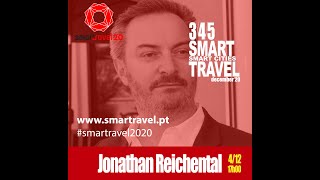
In this keynote for the Smart Travel 2020 conference, Dr. Jonathan Reichental argues that cities must become places people love in order to address the massive challenges of rapid urbanization. He outlines how over half of the world’s population now lives in cities—a figure projected to reach 70% by 2050—creating unprecedented pressure on infrastructure, transportation, air quality, waste management, equity, and climate resilience. Reichental highlights the need for a transportation revolution to cut carbon emissions and save lives, stresses the health toll of air pollution and waste, and warns that 630 coastal cities housing 1.5 billion people face sea‑level rise. He advocates a digital transformation of city services through the Internet of Things and data‑driven decision‑making, while warning against privacy erosion. Real‑world examples—pedestrianizing Times Square, cleaning Los Angeles’s smog with catalytic converters, and Freiburg’s solar‑plus‑grid model—illustrate how innovative policies can make cities more livable. Community engagement, from hackathons to grassroots art projects, is presented as essential for fostering love and stewardship. Reichental concludes with a call to action, offering his book Smart Cities for Dummies as a practical guide for citizens, officials, and technologists to co‑create more sustainable, inclusive, and beloved urban environments.
Chapters
Hi, everyone, I'm Dr. Jonathan Reichental, and I'm just thrilled to be with you for the Smart Travel Convention 2020. And unfortunately, I can't travel to be with you because of this horrible pandemic. But I'm here, based in San Francisco in California, in a great city, and I look forward to traveling very soon and visiting Portugal and Lisbon as soon as I can. It's great to be here, and I want to spend just a few minutes with you talking about why cities want to be loved and why that is a very good thing. So join me on this short journey. Cities are pretty important places, as you would probably agree. Today, over half the population of the world lives in cities. And by 2050, that number will be almost as high as 70% of all cities humans. There's about 10,000 cities in the world. And by the way, up until 40 years ago, the number was half of that. We are building infrastructure the size of New York City every month somewhere in the world. And we'll do that for the, for the next 40 years. People are moving into cities at about 2 to 3 million people per week. So our cities are growing and urbanization is rapidly dominating the human experience. As I travel around the world, or used to travel before the pandemic, and I hope to resume soon, I would visit many, many fabulous cities in the world. And I would notice that those cities had lots of challenges. And I would speak with the mayors and city managers. They had their issues that reflected their culture, but also I noticed some big themes, like, for example, transportation. So many of our cities are built around cars, and cars get congested and they spew carbon emissions into the atmosphere that's heating up the planet and creating a climate emergency. Cars kill 1.3, 1.4 million people a year and injure millions and millions more. We need to have a transportation revolution if we're going to have beautiful loved cities in the future. People want better ways to get around. They want those ways to be healthier and have not such a big impact on the environment. Our cities have been remarkably successful. In fact, they have been the most complex and most successful of human inventions, bringing millions out of poverty. In fact, between 2008 and 2015, about 200 million Indian people were brought from extreme poverty into the world. Working classes and all this progress consumerism is generating the mechanisms of production. As you can see, they're spewing chemicals into the air and creating a lot of pollution. The World Health Organization suggests that up to 2 to 3 million people die directly or indirectly because of the air quality created in cities and we create a lot of waste through our lives. The packaging and the plastic that we consume and going about our daily consumerism. Our cities are successful. They are producing abundance, but it's coming at a price. We have to manage all of that waste in a much better way if we're going to fall in love with our cities again. We need to have clean rivers, clean lakes and clean oceans. Our cities have been successful for billions of people. It's created more access to education and health and jobs and entertainment and so much more. But they're not inclusive enough. We have to have them more inclusive. More people need to prosper and thrive with all the benefits of our urban world. We need more equity and equality in our communities. And the big 800 pound gorilla in the room is climate change. About 630 cities in the world are on coastlines, which represents about one and a half billion billion people approximately. And as the sea level rises, it will flood and our cities will be at the front line of climate change. We need to mitigate it and we need to manage this and it'll happen in cities if we're going to manage the global climate in the future. Our city environments are often analog. They look like this. You go to a building and we fill out paper forms. This is in a world where more and more is digital and looks like this. So cities exist in an environment like this, when in fact, what people want this, we want a digital transformation of our communities. People don't love this. Nobody wakes up and wants to go to an office building like this and wait in line for two hours and fill out forms and then have to return. What people love is efficiency and ease and things that work and they're convenient and at our disposal. That's what people love, love. And if we're going to solve these big problems I've been sharing with you today, we're going to have to bring new ideas to the table. Bolder, more innovative ideas. And a big part of that is going to be the use of technology. Right? Technology is changing so much of our lives and industry in our homes. And of course it's going to help to change and provide solutions for, for our cities. What I love about the city environment, as a person who has worked in cities for a long time, but also now advises and educates governments all over the world, is that it's such a diverse and big and interesting space. It ranges from buildings to health and water quality and waste management and public safety and energy and so much more. Here are Just a few examples. The opportunities we have to reinvent and deliver a better city experience. And so there are amazing ideas that are happening from creative mayors and creative leaders all over the world. Here, for example, in New York City, an idea was raised that what happens if we would stop traffic in Times Square for a few months? Could we give Times Square this important element? Popular tourist destination, commercial center, back to people and away from cars. And they tried it and lo and behold, it was successful. And people started to spend time there, eating their lunch and ordering coffee and socializing and looking at people as they do. And it became safer and a more pleasant place. We started to place Meg again to Times Square by bringing the city back to people. People began to fall in love with this area again. And myself personally, I went to Times Square one evening. It was very late, I was with some friends, we'd gone to the theater, we'd gone to dinner. And then about 2am we went to Times Square where it was all pedestrianized, there was no vehicles there and it was a lot of fun. It was like a little carnival, 2am at night. And we can solve these big problems of our cities. If you recall a few decades ago in Los Angeles, there was a constant amount of smog that was just hanging over the city of la. And we thought, how are we going to solve that? How are we going to create clean blue skies again? And yes, we innovated, we deployed the catalytic converter and we moved to unleaded fuels. And now today the skies are blue again over Los Angeles. And the city is a great place to live for a variety of reasons, including having cleaner skies than they ever had. And we're going to solve our problems through just remarkable innovation. We won't solve our energy crisis by continuing to mine coal, gas and oil from our Earth and spew carbon emissions into the atmosphere and heat up the earth. We can't do that. It's spoiling the environment to a huge degree and it's creating a climate emergency. What we need to do is start to leverage non carbon supplies of clean, abundant energy like wind power and solar and hydro and thermal and others. And you can see over time we're going to be doing that. We're going to be using more and more non carbon to make our environments cleaner. And our cities will change the way they look, they'll change their appearance as we start to adopt things like solar en masse. Here you see the city of Freiburg in Germany, where so many of the population no longer get an electricity bill. No, no electricity bill. They in fact often get a check because they produce more energy than they devour and that energy is sold back onto the grid and they get a check for it. So solar will play a part and make people happier because rather than paying for electricity, they are being paid for electricity. Our cities can be reinvented. You've heard of the phenomena of the Internet of things where we're connecting all sorts of devices to the Internet. Right now we connect about 30 billion and in the next five years we'll double that more in fact to about 75 billion devices will be connected to the Internet. Many of those will be in our urban environments. There'll be sensors doing things like counting traffic and looking for parking spaces and detecting the quality of air and doing surveillance for public safety reasons. And we'll see them in various places, on buildings, on light posts and on traffic signals, doing all sorts of very important activities. Now let me say this, it shouldn't come at the cost of privacy or surveillance or a surveillance economy. I'm against that. We need to respect people's rights and these things will have to be regulated, but on balance, they will provide a lot of advantages. Now, when I joined the City, a city environment, back around 10 years ago, I noticed it was an environment of constraints. There was never enough time, never enough talent, too many projects, never enough money. But there was an abundance of data, Abundance of data. Every city in the world has more data than they know what to do with. And they can build solutions now using that data and they can make better data driven decision making. Here you see, for example, from the city, I was the technology leader in Palo Alto, how we use data to identify almost a near real time issues that were happening in our community. People were reporting them on their phones, things like abandoned bicycles or trash that were spilled onto the ground, or graffiti or any number of other issues. Data became suddenly very important. Now if we're going to solve these big problems and create more beautiful cities, more sustainable, better cities, more lovable cities, places where people want to travel and visit, everybody's got to be engaged. We've got to have a significant uptick in the amount of community engagement. And you can do that too. You can be involved in creating a better community. We need to bring in children and teenagers and scientists and academics and industry and government workers together in all sorts of forums to be able to solve problems together. People love their communities. They do crazy things when they love their communities. Here you see some knitting, graffiti, as it's called, where some club has knitted covers for some Bollards in a community. And you see this all over the world where people have so much respect and they're in love with their, with their infrastructure. Here's another great example of fixing a city wall using Lego, right? This is quite popular again in the world. People love to do this, to participate and be part of building more beautiful, more interesting communities. There's a lot of things you can do to fall in love with your city. Get lost, Go out there, find places you've never been to, wander down streets or go to that church you've always seen but never gone into. Visit that museum that you've passed but never visited. Just discover your own city and talk to people, talk to strangers. As an adult, this is, you know, has very little downside. You will meet people and you might meet people who've lived in a city much longer than you and they'll tell you why they lived there and their story and that'll be intriguing to you. Try something new, right? Try something new in your community. Go to the zoo, ride horses, rent a bicycle or an electric bike and go around your community and then you can co create. You can actually build solutions. Find out if your city hall has things like hackathons or challenges or committees that you can serve on. When you are engaged, when you are part of your community, you have more affinity for it and you will have more love. Now, cities that are loved are better cities. They are more prosperous, their economics are better, people are happier. And when people are happier, they show it and they live longer and healthcare costs go down. But there's effort. We have to do this. We have to build more beautiful, better, more sustainable and more lovable communities. We'll do it together. And there's many ways we can do that as participants. Technology, of course, will play a big role in that. You can be a provider or a participant or an idea generator or, or just a game changer in your community. Now, as I come to the end of my short talk today, if you like this topic, and if maybe if I've inspired you to want to know more, I've written the reference book, the ultimate book on the future of our cities, how can we build better, smarter cities? The book is called Smart Cities for Dummies and it's available all over the world. I've put a link there for you, smartcitybook.com and you'll find lots and lots of links. So you can buy it there in Portugal or wherever you're watching this from, if you're watching this on YouTube later on or on the Smart Travel website, you can certainly find a place. And if you want me to sign a book and send it to you, if you'd like me to actually put a message for you in the book and mail it to your house, I will be very happy to do that. You'll find the link also at Smart City Book to do that, and I hope you'll take advantage and learn all about how you can build better, more lovable communities. So that brings me to the end of my short talk today. It's been such a pleasure to join you at Smart Travel 2020. I'm so honored to have been part of this. I hope that you have an amazing rest of the event, and if you are watching this again on YouTube or somewhere else, I hope it was meaningful and inspirational for you. And whatever the case, I wish you the best of luck in the future and stay healthy.