GX Now - Full Documentary on Government Experience (60 Mins)
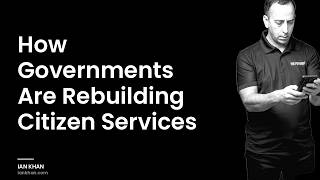
The documentary "GX Now" is a 60‑minute, interview‑driven exploration of the Government Experience (GX) initiative, originally launched in the United Arab Emirates and now positioned as a global template for citizen‑centric public service. Hosted by Ian Khan, the film weaves together perspectives from a diverse set of public‑ and private‑sector leaders—including Jonathan Reichental, Jane Wiseman, Tim Unwin, Marloes Pomp, Siim Sikkut, Mohammed Bin Taliah and others—to map the current state of government service delivery, the pressures reshaping it, and the concrete experiments underway worldwide. Core themes include the rising expectations of digitally‑savvy citizens, the need to shift from “inside‑out” bureaucratic processes to “outside‑in” experience design, and the role of emerging technologies (AI, blockchain, digital identity, e‑residency) in making services invisible, proactive, and personalized. The film highlights success stories (Estonia’s e‑residency, UAE’s “Mabrook Mayak” newborn bundle, Azerbaijan’s ASAN service centers, US state‑level performance dashboards) and the systemic obstacles that impede replication—legacy IT, trust deficits, digital exclusion, governance silos, and the difficulty of aligning cultural contexts. Throughout, participants stress the importance of data‑driven decision‑making, citizen co‑creation, employee happiness, and a future where governments focus on purpose rather than merely delivering services. The documentary concludes with a call for global collaboration, a shared knowledge platform, and leadership commitment to embed GX principles in every jurisdiction.
Chapters
Governments today are grappling with the change brought about by technology. The shift in demands of citizens expectations and service standards has created a new need for governments worldwide to seek new definitions of design and delivery. GX now tracks key governments across the world in the hope of finding answers to what governments of tomorrow will look like, how they will deliver excellence and why experiences may be the key to unlocking the value behind government citizen engagements. GX is an idea born out of the United Arab Emirates. Created to fulfill the promise of government service delivery and changing it to and experience. The model is now slowly evolving to become a template that can be used globally to create government service delivery excellence. In GX now you will hear a collection of global perspectives coming from both the public as well as from the private sector. The opinions of guests in this documentary are to a huge extent based on their experiences of working with governments and being at pivotal positions where governments and the private sector interface, looking at some of the biggest opportunities ahead and also some of the challenges governments must face in the next few years. GX now is the story of dreaming big, of excellence, of changing perceptions and of creating a better future for for government services worldwide. My name is Ian Khan. Thank you for joining me on this journey. If you look at the current state of the government experience domain, there really isn't a standard. Everybody across the world is doing things differently and there's an impact of different industries on government experience. In some parts of the world, government experience is dictated by the retail sector and we make a comparison between retail services and government services. What is happening within governments is also an after effect of how other industries are serving their clients, their clientele and their client base. Governments across the world are trying to adapt to different things and in times of political instability, changing governments, the priorities of governments are changing. Let's talk to Jonathan Reichental. I spoke to Jonathan about his experiences and the challenges that he's seen governments have across the world. Now Jonathan works with governments from Asia to the Middle east to the Americas and in Europe as well. And he knows the pulse of governments and the challenges that governments are facing. Jonathan is a big advocate of change as a professor, as an educator and as a business owner. His thoughts are critical in helping us understand where we should go and what governments should do in order to progress.
One of the things I'm observing as I have the privilege to visit many different governments and cities around the world, it's number one, a recognition that communities have much higher expectations of service delivery today. And so if you're a community member you know, you're used to using consumer apps on your smartphone or going to a website and then you use a government service and it's not nearly as good, or perhaps it's not even digital. The sense is now that this is becoming no longer acceptable, we have to step the game up.
One of the participants of the GX program is Jane Wiseman. I spoke to Jane about what are the challenges of government and what do governments in the Western world face, especially in in the United States and what are her experiences of government service and government service excellence.
Half of Americans can't tell the difference between a Google search result and a Google Ad. We need better data literacy so that we can be savvy about what are reliable sources of fact.
Tim Unwin is UNESCO in ICT and he's also professor at the Royal Holloway University in London. Tim brings a lot of experience when it comes to working internationally at a grassroots level. And what's the state of government experience and services in Europe?
In many countries of the world, people don't trust their governments. And I'm speaking from my experience in Africa, they often are willing to trust the private sector rather than governments. So I think there's some really interesting things around that. But if people don't trust governments, they're not going to be willing to engage with those service provision unless of course, the government makes it essential that they do so through their digital systems. I remember a few years ago many countries saying we're going to go digital by default. But that automatically excludes those who aren't digital. People with disabilities, elderly people. They are going to be marginalized by any move to government services unless alternative mechanisms are put in place. So actually you're going to need to provide service centers where people can come to. So digital by default will marginalize
Marlose Pomp, who's the head of Blockchain and the head of AI partnerships for the government of Netherlands, is an amazing resource. She has so much knowledge and information because she works with other governments from across the world as head of Blockchain and some very critical programs by the government of Netherlands. Marlowe's knows what challenges of governments are when it comes to technology implementation.
In the Netherlands, the government has selected five key technologies like blockchain, artificial intelligence, big Data, Cybersecurity and 5G. And we will invest in this technology more, more in the coming years to improve these services. We try to build human centric applications. It also means that we have a lot of focus on the risk of these new technologies. For example, the government already uses a lot of AI in their services, but of course there's also the risk of discrimination. So that's why the Ministry of Justice has launched a guideline for all the governmental services who are using new technologies like artificial intelligence.
I also spoke with the head of E Residency for the Estonian government, Oat Wather has been working for the government of Estonia for many years, and he brings a lot of experience when it comes to working with startups, working with international bodies, international governments. And he shared some really critical insights when it comes to government exposure. And what does the E Residency program hold and why is it such a great example of creating government experience that is seamless and it adds a tremendous amount of value for any country of any size.
The difference between government services in eu, in Asia, in US is very large, and I think EU has some similarities. But again, looking at conservative countries who do not have maybe that amount of trust for their government, or government keeping their data safe, which is also very important, then these services cannot develop. Looking at countries like India, who is rolling out an identity program as well, but 1.3 billion compared to our Estonia's 1.3 million is a bit of another challenge.
Estonia is one of the biggest examples that is used when it's about government using technology and creating efficiency in what governments do. I spoke with the CIO of the Government of Estonia, Sim Sikut. We talk about what his challenges have been and how he sees the government experience changing. From an Estonian perspective,
our main approach is to make services invisible as much as we can. Let's not focus on interactions, let's focus on delivering a value rather. So a value is, for example, that we ensure compliance. That's why we ask the entrepreneur for some sort of report, even if we ask it online. My point here is being that if we think about it from that perspective, we often see that we don't need to design for those individual interactions and services. We can get rid of many online services literally by automating things away. And so if you leave the philosophy aside, what it practically means is we're trying to, in a stone, at least kill different online services. We've built up by adding more automation, adding more sort of data integration, a bit more small data analytics and stuff like that. One of our first approaches on that parents of newborn babies don't have to apply for parental benefit. It's automatically being sort of granted for them. We are building it up for companies that if companies will consent and agree the government to have access to their financial records, or, you know, let's say data that is digital anyways, then we won't ever bother them with a report. Not for tax, not for employment, not for statistics, not for annual reports, so forth. All these things the companies can now do online. Why do we bother them with an extra step? If you have the data, it's done.
There are definitely outliers and there's definitely countries that are making making a solid effort in the right direction. To fully understand the commitment that the government of the United Arab Emirates has provided to the Government Experience Initiative and to set forth a precedent in government service delivery. I spoke with someone who's leading these efforts at the Prime Minister's office in the uae, Mohammed Bin Taliha.
In the past the focus was more on on how we build the services in terms of processes, in terms of transforming services from being manual to becoming automatic and paperless. However, the customers today look for services that are more towards their experience in other parts of services in the world that they are familiar with. And they would like to see government services being delivered in a similar way or even better.
Alin Bijani is the CEO of the Majd Al Futaim Group in the uae. The Majd Al Futaim Group is one of the largest groups managing retail in the Middle East. Alain shared a lot of critical insights. How the retail sector affects government, how governments can learn from the retail sector. Alain also works for the World Economic Forum and different governments and bodies in creating thought leadership ideas and initiatives that affect governments worldwide.
The fourth Industrial Revolution is a reality. We're in it and I would say it's very important that the rate of change on the inside be at least equal, if not faster than the rate of change on the outside. It's also allowing us to be able to deal with some of the endemic issues that we couldn't deal with before. Technology today presents that capability to do that and it's becoming more ubiquitous, more affordable and more simple to use. It's now on us, our generation of leaders, to make sure that we turn this into the opportunity that it actually is and to make sure that we can drive sustainable economic growth, employment creation, job creation, and we can drive a better integration of our societies in the world.
Fadi Al Hindi is the CEO of an AI based company focused within the insurance industry. But he brings a lot of critical insight to the idea of gx.
Over the past maybe five to eight years, customers are no longer willing to tolerate delays or lack of transparency or not knowing what's the next step, or being mistreated for that matter. Historically the economy was more like product driven in the 70s and then you get into the 80s and the 90s and now it's more moving towards like a relationship economy.
We live in the experienced economy. And I think this is something that you will see more and more and more when you think about the effort that we're putting together across the board, private sector, public sector, and how we're all trying to put everything around the customer, make sure that the customer is actually the epicenter and how can we actually, from a government standpoint, contribute to their quality of life, contribute to their well being, take away all the uncertainties that come with it and give them the ability to focus on what they would like to focus on what they love most and what they like best, which is a service that's one curated around them, two that is there when they need it and actually think about what does the customer citizen need and not what does the government need. For a very long time governments have been focused on actually designing services or they're implementing those designs in a way that suits the governments from different perspectives. I think what we're seeing here is actually a total reversal.
I spoke with government in Azerbaijan and the head of the ASAN Service Center. The ASAN Service centers have completely changed the idea of service delivery. By bringing together different vendors and as many as 300 plus services at one place. It has radically changed how government is delivering services at a service center level.
Traditional ways are not suitable anymore to provide our services and to get satisfaction level. But also we know that it's not only about technologies, it's also about organizational structures, it's about human resources and we are trying to build suitable environment in order to provide our services effectively and efficiently to our citizens.
Where the government has placed incredible emphasis on this is the recognition that everyone is different and a tremendous experience is often not something that is entirely frictionless. Like booking a train ticket. It's not that difficult to say what does the station need to get, go to what time, where you're leaving from and how many passengers are there. That's a very automated process that has almost no variation. But when you're trying to change your name and actually the options that you're going for are not available. When you're trying to consume healthcare services and you have two children who are naturally born, one is adopted, these are the type of unique situations that actually
when organisations are able to deal with
that effectively, that's what makes people feel really good about it because it makes it feel like they actually understand that there are very personalized requirements that citizens have.
If you sit at home, how is your feeling about the services you get from the government? Are you worried about missing out or forgetting about paying your bills, your utilities bills? Or are you comfortable because you know that it will automatically be processed through your digital assistant? That kind of level and that kind of experience is what we're seeking where a customer does not need to worry. Everything runs in the background on their behalf.
Consuming government services anywhere in the world is normally met with the thought of bureaucracy and lots of paperwork. I think what's different here is that there has been an incredible focus on making sure that the pain and the friction that normally is involved with the yearly renewal of services has been taken away. Now, whether that is having your car renewed, which is almost entirely a digital transaction now, whether that is your national id, or whether that is just paying for your parking through your mobile phone, everything is now interlinked. And what is very neat is there is a single portal app where you can then go on. And whether it's hospitals or funeral parlors or government service centers, all of that information is now housed in one place.
I saw a survey that 3/4 of CEOs think that customer experience is very important to their business, but there's no such survey in government. I don't know how many government leaders think that customer experience is top priority, but I'll tell you, there are 10 million government employees and it's not top priority for everyone.
So let's say you have to go to a place, you have to go to a physical place. What's the experience like when you get there? Is it crowded and chaotic? Do you know what to do? Do you get good customer service? Do you talk to people that are well informed? And if they have difficulty themselves getting you the information, do they have access to information, tools to help you as a community member? I think I see governments now beginning to think about the entire life cycle of a process. For example, getting a copy of your birth certificate when you want to submit a request for a permit, which is such a common city or government activity, it shouldn't be as hard as it is today. People don't look forward to that, and the experience should be better. You should be able to and increasingly request a permit online without having to go to a place and take a number and wait and spend half your day in a government office.
In the United Arab Emirates, we focus on customer experience from their life instances. So, for example, if the customer has a newborn baby, we look at that as a point of Life where they need government services about having a new baby. Therefore we started looking at it from a bundling perspective. So instead of a customer looking at which government entities or government service centers they should visit, they just know what bundle they want. I'll give you an example of one of the services that we have. It's called Mabrook Mayak which means congratulations on your newborn. And it bundled more than seven services into one step and more than five payments into one payment and to get everything related to this newborn within three hours. Now using this bundle
we are now moving from one stop shop model to non stop shop model. In Assan service centers we are providing reactive services to our citizens. But now we started launching new project which is called MyGov, my government project. And it's about providing proactive services to our citizens. For that we are very widely using data in order to predict expectations of our citizens and in house by the government. We are trying to involve the companies
to this process as well.
As a result of really rapidly changing world, what is changing is also citizen expectations. Citizens today expect a different level of service at a government level. The expectations are a combination of what they're seeing in the private sector, in the retail sector, in the healthcare sector. And a combination of this is leading leading to the overall citizen need, if you will, for service excellence. Today's citizens, you and I, we all use smartphones and technology to make decisions to access services. And it's very common just to expect that every service should be available on a cell phone, should be available on a mobile device. But not all governments have been able to translate services from a service center to online.
Most so called governance agendas are actually about governments providing services to people through technology. So we can see government websites where you can access forms to fill in passports or licenses, or pay tax. That is a really interesting change of management structure. In the old days, governments had lots of civil servants, lots of people working for them to do the paperwork. Now the effort and load has been transferred back down to the citizens. It's like in the old days when you might attend a meeting, somebody would send you all the paperwork in advance. You didn't have to do anything, you just read the paperwork and took it to the meeting. Now you're sent the files digitally by email or another online system. Or even you're expected to go online to download those forms yourself, then read them, then perhaps print them off because you might need to take them to the meeting. So that is a shift of labour from governments to citizens, or from organisations to employees. I hate having to log on to three or four different sites every day to get information, whereas it could easily just be sent to me in another form. The standard rhetoric is of course that it makes it much easier for governments and citizens to interact with on key things that they need to do. And that undoubtedly has its advantages. It's very easy now to submit a passport application online or your tax forms online. Second point though is, and I'll use the example of our own government digital service, there are many great things about gov.uk however, if you want to find out anything from the government website about a government department or what it does, it's almost impossible. And I think that is an indication of this difference between government service provision and the relationship between governments and citizens and the openness and the transparency around that.
Today, I think citizens are co creators in a government experience. There's an opportunity for each of us to be partners and help get stuff done. A greater openness in more progressive cities and more tools for collaboration are allowing community members in particular to participate in everything from decision making to design sessions, even development of solutions. There's some very interesting experiments being done with community co funding, identifying funds from public sector and private sector to get projects done that have been difficult to get moving because of the reliance purely on public funds. If a government makes available data and a community member says, hey, I could build a solution using that data. Wow, that's a great relationship. That's a great partnership. We have software engineers now who can step up, create interesting solutions, or try to make sense of data and serve up the analytics that helps decision makers make better decisions. That's a relationship we've never had the tools to be able to do before. A good democratic government experience is not a spectator sport, it's something you participate in.
State of Washington is one of my favorite performance driven organizations. There's something called Results Washington. Every single metric about state government is available online. Drill downs to get greater detail. And when the governor hosts a results meeting, the public is invited. It's streamed live online, but they also include a customer or two or three in every single meeting. So if it's about youth development, there are actually youth there giving feedback to the government about how the services are improving, where they need more improvement. So that's a great example at the state level. And right now 90% of our federal government websites are collecting customer feedback and trying to iteratively improve.
My takeaway is that it's really interesting what's happening in the world today. The amount of data that is Generated on a daily basis is just mind boggling. Yet you talk to a lot of the enterprises, you talk to government, you talk to private sector, you talk to large corporates and they will tell you that they have poor data issues with quality. There are gaps in the data, there's
a problem, there's a lot of legacy systems and data that's out there that's quite difficult to mine and bring to the surface. When you're building something greenfield, it's much more simple to do that from A to Z. But the truth is a lot of government departments have huge legacy of information systems that they're using and traditional processes. So.
So the difficulty is trying to stitch
those together in a format that the customer doesn't feel any bumps. It's like having a shopping trolley being pushed across a railway track. Very bumpy experience. And what you're trying to do is take all of those knots out of the experience.
In all services you need a form of identity, but it's identity. It sounds like there's only one identity and I expect you have several identities which you can use. So I will use another identity to log in, for example in my Google account, then I will use for a governmental service, for example. I hope these digital identities, several identities are owned by me and are controlled by me.
The state of Indiana recently created a single sign on so that I can get my park permit, renew my driver's license, you know, certifications, any government activity that I'm doing with the state is all under one ID so that I don't have to continually re enter my information. So that's wonderful, sort of one stop shop. But you know, we're still a long way from being able to integrate from the federal to the state to the local with a single identity. And I think it's probably worth being careful about this because with a single identity in government comes risk. You know, could it be hacked? When it's done by the private sector, government doesn't have the control and can't police it in the way that might be necessary. So for example, in the US we have for the ability to travel, the Transportation Security Administration is responsible for issuing TSA PreCheck, you know, so that they vet me and then I can go in an express lane. Well, there's also a private sector entity that's doing that. What is the fundamental role of government? Should it be the government that says who can get on a plane and is safe to travel and who isn't?
If you let the government have all of your identity, what might they do with it. I often liken this to what happened in Rwanda, where the use of older digital technologies, radio for example, enabled many parts of the genocide there to happen more efficiently. So if a government knows everybody's identity and where they live and everything about them, what can they do with that information? For migrants, it's very often issues around whether qualifications, for example, gained in one country can be compatible with those gained in another country. Imagine if everybody had a digital identity that they could take with them, so that if you're moving from Kenya to South Africa or from Haiti to Brazil, actually you can take your identity with you. I think that raises really exciting possibilities, not only for migrants, but also for governments. If we could get global agreements around what the parameters and what the credentials in digital identity meant, that could be really beneficial.
So it won't be one technology which will solve the digital identity topic. It will be a combination. And at this moment we really try to figure out how can we combine digital identity with privacy preserving technologies like zero knowledge proofs or multi party computation. I think this is a really interesting area to explore at an international level.
We believe in Estonia that digital identity is the backbone of everything. Every person should have an identity matched to them physically and digitally. So every Estonian communicates with the government using their digital identity, meaning they do everything from bank statements, taxes, to registering, the childbirth using the digital identity. And we really can't imagine our life any other way.
It's been nice actually for us as a Estonian government. A learning journey to get to have experience in focus. I'll be very honest here. I think we've been very techie and engineer led throughout our sort of beginning years, especially in a sense that seeing, okay, how much better, how much more efficient we can be if we functionally build things up and you know, for example, put services online, whatever the experience. Now we've really come to the point that to get to next levels, obviously experience has to be at the forefront because otherwise we don't have people that's using it. And so it goes of course, way beyond just issues of nice neat design of an online environment. Our core focus is how do we make the process, the working of government into the best experience. And in other case for us just to look forward, I mean, it's about how do we simplify it radically, because the best experience, at least as far as the students is concerned, if there's none, if stuff happens. For me as an Estonian, it's very hard to give advice on physical service centers because for us, digital journey has meant Getting rid of them.
Largely, there is the tax board that has a physical stand and perhaps the post. But otherwise, if we talk about governmental services, they are 99% online.
If you can't get access to digital in whatever means, because you don't have connectivity, you don't have electricity, you're going to be further marginalised by the delivery of digital services. A classic example is around the notion of smart cities, or I often say, just by saying the word smart cities actually implies villages are fairly dumb. So one of the main challenges is very much that you can't deliver, say, what you can in a small, densely populated area that has full connectivity. That's why it's so important to have access. In the first instance, not all our
citizens are technologically literate.
That's why we need Assan service centers in all parts of our country.
Also, we have mobile buses. These buses are specially equipped with different technologies.
We send that buses to the remote areas where we don't have Assan service centers in order to serve our citizens.
And also we have volunteers.
The human factor within the government experience is the primary factor from all perspectives. I would say so if it is from a customer perspective or from a government employee perspective, Even the employees who work on delivering government services, we looked at their happiness level. We looked at how they understand what customers want. Therefore, we have conducted a series of trainings. It's a customer happiness training where we look at the frontline employees who provide the services. We train them on how to conduct business in a manner that will make the customer happier. And also at the same time, we looked at the supervisors of these government service centers, which we call in the United Arab Emirates the customer happiness centers. And we train them on how to supervise a team of customer happiness officers.
I'm not in favor of absolutely 100% abolishing every government service physically, because we see that some regions, for Estonia, this is the kind of only form of communication that some of these people actually have. And they enjoy these forms of communication. They enjoy going to the post office. But in terms of city life, in terms of actually going to the tax office and waiting three hours to fill in a stack of paper, that should be eliminated. Absolutely.
The way to shape government services is really clear. We need across the board, a template of excellence. We need something that can be easily adapted, easily deployed. For example, if a country has a model of excellence, is that model able to be replicated across different groups, across different departments and ministries? That's exactly what is needed. The GX program in the United Arab Emirates is an excellent example of that. Government service excellence is a top priority for the government of the uae. Things such as tweeting about the rankings of government service centers is not very uncommon in the uae. And this is how leadership runs the country.
GX was created with the vision in mind to drive the attention of people working on services. Regardless to the type of customers or the Persona of the customer. We need to focus on the experience of that customer. Now, who is part of the gx?
Everyone.
So it could be private sector, it could be investors, startups, entrepreneurs. Who could be part of the GX platform has multiple aspects to it. We have the Government Services Forum that brings leaders from around the world around the table to discuss government services. We have the GX online platform that shares knowledge base how governments around the world improve customer experience. We have also the GX talks. So the GX talks also focus on getting thought leaders from different backgrounds to talk about experience of customers. Whether it is digital experience or it is also the physical experience or even experience that has no touch point. So for example, if you sit at home, how is your feeling about the services you get from the government? Are you worried about missing out or forgetting about paying your bills, your utilities bills? Or are you comfortable because you know that it will automatically be processed?
The UAE is an impressive nation. They've got the advantage of being fast and nimble and agile right now in the way that they go after initiatives. Plus they've got leadership that's truly vested and believes in going digital and adopting the fourth industrial revolution. I think these ingredients, when you put them together, gives you a very unique environment because of the platform that's been created by investing in this futuristic thinking.
It's not just their vision and their talk, but they're building things and doing things. I've been able to experience these things firsthand in Dubai. For example, their concept around the future police station. It's a beautiful experience, people feel safe. A lot of it is done by use of digital technologies, assistance from the right resources via video conference, which I thought was incredible. You see a lot of experimentation and prototyping. You see very bold projects, everything from smart Dubai right through to the paperless society, thus making the cost of government be less data to be more accurate. All the benefits we would expect. One of the big ones, the environmental positive side of not having all this paper, they're doing the things, they're demonstrating, they're experimenting, they're helping other communities and cities and governments around the world see what's possible, sharing these insights with the world and wanting to create things like the GX Forum, which becomes a global platform to say, hey, you know what, there's different ways to have a government experience. We've got to be able to create channels that takes these best practices, the stuff that goes well and maybe even the learnings of the stuff that doesn't go so well all the time, and share it with governments in every corner of the world.
So I think the thing that's important about it being an international conversation and frankly being an in person conversation, because we're all busy, if we just try to get together by phone or webinar, we're going to get distracted. But when you plant yourself physically with other people, you make the kinds of connections that last and that allow us to keep advancing the ball, to continue to refine our thinking and to challenge each other. That sense of almost like a healthy peer competition, like, oh, I'm gonna have to have something to say when I get back together with this group. You know, what have I done? What do I bring to the table? So, so I think that's a real value that we can see in this group.
It's really necessary to have experiments within your own organization because otherwise it's too complicated to have these discussions with other partners who develop services. So you must test and explore a little bit within your own organization. You must train your employees. There are hardly any projects where you don't have to collaborate. So it's really important to learn how you can build firm coalitions and what kind of agreements do you need. The legal issues around these collaborations, the governance models.
Of course, it is very difficult to implement ideas as it is because every country has own culture, has own tradition, has own environment. And you can see how they challenge in that environment and how they solve that problem during the implementation process.
Initiatives like this can often tend to be wanting to come up with the best global solution. But these ideas are evolving. The relationship in citizens and states is evolving. Technology is evolving. So a little bit more, I think, self critique and not always positive about some of the activities that happen. Because technology can be used for good and it can be used for bad. And it's how we mediate those in the interests of citizens. For me, citizens are actually more important than governments. Governments should serve their citizens.
We have learned from e residence experience is to try to put yourself in the shoes of the user. Because we see quite often that that's what government officials are lacking. So they sit in their silos and they don't talk to the users, they don't understand the needs of the users. In the age of smartphones and all of the private sector services that we actually consume all the time, we can't expect our governments to lag behind. We believe in Estonia that governments can never compete with private companies and they shouldn't. But governments are the ones who have to offer government services. So it's time to actually go together with the trends. What's happening in the world.
The Global Star Rating program is the first of its kind that assesses government service centers as if they are hotels. So just like when you walk into a hotel and you see that this hotel is a five star hotel and you understand what experience you're going to be getting from a five star hotel. The same similar concept has been applied to government service centers. His Highness Sheikh Mohammed guided us to make United Arab Emirates government as efficient as banks and works 24, 7 like airports. Since this program has been launched, we have realized the fruits of this program by seeing customer happiness centers improve significantly over the past eight years.
The Edelman Trust Barometer ranks the UAE very high. The highest, if not the second highest in the region and one of the highest in the world. I think with the 84% trust. The UE has always designed its government services and looked at government services as actually an enabler to society. Today the UAE is looking forward and say, I want to do even more and even better. I want to be even more customer centric. I want to make sure that my government services are actually not just the best in the world, but the most satisfactory in the world for the people that use them. And actually how can I enhance their life? How can I actually add value to their lives? And this is something that we're seeing happening day in, day out. This culture of transparency that's coming across more and more in the uae. In order to be the best in the world, we have also to hold up the mirror. And this is something that you're seeing happening. And I think the government is leading by example.
The future of the GX program by the Prime Minister's office in the United Arab Emirates is strong. It's something that's tangible. It's something that can be developed and adopted by every government service program in the world. But it needs work. It needs work because implementation of these things is complex. You need stakeholders to agree on these things. You need to get the buy in from people who run governments. And those are some of the challenges that other governments might face when adopting this program. We live in an era of disruption, fast changing expectations in Order to make the world a better place, we will have to play the game in a different way. Whether it's GX or any other program at a government service level, it needs the commitment of the leadership of these countries, of these departments and groups.
So this is an amazing time. There is so much potential and we need two things. We need number one to listen and number two to act. And when you put those two things together, it makes a huge difference. So in the US the Veterans Administration, which serves former members of the military who are now back in the country, they started a customer satisfaction survey. And it turns out people who responded to the survey and gave feedback were four times more satisfied with government than others. Now don't know yet whether some of that is sample bias, that those who decided to answer the survey were more satisfied. But to me it also says that there is power in just asking for feedback. When you engage the public, they become more excited. The city of Santa Monica, California has a well being index. They have decided that the purpose of that city is to support the well being of its people. One of the things they've done is social media sentiment mining so they can tell which neighborhoods are showing through the publicly available information on Facebook and Twitter, what neighborhoods are under stress, what neighborhoods are worried about money and how can the city really do something, something about that. We now have drug treatment in jails because the people who were coming out of jails were 120 times more likely than the average person to die of drug overdose. So now we can do interventions in our jails because the data approach allowed us to target when community members got to participate and help the government choose where the money goes when the people made the decisions. There was more investment in health, more investment in education. And some of those early cities that employed this showed lower incidence of infant mortality. You know, five years, ten years from now, I think we're going to have a much higher level of trust in government because with all of these new ways of engaging the public, there are untapped ideas and resources and potential for really making government just far better than it's ever been.
We are planning to implement personalized services for our citizens from any country, from any place and without any barriers. And to be accessible and available for that, we need also to implement new technologies, AI, machine learning, deep learning and other technologies. Now we are implementing shared cloud based document flow so system and it helps
us to reduce the cost for building
that services and to optimize that processes.
The governments of the future are going to be focused more on Purpose and less on services. Services are going to be done. Artificial intelligence, machine learning is going to take care of most of the services being delivered. We're going to be focusing more on thinking about our future, on how we can magnify life as a nation, as a community. The government will have much more time, capabilities and much higher quotient when it gets to liveability, when it gets to the future of government is going to be about a lot of the problems that we know today. A lot of the topics that we are trying to solve for today are not going to be there. In 10 years time we are all going to be augmented in our capabilities as human beings. We're going to be able to do more for less, but also we're going to be able to actually focus on where we actually make the biggest difference and drive the biggest impact. Not in terms of the small things that happen around us, in terms of enriching life on earth and how we can actually be a continuous age of change and progress.
I believe that AI is definitely going to be the next cycle of major revolution in technology. And what we're going to be able to do with it are a lot of products and services that were not possible in the past. But it's not my belief that the AI algorithm is going to become sentient one day and wake up and figure out that humans need to be eradicated. Let's be more pragmatic and more realistic and let's not worry about the sci fi part. The part of AI that's really exciting are most helpful for, for corporate user or the corporate worker. The first one is this concept of digital twin. And the concept of digital twin is that it's an assistant that's working side by side with the human to be able to improve the quality of the type of work that they're doing by relegating all the mundane manual tasks over to the AI and the automation so that the human is actually focusing on the things that they should be focusing on. Not filing the papers, not thumbing through things and trying to index, you know, a thousand pages. That should all be done by machines. And the digital twin should be providing this workflow automation for the human to become more effective and more efficient.
A lot of services will be global services and then on top of that or beside that, you will have a local flavor. But what I see for example with the blockchain projects, the redshift of diplomas, now it's done by countries, by themselves. I expect this will be a global service. We bring people from all these coalitions and all these communities together to work on these challenges, which are mainly global challenges. And I think at this moment, the first step to bring these experts together, they need each other, for example, the blockchain experts, they need more and more data. And so they need the experts from the Big Data working group, also the data experts from the Artificial Intelligence working group. So the next step is to build broader collaborations worldwide and I hope the Netherlands can be the gateway to Europe for many services.
The future of government services should be something that happens without the customer asking for it. We know what the customers want, why not deliver it to them? Why not go to the customer instead of having the customer come to us? We want to relate it more to the digital experience that customers today have with online shopping, where they get recommendations on what to buy based on their previous searches on the time of the year. We want to be something similar to that and maybe even more proactive. We are aware that the way education is going to be delivered is going to change. We are aware that health care is going to change. All of these services need to be integrated in a way and in a manner that makes it seamless to the customer, seamless to the investor of the future.
We have taken most of our services online already, but now it's the matter of actually measuring the quality of these services, how do they function, what could be improved, what's the journey behind it? You can do most of the stuff online, but we still have lots of relic in the process. In Estonia, when we opened up up our services to non citizens using E residency, that means that we might have some Estonian documents from time to time pop up to the foreigners in our systems. That's something that needs to be worked on. We're working towards the perception of having these seamless background services. Once you are born, we already know your name, we know your birth date, we know quite a lot of things about you. Same for medicine, for example. We're looking at some of the ways where we can predict what illnesses you might have or what's genetic about you and the like.
We've been very pragmatic in a sense to say, look, let's figure out how to solve this organizationally, legally, have proper safeguards in place technologically as well. So this sort of approach to fixing problems and sort of solving them in a very engineered way, even through design, is one part of it and the other part. We have benefited from the fact that obviously we are a small country in that sense and the size doesn't matter really from the point of view, how many people that live. But just the. I would say that as a small country, we have very lean governance in terms of how decisions are made. And I think if oftentimes, if countries ask me, okay, so what makes Estonia a bit more nimble? Because decision making is faster and not too many levels of government to consult and so forth. So that's what has allowed us to go quite a bit way. And I've seen in bigger countries too, if somehow decision making gets streamlined, of course, in democratic context, then you're able to make leaps. Because tech moves fast. You have to be able to move fast along as well.
What will really change the world is when enlightened, progressive governments are able to easily connect with enlightened active citizens, because that's a potent force. You bring those two things together and we can do some really amazing things. This sort of tension that exists between communities and governments, because, you know, communities have great expectations and governments try hard, but they struggle to meet those expectations. In a digital world, you can deliver more consistently and getting access to information and data when they need it, creating more a of seamless channel between when the data is created by government or collected by government and the desire to be able to access that, simply because we want to know what government is collecting on us, but also to be able to make better decisions and to develop solutions. There will be a much greater degree of automation in the future, and this will be both in the digital world through the use of artificial intelligence, but also through robotics. And so we'll have questions about what does that mean to the human experience? What does that mean to jobs? What does that mean to the personal connection we have between an individual and a provider? So we'll see all the positives of automation and artificial intelligence. We also got to be conscious of what that means ultimately to us as humans. We have to decide what we want to do about that. There'll be more change in the next 10 to 20 years than in the last hundred years. When it comes to government experience, it's going to be a remarkable time.
All the different methodologies available today, including the GX program, are amazing. They can change how citizens are served. They can change how citizens, you and I, access services at a government level in the country of our choice. I really believe governments need to look at GX as a program that can bring a new wave of energy, that can bring efficiency and accountability in their governments. The United nations predicts that global population will reach 9.8 billion people by 2050. This means more expectations from governments to serve citizens better and create better experiences. This means a more complex world with new stakeholders, new challenges, and new speeds of response. In 2020, humanity battled a new challenge, the COVID 19 pandemic. Many governments struggled to cope with the pandemic, and yet many succeeded beyond expectations in managing, controlling, and eliminating the threat of the pandemic. One thing all responsive and successful governments did was their ability to respond fast, to engage with citizens, and to focus on success while looking to the future. It is these governments, thinkers, leaders, and trailblazers that are in the process of creating a better world.
If you believe that there is a social contract between the governed and the government, then the thing that governments need to keep in mind when they provide services is, is what people really want to get from that relationship.
Sometimes the solution that will work in
one place won't work in another.
So being very curious about the histories
and cultures in which you're working in
order to match up the services with the particular residents or citizens that they're serving, I think is a real leadership skill.
Making it an outside in approach to services delivery as opposed to inside the
government out is a change of a
paradigm of how government traditionally develops and delivers policy and then thinks about service delivery. Challenges that governments face are no longer technical in nature. Those we figured out how to solve.
The problems that are facing governments today
are more around wicked problems such as
how do we solve homelessness, how do
we improve food delivery to people, how do we improve people's quality of life? We started with public policy, focusing a lot on markets and market failure and
how government had to solve problems of market failure. I think that's still an important thing,
but I think we have to go
beyond that now and understand that equity and justice are really important factors that
we have to take into account and figure out how we can devise public policies that make sure that we're being
equitable and we're being fair and just.
There are places that are excelling in doing digital services, but I have yet to see a government that then harvests the data on the back end for customer insight, for predictive analytics, you know, geospatial analysis, and really optimizing performance.
Just because you have a large, large data set does not necessarily mean it can help you in any way if you, you can't unlock value or information from that raw data. And so the way I think about how government can play a role is to really focus on information that's valuable for constituents, for policymakers, for citizens, for residents, for visitors. Use that information to all be on the same page for what success looks like and how to assess whether or not you've hit criteria that you've set and then ultimately learn and iterate from there.
Today, customers have expectations that are drastically different than what governments offer today as services and we should bridge the gap.
I worry that in a downturn, we're
going to have to be even more
efficient in the way we serve. And with the expansion of digital services, we need to think about how we do old fashioned services in a new way.
One thing that we do within a
city can impact traffic, which can impact
housing, which can impact the migration of people.
We have to consider everything within systems
and within the greater mechanisms of this,
and not just on individual decisions.
Make sure you have the right business
cases and the right governance in place.
You can't innovate if it takes a year to approve a business case to
do a new service.
The one thing that government needs to focus on primarily is really trying to understand community.
It's at the very micro level of
a city and using technology is one
way to be able to do that.
But also being able to embed themselves
within communities deeply to understand the greatest challenges that people are facing and then being able to use that data in a way that can actually affect change.
This next generation cares more about issues like the planet, issues about housing equality than previous generations.
But I think we have to make
government attractive to them.
More from Professor

Technology Ethics and Responsible Innovation Coursera Specialization Launch Teaser




Technoethics: An Essential Leadership Skill for the 21st Century | Dr. Jonathan Reichental
Technoethics: An Essential Leadership Skill for the 21st Century | Dr. Jonathan Reichental


FOF 154 | Jonathan Reichental. On Cities and Governments Using Technology To Serve People Better.

Miasto to emocje, relacje i codzienne historie – rozmowa Waldemara Olbryka z Jonathanem Reichentalem

MS01┃Jonathan Reichental, PhD - Perfection, Creativity, and Who’s Actually Having Fun?