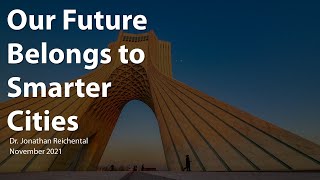
In this keynote for Smart Cities National Day, Dr. Jonathan Reichental outlines the rapid urbanization of the world—over half the global population now lives in cities, a figure projected to reach 70% by mid‑century, with megacities growing at a rate of three million new residents per week. He highlights the resulting pressures: congestion, aging infrastructure, air‑quality‑related mortality, massive waste streams, and heightened climate‑change vulnerability for coastal populations. Reichental argues that these challenges create a massive economic opportunity: a $2.5‑$2.6 trillion smart‑city market by 2025 and an estimated $20 trillion of economic outcomes within a decade. He showcases concrete examples of innovative urban interventions—Paris’s Champs‑Élysées urban garden, Freiburg’s solar‑powered community, IoT‑enabled parking sensors, digital signage, and connected waste containers. He then moves to emerging technologies: AI‑driven security robots, delivery drones, autonomous vehicles, and the prospect of future, even speculative, transport modes. Throughout, he stresses the need for citizen‑centric digital government services that match the seamless experiences people expect from private apps. The talk concludes with a call to action, urging the audience to become active participants in building smarter, cleaner, safer cities and inviting them to engage with him on LinkedIn and Twitter.
Chapters
Hi everyone. My name is Dr. Jonathan Reichental and I'm delighted to be here on the Smart Cities National Day. I'm going to speak to you for the next few minutes about something I'm passionate about and I know that many of you are also passionate about. The subject is why our future belongs to smarter cities. Well, let's look at the world today. The world is largely urbanized and urbanizing. We're well over 50% of everyone living in cities. And in the middle of the century that number will get up as high as 70%. We're moving into cities at about 3 million people per week. Cities have served us very well for many, many years and well over a century. But today we're paying a price. Today we have a lot of congestion, we have traffic issues, we have infrastructure decay. We have growing populations in a lot of cities in the world. In fact, we have megacities. These are cities over 10 million people. The ranks of megacities today, about 35 in the world, are growing rapidly too. But humans have decided that a better future presents itself in an urban setting. More jobs, better education, better access to health care, more entertainment options. Cities are the most complex and successful of human inventions, but they also have a byproduct. Our hyper consumerism, our reliance on materials things have created an awful lot of manufacturing and production activities that are spewing, for example, bad chemicals into the air. And this is happening because our cities are demanding it. And the World Health organization says about 8 million people per year die directly or indirectly because of air quality. We have work to do here. Of course, as we consume more and as more people are present in our communities, we're producing an awful lot of waste, an awful lot of waste. And we haven't really mastered how we take care of that waste. Where does it go? Can we create a society where it's more circular? We first of all don't create as much waste. And the waste that the things that we do create, we reuse. So we are delaying waste and actually avoiding it altogether. Waste is quite toxic in our communities. And so it's a big part of how we need to think about managing our environment and our cities in the Future. And the 800 pound gorilla in the room. We can't talk about the cities if we don't talk about a changing climate. About 1.3 billion people live on coastlines in the world representing hundreds of cities. And if we believe the scientific consensus, which I do, the water sea level rise is rising on our coastlines and flooding communities where there are storms, the storms are stronger. Where there are droughts, the droughts are longer and drier. So it'll be our cities that are often at the forefront of the climate emergency. And it's also, by the way, our cities where we will fix the issue of climate change, at least manage it. I'm not sure we can reverse it, but we certainly try to manage it. Let's go down more to the local level. It doesn't matter where you live in the world. Very often government services in a city context look like this. People waiting in a room, waiting in some city room to have their name called or their number come up so they can fill out some paperwork to get a permit or a driver's license, or request their birth certificate or some other government facility. This is how a lot of local government works. And yet people experience this when they really want to experience it like this, right? They want to have a digital experience in their cities, just like they do in their home life when they're playing games or getting directions or reserving a restaurant, whatever it is they do on their smartphone. They don't want this when they work with government. They want to have this kind of experience. It's a, it's an incredible opportunity. Now in all areas of our cities, there's growth, there's complexity, there's interdependency. There is opportunity. There is opportunity in all of these areas, from energy to buildings to health to education and water and air quality. It actually represents a two and a half trillion dollar opportunity by 2025 for providers. There is a market for this as we develop a future of cities. And the data also says that within about a decade, our smart city activities will generate about 20 trillion to the T. $20 trillion of economic outcomes. In fact, there we go right there. There is the statistic in terms of smart city opportunities that will be present by about 2025, $2.46 trillion. We have new ideas. We have big ideas about the future of cities. You have to think differently because we want to have beautiful, clean, healthy, safe city environments. This is a tremendous rendering of what the major artery through Paris can look like in a few years. This is the Champs Elysees in the great city of Paris in France. And the mayor has finally pushed through a successful proposal that's been approved to make the city center into a urban garden where the focus is on trees, of vegetation and people, and less about cars. So as we move into the future, our future of cities will have, have a lot of innovation and opportunity. But we can think Differently and deploy our cities in ways that are beautiful and add to the quality of life for a lot of people. As we progress forward, our appetite for energy hasn't gone away. In fact, as our cities grow, we want to use more and more power. And we are in the beginning years of an energy revolution. As we move from a carbon world of oil, gas and coal to a non carbon world of solar and wind and nuclear and geothermal and biomass and wave motion and other forms of non carbon energy, it'll change the look of our community. Here you see Freiburg in Germany, which is largely now a city driven by the sun. In this city, the people don't get bills, the city community members get checks, they get paid because they produce more energy than they need. That's a different type of future. And we want to be able to deploy new technologies like the Internet of Things, connecting devices to the Internet. Here's a project that I worked on where we had sensors on the lamps that could detect if a parking space was available or not. Right. And so that information could be fed through the cloud to an app and people would know if there was a space available. And this can reduce congestion in an urban setting. We will see lots of things connected in our communities, like trash containers and things like this. Like this digital signage here in New York City that gives timely information to communities. We can use digital and connectivity and the Internet of things to improve the kinds of ways we deliver city services. And the future is going to be different and we have to think differently, right? We have to think differently. We have to think that in the future there will be more use of artificial intelligence and robots. This robot here is doing the role of a security guard. And this robot never goes to sleep, never misses a day of work, and in fact doesn't get paid. Sure, there's risks here to the future of work for humans, but we also have to be very sober about the reality of what's coming. And in fact, humans should do higher value work. But robots and AI, new technologies coming to our communities, they'll take the form perhaps of drones on the ground that deliver food, like this one, which I in fact worked on a project around and delivered food in one of my communities. This is getting more and more popular. We'll also see autonomous vehicles changing the landscape too, as cars drive themselves, which they will, by the way. We can design the city differently. We don't need traffic signals and lanes and the grid system and stop signs, because computers don't need those. Right. New technologies will just motivate us and require us to shift our thinking around the future. We have to think big. This is a time for big thinkers, not for a time for small thinkers. The future will be different than it is today in so many ways, including surprises like flying vehicles and even technologies we can't even think of today. We have to be ready for that. And so the question I have for you in my short time is what role will you play? And are you ready to help build the cities of the future? Well, thank you again for this special occasion. It's been a real honor to be invited to be part of your event. If you would like to send me your comments or ask a question, I am delighted to answer them. I am very active on LinkedIn and also on, as you can see on Twitter here. Please do follow me on Twitter and ask your questions. And I hope you have a fantastic event and I hope you have amazing success in all your future city efforts and all your smart and sustainable city projects. Thank you and bye bye.