An Evening in the Shark Tank
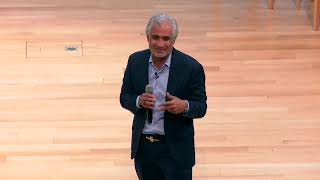
Reza Satchu, Kevin O'Leary, Matt Higgins, and Sarah Paige judge pitches from Harvard students and alumni at a live Shark Tank event. Entrepreneurs pitch ideas ranging from predictive fatigue management to luxury vegan caviar, seeking investment and feedback.
Chapters
Achieve. Okay. And so what would be a measure of success for the next half hour.
And a half for you?
Success would be basically them inspiring me or keeping. Motivating me to continue on my path.
Okay.
All right. Who else. Who else wants a key learning?
Who?
What. What are you hoping to learn as opposed to just watching? What is it that we're trying to learn? Yeah, what are you trying to learn? With limited information, how do you build trust? Okay, so with limited information, how about make it even broader? With limited information, how do you make decisions? How do you actually trust your judgment to make a decision when you desperately want more information? Like, that seems hard. Like, why would that be worth it? Why would you want that? That seems like a really hard thing to want. You're trying to learn judgment. Do you have it? No. You don't have it?
Not yet.
That's why I'm here.
That's why you're here.
So you're hoping this will move the ball forward on judgment. Okay. Anyone else? Here's what I want you to do. Here's what I want you to do. I want you to think about the Founder journey as a hero's journey, okay? Because I really believe that is what it is. Like, parallels are just extraordinary, right? Cut the circle in half and put the top half being the ordinary world and the bottom half being the extraordinary world, okay? And here's what happens to founders, and I hope desperately it happens to you one day soon, okay? Which is that you get a call to adventure. You actually see an idea. Now, most of you, when you see an idea, will convince yourself that you can't possibly have seen a good idea, because you will assume that so many other people with more resources, more information, surely would have come up with that idea. So you won't even get to first base in terms of the call to adventure, but some of you may actually get there, and there'll be a whole bunch of people who will tell you you can't do it. The refusal of the call. Like, what do you know? You've worked for two years at McKinsey. You literally know nothing. Okay? But now you're gonna go start a business. Like, what do you know? There are other people with far more domain expertise. You can't do this. What about the downside? But there'll be one person who will believe in you. There'll be one person, and that person will help you cross the threshold from the ordinary world to the extraordinary world. And the reason you want to go to the extraordinary world, because there's a part of you, which craves uncertainty. Because you know in those moments of uncertainty is where you will learn the most, where you'll actually figure out if you can lead. And you'll face all sorts of dragons, all sorts of crisis, but you'll actually start trusting your judgment to make decisions. And the reward will be you will come back into the ordinary world a far more enlightened person, someone who can have the thing that all of you desperately want, which is to have a positive impact on the people you care about. That can be your family, that can be the whole world. But it's only by going to the extraordinary world that you learn to trust your judgment, to actually have the impact that you desperately want. So these folks are starting the journey, okay? And I want to give you some practical advice on how you might start it too. So this is my little framework, okay? Let's reverse it. Impact. Every one of you wants to have a massive impact. It's why you heard here at hbs. If I asked you what impact you want to have, you'll say you want to cure cancer, or you'll say you want to have more female tech leaders, or you'll say you want to provide access to inner city low income folks. You'll say you want to cure poverty, you want to cure air pollution, all these things. And those things have a few things in common. They're all much bigger than yourself. They're all born typically out of some sort of childhood trauma. Okay, as an aside, and you all sitting here believe you can do it. You all actually believe you can do it. And the data would show that hardly any of you will. Okay, that sheet of paper that I'd ask you, right, about the impact you would want to have, it would share those four characteristics. And what I will say to you is there's no shot of having the impact that you desperately want without committing to something that you really care about. Now, the problem with commitment, especially in a school like this, which values options optionality, is that seems really risky to commit to something, right? It seems really risky to foreclose a bunch of options. Like you've spent your whole life collecting options. You, this school gives you nothing but options. So why would you commit to something that seems really costly. But of course there's a part of you which, where the speech will resonate, where you'll be like, well, I'm not that good that I can preserve all my options and have the impact that I truly want. Like, I'm not that smart. Like I actually need to commit to something in order to have this impact that I want to have. Now, of course, the problem with commitment, especially in the face of so many options, is it really requires judgment. Like, that's where judgment is most needed, when you actually have to commit to something. So how do you go about getting this thing called judgment? And it really starts with, you got to reverse engineer. You got to say to yourself, okay, what's the goal? And I know if I asked you what your goal is, you would paint this picture of this massive positive impact. I also know the thing that will block you is all of these things. How could I possibly have an idea? I surely need more information. How can I possibly give up all these attractive options to commit to one? There is a paralyzing fear to commit to anything that is uncertain, such that there is a complete mass miscalibration of the downside risk, and much more sinisterly, a complete miscalibration of what all of you might be capable of doing on the upside. But it all comes down to this inability to trust your judgment to commit. Now, this gets much worse because you're at a school where suddenly you've got hundreds of choices, you've got all sorts of options, right? Like, for most of you, very few people would have bet on you from where you were to getting here at Harvard Business School. Like, that trajectory for most of you was incredibly steep. But I would say for 80% of you, the next move is entirely predictable and probabilistic. Like, meaning everyone would bet on you for doing the next move coming from a place like this. And so the question is, why is it? Why does the slope flatten so much? Like, why is it that the slope flattens from here and it's all about optionality. It's all about preserving these options, right? I can go to bcg, or I can go take this private equity job that I really don't want, because it just preserves my options. It doesn't make me look silly in front of my classmates. I'll go do the commitment thing later and capture the upside later. And of course, what it misses is that now's the time. Like, if even I would say, Harvard Business School faces an existential threat. And the existential threat we have is we're not creating enough founders, we're not creating enough people who really want to build companies of real significance that change the world. So the question then is, how do you maximize learning, right? Because that's something we can all agree on, right? We all, sure, resources are important, but really, what correlates most with resources and Confidence and credibility is learning. And so what I would argue to you that the definition of learning for me is making consequential decisions that you are accountable for, because in that space is judgment, right? A decision by. By, in and of itself requires judgment. And so how do you actually get the benefits of exponential learning? How can Michelle Zatlen, having never managed anyone, manage thousands of people at Cloudflare, because she's trained and built her judgment muscle. So I would encourage you to think about, as you think about this session, that you embrace the tension. You see it as an opportunity, and realize that judgment is something that can be built.
Let's go.
This is what commitment feels to most of you, right? This is. When I say the word commitment, this is what it looks like to you, right? Because you have all these attractive options, and suddenly you look at this and you're like, wow, that really seems really scary. And I say it's untrue on both sides. It's untrue in terms of the downside, and it's certainly untrue in terms of the superpower that commitment can be. So what I would encourage you to do, as you look at this little, little thing we're doing today, like, in the grand scheme of thing, this is just a pitch contest, but it's also your classmates exhibiting what I'd call a small C commitment, right? They're trusting their judgment to do something, expose themselves, expose an idea that they're interested in, and hope it works, okay? Knowing that Mr. Wonderful may rip them. Rip them to shreds, okay? So the point is, it's a series of small C commitments where you start to trust your judgment, such that you can make the judgment you most want to make, which is to commit to something fully. The other thing I want you to think about when you think about commitment is it does lead to magic. It's a superpower. Like, the idea that you're going to live a life where you preserve your options is a real shame. It's a real shame for a Harvard Business School alum to do that. And so as you think about this, I would be less focused on whether you like a particular idea or not. I would think about the psychology that you have and what you can learn from this session to help you think about how you can truly commit and really see what you're capable of, okay? Because at least these founders are on the path to doing that at a time when the world allows it. The barriers to capital are less. The downs, you can fall only so far. With a Harvard Business School grant or Harvard Business School degree. And so I'd encourage you to think hard about that. Okay? So I'll close by saying that we all want this massive impact. Okay? The way to get this impact is to figure out how to trust your judgment to commit to something meaningful such that you can get the true benefit of Harvard Business School, which is this magic. Okay. You've worked really hard to get here. And so my hope is that this session will move the ball a little further as you think about how to commit to something that you really care about as opposed to thinking, I'll do it in five years time. Okay. All right. So with that, I want to. We'll get started. Okay. I want to introduce Jing and Hunter who are the heads of the entrepreneurship club. And I'll explain the rules in a minute, but these two have done a really great job setting this all up and so I want to welcome them and thank them for all their support.
All right? Hi, can you hear me? Oh, great. Thank you for coming to an evening in the Shark Tank. I'm Jing. I'm one of the co presidents of the HBS E Club with Hunter, who you'll be meeting in a second. If you're unaware, HBS E Club is the student run org powering founders, joiners, explorers here at hbs. So if you're not a part of it, you should join. But we partner with a lot of different organizations here on campus as well as in the broader ecosystem. A few that I'd love to thank today who made this event possible. First is roc, the Rock center for Entrepreneurship Special shout out to Elise who has really partnered with us to make this event possible. We'd also like to thank Wigan, who is a law firm. I don't know where Paul is, but thank you.
Oh yay.
Hi Paul. Thank you for coming. WiganX is Wigan and Dana's division that supports. So if you need legal help, contact Wigan. And then we have xfund who if you are an entrepreneur in the Harvard ecosystem, you probably know them. Their presence is known here. But it's a Harvard born fund. They're deploying fund three right now. So I have 120 million in capital to deploy. And finally we have Diker. Diker Ventures is generously sponsoring the 100k prize for this fund pitch night. Mark Diker, who is here somewhere. Yes, Mark. Yay.
Mark.
Mark himself has 25 years of investing experience, but today he is leaving the decisions up to our sharks. So the sharks we have for you today are one Matt Higgins, who some of you might know he's an executive fellow here at HVS, teaches the D2C sip in the winter, was a guest shark on Shark Tank and is currently the co founder and CEO of RSC Ventures in New York. We have Sarah Paige, who was on the actual Shark Tank. She's the co founder and CEO of Blueland, the sustainable cleaning products company, and is one of Shark Tank Smoke's successful companies. And last but not least, we have Kevin O', Leary, aka Mr. Wonderful. He's from Shark Tank and he's the chairman of O' Leary Ventures, Beanstalks, O Shares, ETFs, and a lot of other things. So without further ado, I'd love to welcome our Sharks.
I don't think I need it. I don't think I need. Okay, all right, so let me just set the rules and then, and then we'll introduce. We'll have a dialogue with the Sharks. So we've changed the format and we've changed it in a manner where hopefully there's going to be more opportunity for feedback and learning as you guys go along. This adventure, this founder adventure. And we're to start with six. They're going to have 90 seconds to pitch one after the other. Okay. There will be no debate amongst the Sharks and the founders. There will only be debate amongst the three of them. And they're gonna use Kevin's words, whack two of them. Okay, so we'll go to four, and then from four we're gonna have a business model conversation. And then finally we'll have two and we'll talk about whether they're the right founder to build these business. Okay. The $100,000 is sponsored by my study group mate and investor Mark Diker, as mentioned. And so we're thrilled to have him. And he's agreed to leave the decision in the hands of the Sharks. Okay, so let me just start. Sarah, maybe I can start with you. This is a weighty decision. You're going to meet sort of six founders who are desperately trying to get kick started on their founder journey. Can you tell me what you're looking for as an investor? What would you be looking for from these founders?
I'd be looking for traction. So customers, revenue. I think the problem with HBS founders, and I feel like I can say this because I was an HBS founder. I also unfortunately sounds like Reza does not like McKinsey. I also spent two years at McKinsey, two years in private equity, spent some time at Goldman Sachs, went to Harvard for undergrad, extremely risk averse. And I think the problem with HBS founders, and this was my problem as well in the beginning, is that everything. I think a lot of HBS founders spend a lot of time in decks, in Excel trying to perfect the business model, trying to figure out the right timing because they do view their opportunity cost to be so high. But the thing is, and I'm the biggest believer, and this is the only thing that you know for sure, right. Is that you're wrong. And the best way to figure it out is to go out there, be humble, test iterate, learn, just start building. So, so today I hope we don't hear a bunch of pitches that are purely theoretical and hopefully we have some companies.
So I will say, Sarah, you may be disappointed, but we shall see. Okay. The one thing I will say is most of these folks are in their second year, in their first semester and will be launching at the end of their second semester. So many of them are in the process of collecting much of the information that you're looking for. But we shall see. Okay, Matt, what about you? What are sort of what do we. What are the biggest mistakes you see that people make in pitching?
I think so taking a step back, I'm. I'm going to approach this as if I'm writing a check because that's the only way I could get emotionally invested in the outcome here. Right. So even I want to support all of you.
You can write a check.
Exactly. So I'm going to presume I'm going to. So two, let's separate the, the, the business from the, from the person. Right. So first on the business, I focus on opportunity costs. And I think a lot of times those who are seeking money don't consider what's the opportunity cost of the person I'm pitching. And I, how do I present to you that this is not going to be another job, even though we both know it is going to be another job for me. Right. When you're an investor and you have a big portfolio, especially you're always assessing, like, how much effort is this going to take for me to get my 10x return, whatever is my model. So I'm looking at something that I think even without my intervention, has a likelihood of being a relatively big business because that check comes with an opportunity cost. And then in terms of the person, I'm thinking about that amazing slide you did about this whole idea of commitment. I'm trying to assess, using verbal cues and anything else I can pick up, whether you have the propensity, the capacity to identify when Things are not going well and then the fortitude to iterate through that moment. And I know it sounds corny and it's Instagram cliche able, but the thing that will determine whether you're successful is your will to survive. And not everyone has the will to survive to iterate through those pivot moments. So I'm looking for language, I'm looking for everything that you put in that slide to measure what is the depth of your commitment to this idea.
Right.
Okay, Kevin, tell me, what do the worst pitches look like?
The worst pitches? Well, first I just like to say this, which makes me very excited, is there will be five broken hearts tonight. This is only going to be one winner. And I really like this year's format because the first whacking occurs after the 92nd pitch to cleanse the field, which is very important. So that goes to my answer regarding best pitch. If you look at the history, and we'll just use Shark Tank, for example, because the format's been on for 20 years in multiple geographies, and years back, a professor looked at the unedited tapes to try and find out if there were any common attributes of the pitches that got funded versus the ones that didn't. Is there anything common in multiple languages, multiple geographies? Turns out there's three attributes. So we'll talk about this right now. Number one is the ability to articulate the idea in 90 seconds or less, which is really great because that's the first part of this. Call it a contest, 90 seconds or less. In fact, the average was less than 30 seconds to articulate the opportunity. The great idea, number one. Number two, tying this great idea to executional skills by being able to say, I can execute on this idea, I'll de risk it from an investment point of view because I can tell you why I'm going to be better than someone else at taking the idea and executing on it. I worked for a competitor. It's in a family business. I failed three times. I know what I did wrong. Whatever it is, your executional skills tied to the great idea is very important because there's a million great ideas, there's zero executional skills out there. And lastly, and this has been the consistent outcome for so many people, you got to know your numbers. If you don't know your numbers. And that is basically the language of measuring the business. How fast is the market growing? How many competitors are there? What's the gross margin, what's the break even analysis, all of that stuff. And you have to have it on the tip of your tongue. If you get the first two right and you don't know your numbers, you deserve to burn in hell. And I'll put you there. And I'll tell you why. Because you wasted a slot for someone who does know their numbers and you should go to hell for that. So if you, someone else is going to pitch out here and doesn't know their numbers, you're on your way to hell. I'll tell you that right now.
So, Sarah, I'm going to just, just.
Know what hell is like.
He knows, he's been there. He came from hell. He knows all about it. Okay, Sarah, Kevin often says that the best pitch he heard was your pitch. Okay. Why, what was so good about your pitch?
I mean, all those things. I think we articulated the concept in the first 30 seconds, much less the first 90 seconds. And I think that's what Shark Tank, the format does force. Every company comes on and gives a 90 second pitch and I believe ours is strong. I know my numbers. I always know my numbers.
And, and you'd had good outcomes already.
And I had good outcomes already.
So I had made money for investors. I care about that a lot.
She had a track record. So how do they get over this? Because they have not made money for investors yet. So what's the. How can they convey a sense of inevitability that this is to going. Going to work?
I was just going to say. It's funny. I was going to say convey inevitability. You demonstrate to me that the universe or God, whomever you believe and put you on this earth to pursue this idea. I hate when somebody identifies like a sleepy Tam and they intellectualize their way to a business that they don't care about. Have not demonstrated that they have any insights that make them uniquely positioned to make that successful. I want to know you were put on this earth to do this if you don't have traction or a track record.
So I often say that the three things and they've come out of this conversation that you want in a pitch is authenticity. It's got to be you. Because if people don't trust you, they're never going to give you the money. You've got to convey a sense of momentum to your point, some level of momentum. And three is inevitability. This is happening like it's happening like. And I'm giving you an opportunity to be part of something that's going to happen. It's inevitable. And so I'd encourage you all to think about those three things where's Brandon. Brandon, come on up here for a minute.
Come here.
Okay, so Brandon is an HBS grad and the last time that we did this, he won. He won exactly this prize. So welcome. Okay, so perhaps you can talk about just so that we can bring it home for reality, what this prize meant to you and where you are today.
Yeah, I appreciate it. First of all, huge thank you to.
You and Kevin and Oliver for putting.
On the competition last year.
We definitely wouldn't be where we are today had it not been for the competition.
So, you know, coming into it, I.
Honestly thought Kevin was like a guy that invests in consumer products and wants to buy TikTok. That's about all I knew. But then I did some research and I realized that, you know, Kevin actually manages North Dakota's venture fund. And naturally, North Dakota, they've made multiple investments in ag tech companies. And so I actually ended up tailoring my pitch to this North Dakota thesis. And it ended up becoming a very wise.
I remember handing Kevin a leaf and.
Saying, let's build the future of North.
Dakota together at that night. Yeah.
And he accepted that leaf.
So tell them what's. So Brad is building an ag tech company. He won last year. And just what's happened? Give us a sense of what's happened.
Yeah, so I remember before the competition, Reza, you said the number one thing that an investor wants is another investor.
And so we got that 100k prize.
From Oliver and that was the beginning.
Of multiple safe notes that came in after that.
And that's how we were able to.
Accomplish a lot of the field trials and experiments that we did this season. And now we're building our model, training it and going to be generating revenue next year. We just opened up our lab space in San Diego, about to be hiring a lab technician and our first business hire an agronomy manager. So we have a lot of good.
Things coming and a lot of it.
Was made possible by this North Dakota connection. So Kevin connected us with the o' Leary Ventures team.
Shout out to Paul and Matt who are here today.
They managed the fund and they connected.
Us with the Department of Commerce grand.
Farm, state of the art research farm.
In North Dakota, which we awarded two and a half acres at. They sponsored an agronomist for us and yeah, we have gotten a lot of traction through that. So.
So my understanding is you're. You're closing on a three million dollar round which Kevin is leading. Co leading and that this is exactly what we'd hope would happen with one of our founders yeah, it's.
It's.
Yeah. More than we could have asked for.
Excellent. Okay.
Thank you. Thank you, thank you, thank you, thank you. Okay. I want to. I want to just go back. I want to go back to something you said, Matt, because it strikes me that we're both big believers in commitment. Okay. You wrote a book.
I wrote a book. I got a. I got a tattoo, too, on my right. Hold my right arm.
You've got a tattoo. That's good. So how do you measure it? How do you sense it? How do you. How do you know it?
Such a good question. I mean, if I only have 90 seconds, I have to go ahead. And you're just looking for intuition to feel like, does this person strike you as somebody who's managed to trudge through the mundane parts of life and they stick with things. If I have more time, I honestly look for evidence throughout their life. Show me something. I mean, I have a bias because I dropped out of high school when I was 16, took my GED, sold flowers on street corners, and by 26, I was the press secretary, the mayor of New York. I went through hell. And the defining moments of my life are when I'm defeated, which literally happens every other week. And so I go through somebody's history and say, tell me those moments when you had to get back up on your feet.
So let me ask one, Sarah. I'll ask each of you this question. Let's target now the audience, right? I don't know if you heard my earlier speech. Look, obviously these six are going to hopefully get some benefit, and one in particular will get extraordinary benefit. But we've got 1,000 people here, okay? And my sense is they're not here just to be entertained. I think there's a part of them that would really like to be founders. They're intrigued by it, they're scared by it. They. They are nervous by this commitment issue, but they're sort of watching in from the outside. Okay, so what would you say? What would you say to them?
This. This is actually a perfect. I was inspired back there hearing you say speak to this. And if I hadn't already founded several companies, I think I would have been inspired to start one. This is. This is the perfect time to launch something. You know, when I came to hbs, so that's. My bio was incorrect. I actually dropped out of HBS after my RC year. I came with a specific goal of dropping out of hbs. I knew myself and starting a business, right? I knew myself well enough that I had been risk averse my entire life and that I wasn't going to be able to go be in a full time, high paying, intense job and do this startup thing on the side and then leave that high paying, stable job and then go start a startup.
Right.
I also realized in the timeline of my life that it was going to be easier when in school versus having a full time job and also being a parent, which I very much hope for myself in the future. Now I'm a mother of two and so I came with that, that intent and like I came also not focused on school at all. I don't know whether I should be giving this advice. I actually got a three in entrepreneurship because I missed so many classes actually building my startup. But it's, it's that bit. But also I think the other bit about, you know, the fortune position you all are in is that like there is no risk, right. Like, you know, when people ask me like, how did you drop out of hbs? How did you take this risk? It's like, what's the risk? Right? I had an incredible resume. I had Harvard on my resume. I had these.
But you understand they perceive they have tremendous risk. Yeah.
And that's what I'm telling you. There is no risk, right? Go start something. You're gonna use someone else's money in a lot of the cases. So it's not even gonna be your money, right. You're gonna raise money, you're gonna get to pay yourself. You're gonna get a shoot, shoot for the stars. And worst case, if you fail, in a few years there's gonna be a nice job at Facebook or Amazon or Google waiting for you that will pay you all well into the six figures. There is no risk. You are in a very fortunate position to be here.
You should go for it.
And it just gets harder, I think as you get older and you make more money and you have a family and you do these other sort of commitments.
You know, it's remarkable because what the research would actually show, right? One of our faculty mates, Paul gompers, looked at 5 million data points and he looked at only two segments of people. Those people who did sort of traditional corporate role and those who founded and failed. And I've said this for 20 years, that those that found that fail are actually more valuable because at least they're testing and trusting their judgment, however flawed it may be. Okay? And it turns out that when you, when you put equivalent or very similar educational backgrounds, those founders that fail come back to the Googles and the McKinsey's and the other places with 2.7 years of additional seniority precisely because the market is valuing the thing that they should most value, which is judgment. And at least they're in the game exercising their judgment. Okay, this is the great thing about this school is you can leave here in your second year with capital and because it's not enough, because it's scarce, you're going to have to make judgments around how to allocate it. Think about how much learning there is in those kinds of decisions as opposed to figuring out where a PowerPoint slide should be. Okay. Like think about the exponential learning. So, Kevin, I'll give you the last word. What advice would you give to these folks as they think about their next steps?
Well, I was put on this earth by God to stop one of you from becoming a consultant. Because the worst thing you could do is take this brand, Harvard, and go live a life of mediocrity as a consultant where you'll never make a decision of consequence. And after two years, you will have that virus and there's no cure for it. Because when I see someone applying to operate a company I'm going to invest in that has only done consulting, garbage is where it goes. And so I love the idea that Sarah said the right words to you. There is no risk. Because if you fail and nine out of 10 may fail, or seven out of 10 may fail, you've made decisions of consequences right to zero. And that's way more valuable than two years in a consultant position, because I'd rather invest in an entrepreneur that's felt the sting of failure and is motivated to show that they can achieve success. That's the whole deal. There's no downside to starting, particularly when you get a brand like Harvard and all the connections you're going to have, that's what they're giving you here. You're out of your friggin mind. If you become a consultant. That's such a waste. It's a waste of a soul.
It's horrible.
Just one last thought before we. I have no problem if you become a consultant, by the way, Just my bias. But we all would have given the exact same question, which is your life has already been de risked by the credential. You have no downside. So the real thing you're afraid of risking is other people's judgment. When it boils down, and when you get a little bit older, as we have, it's horrifying to realize nobody cared. Everyone was too preoccupied with their own issues to really care. And the earlier you realize that nobody cares, the more confident you will just go for it. So that would be my number one piece of advice. Get there quicker and realize nobody cares. So take the risk.
I think that's excellent advice. Okay, so let's move on. Thank you. So that's the framework. Okay. These folks are going to evaluate their decision. I want to introduce Hunter, who's going to introduce our founder. Thing on. You guys hear me? Yeah.
Awesome.
Okay, so I had the distinct privilege.
Of introducing our founders.
I just set the context real quick.
I'm going to call up on stage in one second. But this was a really rigorous process.
Upwards of 100 different teams from across.
Harvard, not just HBS, but all of Harvard applied. There have been three rounds prior to this of pitching and fighting, not so.
Much for these spots. And so this is really a group.
Of standouts among standouts.
So with that, I'd love to call up to the stage our eight pitchers.
All right, we're going to do a brief intro for each one. So first we have Yuj Wang and Joachim Asare. They are Ocadian, which is predictive failure fatigue management for frontline workers.
We have Hilo Grace Lee.
She is working on automated social milestones for gamers, Laptis is Andrew Steen. And Kevin Hu. They are working on streamlining access to trusted substance abuse treatment. We have My Home, who is Lindsay Krisman. She is working on predictive hands off home management.
And last but not least, we have Ash Overbeek, who is working on Pearl.
Which is luxury vegan caviar. Oh, I'm sorry. And TerraFlow.
Last but not least, actually, who is.
Dan Freeman, who is working on biomarker discovery engines. With that, I will hand it back over to Reza.
Okay.
All right, so the process is as follows.
Sharks.
Okay, so they're each gonna have 90 seconds. The clock will start at 90 in a minute. They're gonna choose who pitches if they're co founders or not. There's six teams here and you are to listen to all six. Okay. Process all six, not interject. And then you will have a few minutes to discuss amongst yourselves which two are being eliminated.
State your deal at the start of your pitch so we know who you are.
Well, wait, so wait, so when he says state your deal, he does not mean the name. He just means the name. Okay. He doesn't mean like terms or anything like that. Okay. Okay. Okay. So can you just. They have a problem. Okay, so which order are we going in? Okay, so you guys step up and let's start the clock at 90 seconds.
Perfect.
Hi sharks. I'm Yujie, the CEO of Orcadian.
And I'm Joachim, the head of AI.
And we are here today to pitch to you.
We are.
Asking.
We're asking for 500k in return for 5% company stake to revolutionize occupational safety and health. Two years ago my friend was hit by a car with a fatigued walker behind the wheel. Workforce fatigue happens every day in high risk industry like trucking, mining, construction. Causing tremendous loss of life and economic harm. It's highly prevalent but still life unaddressed among $140 billion per year. Unlike reactive safety camera solutions today that alert the driver when it has already noded off. At Vocadian, we're building predictive fatigue risk management to empower safer, healthier and more productive workforce. We're targeting 50 billion market in the US and Latin America.
Our B2B SaaS platform uses speech analytics.
To assess fatigue with just 30 seconds of speech with no additional hardware. Workers conduct voice assessments before shift to.
Get fatigue levels and performance forecast. This allows managers to be able to.
Optimize these shift schedules and tax dispatch.
We've been conducting commercial pilots since last year with industry leading customers such as Anglo America. We have onboarded seven paying customers with more than 100 workers, thousand workers. We have already generated early revenue and have eight companies.
Thank you. Thank you. Okay, so Grace from Hilo.
Sharks. We're raising a 750k pre seed to revolutionize the $300 billion gaming industry. My name is Grace Lee. I'm the co founder of Hilo. The new Strava for gamers. A platform where players can celebrate their achievements together through competitive and contextual stats. I felt this need firsthand myself when I gamed competitively. Because our gamers would know I was not Grace Lee. No, I was Grace Panda. A separate online Persona with their own content, milestones and social graph. That's the gap that Hilo fills by automating these milestones. Transforming gaming from an isolated experience into a shared journey. Our private alpha has seen daily engagement. And we've partnered with one of North America's largest amateur gaming leagues. Validating the need for something like Hilo. The future of social networks are verticalized. We're already seeing it with Strava for runners, Doximity for doctors. Gaming is actually the biggest market of them all. Someone's going to take it. Join us in building the world where that someone is us. Where the first question gamers ask each other is are you on Hilo?
Okay.
All right.
So The Laptos team. Over to you guys.
Hello, Sharks. I'm Andrew and this is Kevin. We're the co founders of Laptos and we're asking for a $2 million pre seed investment. Over 47 million Americans have substance use disorders and more than 300 people die from overdose each day. That's equivalent to a jetliner crashing every single morning. To find care for addiction, treatment seekers must fight through stone age systems that take weeks. Here's our adapted example of the documents, communications and intake forms it requires to get one patient into one treatment center. It's pretty heavy. This lack of coordination creates hundreds of billions in unnecessary costs. And it means that only 13% of people with addiction actually receive care. There's no way a crisis of this magnitude, and that's this preventable, can continue.
At Laptis, our mission is to streamline.
Access to trusted substance use treatment before writing any code. We facilitated the full treatment search and referral process for dozens of patients.
That stack of forms right there, we did that for every single referral.
This generated thousands of dollars in revenue and and revealed numerous inefficiencies which informed the design of our AI powered software.
That slashes the time it takes to find treatment from weeks to mere minutes. And just two weeks after launching, we're already using it in three hospitals. And we have the right team for the job. Andrew is a US Army Ranger with.
Deep leadership and decision making experience.
And I've worked in product and engineering.
At Microsoft and NASA. This broken system has, has done enough damage. Join us on our journey to fix it.
Okay, before I introduce Dan, just quickly what I should have mentioned is that we had over 100 applications from across Harvard. So this represents schools from across Harvard. Dan is from Harvard Medical School. The first group was from the Harvard Graduate School of Design. And the other four are from Harvard Business School. Okay, so with that over to you, Dan.
Thank you.
I'm Dan Freeman from terraflow. This year, over a million patients will take immunotherapy in their fight against cancer. 85% of them will fail treatment. We could be doing more to help them. Before I came to Harvard, I helped the largest pharmaceutical companies run their clinical trials. And I realized that a major bottleneck for them was in the analysis. Pharmaceutical companies use robots to process thousands of samples a day. But the analysis still consists of a scientist sitting in front of a computer reading papers and testing hypotheses one at a time. My team and I have lived with this problem our entire careers. And we built a tool that we wished we had when we were in the lab. Teraflow not only automates months of manual annotation, but it takes the data output from clinical trials and and connects it to every paper that's ever been published. So we're not just showing pharma company what correlates with outcome. We're actually able to explain why it matters biologically and even what their next experiment should be. Since launching, we've hiled a US provisional patent and published a peer reviewed use case. We've closed paying users including the Cleveland Clinic and Memorial Sloan Kettering. And we've also launched industry pilots and at Eli Lilly and AstraZeneca. A credit to my team's both deep knowledge and deep connections in this space. We're raising a 500k seed round and take it to the next level. I'm asking you to join my round.
Okay. All right. We have Lindsay at my home.
Thank you.
So now you're probably wondering why Mr. Wonderful is up on the screen in his pajama pants, but I'll get to that in a little bit. My name is Lindsey Christman and I am the co founder and CEO at my home. It is absolutely crazy that in today's tech enabled world, we don't have anything that helps us manage our most valuable asset, our home. Yes, we have platforms like Angie's and Thumbtack, but they just overcharge their users and they charge their vendors all for these fall false leads. My home is different. My home is your home's personal home manager. We predict your home's maintenance and then we automatically schedule that work that needs to be done based off of your schedule, your personality, your budget, really anything. Now, There are over 94 million homes in the United States, which accounts for the $600 billion home services industry. And 87% of homeowners today claim that. But the most frustrating part of owning a home is actually keeping up with their home's maintenance sharks. I'm here today seeking a $1 million investment and a shark to lead our seed round in Q2 of 2025. This past summer, we raised our pre seed round at 1.25 million. And we already have over 100 homeowners who trust our product to manage their homes. Now back to Kevin on the screen here. Just last week on Fox News, you did an interview and you stated, quote, the biggest challenge for any plumber is their cost to acquire. Well, I'd like to be the first one to welcome you to the new era of digitized consolidated home maintenance and my home. Our plumbers.
Okay, next we have Ash at Pearl.
Hi, sharks. My name is Ash and I'm raising 500k to scale my company, Pearl. I want to start with a question for the sharks and the audience. Who here likes truffle fries?
Me too.
So the advent of synthetic truffle oil fundamentally changed the truffle industry. I'm trying to do the same thing, but for caviar. The reason being is the way caviar is harvested is incredibly violent towards the fish. You basically slice open a pregnant sturgeon to scoop out its eggs. It either dies or you perform a fish C section, sew it back up so you can harvest it again and again. What makes this more complicated is the sturgeon are the most endangered species group on the planet and that means regulation gets stricter and stricter every year about the harvest and import of caviar. Can't get real beluga in the US anymore. So what's a caviar lover to do? Enter Pearl. We are a luxury vegan caviar company and we win in three main ways. One, our product. We have a superior product to anything on the market.
It looks, tastes and feels just like.
Caviar without the ethical hangover. Number two is our brand. I work in luxury. I worked at LVMH. I worked at McKinsey's apparel, fashion and Luxury Practice. So I understand how to brand, market and distribute a luxury product. And that brings us to number three, which are our margins. Because we can charge a price premium, we are looking at margins, gross margins of, of over 80%. This is a software level margin for a CPG company. So are you in sharks?
Okay.
Okay. I think, I think all six of you could stand in the order that you pitched. Okay. So really what I, What I would ask the sharks is your thoughts. Okay. And so why don't we just start with the general thoughts and then we'll go specifically around ones that you either really liked or ones that you really disliked. Okay, Matt, you want to kick it off?
Yeah, I mean, I thought. I was hoping it'd be kind of easier. To be perfectly honest, I'm not just placating like that. Really, really impressive. Interesting how a lot of people have traction. I see a few examples where I do believe the universe puts you on this earth to do it. And I thought the pitches were pretty sharp. I'm going to leave the more critical comments to my colleague Kevin.
Sarah.
I mean, I can get critical, I guess, but agree, I think kudos to all of you. I think the pitches were, yeah, across the board, impressive. So thank You. I'll start with the last one. Pearl. I love. I love a sustainable business. I love a. I love a sustainable business. Obviously, I think my biggest questions are, you know, how big is the caviar market? I would assume it's, it's actually quite small. I would assume it's certainly less than a billion dollars. And I think that the end result of this competition is VC funding. And I think VC funding is a very small specific type of funding that's not relevant or it doesn't make sense for a wide range of businesses. And I do think that you want to be playing in a large market. I also question what the Venn diagram overlap is between caviar lovers and vegan. And again I would venture to say that overlap is quite small.
Okay. Okay, so we're not going to have you respond but it's interesting feedback which is immediately what Sarah went to is is this a big enough opportunity? Does it fit with the capital base and is there some sort of overlap? Okay. Okay. Kevin, your thoughts?
It's going to be tough to whack too. You know that's really goes to what Matt said. I was expecting shittier deals but we didn't get.
Yeah.
So it's. I guess that goes to the better curation this year. This is pretty good.
Hunter and Jake.
There you go.
There you go.
It's. It's tough. It's tough.
Is, is there, is there one that.
Well, what hit me immediately on the, the, the first pitch, Hilo is that problem should be solved eventually by driverless vehicles. Right?
Not Hilo. Vocadian.
Yeah, Vocadian. Sorry, Vocadian. That deal should be solved eventually by trucks that you know are self driving because. And there are others that are trying to solve as you through. Through.
So Kevin, let me ask you a question. When you look at this, you've got 90 seconds of data. It's not very much data but I know you're a big believer that this matters a lot, Right. Meaning you think you get a lot of information. So I'm curious, what signal are you looking for to give you a decision?
Well, you know, the thing about these pitches is there was a fair amount of time spent here's the idea. But here's why I'm really going to be good at executing it. Which is kind of interesting to see that in the first 90 seconds. And you like that? Well, yeah, because it gives you some. Because the difference with this competition is we have to whack to. So it's very smart to say look, don't Whack me because I'm really good at execution. And here's why. I mean, that's interesting, right? I mean, even though you may not love the deal as much, it's really often the jockey, not the horse that ends up being more important. And this is why it's difficult. There's a lot of talent up there.
Okay, I'm going to force you to start.
Who do you.
Which one are you going to eliminate?
Well, I'm having a hard time, but.
He does have a heart. Deep down. This is off brand.
Yeah. For me, I probably. Because I have no other metric to look at other than is there. Is there a train coming down the track to wipe out your business? And I would say there is. I just don't know when in Vocadian. So that's one of my whacking ones.
Okay, so hold on. You don't have to give your second yet. Okay, Just hold on a second. So, Matt, would you. Is that the which one? I mean, it's obviously a difficult decision and we'll give feedback to the one that. That. That you're. Because I think there's value. And the worst thing that happens most times with fantastic founders is they get told no and they don't know why. Right. So I think one of the things we want to do today is say why? Because the other thing also what I'd say to all the founders here is I can't tell you the number of no's I've got as a founder. Right. It's part of the process. Right. So. But what you do want is the feedback from the no. Right. And it's actually quite efficient because if there were no no's, someone else would have come up with the opportunity. Someone would have taken it. Like there's something remarkably efficient. Why the gains are so great, but you've got to go through so many no's.
Okay.
So let's just keep that all in perspective. So who are you giving a no to?
I want to make one comment and I'll do a no. So something to keep in mind when you're pitching. Right. This is your passion. You know everything about this subject. You know everything that goes into it. I know nothing. I may not even care. So what am I trying to consider? One I'm evaluating. Why are you an expert? What do you know? And what proprietary insight have you gleaned from your experience? So you want to show to me. I've been put in a position to glean something that is worth creating a big business that I can Get a big return from. And I think some of you did that really well. I'm going to talk about hi Low for a second. Right. I don't know anything about gaming. I don't care about gaming. I don't play games. But I believe you really care and I believe you figured out that there might be a business there. And with Hilo, sorry, my home. I understand the problem. Thought you did a great job bringing in Kevin o'. Leary. That stuff does work with him, by the way. But I wanted to know, I wanted to hear more about why are you the person to have identified that problem? Why do you have the.
Huh.
Okay. Okay, fair. But you will have 90 seconds to convince me. General feedback with Pearl. I do feel a little bit. My reaction was I admire your passion for sturgeon and I have seen videos which are horrendous. I am worried that there are not enough enlightened people that are going to care to go ahead and turn towards a vegan caviar. Like, if you love your caviar, your principles are probably askew anyway. You know, you might be like an oligarch. I mean, I like caviar, but it's because I grew up on government cheese. So it's like an insecurity thing. But I was just a little bit feeling like, and I hate to say this, that it might be a solution in search of a problem. So I think I would eliminate you, unfortunately.
Sarah de Juke or is your elimination Pearl?
Yeah, Pearl would be one of my elimination. And I think you can build a beautiful business. I just don't know that it'd be a venture.
Okay. Is there another one that's high up on your list?
I hate to pile on, but. But my. My other one would be my home. I think that that would not be mine.
Okay.
Okay.
So we can have a healthy teaching moment.
I mean, I'm a homeowner. I would love what your proposal posing right as a homeowner, to have it all centralized and in one place to be able to get all my vendors and suppliers in and have it all be sort of like a predictive and seamless. But ultimately what you need to build is a marketplace.
Right.
And you need to be local everywhere. And that is extremely hard. Right. How do you bring customers on when you don't have. You need to have all of the best suppliers and vendors and you know, how do you get this suppliers and vendors on when you have no customers on. And I think that game is really hard and really expensive. And I think the stage where a Lot of DC Capital has dried up. I think it's really hard to do that where there are other players like Thumbtack and Angie, Angie's List, Yelp, that already have sort of both sides of that marketplace.
And I promise I will explain that.
Okay, so graveling is good. Begging is good.
Let's.
Thank you. Okay, so, Ash, you're out. Okay. But I'm going to give you 15 seconds to respond to what I think was a concern you've heard beforehand, but it's not going to change the outcome. But I'd like you to take the 15 seconds.
Okay.
Now.
Yeah.
Well, thanks, guys. The sturgeon say thanks, too. I want to address the comments about TAM. I understand the caviar market, it's small, it's around 1.1 billion with 13% CAGR. But the fact of the matter is the biggest moat for pearl is our brand and our. Our scientists. So I think that the pathway for pearl is to start first with caviar and really, really win in that market, and then move on to foie gras and lobster. Foie gras is about, like, 2, 3 billion Tam and lobster is 10.
Are you using kelp? Is that how you're doing it?
Yeah, we're using a special seaweed from Japan.
Okay.
All right.
Thank you. Okay, so.
Okay.
Okay.
All right, so.
Save the sturgeon.
Okay, we need one more. Okay, we need one more. So Sarah has proposed that it's my home. I'm curious what the male sharks think.
Oh, now I have to agree. So how do I pronounce again? The V. The first pitch.
Pearl.
No, no, the first pitch. The first pitch that we have.
Vocadian.
Vocadian. So I agree with a lot with what Kevin's saying, but I don't want to take the easy way out for why I feel the way I feel. The best decisions in life are relative decisions. So all I have right now is this context, right? So I'm making a hierarchy, and part of that hierarchy is ease of assimilation of what I'm hearing. I have to understand the pitch. I have to understand everything about it. And I had a real hard time following certain elements of the pitch. And I think that's a shame because you're getting such a quick 90 second at bat. But it matters when I'm trying to, you know, rank everyone else. And I also generally agree with Kevin's point that this is a problem that might be solved in the very near future. But for those two reasons, unfortunately, I would have you out.
Okay, so the rules are Majority rules between the three of you. So it strikes me that, Kevin, unless you want to change your vote.
No, I'm good. So I think Vocadian's out.
Okay. All right. So Vocadian's out. The four of you stay around. Okay. So give a round of applause to. Okay. All right.
Okay.
All right, so now we're gonna switch up the format a bit. Okay. So effectively, think about. The first piece was really an overall pitch. Can you actually convey your message in a compelling manner that people want to learn more and keep you around? Okay. The second one is, how do you actually make money? Like, what is the business model that you're gonna execute on? Okay. And then the third piece is, why are you the person to actually build this? Like, what is the superpower you have that you're going to actually be able to do this? Okay. So the format now is. Is they are going to have 90 seconds to tell you how they're going to make money, and then you are immediately going to have 90 seconds to react and have a dialogue with them. Okay. And then we'll go to the next one. Okay. So it's. It's. It's not. It's one at a time with interaction. Okay. And then you will make a decision the same way we have in the last one, where we'll have a few minutes to debate it.
How long is our interaction again?
90 seconds.
90 seconds.
So the whole thing is three minutes each. Half is them pitching their business model, how they make money, half is you guys asking questions, clarifying, etc.
So I'm going to talk really fast.
Yes, exactly. All right, so who's first? Okay. Grace. High, Low?
Sharks. I want to start by asking the audience a question. Who here plays video games? Who here knows someone who plays video games? That's right. Everyone's hands are raised because there are 3.32 billion gamers in the world. That is 40% of the human population. I start with this stat because gaming, like you mentioned, might be an often overlooked market. But I wanna talk about how we're gonna make money in this market through two ways. Freemium subscription and partnered advertisements. So let's start with the freemium. Our free users are gonna have their fun stats and meaningful competition. All our paid users, more competitive leaderboards, customizable badges. We're only charging them $7 a month. And if we take less than 1% of the market with 30 million for users at a 2% conversion rate to premium, that's going to get us to $50 million in annualized subscription revenue. Then we have our partnered ads. A modest one to $2 ARPU. We say modest because Hilo's a verticalized social network. That means we have high intent, captive target audience, making us very attractive for advertisers. Combined with the 30, $60 million, with the $50 million in subscription revenue, that gets us to $100 million business where we're creating spaces for gamers to feel seen in a scalable and achievable way.
Okay, so we now have 90 seconds to ask clarifying questions. Make sure you understand the business model.
Everybody that pitches gaming talks about the size of the TAM in the market, but what they don't talk about is customer acquisition cost. That's the whole deal here. Because you don't have any customers yet, right?
We don't. We have 20 users on our private alpha 2020. Okay.
And that's on the free side. Sorry, the free side. The free.
Yeah. So our free. So it's consumer social. That means that our users have to be.
Do you have any idea what your. Your CAC going to be? Your customer acquisition cost?
Any idea in terms of our customer acquisition cost? We feel like it has to be organic through referrals.
We're going to gamify anything on digital or anything. They're just going to come through referral.
They're going to come through referral and we have a grassroots amateur league and that is actually really important as part of the customer acquisition model because it has to be coming.
That's the risk in your deal that doesn't work. Can you ever be sustainable through a How do you.
So you're already in private beta. Right. And you have X number of people who are doing the freemium model. How many have you been able to upsell to the subscription model?
Well, we actually, like, this is. We're fully recognized. It's early. I'm talking about making the right product. And so we like. I'm sending them the usernames in the discord right now.
Give me the closest example of somebody paying anywhere near seven bucks.
Okay. We have a user. What we asked, how sad would they be if Hilo is gone? They said it's a 10. They're using it every single day. Every single morning they wake up, look at their phone. They look at it between work, before they go to bed, they check it. They said that I want to see how I'm on the leaderboard. That's how important it is to them.
Okay, thank you.
Okay.
All right, so we have Laptus.
Laptis is building a digital Network to.
To connect the dots between treatment seekers and treatment centers. This allows us to monetize three key value propositions. And as you see on the slide, we've charted a clear and attainable path to $1 billion in ARR within this massive market. So number one, daily time savings. By streamlining referrals, we save frontline workers.
At hospitals, health plans and government agencies.
Over two hours a day.
And these cost savings directly improve their.
Bottom lines by millions of dollars each here.
And to justify this point, we're already running pilots in three hospitals.
Number two, improved care outcomes. Today, there's no system wide analytics layer in the substance use treatment field. Our platform captures unique learnings with each referral.
And as we expand our network, we.
Can provide unparalleled insights to improve patient outcomes and drastically reduce the cost of care for health plans.
And number three is efficient customer acquisitions. Treatment centers struggle to find patients and they spend millions of dollars on marketing, business development and sales. And their customer acquisition costs exceed $10,000 a year for many of them. By partnering with all the organizations on the left side of this slide, Laptos will capture a high density of patients, which in turn allows us to provide a customer acquisition channel to treatment centers that is exponentially more efficient than what they're currently using. Of course, building a healthcare marketplace is going to be hard. Get us into the next round and we'll show you why we're the right team for the job.
Who's the cut?
Okay, so maybe Sarah, why don't you or Kevin, you want to start one of the students? Sarah?
Yeah, I'm still not clear like who's the customer and where are you starting? Because right now it feels like there's a broad range of activities and potentially paying customers. But where are you starting?
Yeah, it's a great question. So where we really started was on the ground with frontline cloud clinicians that send their patients to treatment. So we basically went up to them and said, hey, if you have someone that needs to go to treatment, fill out this two minute intake form. We'll do all the work. We literally, that is me sending emails in that sheet. We did that over and over again for eight months to become intimately familiar with what the actual problem was in this space. We took those learnings and we've now developed a software product that hospitals are using because they 10% of people in emergency departments, sometimes even 15%, are substance use patients that need to be referred outside of the department. And so basically we're solving a problem that creates millions and millions of Dollars in value for hospitals. By quickly streamlining people out, I'll find.
All the clinics in America in a few seconds. Are they my customer? Do you charge me?
Yes. So we start with hospitals, we build up a density on the sending side and then we attract enough patients that treatment centers can slash their customer acquisition cost in half or a third. And then we build a closed network. And then after that we get.
How much did I pay a year for your service? I. If I'm a treatment clinic.
If you're a treatment center. So it depends on the size, but we basically benchmark it. If your customer acquisition costs are $5000, then we try to monetize about $2000 per referral and our starting cost will be $5000 a month in subscription. And then obviously if it's a bigger treatment center, it'll get even better.
How'd you get the first three trials? And what are they paying you? Those pilots, how'd you get those for the hospital?
Yeah, yeah. So right now they're.
We're proving. No, no, that's it, that's it.
I don't know enough. I don't know. Just tell me, tell me.
Right there, right there, right there. Somebody Google it.
Okay, Dan at TerraFlow, Matt, Sarah, Kevin. You heard my pitch. What do you wanna know?
How you make money.
So we're gonna start with academic users because they can act as our early adopters and help us build credibility by publishing in peer reviewed journals. That's going to give us the traction we need to get into pharmaceutical industry where we see a much bigger earning potential. Once we're inside of these tier one pharmas, that's when we can take our AI agent and start applying it to adjacent services like sequencing or spatial and start going after a billion dollar drug R and D market.
Tell me how your experience in your job and your career has sort of helped you identify this issue.
Yeah. So there's three parts to this. One is that I've studied artificial intelligence at Harvard and mit and I've patented an approach that is. I've had an approach that is years ahead of what people think is the state of the art in the field right now. Second is my team has been in this game for a long time and we know where the field is going in a way that an outsider or a novice is simply unable to. And the last is that we've spent decades on the other side of the bench. So we understand what scientists want to get out of these studies. And we reverse engineered a way to give it to Them.
Them.
Every single time.
Who else is. Who else is doing this? Who else is doing this? How proprietary is this? I feel like AI everywhere all at once. You know, this definitely seems like a field that's right for it.
Sure.
There are a lot of AI companies that are mining academic literature. What's unique about TerraFlow is that we're starting with what the data is telling you and then working backwards into the literature to.
Okay, thank you.
No, he seated his first.
Oh, you got cut off by.
He just.
He's smart. He has another 90 seconds. Yeah.
Oh, you're right. You have another 90 seconds. Oh, that's very. Try to rush me up. No, you know what? He started differently.
You didn't notice that? Jedi.
Okay, that's good. Another 90 seconds.
Yeah. All right, thanks.
All right, let's see what he did there.
I just want to add one more point about this question. A lot of people think AI is about giving the best accuracy. It's not AI in the setting.
The wait should start. Sorry. Start it going.
Five seconds off the clock, please.
Let's start it going.
I've broken their system.
You just have to be quiet for five seconds.
Let's start the clock.
Yeah.
Wow, the mind control here is amazing. All right, I'm use my time.
Is it not working?
All right, I'll just do it. Okay, keep. Go ahead, talk.
The goal is not to have the highest accuracy. The goal is to build the best case for why your hypothesis is the right one. We have the unique combination of technical and scientific experience to do that.
One of the largest costs for Big Pharma, which there are multiple companies with billions of dollars, dollars, big balance sheets, is clinical trials. Most of them fail. Very expensive. One of the big criticisms of developing new drugs. Why aren't they going to crush you like the cockroach you are right now? What do you bring to the table that they don't already have access to?
So a big part of this is the patent behind our algorithm. It's a method to take the data and the literature and combine it in a meaningful way. No one else is able to do that right now.
So one of my big concerns with any kind of AI business is going to be commoditized in three years and a feature of somebody else's product. Convince me that you're not going to be commoditized to death.
Can you say that again?
That you're going to be commoditized? This is going to be, you know, basically everywhere that anyone can do what you're about to do.
That anyone can do what we can do. Yeah. So this is where again, no one else is going to create a team with a combination of deep domain experience and deep scientific experience. Experience it takes to pull that off and combine that with these early success stories with clients like the Cleveland Clinic and Memorial Sloan Kettering. That's what's going to build the trust in the industry that puts us over the top.
Okay, 10 seconds.
Actually, one second.
One second.
Yeah.
Okay. All right.
Thank you. Okay. Are we good or. Not yet. Okay, so Jing's gonna. It's amazing that a school with this much money can't do this.
Okay.
All right.
Are we good? Okay. Amazing. Let's go. All right, Lindsey. My home. Let's roll.
My home's business model aligns with the habits of today's tech savvy consumers. Think users of Uber or Doordash. We charge a 3% commission fee on all payments that are generated through the through the platform, which includes reoccurring jobs like law enforcement, lawn care, pest control, as well as the one time preventative maintenance jobs. Now, for work that's much more expensive, the vendors pay a one time flat rate matching fee. Now, in the two months that we've launched, we have over 600 homeowner downloads, 162 vendors who have fully onboarded, and we have over 106 active users which have generated $5,300 in revenue. Our current LTV to CAC is 4 to 1 and we spend $138 acquiring a homeowner. But most impressively, we spent zero dollars to date acquiring all 100 and 62 vendors on our platform. Now, looking at our market opportunity from a bottoms up approach and taking into consideration a $300 per year per homeowner price point as well as 94 million homes in the United States, our TAM is $30 billion. And this does not account for the additional revenue streams such as in app advertising or data monetization for industries like private equity or real estate or insurance companies. Now we're on track to do 3 million in revenue in 2025. And with proven track record, we plan to scale outside of Nashville, Tennessee in 2026. And now the million dollar question. How do we become a billion dollar company? We need less than half of a percent of the homes in the US that's 500,000 homes in order to generate that 150 million in revenue, that sweet spot for a billion dollar valuation.
Than. All right, we'll put the bid and a half up again.
Is there a rating system? And how do I know I'm not getting a crap plumber.
That's an amazing question. So we actually.
All my questions are amazing.
That's actually very true. We have a very intense and rigorous screening process for our vendor. So say if you are. We're going on Angie's. There's no qualifications for you. You could just sign up tomorrow and be a plumber yourself. But on my home, we check your coi. We check your registration, your license, your insurance. And we actually have been doing zoom calls. This isn't the most scalable model, but we've been checking our vendors for things like integrity.
What was the.
What was the last time you create the vendors?
That's your answer?
Yes.
Do You Own My Home.com, the URL.
We Own My HomeServices.IO question.
Let me ask what. So I can understand how you're able to aggregate the suppliers, the plumbers and whatnot, but prove to me that you can build a marketing. That you can build a big brand, because it's not going to work unless you build a big brand.
Yeah, exactly. And I think that this is where the inevitability piece comes into this, because this is inevitable. I mean, 63%. There was just a report that came out that 63% of homeowners want a solution that just estimates what their home needs and then books it for them. And that's exactly what we're doing. People are begging for this solution because, I mean, our target customer is our millennial homeowner.
Right.
I don't know how to change my H vac filters. I don't know the exact size. There's so many much that goes on in a home where the systems are dying at different times, that it's just wasting thousands and thousands of dollars. So we just need to prove to the market that my home is the. Is the product to save them thousands of dollars in time.
I mean, how do you. How do you. How do you get all the vendors and the customers on board? Like, what's. What's the go to market strategy? How do you know?
All right.
Okay.
I really want to answer the question.
Okay. All right. So the four of you, come on up. Okay.
Oh, man.
Too hard. All right, so maybe we'll start again at a high level sort of thinking about, you know, how did they do at a high level in terms of articulating their. The robustness of their business model? And then we can go to a specific. To the specific companies.
I'll start Lapis, the substance abuse deal.
Okay.
I didn't listen to the question, Kevin, Kevin, I'm asking you at a high level first before you go to the specific. At a high level. Okay. At a high level. All right. At a high level. Okay. Like. Okay, so we're not going straight to the company. Okay, we're not going straight. We'll go to there in a minute. Okay. So I'm asking you, if you look at the way in which they discussed how they make money, okay, did it resonate with you?
Not in.
Not every case. I got to be honest with you.
Because what do you look for at a high level? What do you. What you do when someone says, tell me what your business model is and how you make money? What are you looking to.
I listen to the entrepreneur and I ask myself, in the market they're trying to gain share in, what is the trend of that market? Is it to grow? Is it perpetual? Is it going to be here in 10 years? Is AI going to disrupt it completely? And will they be part of what happens?
Okay, so a key thing for you is tailwinds.
Yeah, 100%, right?
Tailwinds. Are there. Is this a market that's set up for success such that if they make mistakes, they may still rise?
And are they credible? They say they can do it. Did they have some. Now we're talking about executional skills here. And they were all smart enough to cede, listen, here's why I'm going to be successful. That's very important. But again, you want to look at that market and say to myself, okay, why can't these guys be successful?
Okay.
All right.
So. So again, before we drop down. So Kevin's made the proposition that when he looks at. At a high level is he just wants to know that it's like a rising tide, right? Like there's tailwinds behind you, that you can make some mistakes and it's still. You're going to have the. You're going have the wind at your back. Okay, what about for the two?
Yeah, I'm. I'm sorry, you go first time.
Okay.
I guess I was surprised that no one spoke to the economics. Like, how do we scale these businesses? Like, what does it cost to acquire a customer? How much are these customers worth? I think for all four businesses, it was very hard for me to wrap my head around. Again, what would that mean?
That I've looked at, like an LTV.
To CAC ratio in an LTV to cac. So, Hilo. Incredible. You use an incredible pitch. Truly, I feel so energized after every time you speak. But again, I think it was a bit disappointing that she didn't speak to like, sure, everyone wants to grow by word of mouth and grow virally, but if you. You also want to be able to spend to grow and you want to be.
So from your perspective, what would be relevant from a business model conversation is just unit economics and having a sense of how that over time, how those set of economics would improve as you scale.
Okay, Matt, I'm looking always. I'm trying to assess the magnitude of the pain and the pain point, understanding how big of a problem so I can then make a judgment as to how much is somebody willing to pay for it right now. The good thing is big institutions have big problems and they're willing to pay for it. And the second thing I'm trying to assess is, all right, do you have what it takes to do the multiple touch points it's to.
Going.
Going to take to convert. And then I'm trying to assess like, all right, well, how long is it going to take for you to actually convert? Fortunately, I feel like a pretty decent sized portfolio with a lot of clunky things, whether it's government or health care institutions. So I'm not just looking. Anybody can make up a CAC to LTV ratio and have early evidence. How long did it take you to generate that cac? How much money you're going to have to raise? How diluted am I going to be if I don't do follow on rounds? So it's not just as simple as saying, you know, CAC to ltv.
Okay, so that's very helpful. Right. So just general concept in terms of what people look for as they think about what business models look like. So now, Kevin, let's drop down to the actual businesses. Which ones sort of, from your perspective, were compelling when it came to the probability of making attractive returns on capital?
I'm intrigued with Lapis right now because substance abuse is really expensive. It's a huge pain point. It's politically driven as well, state by state, with each governor and senator trying to solve for their own metropolitan areas on this. And nothing's worked. I mean, we talk about substance abuse. It's a consistent, perennial, you know, perpetual problem. So that was very intriguing. And so I'd like to see them get to Hollywood.
Okay, so let's do it differently. Let's do it this way this time around. Okay. Okay, so give me your top pick. So from your perspective topic.
That's my topic. I could change my mind. I'm that kind of guy.
Okay.
But right now It's Lapis. Okay. Okay. Okay. Sarah, who's your top pick?
I also like lapses as well, though. I feel like we ran out of time, and I wish I could better understand the model and how you're.
Okay, so you agree? So. So, Matt, who's your top. Okay, so he's through. Okay.
All right.
That's not very helpful.
I thought about making more interesting, but.
I'd be like, what's that?
I thought about making it more interesting, but please go.
Please.
No, no, no. I. I feel like there's such passion for the problem that's coming out and the fact that you have those three pilots. The question I want to hear, though, is like, is that a friend of a friend who hooked you up with a free pilot? Is somebody actually paying you so you know that.
That Lapsis is laptop? Come on.
Well, you might be, like, 10 years raised.
There's six of you.
John. John at Laptis says they're through. Sorry. Andrew at Laptis. Okay, okay. He's through. Okay. So now we've gotta. Let's do the opposite. Okay. Who is the one that you would most want to give feedback to? Constructive feedback. They're not gonna go through, but you're gonna give them constructive feedback as to why they're not going.
I can start.
Okay.
I love when there's a lot of people that are very passionate about something, like they are about gaming. But one of my pet peeves is when somebody has a freemium model and they're already in some version of beta, and it's not that hard to go ahead and demonstrate that there's some mathematical extrapolation of conversion rate. Like, we got this percentage to pay for it, and here's what made them pay me $7 a month. They just love being able to post their snippets for all their friends to comment upon. So sometimes when I get a pitch and somebody wants me to believe that they're going to get $7 a month and this is, you know, X percentage are going to do it, I'm like, for just a little bit more, you could demonstrate that to me. And there may be reasons why you haven't, because you're early on, but then I want to wait. I don't want to write the check yet because I know you could prove that out with a little more time.
So that's the one. You have the biggest.
Yeah.
Even though I love it, I love the idea.
Okay.
That's the whacking side.
Yes.
Okay. We have to whack two here.
Yes.
Yeah.
So we already know we whacked none so far.
Right now we've whacked none.
Whack is a really hard. Maybe we could say, how about whack Darwinian. So, yeah.
So Matt has suggested that the one that you would want to give feedback to, which he just did, is Hilo. Okay, so the same question is for you. Which one was the has the most work to do?
Mine. And I feel sorry for saying this because I feel like we didn't get to my. My question. My mind continues to be my home. Again, I think I worry that the customer promise. Right. Is too big out the gates for the consumer. I would want to see more focus. Right. I think it's not good as a homeowner, like, sure, again, this sounds incredible, but you're not going to be able to do all those things all at once out the gates. And I think that's too big of a customer promise. I would wanted her. I would have wanted to hear more of a strategy around. Like. Like, do you just start with home cleaners in Nashville? Again, I don't know that you spoke to a local strategy, but I'm assuming that there is one. And there's just added layers of complexities of like, I have an H Vac person, I have a home cleaner, I have a contract. All these people, they also people that cut our lawn, they like to be paid in cash. Right. They also are typically not doing a lot of things on digital platforms intentionally. And so I think that's another reason why I find this. This one.
Okay, so, Kevin, I would whack tariff flow simply of the cockroach factor.
Say it again.
It's too small, too clinic to, too academic, too far to profitability. And I can't help but believe in big pharma right now. They've got a ton of cash looking at this problem. And that doesn't mean the team can't be successful. I may get it wrong, but I see the path to profitability as a bunch of research first. And I've seen that movie before and I don't like it. It's got a bad.
Okay, so you realize how unfair. Right? So they've each picked each one of the three remaining that they want to get rid of. Okay. So it is true that two of these three are going home. Okay. So the question is, is which two? Okay, so for you, does anybody agree.
On the cockroach thing with.
No, they didn't. You picked TerraFlow, she picked my home, and you picked Hilo. So we need to pick two of those Three. Okay, so one of you tell me.
Well, that's the challenge is if we look at my home or helo, they're both CAC problems. Sarah's already talked about that. Which one has the smaller CAC problem? I don't know. Because this idea of gamers all of a sudden getting involved in, you know, being part of a community, I get it, but I can't believe the big gaming platforms.
That's why you get paid the big bucks to exercise your judgment and tell me which one of these two I can tell you you have more concern with.
My home has a bigger CAC problem. My. My first startup that I dropped out.
Why are we saying that a bigger cat problem when she hadn't present the CAC problem? We're assuming.
I'm going to explain why.
Oh, I'm sorry.
No, no, no. The first startup. And this is. This is why, the first startup I left HBS for was a marketplace. At a marketplace, you make very little revenue. You're not selling any.
Anything.
Right. You're taking a commission. And that commission, you don't have a lot of dollars to work with to go a client.
A bad experience at that. But neither of you want to whack Terror.
I don't know why that votes.
If mine, I'll vote for yours.
Why?
I don't even understand why you want to wack.
Okay, here's what we're going to do. Okay, you're each. Okay, here's what we're going to do. You're each going to get. Not you, not you guys. The three of you are going to get literally 15, 20 seconds each to address whatever you think is the most important issue. And then you guys are immediately going to tell me which two for each of you you're sending home.
Before they do that, can I respond to my colleague?
Yes.
Why don't I want to wack Terror? First of all, I believe based on his subject matter expertise and his professional career and his academic training and the Jedi move to seed his time, that he makes great decisions and he's identified a pretty big marketplace. I would have to diligence and move, but I would not whack them.
But. All right, so. So, Jane, I don't know if they just do 20 seconds each. Okay. Oh, they can do it. Perfect. Okay, so who wants to start? Okay, let's go. 20 seconds.
So for our go to market strategy on our homeowner side, we've been partnering for with real estate agents, because real estate agents have a lot of liability on their shoulders when they're constantly going out and having to refer all of these different vendors to all of their different homeowners. So it's a one to many in that regard. In fact, for our. For our vendors on that side, we're partnering with franchises because franchises, all of the franchisees know each other all across the country, and we can scale massively within the franchise industry.
Thank you. Okay, next one.
Kevin, you're right. Anyone can build an AI agent. The real currency in this game is trust. My company is the only one that has the team and the traction and the success stories to make this happen.
Okay, good comeback.
Maybe not a cockroach.
Every someone and every single one of these have something they can Google. Fix my plumber. When's the last time you're going to Google? I need a social network for gamers. If we start with 100 users, they each refer three people to 13 rounds to get to 30 million users.
Okay.
All right.
Okay. We need a decision. Okay. You guys have lots of information. Okay. We need a decision.
It sounds like we all back Lapis and I'll go on board with the cockroach.
Okay. No, but the question is so. Oh, so you're okay, the cockroach is dead?
No, no, because they both like the roach too, right?
Who's the roach?
Tariff flows.
The roach flows. Roaches are strong and flattering because a.
Roach would be the last thing to survive in an air war.
I'm always positive about cockroaches. They last through.
That's his point. See?
Okay.
It's always be the best cockroach you can be.
So, Matt, who are you? Okay, we'll make it easier. Who are the two? Who's the one you want to step forward?
Who's the one?
One of the three. I only get to pick one of the three.
I would do. We did Lapis, right?
We did Lapis.
So I would do terror.
You do terror.
Who would you do?
Doesn't matter, right? It doesn't matter.
Well, it doesn't.
I don't know. He's wishy washy. So we're going to get to. We're going to give another shot.
High, low.
You give high level.
I think you're saying to whack or to move.
No, to move forward.
You're going to move high level. Move forward. Okay.
You don't have to move.
No, no, I get it.
I'm just. I'm very interested in what's up to you. My home.
Terrible format because no one person decides. You got to get a majority. Yes, I would Move forward. Lapis then.
No Lapis.
We've agreed to.
They're coming through, right? Okay.
They're in.
They're in.
We got them in.
This is literally like my class.
If Lapis is done, then I'm going with the cockroach.
If you chose the same one. Oh, so now we all. Yeah.
What have you picked? Who did you pick going forward?
Oh, no, that only means one word.
I'll go with Teraflow.
Okay. All right, so it's TerraFlow and Lapis. Okay, thank you.
The two companies I understand the least.
All right.
I hated the cat.
Okay, so now we're at the final piece.
Okay.
So effectively this is sort of. I think it's no holds barred except for the first 90 seconds each. Okay, so in the first 90 seconds, you're going to tell us why you are the right team to execute on the business model that you've pitched. Okay. All right, so 90 seconds and then we'll hear from Dan for 90 seconds and then it'll be sort of open season.
Yep.
Okay.
Go for it.
I spent my post college years as an Army Ranger where I made high stakes decisions under stress and uncertainty every single day. I've been placed into countless situations that seemed impossible at the time. And it was my job to lead my team to the other side. And we always found a way through. Fundamentally, isn't that what entrepreneurship is all about? Laptop is close to my heart. While I was in the military, I witnessed tragedy after tragedy, seeing firsthand how substance misuse and the inaccessibility of treatment could ruin lives, families, and communities. When I met Kevin, I was struck by his discipline, his thoughtfulness, and his ability to run circles around his peers. And I knew that having Kevin on the team would make us, would put us on an exponential growth and learning trajectory.
I have deep respect for Andrew. He's someone with self awareness, with work ethic, and with integrity. There's an overwhelming amount of pain in the world, and substance use disorder is at the heart of so much suffering.
I believe there's no greater use of.
Our time than fixing this broken system.
So why bet on us? Unlike others, we're willing to do the work ourselves. As we've already shown you, we spent the last eight months in the trenches experiencing the pain, the frustration, and the inefficiencies of the system firsthand. And we've already started fixing them.
Sharks. This isn't going to be easy, but we view the complexity of this space as our competitive advantage. The challenges that we'll face will only make it More difficult for our competitors to follow.
Kevin, Sarah, Matt, don't miss this opportunity.
To generate exceptional returns and transform lives.
Okay? All right, Dan, 90 seconds.
So let me tell you about my team. My sales co founder made 10 million annual sales for Thermo Fisher, placing the instruments that generate the data that our platform analyzes. So she already knows who the biggest power users are in this game. My scientific co founder is a leading figure that the industry gravitates to to understand what next. And my business advisor created the legacy software that all these pharma companies use before exiting it to be so we understand what the where the industry going and we know who are the key players we need to make this happen. Since I have a little time, I guess I'll tell you a bit about myself. So my family comes from a place and time in the world where private ownership was a theft punishable by death. We later came to Israel, where I was born and where my dad did extraordinary work on the pacemaker that earned us an invitation to come to the United States. And so my sister and I were always raised with the understanding that living in America was not only a gift, but it was an investment that my parents expected to make a return on. That's what drove me to Harvard to start my company. It's what's going to drive me to make you so much money.
All right.
Okay. So this is really your time. We're getting close to making the decision. You can stick with the founders in terms of, but it's really up to you to ask whatever questions you feel are outstanding in order for you to make a determination.
Can I start? So I want to go deeper into the question I've been trying to ask. Tell me how you got those three hospitals and what are they paying?
Yeah. So really how it started.
In a tactical level, I want to know how you.
Yeah. So I sent them a bunch of emails that no one responded to. So I drove to Dunkin donuts. I paid $12, got a box of donuts, and I didn't stop hitting every single treatment center, every single hospital, every single clinic, drop off a handwritten note and some donuts to introduce myself and understand what their problems were. Finally, just through the sheer force of will, we met enough people that were willing to believe in us. Kind of like Reza's hero's journey. And then we got them to buy in hospitals, wanted to see that we actually knew what we were doing. So we found lawyers and social workers who felt this problem desperately. They were literally spending half their days doing Google Searches, calling over and over and over again to treatment centers to see if there was availability, and filling out the same form over and over again. So we said, hey, we'll do that for you. And then we did that over again, learned how the system worked and then we figured out exactly where the bottlenecks were. And there are a couple of them. But the biggest one that we're solving right now is this real time availability piece. So we built software that sold, we show it to the hospitals and every single person, every single hospital we've showed it to has asked us back for a second call. And two weeks after launching it, we have three hospitals using us. These weren't warm introductions, these were just sheer grit, bottom up work. And what we're trying to prove out in these pilots are. So we did this big research and said, what is the value of laptops to a hospital? So there's a big cost saving piece, meaning there are clinicians that do these calls every day. And so by saving their time, you save the costs. There's also a huge revenue generation piece, meaning the emergency department beds are overwhelmed, there's huge boarding issues, and there's a massive opportunity cost. These hospitals are losing out on revenue because they're not actually servicing patients because 10 to 15% of their SUD patients are sitting in the emergency room waiting to get referred out. And so if we can solve that 20% quicker and save two hours a day, it's a 2 to 7 million dollar revenue generation per hospital. And that's. We have some metrics that we're testing out in this pile that we're trying.
To prove at how much time did it go from the first Dunkin Donuts? I don't know why he chose Dunkin Donuts, but the mad run to the fair and the first conversion of a hospital. Yeah, and how many touch points?
How many touch. It's a good question. I think with the specific hospital, probably, I don't know, half a dozen to a dozen with the hospital. But really what we did that made a lot of difference was touch points with other stakeholders in the system because there's a crisis of belief like who are these two random guys? What do they know about this? And we finally got one person to believe in us and we proved that we knew something about it. And so the first hospitals were really hard to get, but once we had one, we just name drop it in another call and then it's much easier. And so I don't believe that to be a linear path actually.
I think how much are they paying you the hospitals?
So the pilot, like I said, so there's an unpaid pilot. We're actually getting revenue from the clinicians and for the hospitals, as you know, the same sales cycles are super long. And so instead of sitting around waiting to talk to all the budget people, we are doing that, but we said, let's learn in the meantime. So when we have that meeting, we can point to the exact numbers that we saved them time to this analysis that we did, and then we make the case.
So you're saying the treatment, the recipient of the lead is paying you for the leads. Just trying to understand how you're getting paid in that right now, you mean?
Yeah. So with hospitals, it's a free pilot for a software product that we built based on our learnings from our basically white glove service. Doing it ourselves. We are still doing that white glove service and we're getting paid per lead, basically on the sending side from clinicians.
Okay, let's.
Let's give Terraflow a moment.
How long till you actually get revenue from today? Under their best case scenario, what does it look like?
So today we have 50,000 RR. We're also in some weights.
What does that mean in terms of revenue?
How do you mean?
Are you actually selling something and taking in cash?
Yes, we are. We have 50,000 from paying users.
Okay, and is that one customer? What is it?
It's 10 academic users each paying $5,000 per user per year. The industry seats are 10,000 per user per year. And so those contracts will generate these.
In pharma companies or. Who are these people?
Pharmaceutical R and D. So they're.
They're under the payroll of the big pharma guys and they're looking for solutions.
Solutions, that's right, yes.
Analyzing your solution.
So where we get the most traction is called core facilities. So it's for example, if you go to the Novartis building in Kendall Square, a whole floor of that building is just these instruments that are pumping out data 24 hours.
How do you get more of them?
So in the early day, my biggest expense for the company was actually airfare to get me out and physically in front of a scientist. Now that we have some of these success stories from our early adopters, we're using more scalable channels like webinars, social medias, as well as looking at a few.
Know who these people are in terms of acquiring, can you. How do you get the list of your potential customer?
A lot of it is from founder, network, also from conferences and from looking at publications. LinkedIn.
Go ahead I mean, how many of these potential customers are there?
Virtually every major pharmaceutical company in biotech.
How many is not hundreds?
And how many license per pharmaceutical company? You're doing 10, you know, 10 of one grand each.
Yeah.
Like how, how. Let's just stick with the 10.
So how.
It's five grand each per year.
So the industry license is 10k per user per year. And so an average pharmaceutical contract would be between 50 and 500,000 per year, just using technology we have now. But we're also looking at ways to apply our AI agent to adjacent services within our existing.
So do the math for us. So you're saying one customer of those 10 could generate 500 to a million per year.
So it's a SaaS model, right?
It's a B2B SaaS model. That's right.
Okay, so let's pause for a minute. Okay, so we need to make a decision. Okay, so we got at 6:38. I want to wrap in two minutes. What? Okay. Yeah, yeah. Okay, so let's. Should we do a little people cheer while they're thinking? Okay, so who's in Terraflow's camp? Okay, who's in latches camp? I don't know. That may prove to be unhelpful. I don't know. It may prove to be helpful. Who knows? Okay, so you guys have to make a decision. We've had a process where, albeit in a short period of time, you got a sense of how they are at pitching, you got a sense of their business model and you've got a sense of who they are as people. Okay, we got Mark Diker over there who is anxiously awaiting the results. Are you happy to let them make the decision, Mark? I have seated my control.
Okay. Excellent.
Excellent. Okay, so it is. It is that time when we need you to exercise your judgment and tell us what you think.
Very often your first intuition is the outcome. I think that's what happened to me. You know, it's. That's what happened with Lapis. For me, I'm just. Dressel market's huge. The guys are so credible. I had concerns about the business model for tariff law. Although I was thinking as you're getting better by the minute, but what you. What I would love to have seen, as you say to me, look, I'm also going to take a 5% royalty on any savings I make so that there's. There's a. Because the amount of money you'd save if this works is huge. And you're just getting a SaaS model fee. You got to Work on that a little bit because I don't know about the upside.
Okay, so you're laptop.
I am.
Okay. One of the two of you.
Same, same. I think that's where my knock gut judgment has been since, since the beginning. And I love, love the Dunkin Do Dunkin Donuts story. I love the passion behind the mission. It's absolutely something that, that the world needs. And what I love about it, as just another founder, is that it's something that I do believe that, like sheer grit can get you very, very far. And I think when you explain how you get these hospitals on board and how you can get these clinicians on board, I do think it's one where, yeah, you can be pretty effective in building out that marketplace and go very far on very little.
Matt, I think Terra is an amazing business and I would never bet against you. I like the fact that you have a product that you know the industry needs and that once you get some traction, customer acquisition, I think is going to be relatively easy, provided you continue to iterate, use your fancy PhD and do everything you're going to do. And I think in the end, it could be a very, very big business. But sometimes as an investor, when I talked before about opportunity cost, every check you write creates a lot of work. And you have to work on things that you're passionate about and that solve big problems. I'm not passionate about solving this problem, but I am passionate about what you're trying to do. And that to make it easier for people to get the care they need, you have a long slog. A customer acquisition is going to be hell on earth. And so because the reason I was asking those granular questions about why did you choose Dunkin' Donuts and everything else, like, in order for you to win, you're gonna need to raise capital, a certain cadence, because you're gonna have multiple touch points over many months to convince those big institutions to come on board. And you're a former Ranger, so I know you have the. But you're not necessarily from the industry, so you're going to have to build credibility. But you already have an example of going through that hero's journey. And so when I. If you didn't have any of that, no way am I doing this, because I would say you're going to. I'm going to be so diluted by the time you finally figure out how to convert. So long way of saying that I would support what you're doing and I would vote for Lapis.
Okay, so the winner is Lapdis.
Thank you.
Appreciate it.
Okay, so can all six. Can you guys talk?
Come on, please.
Appreciate it.
Congratulations.
Okay, I'd like all of the founders. Can all the founders come up? All the founders come up. Okay. Okay. So I started this by hoping there was a teachable moment for all of you. Okay. So it is it. I hope what you saw was they. Them taking stage steps into the extraordinary world, right? Where they were actually trusting their judgment to pitch an idea that they really believed in. Moving into uncertainty with all the imperfection around the information and testing their judgment and learning through it. Okay. And so I want to, first of all, congratulate all of them. It took guts to do this in front of your peers, and I'm very proud of you. I would also say. I would also say that you. You all spent an hour and 40 minutes here. I hope that you will reflect on what you learned and how this might help you with your journey. Okay? So with that, have a great evening.
Okay, thank you.
Great.