1 hr PASTURED POULTRY MASTERCLASS S5 ● E55
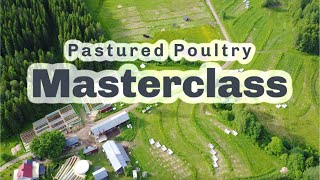
Video by Richard Perkins showing highlights from a weekend pastured poultry masterclass covering pastured layers, broilers and turkeys. Topics include egg collection and packing procedures, mobile housing (eggmobiles and Salatin-style pens), flock management and movement, feed and water logistics, deep-litter bedding, on-farm slaughter/evisceration and smoking, basic economics of equipment, and plans for an upcoming subscription-based farm-scale permaculture design course.
Chapters
So busy weekend. We had an awesome weekend for our pasture poultry masterclass. Looking on Saturday all day at pastured layers and then Sunday pastured boilers and turkeys. Looking at all aspects of running these enterprises, different ways you could go about it, looking at all the numbers, looking at all the HOC plans, all the documentation. We've basically given everyone a blueprint to go start their businesses and super nice people from all over Europe, America and Hawaii coming just for the weekend. And we had a lot of fun. We ended up doing a practical outside slaughtering the pen of birds and getting everyone hands on throughout the whole thing. People did the morning moves of everything and got a good sense of, you know, other things going on at the farm. So today's video is just a few clips just to give a flavor of that. And actually we recorded the whole thing video. It's going to take a while to edit, but we're going to release that to the course participants and then also put it into our farm scale permaculture design course which we're hoping to release on subscription to everyone. The whole course will be released immediately. So for one month subscription you'll be able to take the entire training if you want to, if you're lacking funds. It's going to be basically the most comprehensive, small scale, whole system design, training and business planning out there and it's going to be available for everyone all over the planet at extremely low cost. So I'm super excited for the development of that and it's going to be released in the coming weeks, hopefully. So we're up at Turkey's now and we've got 150 birds up here. Energizer off, open it up. We're just going to put feed down here. We're moving these guys every two days because we're trying to basically take this land down for the neighbor and we don't expect good recovery for quite a while. Part of our agreement with the neighbors to graze it down really short, that's the traditional way here, is to over graze everything basically. And you know, we have to respect the wishes of the landowner. His request is that we really graze to the edges, take it right down and make sure no young trees are coming back into the pasture. So little strips for intensive trampling, manure load and taking our time. We're actually aiming to spend the next 8, 10, 12 days in here if we can. We're just extending it as long as we can and following up with turkeys who are spending a couple of days in each Spot and leaving it with a lot of manure and a bit of ground cover trampled down. But just really taking our time and waiting to see if we're getting the land cut on the other side. So there's a few hectares in the field here, a few hectares in the field up here that goes back up to the farm yard. Cows are happy, Niels is happy, Toby's unhappy because the rain just got put back till next week. Getting the water down. Carrots coming up. Wagner's awake. Hi, little man. We're getting over a thousand eggs a day, so it's a lot to handle. And the picking of the eggs now makes the packing much quicker. So we do a bit of work in the field and that saves a bunch of time over there. So we're taking up feed. So I was saying we're giving the birds 130 grams each a day. That equates to two buckets each eggmobile in the morning, one at feeding time. Now that will help distract the birds. And Then one at 3:30 when we close the nests up. So this will help keep them out of the egg mobile while we're packing away. That's an important one, my love, otherwise it won't work. Dad, it's too cold. You're too cold. You better run and find the jumper. Monthly yurt and you might find a jumper. You can find the right shoes as well. These egg crates are industry standard. You buy them in Italy and Europe and they stack like this. So you can fit six trays, 180 eggs in each one. And you can't put more than six trays in. If you put seven in and then put that on, it will squash the whole 30. Each tray of eggs is worth €11. So every egg counts. Like we were talking about. The eggs that go down on the ground, like a few each day is normal because there's birds that lay too early or too late at night or whatever. But you need to keep real detailed records because, you know, five eggs a day, 35 a week, times that by a year, it all starts adding up. Right? These little trays are good because they're hygienic. And if you sort eggs into trays, then it's very easy to flip them into cardboard and it's quicker that you don't have to handle every individual egg. So the aim of the game is to have clean eggs because you're not allowed to wash eggs here. In America, you have to wash eggs often with chlorine in the water. So different regulations. But in Europe, you're not allowed to clean eggs. So these trays, you see, they have like plastic at one end and nothing on this side. They stack up opposite and that's how you know that they're sitting nicely, they won't crush each other. And then they become very resilient. We can bump around the field and they're not going to break. And we'll then transfer these later, we'll do the packing later and grading and record keeping and look at what we do there. And we stack them back in these with cardboard trays. And then this is what we use for storing and then delivering. So we have a lot of these crates. And what you'll notice, the reason they're important and special for egg collection is that they have gaps down the side so you can lift a tray of eggs or a whole stack of eggs and put them in. So it's an important detail. You don't need this when you're starting out. You know, if you're starting out with a smaller number of hens, you can just make do with what you got. But as you scale up, you want more efficient systems. Egg collection is pastured poultry masterclass. And we've got a nice group of people from Hawaii, America, all over Europe and to today we're looking at pastured layers and then tomorrow we're doing turkeys and broilers and doing some evisceration and slaughter. So hands on, sort of practical course with a lot of theory and planning and numbers, economics in the background. This tray is pretty good. I'm going to basically take that down off and I would use sandpaper to take away. This will come off very easily with sandpaper. I'll flip them and if they're the same the other way, stamp them gone. So I can do, you know, I'm sorting 30 eggs in seconds. And in the old days we used to handle each egg and really look at it. But just by doing a bit more sorting now, it saves us huge amount of time. So it should take less than an hour to sort a thousand eggs and stamp them and do the record keeping. That's a little cracked and it's in the sorted tray for. For eating. So this is fine for us to eat because it's not broken through the actual membrane. But there were some dirty eggs in there that didn't get sorted out. And there are more than six trays in here. So if I stacked another one on top, I would break all the ones on the top. So it's little details that, you know, you have to Learn by making mistakes. It's three and a half meters wide. It's 4.8 meters long. And that accommodates a four meter roof sheet, which is the standard size roof sheet here. That just is easy. This is about two and a half meters. What's important with this? So it's a caravan chassis. And caravan chassis are super light. They're just one tube on each side. And it's good to have a really strong jack on here. This is like off an IFA Williams trailer. It's just good quality British thing. But you imagine you can build this nice balanced trailer and then There might be 400 chickens all at this end and they weigh 6, 700 kilos. People always ask like, does it get too hot if it's black? Any metal sheet gets hot. It doesn't make any difference. Hot air is going out the roof. So we use black because that's the only thing they sell. Like the easiest thing is to have a four wheeled trailer that you can just hook onto your. Whatever you're pulling it with. And there's no weight on it. We wanted to build these cheap. €1500. €15,000. Each of these eggmobiles is turning over €35,000 in a year. If I can build it for €1,500, I'm in a good stand. You can buy fancy automated ones, but it might cost you €15,20,000. Can you afford to pay that off? Can you afford to buy it in the first place? And can you afford to pay it off with eggs? You need to look at the numbers. So for me, I want to build stuff out of scrap wood. This is all free timber from the timber yard that we get all our wood from. I bought the metal mesh. This is 4 mil wire with 40 mil gaps that you need that it supports all the feet. So you can see when they walk in it, it supports their toes. But it's big enough to let all the shit through. You don't want to have a small mesh or it'll be dirty in there. So we never clean this out. Really. It's like totally dropping through where you want it on the pasture. Free wood, little bit of cost. In metal sheets and these roof screws. You need to keep it waterproof. So there's two ways to hold hens. One is to support the keel and wings. The other is to hold them by the feet. It doesn't hurt them and they relax. Any bird hung upside down will relax. You can walk a few hundred meters comfortably. It wasn't. It doesn't hurt it. It Just chills out. It holds its head up so the blood is not concentrated in its head. But that's a standard way to catch birds, is catch them by the feet or hold them to support them that they're not flapping their wings. It's interesting to feel these birds. Look, you can see the keel. They are tiny, they have no breast. This is about 1.6, 1.7 kilos. So it's the birds in the roller pens, the roller boilers, they're already much heavier than this. And yet this one can pump out an egg every day. We've never lost a bird inside the pen like this. We've lost two predators that came out the fence. So you see a couple escaped because we didn't bother putting the pegs in proper. Sometimes we're a bit lazy. It's like if we don't have to put pegs in, we try not to because it just saves time. It's more, you know, it's double the bending over to pick up all the pegs. It doesn't seem like much, but when you're doing all these manual jobs quickly and running around doing all kinds of things, then it's, you know, we avoid it if we can. But it does mean some get out. Now I said yesterday, I'll say again, there's 400 chickens in a small space, 250 meter nets. So this strip is 9 meters wide. That means it must be 41 meters long. So what's that, 3, 6, 400 odd square meters, is it? Three hundred and sixty? So that's how much space they have today. That changes obviously according to the width of the fence. But basically I've got two 50 meter nets and that's good for up to 400 birds. But you should move them every day or two. If it's like really wet, I might move them every day just because they'll be impacting the ground a lot more. Right now the ground is super dry. I need recovery. I'm going to move them as slow as I can. I could even just move the eggmobile up to there and leave them a bit longer. You know, I'm managing it according to what I see on the ground and what's happening on the ground, where they're going in the future too. But we've never lost birds to predators in this scenario because I think it's just too intense, you know, it's too confusing and too risky to dive bomb this many creatures. And also I trained them with a drone and I also trained them by going now they're still scared. They're often not scared of me because they're like, ah, yeah, it's him. So they just don't bother. But in the first days they come, they've come off a barn floor, they've never seen grass, they've never seen an egg mobile, they've never seen someone like Neil's and you know, they don't know what's going on. And so they never heard anyone speak in English. So they're like. So what we do when we introduce birds is we put them in the eggmobile. We put some food and water in there. They're mostly just startled and they don't want to eat and drink much anyway. They just want to sit there. And we just leave them overnight and we let them out in the morning and then that night we put a light inside just like a battery powered lamp. And first night they're all in roosting. Now at that time it was end of April, they were in at 9 something. Now it's 11:30 in the middle of the summer. And now it will get earlier and earlier, but someone has to be awake to come close them up. And that gives them an extra level of security that, you know, typically a fox will come in the night or in early morning. There's no way a fox can get them. They're inside the Eggmobile with a mesh floor and a closed door and they've got an electric fence. So you're totally predator proof, that scenario here. Like you want to check the fences. It's good to take a little battery tester, fence tester and just learn about, you know, how much shorting out is okay. And you know, some people come along and cut the grass with a mower to put their fence up. That is not something you want to be doing. Like it's better to bring a cow along who cuts the grass and then eat the cow or whatever it is. Like you don't want to be doing manual work just to put a fence up so you can squash it down with your feet. You can squash it down with the rhino. When we were in front field last, the grass was up here. It was a jungle. And so I just drove along the tree line with the rhino just to make it a bit squashed down that we could then squash it more with our feet to get the fence up. So it takes a bit longer to move then because you've got to get the ground down. But you don't want to be cutting the grass. That's crazy. So number one, number two, number three, so I know which. There's two boxes for every eggmobile. Right. Can you hear okay? Yeah. So the basic setup I have here is a bucket underneath me and any eggs that are going to break, I drop in here, not on the floor. I'm trying to keep the floor clean and tidy so that one can go to pigs later with any veg scraps from dinner or whatever. So I've got a bucket under my feet. I've got a sandpaper block. You can use different types of sandpaper blocks. But these thin ones are nice because they're very flexible. I've got my egg stamp, which is our production number, that once the egg's the right way up, blop makes a little stamp. And so you go. And I've got some tissue paper up here in case I do drop anything. I can wipe it up. I've got egg cartons up here. I've got eggs everywhere and that's all I need. I've got some masking tape so I can write the dates on things. And I've got my record keeping up there. I've also got scales here to weigh each tray. And I've got a candler for looking inside the egg. And I'm looking for micro cracks. Can you see the air sack there next to the light? That will grow as the egg gets older. So you can tell the age of an egg by seeing how big the air sac is. But this will detect micro cracks that your eyes can't see. But personally I can feel them. If I handle an egg, I don't use it very much. Technically you're meant to. But what they do to check, that is they come and check like 400 eggs and they will look at each one and if you have more than like two cracks, then they can shut you down. But when they come, they never find cracked eggs. And that's because I've got like a sensitivity of handling. You know, if you do this every day for a couple of years, you, you know eggs like no one knows eggs. So you can even see things that aren't even there on the eggs. So what I'm doing is I've got eggmobile number one next to me and any half completed tray that's not full, I'm leaving it to the side to fill in any I discard out of here. So now I'm focused on full trays and I'm looking above any that need my attention. Like this one's got some yolk on it and I can just rub that off like so. And I'm going to do the same for the bottom half. So all the down has hopefully gone, but this one didn't get done. It's got dust on the top, it's got down on it, and you see down just flies around. So you imagine if you had all the down on all the eggs and the doors closed, it's just going to be like. And it ends up back in the eggs over there somewhere. So it's no good. So I'm basically scanning through everything. I can see the sorts of eggs that might have a micro crack. Now, if I'm collecting eggs, I know I haven't put any cracked eggs in because I'm feeling them as I pick them up and I'm picking up six at a time, but I can feel and hear if they bang together. I can hear sonically, that's not good. So if I've done the packing, the collecting, I know what I'm dealing with, as it were. Basically, I'm ready to flip these. I'm happy with that. I'll take a tray and you pop them on top, flip them over, make a stack with them. So they're all stacked up nice. Now I've got a cracked one on the bottom. That's a bee egg. So I will start a bee egg collection over here. And if you're unsure of cracks, you can really see them. Can you see how the little hairline crack comes out? Now, if you just look at this, you see that middle bit? You don't see the hairline crack, but you get used to feeling hairline cracks where there is no big crack. But these are bee eggs. I can eat that. The membrane's not broken, it's not losing air or, you know, no bacteria can get in. So I'll eat that for breakfast tomorrow. So that's my bee tray over there. And now as I turn them over, I see dirty ones. Like, that's too dirty for me to clean in here. This one's fine for me to clean in here. So that just got rejected to a bee egg status or whatever. I'm taking off any down. This one is dirty too. There's quite a lot of dirty ones here and I'm taking from my spare tray over here to fill them up. And now these eggs are certified. So I'm saying these eggs are all good and I stamp them like. So once I've stamped, I'm stacking up these and they go different ways each time. So you just got to learn, like, the visual thing of like, aha, this one is going this way. And we get to stacks of six and then I can put them back in these white crates for weighing. If you're not selling by weight, you don't need to know the weight. I'm selling eggs for the same price of a tray. Whether they weigh 200 grams more or less, I don't care. What the statistic is, is they want to know how many kilos of eggs you produce a year. So you don't need. You could just weigh this and you know that six yellow things and this weighs that. That would be the easiest way to do it. And what I'm doing with any bee eggs then is I'll take them up to the kitchen and if there's sea eggs, like, if eggs come and they are really like the one I just smashed, I threw it in here, didn't I? Yeah. If the eggs are too smashed, I'll just drop them straight in there. Or if they've got shit on them or they're just really dirty, I'll just throw them. Because I also don't want to take really dirty eggs to the kitchen because you don't want to be cracking an egg with shit on it into a nice clean omelette and then like a big lump of poo goes in the middle and you're like, meh. So we have enough eggs that we'll just get rid of them. Like, if you have less hens, you might be a lot more careful because you're dealing with, you know, like that. But what I need to do then, right, because I'm building up my stacks. I'm going to put these back for you lot to do, though, because otherwise it'll be unfair to team two and three. And what I need to do is finish each tray to the top. So, EggMobile1, I need to know how many eggs EggMobile1 made, right? So in my egg collection data, I have eggmobile. Where are we, July? Now? So I have a sheet for Flock 1, Flock 2 and Flock 3. So first I need to know what each flock laid and how many were broken and how many were bee eggs for each flock so that I can see how the different flocks compare. But then in the actual egg storage, I need complete trays. So yesterday's tray, I don't know which eggmobile that's from. It doesn't matter, actually, because yesterday's tray is not full, so it's got a date on it, so I know when it's from. So what my job is then is once I've stock taped what each egg mobile has Done. Now I have to consolidate them so that each of these is full with six complete trays. And there's one last tray that's not complete, and then I take that one and put it into yesterday's to fill yesterday's up. It's okay for today's eggs to go to yesterday's, obviously, not the other way around because it's the shelf life thing. So then the eggs get stored over here. And it means that every single tray this way should be totally full. And on the date that it's labeled, Niels is doing it. So I don't mind. No, no. But like this, I wouldn't take that off. That's calcite in the egg. But I took that little muddy patch off and that's fine. So we're smoking chickens for tomorrow's dinner and we've gone for birds that are equal size, so 2.2 average, although there's a three kilo bird in here. And we've just skewered them with this needle through the breast out the back to enable us to hang them up on a hook. And it's important the birds don't touch when they're smoking. They will get funny skin and stick together. I've just lit a fire. So we're using alder spawn, alder sawdust at 0 to 2 millimeters. That's ideal for this kind of smoking. And I've lit a small fire with pine just to get the embers glowing. I put the sawdust in a kind of snake shape rather than one big pile. It's going to burn along from one end to the oven, and that's important for the temperature. The first test we did, we had one big pile. It went up to 100 degrees and sat there for hours and hours, which is overcooking the chicken. Here we can read the temperature and on the back we have a thermostat that is set for 72 Celsius. So it seems to sit about 74 degrees, which is ideal. We brine these in 10% solution. So 20 liters of water for seven chickens and that's two kilos of sea salt. It's really important to use good quality salt. And they had about 15 hours. We drained them, let them sit in the chiller, and then now we're going to smoke them for about 20 hours, I would say. So it's 7 o' clock now, so we'll take them out in the afternoon. Well, we won't take them out. We'll turn the smoker off and leave the door Open. It will still be smoking, so flies won't go in. We'll let it cool in the smoke, which is better for the flavour. And we'll have them for dinner tomorrow night. Very nice. So I normally hang them in, then light the fire just because there's obviously smoke billowing out, but because we're a bit pressed for time, we just put them in. What will happen is the temperature will go up to 72 or something around 60, 70 very quickly. He was saying it has to reach this temperature in four or five hours, but it goes up in 10 minutes because it's a fire in an insulated box. Hey, cat. But the temperature will fall back down again when the fire goes out and then we'll shut the door up. So right now I want oxygen in there to get the fire, but I'm hanging these away from the actual fire because I don't want fat dripping on the fire. It will send up rancid fumes. And with this few birds, I can just have the fire over here. But once we get this full of 50 chickens, we need to have fat trays that collect the fat and stop it dripping in the fire. So we're in testing phase and this is. We've had a few successful tests now, so this should go well. I'm confident, and I will just monitor the temperature throughout the night. When I go to bed, I'll check it and when I wake up, I'll check it to check that it's safe. And then we'll probe the bird's breast at the deepest point in the tissue to make sure it's cooked. We're up early today. We're doing morning chores, we're doing the hens before the others get here. It's half past five. Normally we're doing this at six o' clock because moving hens is time sensitive and obviously there's light coming through the bottom of the eggmobile and hens want to get out. And that's the one downside of hens in this climate is they don't go to bed till 11:30 in the middle of the summer and they want to get out again at six. And so it's a time pressure thing because we have had experience with birds crushing each other against the door, wanting to get out. It's where having an automatic opener might be useful. But in our case we just get up and get the chores done. And so in this eggmobile we got a bottom facing door so there's less risk of crushing actually, because they're sitting on the door rather than sitting against the door. So we just feed and open the nest boxes in this one because we're actually going to move two of the others. Now we're going to look at the ground and we might only actually move one because the ground is not recovering at this time. So nests open, birds are good. I'm just checking if there's any problems anywhere in the eggmobile. Yeah, we're going to maybe move the other two, but because the ground is not recovering because of the drought we're having here, we're actually trying to slow down the movement of the birds as much as we can. One thing we can do if the birds haven't impacted a nice bit of ground is just move the egg mobile along rather than change the whole paddock just to spread the manure load. Because here for example, is a patch where an egg mobile sat last time. So each time we come through we're trying to move the eggmobile to a different spot. But you see the relative difference in the vegetation here. It's a very dense patch of still rapidly growing vegetative grass. So just by moving the egg mobile and leaving the fence, we, we can spread the manure load. But yeah. Today is the second day of the parsnip poultry training and we're focused on parsif boilers and turkeys. We're actually going to do a group evisceration to get everyone getting their hands on. And so Toby and I and Niels are up early just to move the chickens and feed the turkeys. And then we're going to meet the crew at 6:30 and deal with the broilers nice and slow to get everyone used to the salatin style pens as well as the roller pens. And so we leave this fence and set up the next fence ready for them to come running through. This is kind of. Whilst the ground is not recovered, it's ideal for these young birds. It's not too tall for them and they're only six weeks old, so they're still babies, but it's very vegetative. That is perfect forage for such young birds. Now they know they're going to move, so we have to work a little bit swift and we have an opening up here so we can open this into the new pen as soon as we're ready. And we're using a 50 meter and a 25 meter fence and they will get both of them at full extension as they grow now. But you see they're not getting the full 50 meters and so what we're actually going to do is play with adding another fence that goes from there to here up and connects back in. It's obviously got to be long enough for the four pens. Well, each pen is a salatin pen with a wheel on it. So it's four by three. So you can see it's 16, 17, 18 meters. So we got to know we have 18 meters in this case. I think we're going to take a 25 meter from here to here and bring the end of that fence to meet it. And it'll be just long enough to get all the pens in. Yeah, because we've got 18 plus 7 meters to be able to do that. So it works. So we lay the fence out and then we get it up as quick as we can. They might start crashing the fence soon because they know we're going to move. They know the ground's good over here. You see, they're foraging and there's no electric in the fence. So let's get going. So we always start now. We start here and go this way. We're joining onto the fence here and then we're going to bring the end of the fence to it. And then every second day we're setting up a new 50. So he has to bring the fence here. Lukas, you need to bring the end here so that we know, like, we'll take this bit away as we let the birds through, but we need to know it's in the right place. So this is where it starts. And so when we get two sections across, then you can head 90 degrees that way. And so, Simon, do you want to put that corner post in where it was there? And then I can take this away and we'll let the birds through. As soon as he's got that fence up so someone can follow Lucas and start putting that up, I'll take this out the way and we can take these two bags of feed and we want to put them down the middle here in a long line. And the reason we're doing it precisely in the middle is then we can pull the pens over the top of the birds who are going to be focused in on eating food so nice and evenly. You'll start in the middle and you can see how long it is. You want to be in a straight line here. Straight up, really straight. And we're tensioning the bottom of the fence really well. So nice and straight, you guys. You should make one line right down the middle because now we're going to be in danger of squashing all the birds. It's counterproductive. And we're using the old fence to create a guide for them. I would put it on the inside. And so you see the birds become self moving and then we just start unlocking the wheels. They have a little screw through the spokes to stop them moving. And then we have to come along and carefully move the pens over them without squashing a bird. Now this must be done. It can be done swiftly, but it must be done well because if you run over a bird, you kill it mostly, it will die of internal bleeding. And so this is where the feeding was really not very optimal. Like one line down the middle means the birds are very concentrated, that you can basically walk quite fast over them. Because these birds aren't as responsive as something like a layer hen. They'll just sit here. And so it's a little bit logistical this morning, but you get the idea. They move themselves, they're eager to get on fresh ground and they will move on their own without food. But obviously when there's food they will stay there too. So then we're just getting the fence up the back. We're trying to keep it quite tight up to the, to the structures. And because this isn't a natural connection, I need to sort of plug that under there and I'll just tighten it back up again with this one. We want to get this waterer to the middle of the pen so we need to actually enter again here and we'll pull it all the way to the the middle where it's accessible to the maximum amount of birth. So we're keeping tight up against the tree lane and I'm staying low to the ground and I don't need someone to watch. I just need to check every now and again and just give the birds time to catch up. So we can do this job swiftly without rushing. Like we don't want to rush the birds, we want them to be stress free and I'm not even seeing under there, but I know that I'm not crushing any. I can also hear the birds, right. But I feel like I'm in control. I know I'm not squashing anything and if there's someone with me, I can have them watch out as well. But if I don't have someone with me, I need to look or I need to wait. Ideally I look and wait, but you see, they want to come forward. Is that me on fresh ground up. So then I come back, I put the feeders in ready for whose I'm feeding. Ideally I don't spill all the water, but I might in this case, and then I'm on the next one. So it really doesn't need to take long. Like, I can move all these pens, like 10 pens in 20 minutes. But the key with these is just to learn to be confident with moving. I'm just gonna do it again. I don't really need to be looking at the birds because I know that it's anything. If there's gonna be a foot under there and it's not gonna hit it because it's off the ground. But likewise pulling it out, like, once the dolly is in a good position, it's a swift, rapid thing. It doesn't need to take, like, we don't need to be careful, we need to be swift because that's. We know birds can't get under in the way in that time. I really appreciate the design of these pens. Having done some adaptations, There are some very strong points for just doing it like this. I can move and service these as quick as I can move them. You know, it doesn't take long. And the birds are extremely safe and weatherproof, you know, so we've only ever lost birds due to bad weather from someone turning the pen the wrong way around. And I didn't happen to catch it. And we've had birds in minus degrees, three weeks old, coming out unfeathered in minus degrees in the snow, and they still were fine. We just had to do a bit of extra work wrapping them up. And they were a bit smaller than planned, so there was a bit of economic dip, but no problem. We didn't lose them. So that's pretty impressive. So you can see these are made in panels right now we're always pulling from the 3 meter ends because if you pull from the 4 meter end, you're putting a lot more stress on it. You know, it's a longer edge. It's going to bend. So you can see the basic structure if you want to build them. I would take photos of this really carefully in the right places to think about how you do connections. And then I would make a jig so that all the pieces can be cut the same. It's like making a yurt, you know, you're doing hundreds of things repetitively. So if you need to make 10 of these, you can do that in a few days. You just need to cut all the pieces, stack them up, right. And then order it all out and make a little workflow. So you can see we've made each panel separately. Here's the end panel. End panel. And Then the side panels on the outside, this is perfectly spaced so it locks together. It's a lot of thought behind the actual construction so that we can repair it easily. Whatever. And then you've got a very strong corner because you see we're pulling against this. But this is bolted to this, and this is bolted to that, and this is bolted to that. So it's very strong. And what's beautiful about this. So you can see how the corners have these vertical struts. So that gives it strength in this direction. This gives it strength in this direction afterwards. And then the middle's got a support to hold this beam up. And you see the beam is lower down, so it holds this beam up, which supports the roof. And then these beams are put sideways across the long length. They're not going this way, which gets in the way when you're trying to collect the birds out. So it's very specifically designed to be perfect in that way. Not through my design, through Salatin's work making the optimal design over decades. So if you want to build these, I highly, highly recommend you copy this very precisely, even down to the dimension of wood. That's something we've improved over Salatin's design. They are really heavy, and you can't necessarily move them unless you're strong and you know you'll get a back problem or whatever. But this is a perfect weight of wood. If you buy or take the time to select wood that doesn't have knots, we've just gone to buy the cheapest stuff from a cheapo store in Sweden that you know, it's cheap price, but you get crappy quality wood and it tends to break, like you saw this morning in a couple of them where you have a big knot here and it's taking a lot of stress on the dolly and you hit a big lump and pull hard and, you know. So just select better wood. But even if it does break, you can replace it, which is good. But look, I can stand on there, and that's really strong, and it's made of really flimsy stuff, but I can really put some weight on that. Probably two or three of us could stand on it. I don't think we'll try, but I reckon we could. Tin. If you look at Salatin's work, you'll see all his pens so they face the sun. The sun can come in the the pen, and the wind protection is on the other end. As I explained this morning, we need to ensure our wind protection is on those sides, because the wind is Coming from there. That's why we put a windbreak there. Actually, what I'm doing on this land is blocking the land up over time. I have a windbreak to protect my tree lanes. Then I have a hedgerow, then I have avenue trees, then I have a riparian and there's a hedgerow above the vineyardy place and then there's a hedgerow at the top. So I'm going to actually block the land up into very small parcels of highly protected land because it makes a big difference to the value of the land in. In between. Then this is just plastic roofing sheet. And that's the key. Magnus is plastic roofing sheet. He's gone, but his wife was complaining about moving them because they're too heavy. But he's put metal roof sheet on. That's not. Not a good idea. Plastic roof sheet or something. You could try that. A friend in Australia does. Is that corrugated plastic? You know, like almost like cardboard. It's got holes inside for packaging or whatever. Yeah, it's even lighter. Yeah, it's cheap and lighter. Now, it probably breaks down in the sun a bit quicker than UV treated roofing, but it's cheap and easy to replace, so it's very light. What you got to be careful of is water pooling on the roof and weighing it down. And then when you move it, you're tipping water on the young birds or whatever. But that's the same with these anyway, like water pools on them. But you can see the construction is the same for all the roof panels. You know, it's very simple, very easy. And then the chicken wire, ideally you build it the height of the chicken wire or you buy chicken wire the height of your pen. Now, these are 60, which is ideal. They don't need to be taller. And that means we can just unroll a reel of chicken wire and staple it on. Easy. Now, we bought the timber for this, so you might end up spending two and a half thousand crowns to build one like this. €250. But every batch of birds coming through, and there's six in the season here you can get through, is two and a half thousand euros, of which 2,000 odd is profit. So this one little piece of infrastructure can kick out €12,000 of profit in a year. So pretty good investment, I would say. The waterers, we don't have the waterers here, but I wanted to show you the detail of them because they're finicky. We will need the waterers when we get the birds up here. Now, the deep litter is A very special thing. And deep litter actually reduces mortality, Right? So once the sawdust is in, the birds come in, they don't really do much for a couple of days because they're not shedding much and they're very small. But then they start to eat exponentially, right? So then they're shitting everywhere. So the aim is to always put more sawdust down that it doesn't smell bad in there. If you're losing ammonia, then that's your nutrients going up in the air. Joel Sellerton says a nice thing like farming should be aromatically and sensually pleasing. If you're losing nutrients up in the air, if you can smell a farm, then their nutrient cycle is broken. We don't want nutrients flying up in the air. We want to capture them, use them somewhere else for the benefit of something else. So that's a good standard for maintaining the bedding is like, add enough that it doesn't smell, and as they grow faster, then you need to add more regularly, whatever. And so we just keep doing that as they grow. And then once we take the birds out, we don't clear out the bedding ever in the whole season. What we do is take about one and a half watering cans per brooder pen and water it finely with a rose. You know, water the bedding and then we take a pitchfork and just turn it. We don't turn it over, we just like break the surface because it's a bit compacted from the birds and the shit. So we water it, turn it a bit, just to make sure the water gets in there. And then we cap it with about an inch of sawdust and then we press it down again. Put the lights down for the next birds, warm the water up, ready for their arrival. Now, doing that reduces mortality massively because you've got a biological nappy. Like, think about chicks. They live underneath a hen under her wings. They shit everywhere on the natural forest floor. Wherever they live, they're sitting in their shit a bit and they're living in this little environment for a few weeks. And they're designed to do like this, right? So the biology that eats their shit has some interaction that's maybe too complex to understand, but basically it's making a biological nappy that keeps those birds healthy. It's probably filling their gut with bacteria and making their immune system work just like us, right? You need to be born through the vaginal cavity passage, whatever, so that you get in contact with the things that kickstart your immune system. Now, miconium, the first shit this really important part of the immune system of a human. Anyone born by caesarean has their immune system compromised by default. So nature knows all these things and has worked it out. And humans love to impose their, you know, reductionist, compartmentalized ideas on it. But in this way, mortality goes down. And Christoph was relating yesterday that his first batch, he had higher mortalities, and then it went down in subsequent batches because he's doing the same stuff. And that makes sense, but in the industry, they clean it all out, spray it all with chemicals, anti life. We're trying to promote life. Microbes, these little things that we wage war on, they're the things that keep the system healthy. Weeds, they're the things that repair soil and keep the system healthy. Thoughts, emotions, sensations, they're the thing that tell you you are totally fine regardless of what's going on. We wage war on all the very things that keep the system healthy. It's interesting. You have a kitchen worktop that you make food on and you eat from, and you have a toilet bowl, and you have a New York City street, and you won't touch food falling on there or there. And yet this is the dirtiest place by far. The New York street is sterile. There's nothing living. There's sun, there's wind, there's rain. Toilet bowls, you put a lot of energy into cleaning. Your kitchen work surface is nasty if you spray bacteria, like, you know, make them stained. They did a lovely series in Sweden where they gave a family a chicken to cook and stained the juice with, like a UV light or whatever. And by the end of the evening, they're, you know, literally everywhere. Ceilings, floors, all over the house, all over the. Like, it's everywhere. And that's true of all of us. Like, we think we're running some hygienic thing, but the dirtiest places are the places we think are hygienic into the actual pen. And then we can open the sides and we'll lift and scoot the birds in at the top. And I can just start lifting them out. In the beginning, I can grab them by the feet. When I have more opportunity, it's fine to grab them by the feet. As long as you use both feet, you can hurt them. If you're lifting a heavy bird with one foot, it's typically easier just picking them up in the middle. Now if we're filling up waters, we need to inspect them carefully that they're actually hanging free hanging. We can put this wooden stick under here to give a better consistent ledge. And I'LL just change the knot in here to allow the water to stay sitting there while the other one is lifted off. Okui. We saw that it sat at 73 or 4 all night and so now we need to open it up. So it's going to be a bit logistic working here with the smoke coming out as well, but that's the way we're doing it. Looks good now. It hasn't finished smoking, so it will keep going. What we could do to stop the. Well, we want it to sort of cool down in the smoke, but what we could do is sluice a bit of water to stop the smouldering and it will still sit there in the smoke, as it were. So I'm going to do that just to make it a bit easier for us. That's going to throw up a bit of ash, which isn't ideal, but I think it's going to be a bit uncomfy standing here with loads of smoke. Excuse me, but you get the idea. Now. The chickens look very beautiful. We like it. So we've got a bit of a logistical situation, obviously, when we're slaughtering for real. Like this is not certified or to standard, so we can't sell birds in this manner. We are moving everything outside so we can all see because it's too many people for the job and so we need to be able to like see what's going on. And we're now doing kill station down there. Normally we would reverse the birds up here and there's a tent up here and a bit of shade for the birds. And we're doing one pen at a time just to have minimal birds sat in a crate for, you know, we don't want to bring 300 birds and have them sitting there all day. It's just comfier to bring a pen at a time. And someone's off doing chores anyway so they can bring more birds. So normally we're killing here, passing through after they're bled into there. And the whole process is inside. We're all wearing white, clean, laundered clothes with white aprons, hair nets. We've all scrubbed nails and arms and alcohol and everything's clean. And if you need to go to the toilet, you have to totally undress. Having cleaned, clean again outside, then clean again, get back in and clean again. It's the whole process. So you try and avoid doing that. So we're like, please try and think of hygiene because these will be test birds for big batches of smoking. But we'd like to Eat them. So it's nice to, you know, don't leave bits of your finger in there if you cut your finger off or stuff like that. So are you left handed or right handed? Okay, take the shotgun, the right hand. Alright, these are going to be coming in sixes next time. One of the scolding team want to keep rolling. First thing, bird away from you. Lift up the tail straight. Cut down on the rump line to get to the spine. Not cutting your fingers, no finger underneath pushing up the tail. There's no way I can cut my finger. Then we turn the knife sideways, cut sideways to get under this oil sack. This knife is ridiculous. That's why it's cut through it. Get rid of that. Give the knife to the person over there to do theirs. And try not to cut into the bone. You'll blunt the knife. Cut a little bit high up maybe. No, it's okay. It looks different from this angle. Watch your fingers. There should be no cutting the fingers at any point. Okay, flip the bird over on its back facing a bit towards you. And we pinch up the neck skin away from the breast. So there's no way we're cutting into breast meat. You can see this is just flappy skin and membrane. This is a dangerous point because this is one point where if you're moving really fast, you slice across your fingers. So you be careful. We're just cutting the skin. That's it. Yep, yep. And then I'm putting my finger in the gap between the breast meat to hold my bird. This is how I keep control of my bird. No one's going to get that off me. It's my bird. Yeah. Then I'm taking my finger in the neck skin, pulling it down. Just rip it. Doesn't matter how hard you rip it really. And then I get my crop. Careful with knives. You got to really watch. There's one more chicken knife. So there you go. It might be blunt but it'll do for now. Now we've got the crop on the breast on the left hand side as you look down at it. So I'm rolling it, look, see here, this is the trick. I'm rolling it onto my finger and then moving my thumb back to grab it again. I'm securing it so I can rip down. I'm not ripping so hard I break it. I'm just tearing it from the membrane, from the breast. Like you've got it off the breast meat. Now if you pull that, you're going to split the guts. So you did the job. It's Separated here. Don't pull it any harder or you'll rip it apart and food will come. Alright. So I switch it over to this hand and I hold the neck skin and I just tease it off. Look, you see how it's disconnected? We're not pulling that hard, we're just teasing it off that I end up with a sack in my hand. So that's the sack that gets full of food. Yeah, just pull that. It's just a little connection there of tissue or something. Yeah, we got that. You've pulled it out from that end, that's fine. And you've got your windpipe. That's good. So that's the next step is digging underneath the windpipe and esophagus, holding the neck and just pulling it out. So now we've got a windpipe, an esophagus and a crop released from the bird. And they're joined together by fascia, you see here. So that's released. Yeah. Then we're turning around, hand on keel, pinching up the skin and we're making a cut between our fingers and the asshole. But you've got to get through the skin, the membrane, the fat, without cutting the gut. So just do a little cut. It's why we put pressure. See, I'm putting pressure and I get tension in the skin that lifts it slightly off the gut so I can go across and I've got to the fat layer and I know I can go a little bit deeper and I'm still not cutting anything. Here's the. The fatty layer. See how close the guts are? There they are. The white one is the fat. Yeah, and it goes thicker. Look, see, there's a white layer and then a thick fat layer. So it's membrane and then fat. So it gently does it. Now you can poke your finger in there because we just want to be able to get two fingers in and rip. Not too hard, but opening it so we can get a hand in there. Yeah. Cold pulling. Now look, see here, there's your gizzard and there's the fat you can see on the outside of the gizzard here. I see a liver up behind it. But I want this fat. If I can get it right. There's the fat and the gizzard under it. It's a join to the bird. So I'm trying to separate the gizzard from the fat and keep all this fat. Look at all that fat. That's probably 40 cents worth of fat. This makes incredibly good cooking and broth or whatever. So I've separated my gizzard from that and kept all the fat in the bird. That's what I want. And now I can see gizzard, liver bits. Yeah, good. Don't pull the gizzard out. You don't need to. I was just pulling it to show you. I'm just sliding my finger over. In half a second. We get your hand into the right. Just pick up what you can. Scoop it, scoop it, pull it out and get it off the table. Doesn't matter if you break the esophagus or whatever. We're just getting all the guts out. We checked the heart, the heart's good, liver's good, gizzard's good. I'm just going to cut this one out because I'm not keeping anything. I cut down very close to the sides of the bum and cut under it. This has left a bit of the side of the bum because it's the wrong size knife, but other than that it's good. But look at all that fat on the pubic bone that is normally all cut away. Right, that's possibly 80 cents of fat. So everything's gone and inside except the lungs. And you get the lungs in whatever way you can reach. You're scooping the lungs out against the ribs. You see the lungs, the pinky bits. So you've got to scoop. I use two or three fingers and scoop and try not to break them because otherwise they're really hard to get out. So I take them out in one piece and you can see the lungs, the ribs. Just pink ones. Yep, that's the lungs. So pull them out. If there's any testicles, pull them out. You'll have got to them already. So now inside, you see the lungs have gone. Everything's gone. That's perfect. You're looking to end up like nothing inside. No lungs and there's no windpipe sticking out the top. And then at that point, I can just hold the bird up by its neck, cut it off, level with the shoulder. That bird's done. Goes to the clean team. They are just weighing the birds before they go in, which we don't normally do. 2.13. Just so that people get a sense of how big the birds, where they were handling and what the value of these birds would be. So not quite doing it to protocol, but we'll have a good clean now, Just to have a bit of record keeping for the process, because we'll be doing a big slaughter tomorrow. It's 1.85. These are not birds that will sell. They're birds that are passed for hygiene. They're all a birds and we're going to smoke them as a test batch for smoking. A whole big batch of 40 birds. 2.56. If I was doing slaughtery on my own, I would buy different gear and set it up differently. But I bet I would be able to do it pretty swift. I was just saying there's a woman in Sweden, not too far north, who does 5,000 birds minimum on her own and she must have it down, you know. Now, Nicholas went there to see it, but not in action, just saw the space. It was pretty simple. But I can see how long it would take. I think I would go for 18 kill cones. So I reckon it would take me 10 minutes max to bleed, stun and bleed 18 birds. Right. And then I would buy a Ashley Scolder from the States, an automatic scolder. It's a bit more expensive. Our scalders we are using are like €200 and it's just a hot water tank. That's all it is with the thermostat. But the proper scalder is expensive. It heats up fast, it holds temperature fast. Obviously, if you're putting lots of birds in quickly, it takes some heat out. But this one is, you can put six birds in and it's turning them round because you're lifting birds out and putting them in again to get the water into the feathers. This one will do for the time you want at the temperature you want and then stop with them out of the water so you don't have to be there to like grab them at a certain time. And then I would set up like stainless steel chutes and I would just be pushing those birds into a plucker that spits them out automatically at the other end when they're done. So like Ashley in the States, they make, you know, bigger commercial pluckers. Then I would have one evisceration table. I probably wouldn't save livers, hearts, things like that, just because it adds five seconds of bird, which if you're doing it on your own, I can't be bothered. So I would just probably do it like that. Then I'll have a rail system for moving it and I would probably do this in one big line. And my goal is I have to get birds from body temperature down to ultimately they have to get to 4 degrees C internal in 8 hours. That gives me time to stock a load of birds up here and only put them in the chiller every now and again. Because our chiller we just put 700 kilos of chicken in it and got it down to temperature in less than four hours. So it's a powerful chiller. You're spending like €7,000 on a chiller like that. So this is a blast chiller, designed for chilling meat down. It's not just a cool room, it's a chiller for meat because you're taking something at 37 degrees, that's got a lot of density and you've got to get it down quick. Organs have to be chilled much quicker. They have to get to 3 degrees in 4 hours. But you put them in ice water in the chiller and we pass them through every 50 birds. But on my own, I can definitely keep that rate up all day, no problem. This one is happening automatically. I'm going to take these birds six at a time, put them in here. It's going to take me, let's just call it one minute to put six birds into it. It's not taking 10 seconds even, I'm just going bleh. Pressing the button. So we'll call it a minute then. I'm taking feet off here because I don't want them in the plucker, right. So once the birds. So as soon as I put the birds in there, they're taking about a minute 15. I can do two chickens in that time, maybe three. So I'll go back to doing that. This is all technically dirty side and this is technically clean side. Now we have two rooms, dirty and clean. There's the same bacteria in both. The woman that does all these on her own, she just has an imaginary line that she puts a different pair of boots on. Now she's in the clean side and that meets regulations. So I would do something like that because it's obviously more, you know, I would want this in a room all in one line. That is very simple for one person. So now I've obviously got to deal with collecting birds, which I would do 4 o' clock in the morning on my own. I'd bring all the birds, so I'd buy more crates. I wouldn't go up in multiple times. I would get all the birds in one go. So they would have to sit longer in crates, but that's fine. I mean, day old chicks sit in crates for 12 hours being delivered all over. And so the birds go in the slaughterhouses, they can deal with it. It's not ideal, but they can deal with it. So I would just do that before I start. And so six birds, let's call it a minute. There. And to take the feet off six birds, let's call it a minute there. And then this is going to take less than one minute here. And then it spits them out on their own. I can do birds 25 seconds, 30 seconds continuously for sure. So every six birds is taking me three minutes. And I'm doing in the time this is going on, I'm doing two birds, let's say. So this is taking me two minutes. Yeah. Is that fair? And then I'm hanging those six birds up on a hook on this thing and that hook can go straight into the chiller so I can hang them on this rail system in the chiller. So I'm just setting it up so I do minimal moves. I can just push 36 birds along this rail just by pushing the back one. So to hang them up, let's say for every six birds it takes another minute, let's say two minutes just in case I drop a hook or whatever. And then every 30 birds it takes two minutes. So we'll just leave that out of the equation because it's, I mean, do you know what I mean with the rail system? So I'm putting 36 birds at a time on hooks and then I'm just going to push 36 birds into the chiller, close the door. So it's not taking any time at all. So I hope that gave you a flavor of the enjoyable weekend we've had here. The crew did a great job. We've got some beautiful birds. Now we can't sell these so we're using these to do a test smoking and we'll be putting two lots of 40 birds into the smoker to see how it goes with a big batch because we've tested it very successfully with small batches and had a beautiful smoked chicken dinner yesterday. And yeah, we'll see how that goes. I'll update you with that as we go. We've got a busy week now before we're off to Stockholm to do our one day event with Curtis Stone, the urban farmer. And then back to the farm with Curtis and his wife Katie and their child Violet to do our intensive four day training at the farm in two weekends from now. So it's going to be awesome. We're looking forward to a very busy course and lots of inspiration people from all over the world coming from for that. So thanks so much for watching as always, really appreciate your likes, your views, your shares and I'm really excited to just be pushing out information at the moment and just getting more and more people inspired and informed to go out and start their own regenerative enterprises or refine their regenerative enterprises over time. And it's yeah, I just keep seeing now around Europe more and more people that we are influencing and it's amazing. It's really amazing and touching the sea. And I love to hear from people that have been inspired by what we're doing and are mimicking some of the things we do. So let us know about it. Send links in the comments below and let's share all this stuff so that more and more people can feel confident to go out and get started for themselves. You can find out a lot more in our book in the links below. Making Small Farms Work, our online trainings on there and as we know about the releasement of, sorry, the releasing of the subscription based training so you can get access to all of educational content. It's going to be 75 hours of educational material, all our business spreadsheets, all the planning data, all the HSCC plans, record keeping, everything you could possibly want to start up similar enterprises, as well as a whole organized framework for designing your property from scratch. And then keep in touch with the channel because I'll be releasing a video when we've launched that hopefully in the coming weeks and then we can really spread this information to literally anyone who wants it, which is awesome. Thanks so much for watching. See you in the next video.
More from Richard


A review of short and intensive season on a mixed farm and restaurant/event space in Sweden






Alskade Kyckling Exploring complexities of poultry production in Sweden and what we stand for


