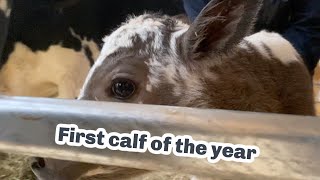
A Ridgedale Farm vlog by Richard Perkins documenting a day of spring farm work: leveling and installing legs for multiple raised platforms (yurt sites), preparing timber and pegs with a laser level, and caring for a newly born calf (Clover May’s calf). The video blends practical build techniques (tool use, layout, tree-felling plans) with observations about microclimate, pasture management, and small-scale livestock decisions, concluding with routine channel promotion and resource links.
Chapters
Thousand apple seeds. Bittenfelde Antonovka. Snotty. Nooshy you Snotty. So just driving along on the way back up to the farm, this is what happens every year. You see the drainage is not work in there, but this land is about 30 meters lower in elevation than our own. And you see it's already cleaned up now. In middle of February our land will typically have snow still on it for six to eight weeks later. And you can see in the hills in the background, it's not a, you know, it's not a great elevation difference and it makes a huge difference. Obviously this is south orientation somewhat, so does always get a bit more sun and clears out a lot quicker. But it's. You can see the line up on the hill on the right there. It's, you know, I dare say it's even 20 meters elevation, but it's the sort of edge of a climate zone. So if you zoom in on the Swedish climate map, we're in this zone between zones 3, 4 and 5, made confusing by the hills and the water bodies. But it's pretty amazing. Just that little elevation difference, maybe a bit of orientation makes a massive difference to our growing season and you know, four to six to eight weeks difference in our short growing season is huge. You can see the fields on the far top, right, that's our neighbours and you can just see up into Nutfield. So a bit of progress this morning balancing this with many other projects on the go. But I've managed to put in the pegs and cut a level set of legs. The bottom of the metal brackets has a little sill that the wood sits in and has drainage holes and at the bottom as well. So what I've done is used a laser level receiver on that lip and chose a place to put the laser level just by eye. Looking at where the highest spot is to make sure I clear stumps and undulations in the ground, etc. Seems pretty good. There's a couple of points that are tight on the trees, but they. I mean they got them in, so should be alright. Start building next week. So first ground spikes and level legs in. Awesome. First sunny day in a while we're sitting out eating. What is it? Applesauce and cream apples from our garden. Preserved. Oh, nicely done, Seku. Last bit of ice. So Clover May's had another go. How many casts has she given us now? 2. Clover May is quite old now. Now how is she 10 years old this year? 10 years? Three? Four? I mean at least four. I mean she should have been five if all had lived. She had one problem. One. But she's got this. She kind of freaks out in the beginning now. And she pushes the calf away a lot when she wants it to drink, but she's just inadvertently shoving it away. So Johannes just put them in a little pen. A, to keep the other cows away just because they're all so curious. And B, just make sure the calf latches on and gets its first colostrum and belly fall. But she seems strong. She's cute. This is Scanson's daughter. She's got some of Scanson's brown mottle markings. So we try one more drink on this one. But I'm gonna try again. Exciting cows. What do you think about it? Soon these folks are gonna see green growth. Then they're going to get very curious to get out of here and we'll do a transition. It's probably a little while till we'll get them out on bales on the land because it's always so wet at this time of year that they will just trash the pasture very quickly. Now we've got the tractor. It's probably possible for us to get a bale right up into the high forest where we cut the timber. So what we might do is put some bales up there and have them run through before we rotate pigs through this year we're just going to have a few pigs, not many. Mainly just for ourselves to eat. Maybe we'll sell a little bit. But I'm really excited to have pigs again at the farm. Making sure the calf can taste and smell the milk in the sac. Clovermay's only actually got two working teats, which is not ideal. But once the calf knows what it's doing, it'll be fine. She's got plenty of milk. The Clover May will probably. Maybe she'll give us one more calf and then taken out of the herd. Probably she'll reach 10. She was our first animal on the farm. Maybe she. This calf doesn't want to be in here more. I think it's good for them to be so the other cows don't distract them and so that Clovermay can't move around super much because she kind of turns over the cow and the calf and knocks him over a lot. Just got to let them get the hang of what they're doing and then they seem to be fine. Good job. Clover May Cutie. What are we gonna call her? Something with Mei, I think. So she's coming from the Clover Maid dynasty. Yeah. What a beauty. They can Hear some clover males. She can also be just Maya. Okay, found a minute to get up here. Work on number two. It's quite close to number one over there and a bigger gap up to number three. But that's sort of logical positions where they seem to fit well. Okay, so number three I've just measured with the laser level cut. The pieces come up and it's now time to just mock up by putting a frame on. You can see something's a bit out of line there. But I dare say we'll get away with that. Check. That's good. And then we've got the frames of these three up. I'm thinking today I'll get up to the other side where the yurts will go. One is marked out before the snow melted. So we'll check that that's all still good and see if any of the pegs have fallen down. And then we can do this process over there. And then the last year hasn't been marked out at all yet. But that's pretty simple process. Okay, number three. It's looking good. Looking very level. Just crouch down. You can get a sense of it's within a few millimeters. It's hard with a camera to see because you obviously get a bit of distortion. But that is spot on. They're all looking fantastic. Very nice. Having the CAD plans. Ridgedale Builds is going to be here this spring, late spring or summer. So many easeful building projects once you've got really accurate 3D models. Sun's returning. So beautiful up in this woodland when the light filters in like this. Okay, making a start on the yurts now. This is the one I marked out in the snow. You see the chalk remnants. So I've just taken a heavy steel bar and bashed holes. This one's in the side of a tree stump. It's quite rotten out now but that's got good ground contact. Bashed the starting holes and I just put these in. And then I've just got a bit of 18 mild steel somewhere in here that I'm using as a handle. So I can put this in like so and I can wind that down. And then when it gets to near ground level where you're talking in this whole piece, you can use it as a big lever like that. Seems to work quite well. Two trees to take out here. This one and this one. Don't think I'm going to get to that today but I had a look at the way I want to fell them. I'm either going to fell that way or that way. This one I'll fell down that way and I'm just going to miss the feet. So I'll put the feet in now and I'll just fell the trees to make sure I miss that. One thing I talked about before is possibly building a bridge over here. Now. I found a way up with the rhino now which is quite great because I couldn't get up in the snow. But that means we should hopefully be able to tow the cladding boards up. It's. It's very steep but we'll see. Getting over here doesn't look so easy. Although the pathway seems to have come down this way. I think I might be able to get through that. It's pretty steep and there's a ditch that's flowing there so we're not sure. But this is where it be nice to have a walking bridge using some of the tree trunks just to go over the damp stream and be able to walk across to the other yurt. But you can also access it from up the road there. But if I can, I'd like to get all the feet in place today. That would be a really great start for the week. To start Monday on framing. So we'll see how it goes. It's quite tiring work getting these in, but it's still before lunchtime. Said it a million times, this has been such an incredible tool. This is a self leveling laser level. I bought this when I was in my early twenties doing keyline design. I've used this so many times it's probably about €250 at the time. There's many brands available, obviously. Just need simple measuring stick and a tripod. I just set it up on the stump here because it's self leveling and I'm just estimating the lowest point necessary to cover all the trunks, etc. And so the tripod is not so handy to do such low level. Good bit of kit. Bear in mind these need careful handling. If you drop them, they need recalibration. Can be cheaper to rent them but the amount of times we've used this on our farm. I'm so glad I bought one and don't need a fancy one. It just needs to do the job, keep it in its case, don't drop it, don't let people drop it. So useful for building all sorts of things. Laying out key line patterning. I'm just off now to cut the feet for the first of the yurt platforms, back down at the saw bench just to cut the legs and I'm In a T shirt and comfortable. Sometimes I'm putting the jumper on in the forest where it's shaded, but it must be a good 8 or 10 degrees today, which is fantastic. It's always this time of year. It's all relative, right? So in Sweden, when the sun comes, Even though it's 8 or 10 degrees, it feels so warm that it's probably like 20 degrees to someone that lives in the UK or something. So making the most of it. Gonna keep chopping. Okay. Got this first yurt platform together. Obviously these are not in place. They're just sitting there so I can check the levels, etc. Going to fell those trees out another time. Couple of little errors on this one, but that's okay, we can work them out. A couple of short poles and I need a longer pole for the corner. Not sure when what went on there, but looking good. Ragnar is filming. Good job, Raggy. Ragnar's feeling so warm. He's out without a T shirt and he wants to go on a hammock. So I'll show you Ragnar special hammock knot. You do like this. You go around your fingers, spin it round, pull it through, and it's a quick release knot. So this one will jam tight and hold your weight. But when we want to undo it, we can just yank on this string and it will come undone. You are feeling all summery. Test it out, see if it's at the right height. This is handmade in Thailand by a lady. It's something like 3km of thread. It's triple plied and it's just perfect. You like a cocoon? Raccoon. A raccoon or a cocoon? Cocoon. Like a little butterfly cocoon. Hey, are you enjoying the sun? Taku likes the idea of it. Hey, Taku dog. Okay, sun is getting low now. Last yet. Pretty good for a day off. Two trees to take out. I actually moved this site originally. We're going to have it on the front of the hill because it's quite a nice view. But it's much flatter here. And even despite that, you see the low pegs at the top end. We've still got 7cm at this end. If we had built there, would have had well over a meter. Trying to avoid that. And it's pretty nice view up here anyway. Love it when the sun comes into the forest like this. It's just so nice to be outside after being on the computer most of the winter and, oh, it's tiring. But it's really good to be out doing projects. I'm really looking forward to be much more farm based this summer. And I've been seeing huge owls and deer and elk every day. It's. It's really. Yeah. Something else. Exciting times yet. Number two. Well, that folks is a great way to end a Sunday. It's been a lot and there's most of the work still to do. There's two trees within this frame to take down and there are two in the first year platform. The other three teepees. There's one just over here, two at the end there. They're ready to start building on. It won't be a big deal to take the trees down. It'll be a little bit of work to clear it out, make things ready. But as I said before, these are not fitted. It's just getting the legs in and level. And you can see across here it's beautifully level. All of them are beautifully level. And that's a big psychological step. I feel like, like obviously the work of putting in These will have five hanging beams in the straight section, two on each side with a 45 degree bend. Putting all that in and putting all the cladding in, even getting the cladding for these two up here. I do have a pathway now with the tractor so hopefully I can bring a tractor trailer up because obviously it's too wide to bring them up on the forks. That's a lot more work, but it's kind of straightforward work at this point. The hardest bit is getting started and getting all these points level so that now we see the template, you can see what all these frameworks are going to look like now. And so that's a big psychological step for me to be cracking on with this project. And it's really cool for me because I've been visualizing this for years really in different formats. But we've always said we would love to have this part of the land as part of our farm. Acres of the investment we've put into the market garden, all of the beautiful no dig market garden beds. But also it used to be, or certainly that half of the property used to be part of our property. It seemed like certainly it's on the same level and it would have been clear. There's fields. Even if it wasn't part of the property, it was all part of the same sort of field Clearing this piece of land I think on this side was always part of. No, it wasn't always forestry because I've got old maps from the 60s when it was actually pasture. It was probably kept as pasture because it's lumpy. It's got these sort of deep ravines that come through and drainage tunnels. But that's good for a weekend off. I'm super happy with the progress. All right, that's it for the episode, folks. Happy weekend. Ready to start work tomorrow. If you like our videos and all that jazz, click, subscribe, share them. Press the little like buttons. Helps with the algorithms, all that stuff and you find out a lot more in the links below. You can read our book Regenerative Agriculture. It's a manual. You can get it as a PDF, you can get it as a hard copy book. We'll post it anywhere in the world. People have been loving it, giving rave reviews, starting their businesses based on it. So make sure you read that if you haven't. There's free resources in the links below as well as our paid online trainings and we'll see you in a video very soon. Bye for now.
More from Richard


A review of short and intensive season on a mixed farm and restaurant/event space in Sweden






Alskade Kyckling Exploring complexities of poultry production in Sweden and what we stand for


