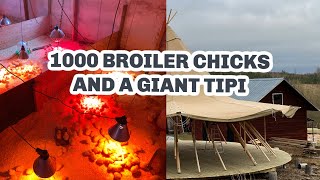
Richard Perkins erects an 8.9-meter tipi on his farm deck and receives 1,000 one-day-old broiler chicks. The tipi build involves marking spacing, fitting poles with locking pins, and clipping canvas. For the chicks, he wets their beaks to teach them to drink, keeps them at 32°C under lights, and changes water up to five times a day.
Chapters
Okay, welcome back to another video. It's raining. Perfect. Time to pull up a mega teepee. First thing we've got to do is mark out a circle. Then we're putting up the three biggest poles as a permanent tripod, marking their spacings very accurately. Then we get a ladder up. We start to put up the support posts around Lots more wood. We've got to work this out. Never done it before, but that's what we're doing this morning before a thousand birds come at lunchtime. Okay, marked out the circle in pencil here. And then we have to mark 3 points 8.9 meters apart. And that's where the initial tripod will go. Dave is a fireman, so that's Andy. Have someone that's good up a ladder. So this is the central tripod. And you see these poles fit in with locking pins. And these three are the only ones that fit in with this locking pin. The others will just fit in with these pins. And that's to ensure that when you're taking it down, you leave that tripod in place and don't kill yourself. What we're going to do is put some wooden chocks into the decking and basically lift the middle. Push this one up. It'll be out in the garden. And once we've got the tripod in place, we can secure it down, start adding further poles. I don't. You're saying this has to be vertical, but it's impossible to keep it vertical. I guess you've got to just, like, hammer time. It's now. Or I could get a bit of wood and help push it up. Are you girls okay? Yeah. That's it. Are they staying in? Yeah. Perfect. Now we roll. Okay. Safety third. We've just chalked in these supports. Gonna put a ladder up, chock the ladder down. Then we'll put a safety line through the top of the teepee. Put a harness on Dave so if he does fall, he'll stop 2 millimeters above the deck. Perfect. Safety third. So we got all the poles that are clipped into the top. In between each of these poles will be two other poles that just sort of lean up against it, help keep the canvas out. We're just gonna go up. Cup tea, Dave. Okay. Nicely done, Dave. It's pretty solid up there. The whole thing doesn't seem to wobble, does it? And then it gets stronger, obviously, the more you add on. Now we've got to move the ladder to get the last two in. Then we put some cross beams that join into these metal brackets. And we lean up two poles that are just freestanding that hold the canvas up pretty good. Cup of tea just arrived from Elin. Thanks, Elin. Perfect timing. So these are just tied at the top, and their function is just to support the canvas to hold it out. What have we got next to do? Well, we've got these arms that lift up like the witch's hat, and they seem to go through these holes up here. So the roof structure will be about two and a half meters high and will stick out like that, which will greatly extend. I mean, it will double the size of the space or more. Very nice. Got to work out where to put the door. And then we're ready for canvas. But before we put canvas on, we want to be able to find a good way to secure these poles permanently onto the deck. Wow. Ian is a star. Look, we've got homemade cookies with blackcurrant jam from the bushes. Little gray tea for the English boys. Okay, so next step. Now we have these posts that lift out and hold the canvas outwards. But the instructions are not very clear. They have some pins and straps to hold them in, but we don't like the feeling of it. It's not clear from the instructions how you actually do this bit. Okay. Instructions were very unclear. Looked it up online. Basically every picture we found, people do it totally differently. We saw people that have one of these metal pieces at each end of this. We never saw this bracket, but it seems to fit. Fit the end of the wood, and it squares up this joint and will deal with some friction. Don't know if that's the correct use of it, but couldn't really find out any more details. We put them in. That's the lunch bell, and that means we're ready for canvas once we've secured down to the deck. It's getting a bit windy today, but it's not super high wind, so maybe we'll have a go with that. Birds are coming. 245. Okay, Hannah and Ragnar are back. That means there's a whole car full of chickens. Hi, Ragnar. What have you brought for us? Whoa, little chicks. Thousand day old chicks. Okay, we've got them in, Ragnar. First we'll get them in the pens.
Then I'll find you one you can hold.
Okay. But we must get them in as quick as we can now. So it's two and a half trays each.
I'm going to show you the magic carpet trick there. You just gotta be confident. It's much better to do this than to handle all the birds individually, they don't need to be touched. You see, it's totally fine. They're going to snuggle under the lights.
So two and a half.
I can do the half one.
Yeah.
Just hold the box over. No, I put the lid so it's folded halfway over. So they've just been born this morning.
Or just hatched as more accurate.
Say they've never had water, they never had feed.
So our job is, as always, to.
Get them used to drinking water. So once they're all in, we just.
Dunk the heads, we put the beak.
Of some of them to the water. You can see these ones are already drinking. So if we introduce 20 or 30 to the water, then they'll teach the others very quickly. Chickens are creatures of mimic and habit.
Then we'll have open access feed for.
The first day, first four days, then we go on to a feed regime. After the stress of being introduced, we'll let them settle down and then we'll.
Come back and rigorously check temperatures, etc.
Hey, little ones, you look brilliant. They're all in. You want to come and see one? Okay, you climb over here. It's a bit full up.
I want to tick all of them.
Tick them.
They'll take you a while. So, Dave, now what we're doing is.
Taking them like this.
Put your, like cup it in your hand and take the back of the head and just dunk it to the water. So its beak gets wet.
And we do that to like 20.
Or 30 in each pan. And they will quickly show the other ones where to get water. So this is the most important bit. When the chicks are this young, it's critical they get water. It's critical that they're at the right temperature because they lose. Even though they're covered in down, it's not particularly insulating. They actually lose most of their body heat from their belly touching the grass. Both hands, cup it. Cup your hands together.
Yeah.
Don'T squeeze it. Let's put him back with his buddies so it doesn't get cold. You see, Ragnar, what I'm doing and just putting their beaks to the water. And you see, other ones have learned already where to find the water. So it's critical they have super clean water and 32 degrees under the lights. What we're looking for, when we've left them alone for a little bit, we want to see some sitting under the lights, some zooming off to get food and water. And we'll listen to the birds carefully here. Like right now, they're a bit agitated because they've just traveled across the country and then been relocated out of a box. So they're naturally stressed. But give them half an hour. When we've left, they will have settled down very nicely.
That's good.
All right, I'm going to the next pan, Ragnarok. You see, they're huddling to get warm there, but we've got the lights quite low, so they'll be fine. We want to have a good distribution where they're not cramping each other and getting too piled up. Yeah, that's a full Buddha, folks. Thousand birds. A big job now is regularly changing the water. So the quality of the water, which is exceptional here in Sweden, is vital to their feed intake and health and well being. So we change the water up to five times a day. The water is up on these planks of wood and so we can adjust the height to keep it off the bedding.
It is noisy. A wave noise for me. Away all the kittens to go to.
Gently, gently, gently. You can see they're drinking here nicely. Then we'll get feed. We'll give them free access feed for 4 days with boiler style of food. Gotta be very careful walking around in here with clunky big boots on. Now, I've said this many times, but if you are working on your own, I would have a nipple water system probably, and then you would have nipple water in the pens. It would save a lot of changing waters and would make things much more efficient in the hot summers when evaporation is an issue. The reason I don't have automated systems is because we're working in a learning environment with many different people around. And I want to see visually that the water is clean. It's been checked and filled up. So it's important for me for visual monitoring. But if I was just working on my own, I would probably have automated water to make it simpler. Did you have a good trip to see Momo?
Yeah.
Did you see your grandmother?
Yeah.
Was it fun?
Yeah. But chewing our feeding.
We're gonna get some feed.
Yep. Yeah, that's right.
Those back lift when walking.
Okay, Ready to pull the cameras over. That's a crazy view. Nice engineering. Simple but robust. We like it. Yeah. I'm pretty sure about halfway up, Ragnar's holding all the weight there. Look, Ragnar, you're making it work. Okay, that was a mission. But the canvas is on. We've clipped it to the bottom of these posts that are the extenders that allow us to lift the whole canvas Up. You see, it's got these bungees to allow it to open up. Obviously in high winds you got to put them down. We don't have any ground to peg these into, so we're going to have to come up with some kind of fitting in the deck that we can tie them down to. But first we've got to get rid of that pulley, put in the top crown and put in the top cover that's got ropes down so you can, from the inside you can pull them and ventilate the space. So we've got to get a ladder on the outside now. Interesting. Okay, throwing out the crown, putting on the top cover. Which one's Richard? So one through each? No, they're all coming to the same place. Just through there somewhere. Okay. This is not real teepee. Cuz you got to stick your own little teepee bit on the top.
It's got little six sticks.
It's a bit heavy to carry up on its own. Okay, last three. Crowning the teepee. Nice one, Dave. Okay, so these pegs go against one of the poles and when you pull, you open it up. When you let go, it's on elastic. Very nice. So it's getting late in the day. We're gonna go and just pop these sides up because that will probably create a bit more tension on the camera. So we haven't got time to create fittings to hold it down. Obviously if this was on earth, you would just peg them in with the big pegs they supply. We need to fit some brackets or something. We've also got more brackets to fit around. We've put the main three tripod pegs held down like that. They're all held with pegs. So the only way this would move is if the whole thing lifted it with once, which given the weight of the structure, I can't imagine ever doing. Yeah, probably we'll leave it like this tonight. We don't have any storms forecast and that will let the deck dry out nicely and then we'll worry about the rest of the fittings another day. Well, that'll have to do for this evening. Gonna leave it there. Hope we don't get too strong winds until we can finish up some of the fittings tomorrow. Super cool. This really changes this space for us to be able to have lunch. Looking out on the gardens, hoping that we get fair weather. We can keep this open a lot of the time. The kitchen right here, it's going to be fantastic. A little bit of a pain to put the sides down, doesn't take long to go on each clip, but we need to find a better way to secure all of the rings to the decking. I suspect we'll come up with some kind of carabiner thing to do that. And you have to take these poles in and out when you want to put the sides down for the doors. That's a bit of a pain, but no big deal. We'll get used to it, I'm sure. To be honest, not super impressed with the instructions. Love the quality of the teepee and all the engineering and components, but the instructions are super outdated. They are 11 years old. It appears a lot of the pieces have been change. They don't look the same. There's no pictorial demonstrations of which way round some of these things should go. When you look online you find people have sort of seem to made up different ways of doing the same things. I'll feed that back to them. They're a local company in Sunnah, our nearest town and I love what they do and it's great working with them to have these structures. We got a good deal on them and I'm happy to promote them as a really cool company. But instructions need updating because that was a faff. There's no way that that takes two people two hours if you haven't done it before. With those instructions it took two hours just to work out what half of it meant. So we'll see. But yeah, pretty impressed, pretty happy with that structure. Just before we sign out, we'll check in, see how the birds are doing. A lot quieter in here. A little bit on the cold side. It's nice and warm in that puddle.
This ideal temperature there.
It's okay, but they're just staying warm.
Ideally 32 degrees and that's definitely meeting the target.
There's a few outliers.
A nice calm chirping. That's a great sign.
Alright folks, dinner bell's gone.
We've got a sign out. That's all for today.
I'll be keeping you.
Update with progress here with the layers with the boilers.
We're getting pigs again soon this year.
It's fantastic putting up all these stretches.
It's busy, busy times.
Really fun.
Really loving the crew and to have Selma and Elim back and Malta and Dave, just really nice group and yeah, looking forward to so many beautiful things to come. So, so many experiences, new memories created. Wonderful things. Thanks so much for watching folks, as always. Don't forget, you find a whole bunch more in the links below and you can see the kickstarter that's on for.
The next 12 days.
Now it's 200 and something percent funded. And that's the chance to pick up an early bird copy of this hardcover massive book on how to build all the things that we've been designing, inventing at the farm here. So check that on the links below. See you in a video very soon.
More from Richard


A review of short and intensive season on a mixed farm and restaurant/event space in Sweden






Alskade Kyckling Exploring complexities of poultry production in Sweden and what we stand for


