1000 broilers out to the tunnel and lots of planting in the sun
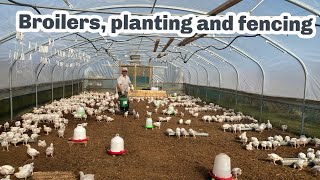
A farm crew moves 975 broiler chickens into a polytunnel for grow-out, builds temporary fencing, and hardens off vegetable plants. The tunnel provides six times the brooder space and generates roughly €30,000 in income. They're using 2 kg of oyster shell per 10 m bed for slow-release calcium and watching bird-flu restrictions that could affect future batches.
Questions this video answers
975
Approximately 2.5% (two and a half percent).
About €30,000.
2 kilos per 10-metre bed.
About six times larger.
Chapters
Big day today. Boilers are going out, but for the first time ever they're going out into a polytunnel. Okay. Got spinning jenny up the top early in the morning. Breakfast buffet not till 9 o'. Clock. So we're running out the two wires. What we do is run it out. Put a termination knot at the far end by the sea. Pin the whole nail in. We're just using these insulators to help it slide around the corners. We'll pin it in with nails. Then we tie a termination knot at the top end loosely and we cut the wire in the roughly in the middle of the fence. Get the chain strainer on. Do a Texan brown. Join it up nice and tight. Ah, the old Hayes fence stretcher. Great tool. €30 stretched all our fences. Lasts forever. You can get different ones. Haze are the best. Get a Hayes one doing the old Tex brown to join the lines. Done by brekkie. All right. Fence is finished. Now we got the other side to do. So want to see if we can get the trailer and the grizz grizzly round the headland. Now this was an old farm road, but it's just got fallen trees, hard to get through. There's the ditch here, but it runs out and I think I can get across there. So we're just seeing can we get around with the grizzly going through the reeds. So here's a nice place. There used to be a stone wall around here. But this is a nice place that we can get a fence post in there and it will create a natural wall and then just cut through to make a short distance. Now this was a farm road that went all the way around the rock. But it needs a lot of clearing work that we haven't got time for now. So this might become a temporary fence. It might be that I fenced the entire property further out, but it's not very much pasture. You can see here is an old stone wall. So this would be a nice natural end. I want to be able to access all the way around with the quad in the future. But should be. What's that, 30 meters, maybe 35. Just cut through the brush here and two end assemblies and we're off. Nicely done. All right. Following the old stone wall. So nice easy short stretch just going out into the sea. Easy. Okay. Job pretty much done. We're not going for tents fence because this is temporary. I want to reinstate the farm track so you can get all the way around with the quad. Easy. And I want to fence our entire property. But we need to speak to the neighbors because part of the field on the other side of the road is mine. Got to work out how we deal with that. But basically this has just got to stop sheep. So this will stop sheep. That's good enough. We're not going to even bother putting the wires on top because this is temporary. Sheep can't jump very high. So that'll work fine. That means we can go for breakfast then. We've just got three places that we've got to block up on the mountain. Job done. Okay. Up the cliff. 4. Four little sections to go. And if it works out well, we're done. All right. Steep. So we've got a little gorge here. But they can't get down that. So this is a walking path up here. But I think we have to have some kind of fence here. Pretty easy. Okay. To the next spot. So we're figuring that is not accessible to a sheep. Just going simple. That'll do the trick. Two more places like that on the side of the rock. Hopefully that'll be enough. Davey's wrecking, wrecking down the side to check we didn't miss any obvious spots. I'm gonna make it down here in inappropriate footwear. So we got wet wellies going fishing last night. Okay. Penultimate section, little cliff face. So there's a sheer wall this way to the fencing we did before. Shear wall this way all the way back to the farm. So if we can plug this up with this bit of net should just reach. We have just the right amount. We're down to the. Down to the meter with our fence calculations. All right. We managed to block up there. Now we're blocking up here. It's not a tight fence just to create a physical barrier. Last bit of fencing. Oh, what a beautiful day. Fencing is complete. Very successful mission with great crew. Four was the perfect number it seemed. It's only midday so we've got a little bit of time. We want to be home for dinner. So we're going to make a picnic and head off to the open coast. Walk in the nature reserve, have dinner and then head home to have dinner with the crew. Great job. It. So we're gonna have to harden off stuff in here. We typically use the small tunnel however that's going to have boilers in after breakfast. And so this space has got some Lada squash etc that won't go in for a while yet. So this will be our hardening off space this year for now. So we're now self sufficient on compost at the farm using the bedding from the hens that we take out of the tunnel from the winter and put into windrows. And this year we're putting down oyster shell. Two kilos per 10 meter bed. It's something we do every four or five years just to have a slow release calcium. And that's because with high levels of organic matter, you can get some nutrient bind up if there's a lack of calcium. And obviously oyster shells are something we have at the farm all the time with the laying hens and it's a way to have slow release calcium. One thing we do add is pelletized chicken manure because the bedding is not always consistent and we're pulling out a lot of crops out of here in a short season. So we do use pelletized chicken manure because easy to handle, easy to measure out consistently and we use that to balance the fertility in the beds. Okay, day 22. So these birds are on a big adventure today. We'll take out chicken crates and pack them up after breakfast. It's a little cold, still frosty, so we don't want to take them out right now. And we'll probably take. Typically we put like 40 in the crates. We'll see. They look quite big, so we'll see how many fit in. And then we're waiting to hear about the bird flu ban because we're taking another batch in a week's time. We left a weak gap between the two, but we can't take the second batch unless the bird flu looks like it's lifting because they would obviously have three weeks in here too. But we basically need to know the bird band is lifting in a month. Otherwise we have nowhere else to put birds. So it looks favorable. There's not been new cases that we've heard of, but you never know. Okay, so this is the coming boiler space after breakfast. Still plants hardening off in here. They've got to go. But whilst we load up the birds, the gardeners can get these out of here. Different onions, brassicas. They will go off to the caterpillar tunnel. It's going to be a very different space this year. This is much bigger space than the brula, obviously, so it will look quite empty to begin with. It's about six times the space. Interesting. It's going to be a noisy tunnel. Garlic is just imagine transplanting going on in the small tunnel. Sam. Moving day. So first we take out the feeders, then we'll take out the waterers. That allows us to get crates into the pen and we use Them to sort of push the birds to a side, makes it easier to gather them. It's a little stressful day for them, but we want to make it as stressless as possible. Pick him up to a time. Come in. 10. 40. Okay, that's good. So you just gotta be careful when we're stacking them. Like, they can have their head straight stuck out that you don't smash them on. Another one. 28. Are you counting? Right. Okay. So whilst things were getting pretty crowded in that brooder, it's gonna look pretty empty in here. By the time we get all the birds in here, it's about six times bigger, the space. I think they'll be rather happy in here. So I like to pick them up two at a time, supporting the breast and holding them together. You can pick them up by their feet. It's okay to pick up birds by their feet, but boilers are pretty heavy, so I don't usually do that with boilers, especially when they're bigger. It's totally unacceptable when they're two or three kilos in weight. Also, like with the laying hens, if they get out the fence or whatever, you can throw them back into the fence and they'll flutter down and land gracefully. But broilers are not, you know, they're quite aerially challenged, so you can't do that with a broiler. So it's important to support their body weight because they're such big birds. But two at a time. It's comfy like this. All right, that's the first batch. Okay, last batch. See one here with a bit of blue spray. What happens sometimes is they'll get a little picked up by the others when. While they're still feathering up. But any sore spots, we cover them up so they're not red anymore. It's typically on the oil glands. They'll peck at each other. When they get to this sort of stage and it's getting a bit cramped and quite warm in the brooder, they will peck at each other's feather glands, or one will be preening itself and develop a sore spot where it just over preens itself. So we mark them blue so they. I'm not attracted anymore to peck at it. Okay, so that's the batch of birds. Thousand birds. So it's 975. So two and a half percent lost in this first batch. Now, that's acceptable. And we would find that that would typically go down with subsequent batches where you've got living brooder, but that's totally fine. Now, just Reference. This tunnel is big enough for these birds at full growth. That gives you a sense of how industry regulations are for industrial productions. I hope to God that these will not have to be in here more than a week or two. That would make a nice transition from the brooder out to the outdoors. And right now it's, you know, a bunch more space than they had in the brooder. But the idea of these full size in here, in this density is quite frightening to me, actually. As I said, this is the first time we've ever had to do this. We've anticipated having to do it in a few years ago with bird flu, but luckily the bird flu band lifted in time. We went for an early batch of chickens this year because we have no stock in the freezer. Don't ever want to have to do this, but it's a very significant part of the economy. It's about €30,000 of income here in this tunnel. And so it's a big decision to decide not to do it. It's a tough decision that I bet a lot of farmers have had to make this year. Whilst this is a million miles from raising them out on past and moving daily, we hedged our bets with the fact that the ban will probably lift. As I said, there's been no cases for a month now, so it's very possible they could lift the ban this week or next week. And in that case, it's really no big deal for the birds to be in here for that time. In fact, it will make a rather nice transition for them and let's hope. Fingers crossed. We've really got to wait and see, but we're going to prepare the roller pens and get them up into top field the very day that they announce that that's allowed. And let's hope it's very soon. First lunch from the kitchen. All right, we're taking the afternoon easy. Everyone's had a long weekend, but we're waiting for Yanne. Got the boat out. Go catch the pike. Searching in for the spring pike. It's a good time of year to catch the big ones. All right, hammock time. Thanks so much for watching as always, folks. Hope you found that interesting in some way. Hope you're managing to deal with bird flu appropriately if that's going on for you. Enjoy the nice weather if you're getting it. See you in a video soon.
More from Richard


A review of short and intensive season on a mixed farm and restaurant/event space in Sweden






Alskade Kyckling Exploring complexities of poultry production in Sweden and what we stand for


