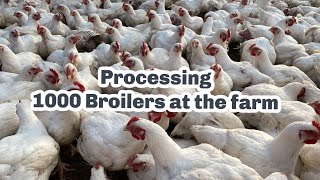
Richard Perkins walks through processing 1,000 broiler chickens on-farm over three days. The team stuns, bleeds, scalds at 63.7°C, plucks with a Seibman machine, eviscerates, and grades by weight, handling roughly 330 birds per day with detailed attention to water changes and equipment logistics.
Questions this video answers
1,000 broilers.
Approximately 330 birds per day.
Target 63.7°C for 1 minute 15 seconds.
After about 150 birds (change about half the water).
Seibman (Germany), about €1,500.
Chapters
Okay, welcome back to another video, folks. Today we are starting slaughter week. We've got a thousand boilers here that are getting processed. We're going to do 330 each day with packing the following day just to break it up, make it more manageable. Training up the team for the first time, it's always taking a bit longer. I expect we'll be done with the clean down by dinner, but hoping to get faster. It takes about five hours with a oiled team, but it'll take a bit longer today. Just a note for viewer discretion. This video contains some images that some people might find distressing. We kill, butcher, process animals on the farm for local consumption and it's something we take great pride in. Some of you that are squeamish or don't like those things don't watch our videos. As simple as that. I don't appreciate comments from people that choose not to eat meat or choose not to, you know, choose to turn a blind eye to what happens to put food on the table. But I don't tolerate silly comments and inappropriate things on our channel. So don't watch if you don't want to see.
All right. Sunrise Lord of the day.
Just doing the first egg mobile out on pasture. Philip.
Ready for the day. Okay, sideways move today. So what happens with this roller pan set up is when we get to the end of a tree lane because we're only using half the width of the tree lane to the strawberry lane there we're doing a sideways move and.
Then we're coming back down that same line.
Very nice. Sideways boilers. Sideways hop completed. Okay, so those of you who follow the channel know the drill.
We use the sedge beer.
Low voltage stunner. Birds have to be stunned before bleeding out. Here in Europe, this is a great model. Sedge beer in the UK could get up to about 0.4amps. For 10 seconds or so. The legs will tense and then they will relax down again. Then we cut the carotid arteries to bleed them. Takes about a minute to bleed out and then we take heads off at the top of the neck to allow us to feed the birds in. Ready for scaling. Okay, first birds in. Take 40. We've got to get this to 63.7 degrees steamy. So we have this set a little bit higher and then just add some cold water in the day to get it on target. We want 63.7 and we're scalding for 100. Sorry. 1 minute 15 seconds. Temperature and time is totally critical for a good scald. So right now we're on 63.3. I think we want to keep it there, but the scalder is not super.
Precise, so please don't touch that one. It's just over 50 degrees, but that's.
Actually 64 or something. So it's going to start rising in.
Temperature and we need to add coal to it. And that's better because it means we flush water through.
So a little timer on the wall. We got 1 minute 15 at 63.7 is the target temperature. We change this water out after about 150 birds, about half of it. Once the water gets too dirty, it's very hard to pluck well. So that works well for half the batch. Feeder removed. When you a sharp knife at the knee, careful to avoid cutting the foam. And then birds go six at a time into our plucking machine. This is from Seibman in Germany. It's about €1500. Don't buy a cheap plucker, they're rubbish. You'll end up buying a good one anyway. Birds in. Birds in marks a batch of six coming in so the time can be recorded on the data sheet. Then we know how long it takes birds to get into the chiller. After plucking, they're eviscerated and necks off, Everything out as it should be. They've still got a few pin feathers on the tail and they need spraying down. So they go straight to Clean team, Clean team. Rinse them off, check the feathers, parade.
The birds.
Try not to throw them out. And then they come into this clean room. They are weighed. Once they're weighed and graded, they're hung in weight categories in the chiller here. What's. So organs go in cold water with ice cubes just to chill them quicker. Birds in their weight categories. All right, getting back in after a break. We've got big birds. 2.5 to 2.69, 2.3 to 2.49, 2.1 to 2.3. And bigger than 2.7 big birds. So we've got about 100 to do. Okay, preliminary clean down taking place, washing down the pad, washing down everything. Pretty good effort. We've done 330 birds looking good. Great effort by the team for a first order that went exclusively extremely well. Very nice. Okay, so things are getting picked up by the gut truck. We've got three slaughteries two days apart, so we're going to call them today and that means that hopefully they have to come within three days. So that means they will pick up maybe just today's or maybe today's in the middle one.
Then we'll have to get them again.
Just rinsing off the crates, the aprons, boots. Get everything back to how it was. And then tomorrow morning we'll be packing the birds, taking them away off the farm.
All right. Busy week ahead, folks. That's it for this video. Don't forget, you can find out a whole bunch more in the links below. We'll see you in the video soon.